
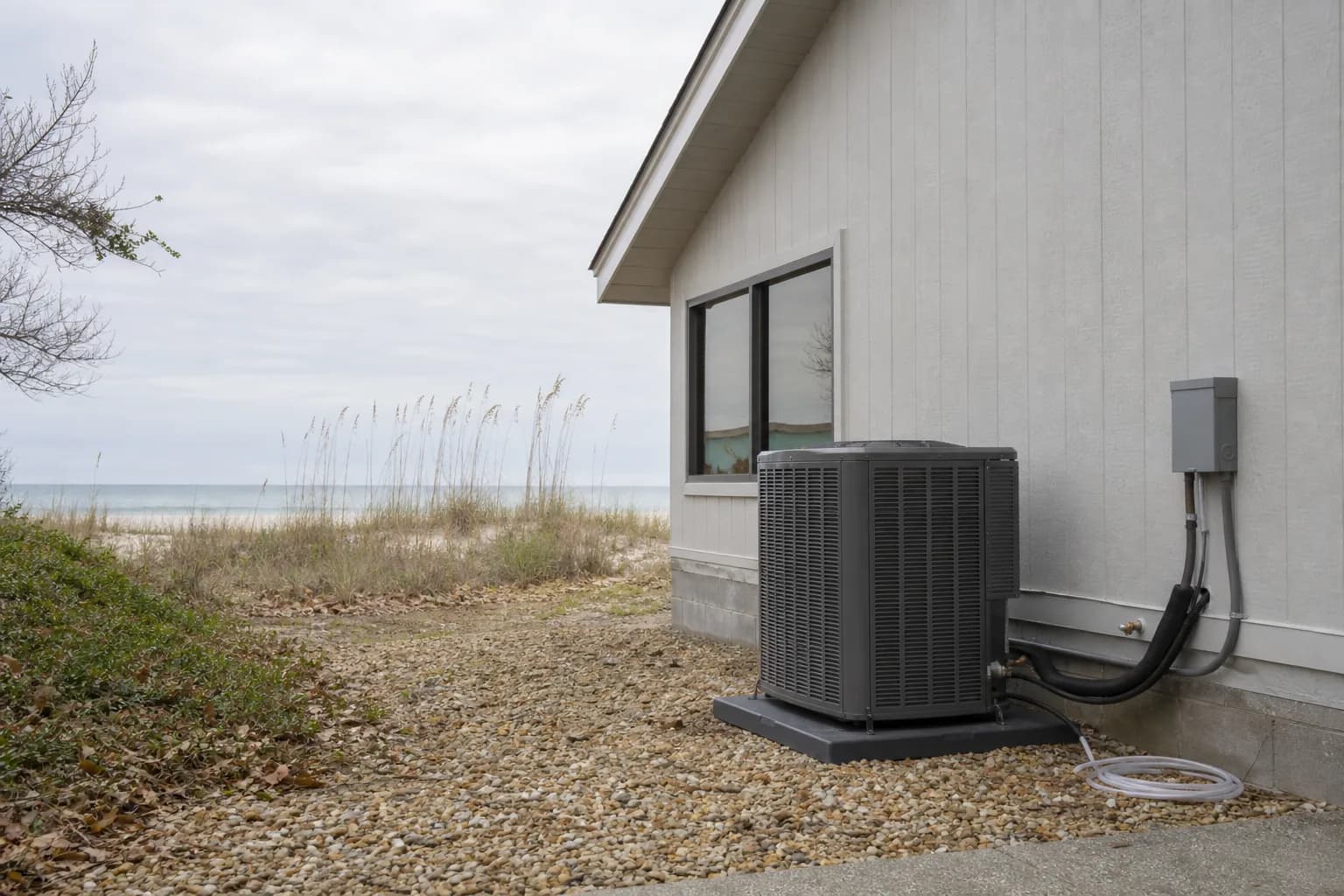
Why R-454B Pushed Gulf Shores 2027 Replacement Costs Higher
The 2022 EPA AIM Act set a refrigerant phase-down through 2030. What it means for a 3-ton replacement quote in Gulf Shores in 2027 versus 2025 — line by line.
Published 2026-09-30 · Updated 2026-09-30
Author: Landon Jahnke | ACExperts251
Reviewed by: Landon Jahnke · Owner · Alabama HVAC License AL #16117 · EPA 608 Certified
The 2022 EPA AIM Act final rule, footnote 14: "Service technicians and homeowners should anticipate refrigerant phase-down pricing pressure beginning Q1 2026, intensifying through 2030." That footnote got buried under 400 pages of regulatory text. Manufacturers knew. Distributors knew. Most Gulf Shores HVAC contractors who told you in 2024 that "replacement costs are stable" weren't lying — they hadn't read the footnote either. Here's what footnote 14 means for a 3-ton replacement quote in Gulf Shores in 2027 vs. 2025.
I'm writing this post because Gulf Shores homeowners walking in with a 2024 quote from another contractor in hand keep asking why a current 2026 quote is 14% higher for the same scope. The answer is footnote 14, and the answer is going to be footnote 14 for the next four years.
This is not a "the sky is falling" post. The pricing pressure is real, but it's also predictable, and predictability is what lets a Gulf Shores homeowner plan rather than panic.
What footnote 14 actually says
The AIM Act of 2020 directed the EPA to phase down hydrofluorocarbon (HFC) production using a stepped allowance schedule. The final rule implementing the phase-down was published in 2022, and footnote 14 of that rule contains the warning the industry mostly ignored.
The relevant passage: as production allowances drop on the schedule (15% reduction in 2024, 30% reduction in 2029, 70% reduction in 2034, 80% reduction in 2036), refrigerants like R-410A — which dominated residential AC equipment from roughly 2010 through 2024 — will see steady wholesale price increases. Manufacturers transitioning to A2L refrigerants like R-454B and R-32 face equipment retooling costs and supply chain reconfiguration that get amortized into new equipment pricing during the transition window.
The footnote also warned about service refrigerant scarcity — the R-410A still in the supply chain becomes more valuable as production capacity converts to A2L lines. By 2027 a pound of R-410A wholesale costs roughly 60% more than it did in 2024.
For a Gulf Shores homeowner replacing a 12-year-old system in 2027, that translates into specific line-item pressure on the installed quote.
A 3-ton Gulf Shores replacement, 2025 vs 2027
Let's walk through the actual line items. This is for a representative single-story Gulf Shores home in Craft Farms or West Beach, 1,800 sq ft, replacing a 12-year-old R-410A 14-SEER unit with a new R-454B 16-SEER unit. Coastal-rated equipment, standard install complexity.
2025 quote:
- Equipment (condenser + air handler + coil): $5,400
- Refrigerant initial charge (8 lbs R-410A): $680
- Line set replacement (50 ft): $850
- Electrical disconnect, whip, surge protector: $385
- Permit and HVAC tax: $245
- Labor (8 hours, 2 techs): $1,920
- Coastal corrosion package (coil coating + cabinet sealant): $620
- Disposal and refrigerant recovery: $185
- Total installed: $10,285
2027 projected quote, same scope:
- Equipment (condenser + air handler + coil), R-454B-rated: $6,150 (+14%)
- Refrigerant initial charge (8 lbs R-454B): $720 (+6%)
- Line set replacement (50 ft, A2L-rated copper): $980 (+15%)
- Electrical disconnect, whip, surge protector: $410 (+6%)
- Permit and HVAC tax: $260 (+6%)
- Labor (8 hours, 2 techs, A2L certification adder): $2,080 (+8%)
- Coastal corrosion package: $660 (+6%)
- Disposal and refrigerant recovery (R-410A recovery has its own pricing now): $245 (+32%)
- Total installed: $11,505 (+11.9%)
That's an $1,220 increase over 24 months. About a third of it traces directly to footnote 14 dynamics.
Where the increases come from, line by line
Equipment +14%. This is the biggest single mover. Manufacturer pricing on R-454B-rated equipment is higher than equivalent R-410A models for three reasons. First, A2L refrigerants are mildly flammable, which requires different internal component design — sealed electrical compartments, leak detection sensors on some models, different expansion valve specifications. Second, R-454B systems generally operate at slightly higher pressures than R-410A, which requires upgraded compressors and tubing. Third, the manufacturers are still amortizing retooling costs from the 2024-2025 transition across a smaller production volume than they had with R-410A at scale.
By 2029-2030, this premium will narrow as A2L equipment becomes the dominant production line and economies of scale return. Right now it's a real, ongoing cost adder.
Line set +15%. A2L refrigerants have specific copper tubing requirements — primarily around joint integrity and brazing standards. The line set itself isn't dramatically more expensive, but the certified-installation labor and the brazing materials run about 12-15% more than the legacy R-410A standard. Some of that gets absorbed into shop overhead but most passes through.
Labor +8%. Two factors. First, normal wage inflation across the trade has run about 4% per year in coastal Alabama through 2025-2026. Second, A2L installation requires updated technician certification (EPA Section 608 with A2L endorsement, plus manufacturer-specific A2L training). That training carries real cost, and it shows up as a small per-job adder rather than a separate line item.
Disposal +32%. This is the line item nobody saw coming. R-410A recovery used to be effectively free — contractors recovered the refrigerant, sent it back through a reclaim distributor, and the value of the reclaimed refrigerant offset the disposal labor. With R-410A wholesale pricing rising, the reclaim economics shifted, but so did the regulatory burden. The EPA tightened recovery documentation requirements in 2026, and that's now measured paperwork and chain-of-custody time on every replacement. The 32% increase reflects the shift from "near-cost-recovery" to "actual labor and compliance cost passed through."
The other line items moved with general inflation — nothing structural.
What's specific to Gulf Shores in this picture
A few things make the Gulf Shores math different from inland Baldwin County math.
Coastal corrosion package is non-negotiable. Direct Gulf-front exposure means standard residential equipment fails 5-7 years earlier than equivalent inland equipment without coil coating, cabinet sealant, and stainless-steel hardware. Skipping the coastal package on a Gulf Shores install is one of the single biggest cost mistakes homeowners make on competing quotes — they save $620 today and lose 4-6 years of equipment life. ACExperts doesn't quote uncoated equipment for Gulf-front locations.
Service access pricing varies more here. Condenser placements at older Gulf Shores condos and beach houses range from "easy ground-level slab" to "fourth-floor balcony with crane access required." For most single-family Gulf Shores homes the install is straightforward. For Indies, upper-floor condos, and similar Gulf-front buildings, add 15-30% for crane time, building coordination, and HOA approval scheduling.
Vacation rental income loss adds urgency math. A failed system during peak rental season in Gulf Shores costs the owner $300-$500 per night in lost bookings on top of repair cost. That changes the calculation on whether to replace proactively in shoulder season versus waiting for the failure. We've covered the rental-specific math in the Foley July 4 pre-check guide and the Gulf Shores back-to-school reset.
The 2028 outlook
Footnote 14 implies further increases in 2028 and 2029. Here's what we're watching.
R-410A scarcity tipping point. By late 2027 or early 2028, R-410A wholesale pricing will likely cross the threshold where service top-offs become genuinely uneconomical for systems with even small leaks. Homeowners with R-410A equipment showing slow refrigerant loss should be running the ROI calculator sooner rather than later — the math will tilt further toward replacement each year.
Tariff and copper pricing. Compressor and line set pricing depend on copper, which has held high since 2024 and shows no signs of easing. Tariff dynamics in 2027-2028 could push equipment pricing further. Direction is uncertain but it's a watch-item.
A2L installation cost normalization. As more contractors complete A2L certification and the labor pool expands, the certification adder on labor should shrink. Installed pricing is likely to ease by 2029-2030 — but not before then.
What this means for a Gulf Shores homeowner deciding right now
If your system is 12+ years old and on Gulf-front exposure, the math says: replace in 2026 if cash allows, 2027 if you need financing time. The increases between 2026 and 2027 are real, but the increases between 2027 and 2028 will be larger if footnote 14 holds.
If your system is 8-11 years old and not showing problems, the math says: don't rush. Run it. Plan capital for 2028-2030 replacement and use the time to budget for the higher installed cost.
If your system is under 8 years old, footnote 14 doesn't apply to you — your existing equipment is yours forever, and you only deal with refrigerant cost if you need to add some during a service call.
ACExperts walks every Gulf Shores replacement quote through these specific numbers before signing any paperwork. The Foley 2027 cost guide covers the repair side of the same dynamics, and the Baldwin County AC longevity post lays out the lifespan math for systems on different exposure profiles. The Loxley back-to-school mistakes guide covers the maintenance side.
The pricing pressure is real but it's predictable. Footnote 14 is the document everyone should have read three years ago. Now you have.
FAQ
- Is R-454B actually more expensive than R-410A on a per-pound basis?
- Right now in late 2026, no — R-454B wholesale pricing is roughly equivalent to R-410A. The cost driver isn't the refrigerant itself; it's the equipment compatibility surcharge, the A2L safety-classification handling requirements, and the smaller distributor network. R-454B is mildly flammable (A2L classification), which means it requires different leak detection, different brazing protocols, and updated technician certification. Those overhead costs are getting baked into installed pricing on every replacement until volume catches up to legacy R-410A scale.
- Should I rush to replace my Gulf Shores system before 2027 prices hit?
- Probably not. If your existing system is under 12 years old and not showing repair flags, the math says run it. The 2027 increase is real but it's roughly 8-12% on a $12,000 installed system — about $1,000-$1,400 — and that's less than what you'd lose by retiring functional equipment three years early. The exception is a 14+ year old system with corrosion damage typical of Gulf-front exposure. There the equipment is going to fail in the next 18 months regardless, and replacing in 2026 versus 2027 saves real money.
- What's actually in footnote 14 of the AIM Act final rule?
- The footnote acknowledges that HFC production allowances drop on a stepped schedule through 2036, with the steepest cuts in 2028 and 2032. It specifically warns that service refrigerant for legacy R-410A equipment will become scarce as production capacity converts to A2L refrigerants, and that homeowners should expect both equipment-side and service-side cost pressure during the transition. Most contractors who quoted 'stable pricing' in 2024 hadn't read past page 80 of the rule. The footnote is on page 287.
- Does the higher 2027 cost mean I should size down to a smaller system?
- No, and this is where Gulf Shores homeowners get into trouble. Sizing down a 3-ton replacement to a 2.5-ton 'because it's cheaper' produces a system that runs constantly through August and still doesn't dehumidify the house. The right size is determined by Manual J load calculation, not by what fits the budget. If the 2027 price is uncomfortable, look at financing terms or step up SEER for lower long-term operating cost rather than undersizing.
Need this handled?
Straight to the service page for your town — pricing, local details and a form that reaches a technician.
More from AC Replacement Cost 2027

ACExperts HVAC
We Take The Heat So You Don't Have To
Fast, honest heating and air service across Baldwin County. Speak with a technician and get on the schedule today.