
Foley July 4 Vacation Rental HVAC: A 72-Hour Pre-Check
A pre-mortem of the worst-case July 4 weekend AC failure at a Foley rental, then a 72-hour pre-check that prevents it. Real timing, honest tradeoffs.
Published 2026-07-01 · Updated 2026-07-01
Author: Landon Jahnke | ACExperts251
Reviewed by: Landon Jahnke · Owner · Alabama HVAC License AL #16117 · EPA 608 Certified
Friday July 3, 4:47 PM: family of eight pulls into your Foley rental, opens the front door, and the house is 84°F. The AC is running but not cooling. They call the property manager. The property manager calls us. We can be there at 8:30 PM if we drop everyone else. The 4-day weekend is already on the line. Now rewind 72 hours. Here is the pre-check that keeps the pre-mortem from being your weekend.
Over 13 years working Baldwin County HVAC, I've handled the July 4 emergency queue every summer. The calls follow a script. The customer is polite at first, then increasingly tense, then resigned. The guests are tired from a long drive. The AC is running but not cooling — almost never fully dead. And the underlying cause is almost always something a 90-minute pre-check three days earlier would have caught.
This isn't a sales pitch for the Comfort Plan, though that plan exists for exactly this reason. This is the actual checklist. Walk through it yourself or have us do it — but don't skip it.
The pre-mortem in detail
Before the checklist, finish the worst-case story so you know what you're preventing.
4:47 PM, Friday July 3. Guest family arrives. House is 84°F. They turn the thermostat down to 70°F. Nothing changes after 30 minutes. They text the property manager. Property manager calls the owner. Owner calls a contractor at 5:18 PM.
6:00 PM. Tech dispatched. Arrives at 6:42 PM. Diagnostic begins. Indoor coil is partially iced — capacitor on the outdoor unit failed sometime in the previous 36 hours, condenser fan was running intermittently, indoor coil was cycling between thawed and refrozen. Tech thaws the coil with the fan, replaces the dual-run capacitor, recharges the small amount of refrigerant lost during the iced-coil runtime, and verifies cooling at 8:14 PM.
8:14 PM, Friday July 3. House is at 79°F and dropping. Guests have been hot and frustrated for most of the evening. They're already drafting the review. The repair invoice is whatever the parts and labor add up to — and at peak holiday call volume, what really hurts isn't the bill, it's the lost weekend, the platform refund, and the review damage.
Saturday morning. A critical review goes up — the gist being that the property was hot on arrival, someone was sent to fix it, but it took hours and the first night was ruined. The next stretch of bookings can take a meaningful hit because a single low score drags the listing's average down right when prospective guests are comparing options.
Total cost of the failure: a service-window repair plus thousands in suppressed future bookings. Cost of the pre-check that would have caught the failing capacitor on Tuesday June 30: a $79 service fee plus a small preemptive repair. The math is not subtle.
The 72-hour pre-check, hour by hour
The pre-check assumes you have a Foley rental with at least one HVAC system and a booking starting Friday July 3 at 4 PM. You're starting on Tuesday June 30. Here is what gets done.
T-72 hours (Tuesday morning, 9 AM): the walkthrough
Walk through the property like a guest would. Note the temperature in every room with a cheap digital thermometer. Setpoint should be 75°F. Acceptable variance between rooms: 2-3°F. Anything more than that is a duct or balance problem that will surface as a complaint when guests arrive.
Smell each room. A faint musty odor at the supply registers is condensate biofilm. A strong musty smell with visible discoloration on register grilles is mold colonization in the duct system, which is a separate conversation entirely — see our work on indoor air quality.
Check the thermostat. Is it set to "Auto" or "On"? "Auto" is correct — the fan should cycle with the cooling. "On" runs the fan continuously, which sounds like better airflow but actually re-evaporates condensate from a wet coil back into the air, raising indoor humidity.
T-72 hours (Tuesday morning, 9:30 AM): the filter
Pull the filter. If it looks like anything other than fresh out of the box, replace it. Period.
Filters in Foley rentals get neglected because no full-time resident is changing them. The shedding from beach guests' towels, sand tracking, and dog hair from pet-friendly bookings loads filters at 2-3x the rate of an owner-occupied home. A filter that looks "okay" to a homeowner is often 35-40% clogged in a rental context.
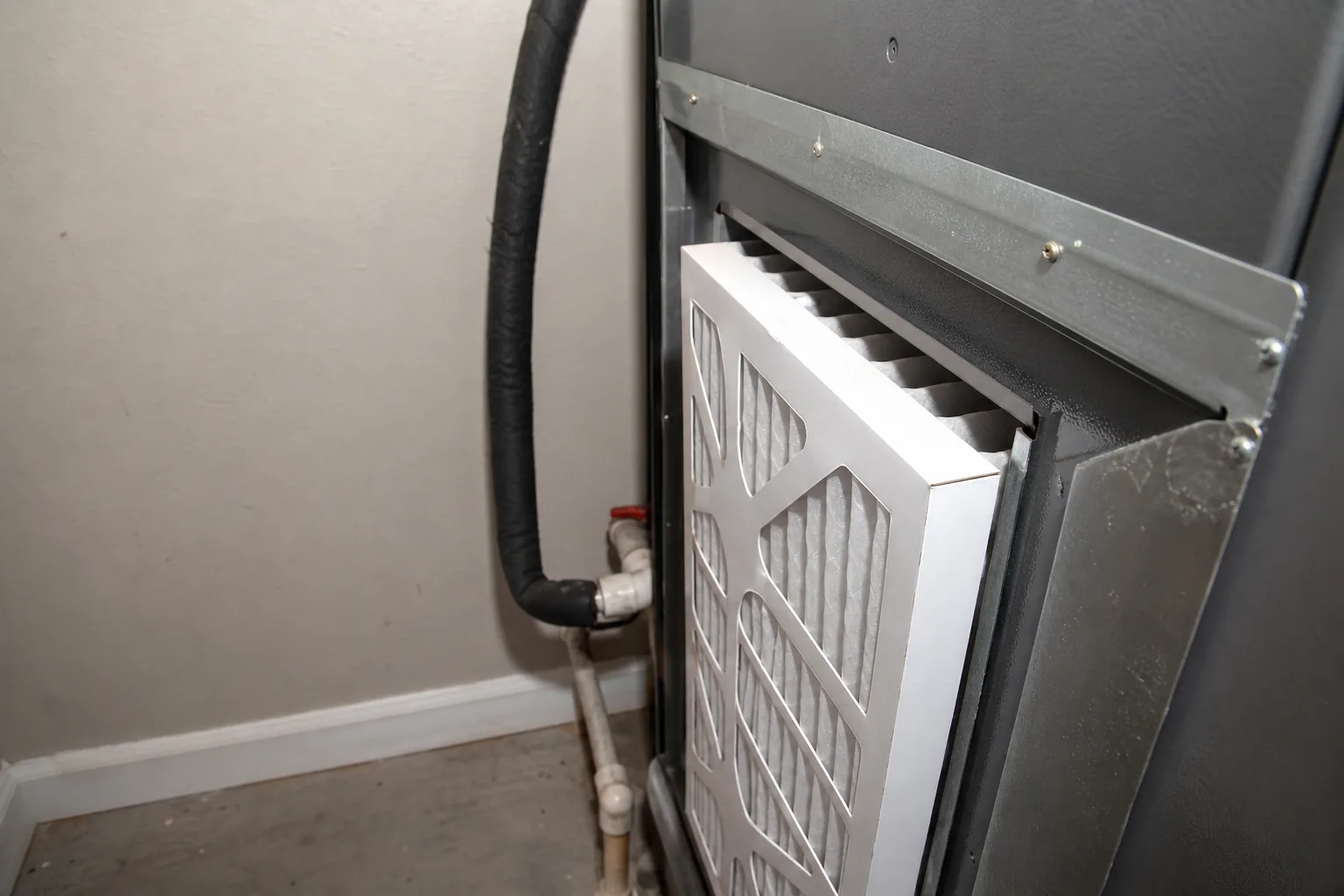
A MERV 8 filter in standard residential sizes is a few dollars at any big-box store. Buy four at a time. Change between every long booking. A clogged filter is the single most common cause of the "AC running but not cooling" call, and it's the easiest to prevent.
T-72 hours (Tuesday morning, 10 AM): the outdoor unit
Walk to the condenser. Look at the fins. If you cannot see clearly through to the inner coil, the unit needs cleaning. Foley sits about 8 miles from the Gulf — moderate salt exposure plus the standard Baldwin County pollen, lawn debris, and humidity-driven fin oxidation builds up faster than most owners realize.
Listen during a cooling cycle. The compressor should hum at a consistent low pitch. The fan should spin smoothly. Any of the following are warning signs:
- A buzzing or humming without fan rotation. This is a failing capacitor or a seized fan motor. Service call now, before Friday.
- A clicking from the contactor every 5-10 seconds. Contactor is pitting and the contacts aren't holding. Service call now.
- A low-frequency growl from the compressor that gets louder over 30 seconds. Compressor is laboring against high head pressure, often from a dirty coil or low refrigerant. Service call now.
Touch the suction line — the larger of the two copper lines coming out of the unit. It should feel cool and slightly damp with condensation, like a cold drink can. If it feels warm, refrigerant charge is low. If it's iced, you have a separate freeze problem.
T-72 hours (Tuesday afternoon, 1 PM): the indoor unit
Open the air handler closet (or attic access, depending on the install). Look at the evaporator coil if you can see it. A clean coil is shiny aluminum. A dirty coil looks gray or brown with a film. A dirty coil cuts cooling capacity by 15-30% and is a freeze risk on hot days.
Check the condensate drain. Pour a cup of distilled white vinegar through the drain access port (there's usually a T-fitting with a removable cap on the drain line near the air handler). Listen for it to flow through cleanly. Standing water or a slow drip is a partial clog. Full clog = water backs up into the secondary drain pan, the float switch trips, and the system shuts down — usually right when guests arrive.
Look at the secondary drain line if there is one. If you see water dripping from the secondary outlet (often visible from outside the house above a door or window), the primary is already clogged and you're operating on borrowed time.
T-48 hours (Wednesday): the load test
This is the one most owners skip. Set the thermostat to 72°F at 11 AM. Let the system run continuously for at least 4 hours through the heat of the day. Don't open doors. Don't adjust the thermostat. Just let it work.
At 3 PM, check:
- Indoor temperature. Should be at or below 73°F. If the house is still 76-78°F, the system isn't keeping up — something is wrong.
- Supply register temperature. Hold a thermometer at a supply for 60 seconds. Should read 18-22°F below the return air temperature. Lower than 15°F delta = airflow problem (filter, blower, ductwork). Higher than 25°F delta = airflow restriction (filter, frozen coil starting).
- Outdoor unit. Touch the suction line again. Same test as Tuesday — cold and sweating. If it changed between Tuesday and Wednesday, the system is drifting.
If anything from the load test reads wrong, there are 48 hours to fix it before guests arrive. That is enough time. Call 251-383-HVAC and say it's a pre-rental check with a Friday booking — calls that flag a hard deadline get worked into the schedule accordingly.
T-24 hours (Thursday): the final pass
Turn the system off completely Thursday morning. Let the coil dry for 4 hours. Restart at 1 PM and run continuously through the afternoon. This dries any standing condensate from the dormant hours and resets the coil for the guest arrival.
Set the thermostat to 78°F overnight Thursday into Friday morning. Higher than guest setpoint, lower than vacancy setpoint. This keeps humidity in check without overworking the system right before peak load.
Friday morning at 9 AM, set the thermostat to 72°F. The system has 7 hours to bring the house to setpoint before guests arrive. In a properly working system, that's plenty. In a system that's been struggling all week, this is the buffer that gives you a fighting chance.
What the pre-check costs
If you'd rather have us run the pre-check than do it yourself: $79 service fee, full system inspection, written report. Any repair work is quoted before it starts, and second opinions on quoted repairs are free. We service Foley, Orange Beach, Gulf Shores, and Fort Morgan — the high-rental-density zip codes in southern Baldwin County.
Comfort Plan members get two tune-ups a year, 10% off repairs and replacements, and $0 service fees on regular calls. For rental owners, the practical value during holiday weekends is having an existing relationship and current records on file when the calendar gets tight.
The high-risk Foley rental profile
Some rental properties are at higher risk than others. The pre-check matters most if any of these apply:
- System age over 12 years. Capacitors, contactors, and blower motors fail in clusters as systems age. Pre-emptive replacement of small components prevents emergency calls.
- No maintenance in the last 12 months. Filters, drain lines, coils, and refrigerant charge all drift over a year. The longer the gap, the higher the failure probability.
- Walker Grove-era 1970s construction. Older Foley homes with retrofit ductwork have airflow issues that show up as freeze events under heavy load. See why a Gulf Shores AC freezes at 2 PM for the airflow physics.
- Multiple back-to-back bookings without a vacancy day. No window to do a thorough between-renter check. The pre-check before the holiday weekend becomes mandatory rather than optional.
- Pet-friendly listing. Hair load on filters runs 2-3x. Filter replacement frequency goes from monthly to every 2-3 weeks.
Friday at 4 PM, the version that doesn't end in a pre-mortem
The version of Friday July 3 you want: family of eight pulls in at 4:47 PM, opens the door, the house is 71°F. The kids run inside. The grandparents settle in. The renters never think about the AC for the entire weekend, which is exactly how a vacation rental AC system is supposed to work.
That version costs a small pre-check three days earlier. The other version costs an order of magnitude more, plus the review damage. Pick.
Schedule a pre-check at /schedule/ or call 251-383-HVAC. Tell us it's a rental and what day the guests arrive. We work the calendar backwards from there.
FAQ
- How fast can ACExperts respond to a July 4 weekend rental emergency in Foley?
- Honest answer: emergency calls get answered 24/7, every day, but during the July 3-5 stretch every HVAC contractor in Baldwin County is at capacity. Comfort Plan members get priority. If you're calling at 4 PM on July 3 with a guest checking in at 4:30, realistic best case is a same-evening visit, realistic likely case is morning of July 4. The 72-hour pre-check exists because the alternative is a coin flip.
- What's the minimum lead time for a pre-rental HVAC inspection?
- Schedule the pre-check 5-7 days before the booking, ideally on a Tuesday or Wednesday so there's time to source any parts that come up. A 72-hour window is workable but tight; inside 48 hours the diagnostic can usually still happen, but a repair may not land before the guest arrives.
- Should I leave the AC running between bookings in a Foley rental?
- Yes — at 78-80°F. Turning the system off entirely during vacancy lets indoor humidity climb above 65%, which loads the coil and the structure with moisture that the next renter's setpoint of 70°F will struggle to remove in the first 24 hours. The cost difference between vacancy at 78°F and fully off is small — much less than the cost of a humidity complaint or a moldy-smell review.
- What does a guest-facing AC failure cost in lost revenue?
- For a 4-bedroom Foley rental at peak July rates, gross revenue runs $400-$550 per night on common listing platforms. A 4-day weekend at $475 average is $1,900 in booking value. Add platform refund policies, cleaning fee retention rules, and review-score damage that suppresses the next 60 days of bookings, and the realistic financial hit from one failed July 4 weekend is typically several thousand dollars. A pre-check is a $79 service fee plus whatever repair is needed if something turns up.
Need this handled?
Straight to the service page for your town — pricing, local details and a form that reaches a technician.
More from July 4 Vacation Rental

ACExperts HVAC
We Take The Heat So You Don't Have To
Fast, honest heating and air service across Baldwin County. Speak with a technician and get on the schedule today.