
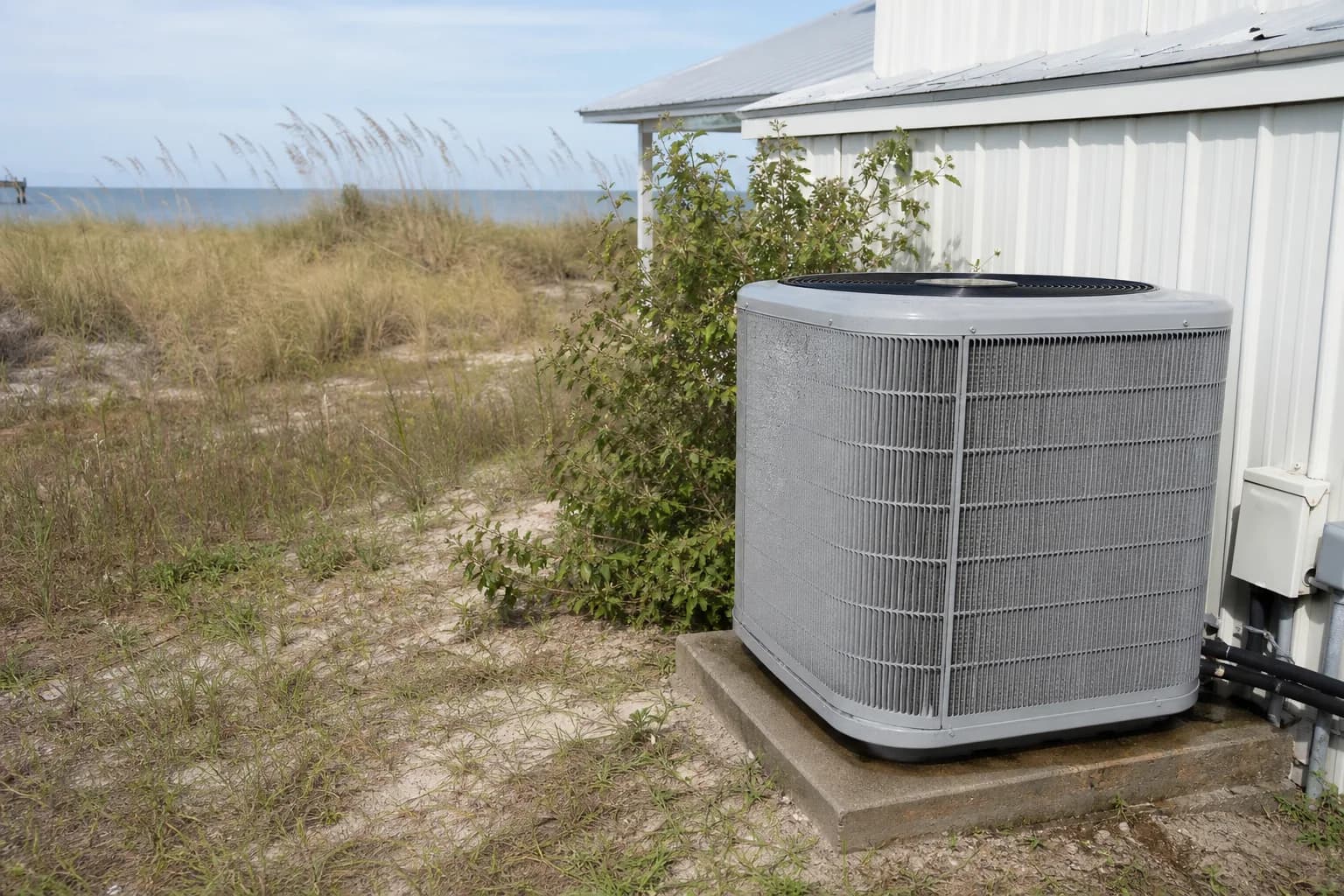
Back-to-School HVAC Reset for Gulf Shores Households
Back-to-school HVAC reset for Gulf Shores households — most parents never switch off summer mode when school starts. The reset is free and cuts your August bill.
Published 2026-08-03 · Updated 2026-08-03
Author: Landon Jahnke | ACExperts251
Reviewed by: Landon Jahnke · Owner · Alabama HVAC License AL #16117 · EPA 608 Certified
Most Gulf Shores parents I talk to never reset their HVAC schedule from June when school starts in August. The reset is mostly free, takes about 90 minutes, and can noticeably cut your power bill for the rest of cooling season. Here's how to do it the same week the school bus first rolls past your driveway.
The reason it matters: from roughly 7:15 AM to 3:45 PM Monday through Friday, the house is empty. Running the same setpoint you used in June while nobody is home is paid-for comfort nobody is using. A 5-degree setback during school hours, on a coastal Alabama summer cooling load, is real money on the bill. Below is the full sequence.
Where the reset has to happen
The reset is not one change. It's a small chain of changes that compound. Skipping any single one cuts the savings roughly in half. Doing all of them in the same 90-minute Saturday afternoon hits the full $40-60 monthly delta.
In order:
- The thermostat schedule
- The filter
- The supply register adjustments
- The fan circulation setting
- The condensate-line summer flush
- The tune-up appointment
The first four cost nothing. The fifth costs $0 if you have a wet/dry vacuum and 5 minutes. The sixth is the tune-up, and it's the only line item that asks for a check.
1. The thermostat schedule
This is the lever. Everything else is supporting work.
Pull up your thermostat. If you have a smart thermostat (Ecobee, Nest, Honeywell T9), tap into the schedule menu. If you have a programmable thermostat with physical buttons, get the manual out — Honeywell T6 Pro and Pro 1000 series are common in Gulf Shores and the schedule menu is buried under Menu > Schedule.
What you're setting:
- Weekday morning (5:30 AM - 7:15 AM): 73-74 degrees. People are home, getting ready, and you want comfort during the chaos window.
- Weekday school hours (7:15 AM - 3:45 PM): 78-79 degrees. Setback when nobody's home.
- Weekday afternoon (3:45 PM - 9:30 PM): 73-74 degrees. Family time, homework, dinner.
- Weekday overnight (9:30 PM - 5:30 AM): 75 degrees. Sleep is more efficient slightly warmer than people assume; the body cools the bed, not the room.
- Weekend: 73-74 daytime, 75 overnight. Drop the school-day setback entirely on Saturday and Sunday.
Five degrees of setback for 8 hours, five days a week, on a typical 3-ton residential system is where most of the bill savings comes from. Less aggressive setbacks (2-3 degrees) leave a lot of the savings on the table. More aggressive setbacks (7-8 degrees) start producing humidity recovery problems and aren't worth the marginal energy gain in a coastal climate.
2. The filter
While the thermostat is in your hand, walk to the return grille and pull the filter.
If it looks gray, replace it. If it looks white, replace it anyway. The August filter has run through the heaviest cooling load of the year and the second pollen wave is starting — late-summer ragweed and goldenrod kick in the third week of August along Bon Secour Bay and Little Lagoon, and the airborne load doubles by Labor Day. A filter that was acceptable on July 1 is past its useful life by August 11.
Standard 1-inch filters: replace every 30 days during cooling season. 4-inch media filters in a high-end air handler: replace every 90 days, but check at 60 if you have pets or live in West Beach where the salt-air load is heaviest. If you're in Craft Farms or Craft Farms North with mature pollen-heavy hardwoods, lean toward the shorter end of those windows.
A loaded filter restricts return airflow, which drops the suction pressure on the evaporator coil, which causes the coil to drop below freezing, which forms an ice block over the coil, which strangles airflow further. That's the call that comes in on a Saturday afternoon when the homeowner thinks the AC died. It didn't die. The filter was the problem from June.
3. The supply register adjustments
Walk every room. Look at every supply register. Adjust them.
What you're adjusting toward: rooms that are unoccupied during school hours (kid bedrooms, guest rooms, the formal dining nobody uses) get their dampers closed about 60-70%. Rooms that are occupied during school hours (the home office, the great room with the desk in it) stay at 100% open. Rooms that need overnight cooling (master bedroom, kids' bedrooms) stay at 100% open.
Don't close any single damper fully. A 100% closed register at the end of a duct branch creates static-pressure backup that the blower has to fight, and the energy cost of fighting it usually exceeds the cooling savings of redirecting the air. 60-70% closed is the sweet spot — meaningful redirection without static-pressure penalty.
This step is worth a meaningful chunk of monthly savings on its own. It's also the step most homeowners skip because it requires walking the whole house. Worth the 10 minutes.
4. The fan circulation setting
On the thermostat, find the fan setting. It's almost certainly set to AUTO (fan only runs when cooling is active).
Switch it to ON for one hour twice a day — once at 11 AM and once at 4 PM. Most modern thermostats have a "circulate" setting that runs the fan 20-30 minutes per hour automatically; that's the equivalent. The fan-only operation moves air through the home without adding cooling load. In a Gulf Shores home with the master bedroom on the south side and the kids' bedrooms on the north, this evens out temperature stratification that the thermostat's single sensor doesn't catch.
The energy cost is real but small — fan-only operation pulls a fraction of what full cooling pulls. The comfort benefit is what matters: the master bedroom that was 76 at 6 AM (great) and 79 at 6 PM (not great) on the same setpoint comes out closer to 77.5 both times.
5. The condensate-line summer flush
Walk outside. Find the white PVC pipe that comes out of the side of the house, usually 12-18 inches above grade, often near the outdoor unit. That's your primary condensate drain.
Stick a wet/dry vacuum hose over the end of the pipe. Tape the connection if it's a loose fit. Run the vacuum for 60 seconds. You'll pull out a slug of biofilm and standing water — what you wanted out of the line.
This single step prevents one of the most common August emergency calls along the coast: condensate backup, float switch trip, system shutdown. The Gulf Shores humidity load is high enough that a 90-day flush schedule is appropriate during cooling season. August is the right time to do the second flush of the year (the first should have happened in May during pre-summer prep).
6. The tune-up appointment
This is the only line item that's not free. A late-summer tune-up covers the things you can't check yourself — refrigerant pressures, electrical amp readings on the compressor and fan motor, capacitor microfarad reading, contactor contact-pitting check, indoor coil inspection, condensate treatment with biocide tablets. Our standard service-call rate is $79; we'll quote the full tune-up over the phone.
Why the late-summer tune-up matters specifically: the system has now run hard for 90 days. Components that were marginal in May are showing wear. A capacitor that read 38 microfarads in May (rated 40, acceptable) might read 31 by mid-August (failing, will fail completely on a 95-degree afternoon). Catching it now during a planned visit is meaningfully different from catching it during an after-hours emergency call.
The preventive maintenance service page covers what's included. The Comfort Plan rolls two tune-ups and priority routing into one annual price.
Tying it back to the bill
For most Gulf Shores homes, the bill delta between summer-mode and school-year-mode HVAC operation is real and noticeable through the August-to-mid-October window. The 90-minute reset does that work for free. The tune-up adds cost but extends the equipment's reliable runtime through peak load and reduces the odds of an after-hours emergency call.
For homes farther up the county, the reset window shifts slightly later because schools cluster around the same start week but the ambient cooling load drops faster inland. The Stapleton bill-day post covers the equivalent reset for north Baldwin homes with capacitor-pattern context. The Daphne pre-summer punch list is the springtime sibling to this fall reset; both posts assume the homeowner did the other in season.
What to do this Saturday
Block 90 minutes Saturday morning. Walk the house. Set the schedule. Change the filter. Adjust the registers. Set fan circulation. Flush the condensate line. Then call us at 251-383-HVAC and book the tune-up for any open day in the next two weeks. Tell whoever answers that you read the back-to-school reset post and want the late-summer tune-up.
Your September power bill will tell you whether this post was worth your Saturday. If the reset did its job, it'll be lower than your August bill. If it isn't, call us back. Something else is going on, and we'll find it.
FAQ
- When do Baldwin County schools start, and why does that matter for my thermostat?
- Baldwin County Public Schools start around mid-August most years. It matters because the school day pulls people out of the house from roughly 7:15 AM to 3:45 PM Monday through Friday. That's a 35-40 hour weekly window where the cooling setpoint can rise from 73-74 to 78-79 without anyone noticing. On a coastal Alabama summer cooling load, that one schedule change can meaningfully reduce your August and September power bills.
- Won't the AC just have to work harder to cool the house back down at 4 PM?
- Counter-intuitively, no — not the way most people assume. Recovery cooling for a 5-degree setback runs the system harder for 35-60 minutes when you walk in the door, but the energy used to cool back down is much less than the energy saved during 8 hours of higher setpoint. The 'it works harder' instinct is directionally right but wrong in magnitude.
- Should I change the filter at the same time as the thermostat reset?
- Yes. The August filter has been running through the heaviest cooling load of the year and the second pollen wave (late summer ragweed and goldenrod start showing up in late August). If you stretch a 1-inch filter past 30 days during August, you risk a frozen evaporator coil — a common call on a 96-degree Saturday afternoon. Filter at the same time as the schedule change.
- I rent — can I still do most of this reset?
- Yes. The thermostat schedule is yours to set regardless of whether you own the equipment. The filter change is usually the tenant's responsibility under most leases (check yours). The fan-circulate setting and supply register adjustments are all behavior, not equipment. Only the tune-up itself is a landlord conversation.
Need this handled?
Straight to the service page for your town — pricing, local details and a form that reaches a technician.
More from Back To School Reset

ACExperts HVAC
We Take The Heat So You Don't Have To
Fast, honest heating and air service across Baldwin County. Speak with a technician and get on the schedule today.