
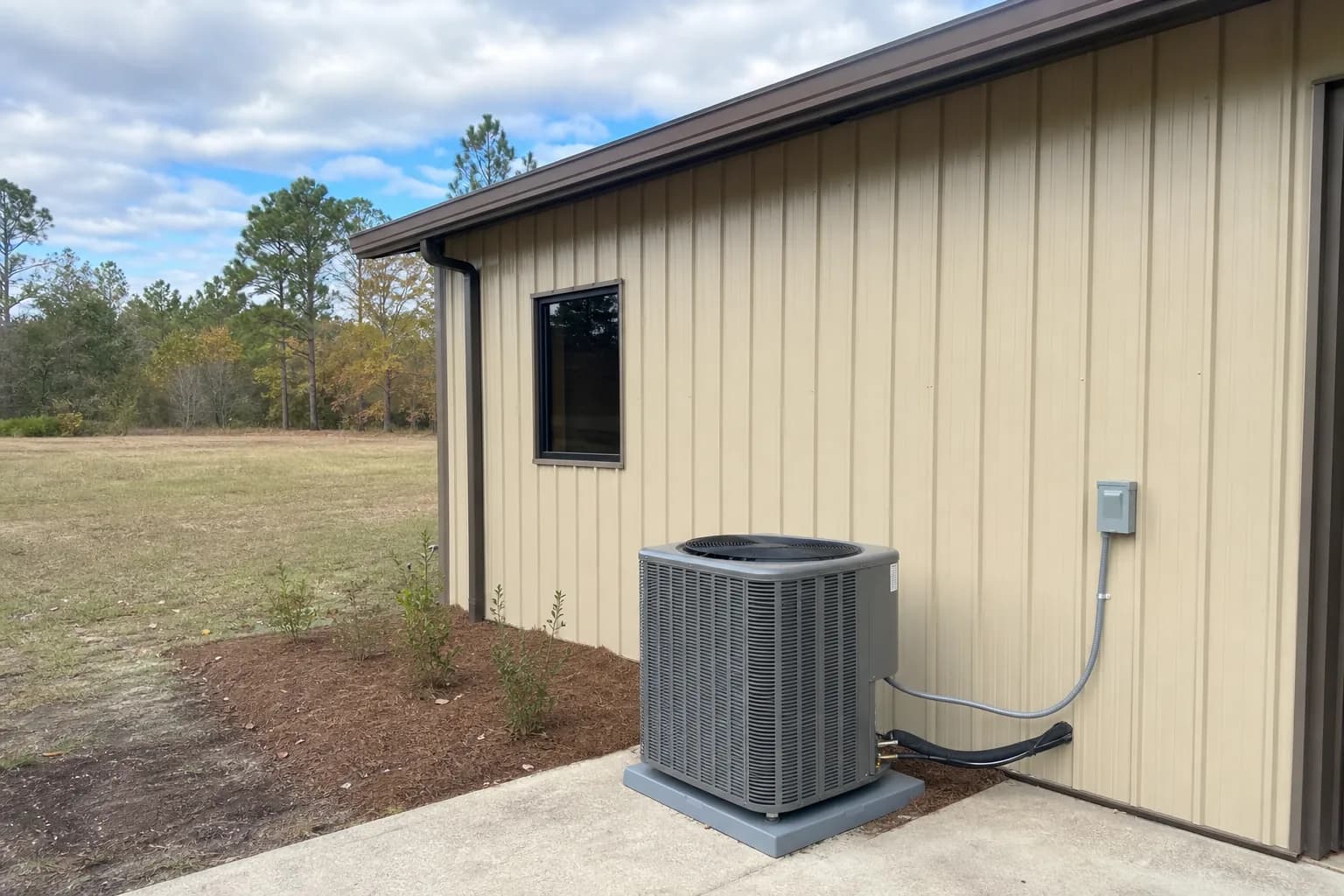
Foley AC Replacement Sizing in 2026: 3-Ton vs 4-Ton vs 5-Ton, Backward from the Bill
Foley AC replacement sizing in 2026 — run 3-ton vs 4-ton vs 5-ton backward from the power bill, not forward from a quote. A framework for an honest cost comparison.
Published 2026-09-28 · Updated 2026-09-28
Author: Landon Jahnke | ACExperts251
Reviewed by: Landon Jahnke · Owner · Alabama HVAC License AL #16117 · EPA 608 Certified
Picture two August 2025 power bills in a 1,950 sq ft Foley home: one with a 4-ton AC, one with a 3-ton variable-speed. The variable-speed bill is meaningfully lower — often $40-$60/month — and over 96 months that's a substantial chunk of the install delta. The 3-ton variable-speed costs more upfront than the builder-grade 4-ton, but on 8-year total cost of ownership the math frequently flips. The Foley sizing math runs backward from the bill, and most contractors won't show you that page.
This post walks through three Foley sizing scenarios — 3-ton, 4-ton, and 5-ton replacements — with the framework for comparing them on 8-year total cost of ownership rather than headline install price. The point is to show why the cheaper install is sometimes the more expensive house, and why the more expensive install is sometimes the cheaper house, depending on what's behind the equipment. For written quotes on your specific home, call 251-383-HVAC.
How to read a sizing decision in reverse
Most homeowners get this conversation handed to them forwards: contractor walks the house, eyeballs the existing equipment, says "you've got a 4-ton, we'll put in a 4-ton." That's how Foley ended up with a generation of oversized equipment in Glenlakes, Cypress Gates, and Cottages on the Greene — every spec builder in the early 2000s used the same lazy rule of thumb and every replacement contractor since has matched what was already there.
Run it backward instead. Start from the August power bill. A Foley home with a properly sized variable-speed system and decent ductwork should run a peak summer bill in the $260-$310 range for 1,800-2,000 sq ft. If your bill is $340-$400, something in the equipment-plus-envelope chain is wrong, and replacing the equipment with the same size you've always had is going to give you the same bill you've always had.
The four things that move that number:
- Equipment efficiency rating (SEER2 in 2026; was SEER through 2022)
- Equipment staging (single-speed vs two-stage vs variable-speed)
- Equipment sizing relative to actual load (Manual J calculation, not square-footage rule of thumb)
- Duct system condition and insulation
A 4-ton single-speed system installed correctly through good ductwork can outperform a 3-ton variable-speed installed badly through leaky ductwork. The equipment label only tells part of the story. The duct side gets covered in the Foley pre-summer punch list approach and the builder-grade vs premium comparison — same logic applies to Foley.
Scenario one: 1,950 sq ft Foley single-story, 3-ton vs 4-ton
This is the most common Foley scenario. Single-story home in Glenlakes or Cottages on the Greene, built 2008-2018, currently running a 4-ton single-speed system that's 11-14 years old.
Manual J calculation result: roughly 30,800 BTU/hr cooling load at 95-degree outdoor / 78-degree indoor design conditions. That's 2.6 tons. Round up: 3 tons.
The original 4-ton install was oversized by roughly 30%. Common in this neighborhood profile.
The replacement menu for this scenario:
- 4-ton single-stage R-454B at 14.3 SEER2 (matches what's there — cheapest install, highest operating cost)
- 3-ton single-stage R-454B at 14.3 SEER2 (right-sized, basic equipment)
- 3-ton two-stage R-454B at 16.0 SEER2 (right-sized, mid-tier)
- 3-ton variable-speed R-454B at 18.5 SEER2 (right-sized, premium)
The 8-year cost-of-ownership comparison usually lands the 3-ton variable-speed and the 3-ton single-stage close to each other, with the over-sized 4-ton single-stage costing the most on total ownership despite the cheapest install price. The cheapest install is the most expensive house. The 3-ton single-stage and the 3-ton two-stage land in similar territory — your choice on those depends on humidity preference and how long you plan to stay.
Scenario two: 2,650 sq ft two-story Foley, 4-ton vs 5-ton
Different profile. Two-story home in Greystone Village or Hidden Lakes, 2,500-2,800 sq ft, built 2012-2020, running a 5-ton single-speed.
Manual J calculation result: roughly 41,200 BTU/hr cooling load. That's 3.4 tons — call it a strong 4-ton with proper ductwork balancing between floors, or a 4-ton with a small mini-split for the bonus room over the garage that always runs hot.
The original 5-ton install was oversized by roughly 25%. Common when the builder used a single piece of equipment to serve two floors with marginal duct sizing.
The replacement menu for this scenario:
- 5-ton single-stage R-454B (matches what's there)
- 4-ton single-stage R-454B (right-sized, no zoning)
- 4-ton two-stage with zoning damper system
- 4-ton variable-speed with zoning
The zoning piece is what makes the math actually work for two-story Foley homes. A single-speed 4-ton serving both floors with no zoning will do a worse job than the oversized 5-ton it replaces — you'll get the right total tonnage but wrong distribution. With zoning between upstairs and downstairs, the variable-speed 4-ton can match output to which floor is calling, which is the actual problem the 5-ton was trying to solve with brute force.
Closer race on 8-year total cost than the single-story scenario. The variable-speed zoned setup often lands close to just replacing what's there with a 5-ton single-speed on total ownership — but the comfort difference is night and day. Two-story homes in Foley benefit more from zoning than from raw tonnage.
Scenario three: smaller Foley home, 3-ton vs 2.5-ton
Less common but worth covering. Smaller home in older Walker Grove-era Foley, 1,400-1,600 sq ft, currently running a 3-ton.
Manual J result: roughly 22,400 BTU/hr. That's 1.9 tons — call it 2 tons or 2.5 tons depending on duct condition and shading.
The replacement menu for this scenario:
- 3-ton single-stage (matches what's there)
- 2.5-ton single-stage (right-sized)
- 2-ton variable-speed mini-split with existing furnace/air handler staying
- 2.5-ton two-stage central
Operating differences are smaller in absolute dollars on this profile because the load itself is smaller, but the proportional savings are similar. The right answer depends heavily on the duct condition. If the original 1970s ducts are still in the house, a mini-split conversion sometimes pencils out cheaper than running a full central replacement through compromised distribution. The mini-split decision in the Alabama homeowners guide covers this trade-off in detail.
What this means for a Foley homeowner shopping a quote
If you're holding a contractor's quote for a 4-ton replacement and you live in a 1,800-2,100 sq ft single-story Foley home, ask the contractor for the Manual J calculation. Not the rule-of-thumb number. The Manual J. If they didn't run one, they don't know whether 4-ton is right — they're matching what's there.
A Manual J site visit takes 45-60 minutes. It comes standard with every ACExperts replacement consultation at no charge. The output is a 4-page report with the actual cooling load number and a recommended equipment range. From there the variable-speed-vs-single-stage decision becomes a budget conversation, not a guessing conversation. Run the ROI calculator for your specific scenario and you'll see the same pattern these three examples show: the cheapest install is rarely the cheapest house.
Downsizing blindly is just as wrong as oversizing. A 2.5-ton in a house that genuinely needs 3.5-ton produces its own set of problems. Manual J is the answer either direction.
A note on R-454B pricing in 2026
All the install prices above assume R-454B equipment, which is the default for new Foley installations as of January 2026. R-410A new installs are no longer available from major manufacturers. The supply-and-pricing dynamics on the refrigerant side are covered in the R-410A vs R-454B refrigerant leak post — short version: new equipment on R-454B carries roughly the same install price as equivalent R-410A would have, and the long-term service economics favor R-454B because the refrigerant supply will be stable.
How to actually run this for your house
Three numbers are enough to run the same exercise for your specific Foley home:
- Square footage of conditioned space (excluding garage and unfinished basement)
- Year built
- Last August's power bill
That's enough to estimate where you sit on the curve. A 30-minute conversation at the kitchen table plus a Manual J site visit gives you the actual numbers in writing — equipment options, sizing, install cost, and projected 8-year operating cost on each. Free estimate, no pressure either direction. Foley, Silverhill, Loxley, and Bay Minette are all on the same routing schedule. Diagnostic calls are $79 if you also want a current-equipment evaluation; replacement estimates by themselves are free.
The math runs backward when you let it. Start from the bill, work back to the equipment. Most Foley homes were sized forward, and most Foley homes are paying for it.
FAQ
- How do I know if my Foley home is actually oversized at 4 tons?
- Three quick checks. First: how long does your AC run on a 92-degree afternoon? If it's cycling on for 8-12 minutes and off for 20-30 minutes, you're oversized. Properly sized equipment runs 18-25 minute cycles in design conditions. Second: indoor humidity. An oversized system in Foley will register 58-65% RH because it short-cycles before pulling moisture out. Properly sized runs 45-52% RH. Third: room-to-room temperature spread. Oversized systems with undersized ducts produce 5-8 degree spreads between the master and the back bedrooms. All three can be verified in a single Manual J site visit.
- What does Manual J actually do that contractor 'rule of thumb' sizing doesn't?
- Rule of thumb is square footage divided by 600 — that's how a lot of Foley homes ended up with 4-ton systems on 2,000 square feet. Manual J accounts for window area and orientation, attic insulation R-value, wall construction, infiltration rate, internal load from people and appliances, and Foley's specific design temperature (95 degrees / 78 degrees). The result is typically 15-25% smaller than the rule-of-thumb number for tight Foley new construction in subdivisions like Glenlakes or Cypress Gates.
- Are variable-speed systems actually worth the upcharge in Foley?
- In Foley specifically, yes more often than not. Foley sees 1,800-2,200 cooling-mode runtime hours per year versus 600-800 in cooler climates. The variable-speed efficiency advantage compounds across that runtime. The 8-year cost-of-ownership math for Foley often pencils variable-speed ahead even before you factor in the better dehumidification. Single-speed still wins in scenarios where the homeowner is staying under 5 years, has unreliable utility prices, or is on a strict cash-out budget.
- What if my old Foley system was 4-ton and worked fine for 12 years?
- It worked, in the sense that it kept the house cold. It didn't necessarily work efficiently or comfortably. A 12-year-old 4-ton single-speed in a 1,950 sq ft Foley home almost certainly short-cycled, ran high indoor humidity, produced uneven cooling between rooms, and cost meaningfully more to operate than a properly sized variable-speed would have. The fact that it lasted 12 years is a credit to the equipment, not evidence that the sizing was correct.
Need this handled?
Straight to the service page for your town — pricing, local details and a form that reaches a technician.
More from AC Replacement Cost 2026

ACExperts HVAC
We Take The Heat So You Don't Have To
Fast, honest heating and air service across Baldwin County. Speak with a technician and get on the schedule today.