
5 Back-to-School Mistakes Loxley Homeowners Keep Making
Five common Loxley homeowner objections to the back-to-school HVAC reset, and the data that knocks each one down.
Published 2026-08-11 · Updated 2026-08-11
Author: Landon Jahnke | ACExperts251
Reviewed by: Landon Jahnke · Owner · Alabama HVAC License AL #16117 · EPA 608 Certified
Five common Loxley homeowner objections and the data that knocks each one down. Over 13 years working Baldwin County HVAC, I've heard all of these in the first two weeks after school starts. They are reasonable on the surface and wrong underneath.
Objection 1: "I don't need to reset the schedule — the AC is still running fine."
Yes, but you're paying for it.
Running fine is not the same as running efficiently. A summer thermostat schedule left in place through September keeps the house at 72°F from 8 AM to 5 PM in an empty Loxley home — a window when no one is benefiting from that setpoint and the system is fighting outdoor afternoon highs that still hit 88 to 91°F through mid-September. That's six and a half hours per weekday of unnecessary compressor runtime, or roughly 32 hours per week, across the September-October period.
In a 2,200-square-foot Loxley ranch with a 4-ton single-stage condenser running at typical Baldwin County electric rates, that's $42 to $68 in extra September billing alone. Multiply by October and you're at $80 to $130 in savings the schedule reset captures.
The objection is not wrong on its face. The system is running fine. It's running fine all afternoon for nobody. Reset the away setpoint to 78°F. The system still cools to 72°F by 3:15 PM when school lets out and the kids walk in.
Objection 2: "My smart thermostat already adjusts."
Probably wrong. Most factory geofences don't account for the 8-to-3 school-day pattern.
Geofence-based smart thermostats know when phones leave the house. They don't know that one phone (the parent's) leaves at 8:15 and comes back at 5:30, while the school-aged occupants are gone from 7:30 to 3:15 with a different rhythm entirely. The factory algorithm sees "phones present, phones absent" and blends those signals into a setpoint pattern that's optimized for adults in a workplace, not kids in a school district.
Specific failures that show up in Loxley smart-thermostat data:
- Recovery starts when the parent's phone arrives at 5:30 PM. Kids have been home since 3:15 in an 80°F house for two hours. They turn on every fan and complain about the heat.
- Learning algorithms take 14 to 21 days to converge on a new occupancy pattern. By the time the algorithm has the schedule right, October is half over.
- Some thermostats default to a "hold" override if anyone touches the screen during the learning period, which freezes the schedule at whatever setpoint was active at the override moment. I've seen plenty of homes running 76°F all summer because someone bumped the thermostat once in June.
Manual schedule, four edits, takes 90 seconds. Cuts the smart-thermostat learning curve out entirely. The Spanish Fort September reset post covers the exact four edits to make.
Objection 3: "Filter swap can wait until Labor Day."
August humidity loads filters 2 to 3 times faster than April. By Labor Day the filter is already past its useful capacity in most Loxley homes.
The Loxley angle on this is specific. Pecan and satsuma orchards in and around the town shed pollen and particulate that drift through residential subdivisions like Whitehouse Forks, Carter Plantation, and the older Highway 90 corridor. That particulate load combines with August's humid-air biofilm tendency to pack a 1-inch filter to 70 to 80 percent of static-pressure failure by the last week of August.
Static pressure on a typical residential air handler is designed for around 0.5 inches water column. A loaded filter pushes that to 0.85 to 1.05 inches. Above 1.0 the high-limit safety switches start tripping intermittently — homeowners notice the system "shuts off and on" without obvious cause. The fix at that point is the same fix that should have happened three weeks earlier: replace the filter.
If you want a numerical test you can do in 30 seconds without a manometer: pull the filter, look at it from edge-on against a window or lamp. If the surface is uniformly gray-brown rather than showing any hint of the original white pleat lines, it's done. The version that matters is whether the pleat lines are still distinct, not the lighting conditions.
Replace it the first weekend after the kids go back to school, not Labor Day. The two weeks of saved system load are worth more than the 14 days of filter life you didn't quite finish.
Objection 4: "We just had it serviced in spring — it's fine."
Spring service catches spring-side problems. The September reset is for a different set.
A Loxley spring tune-up — refrigerant pressures, capacitor test, contactor inspection, condensate drain clear — verifies the system is ready for the cooling season. By September you've put 1,400 to 1,800 hours of compressor runtime on equipment that started the season with 6,000 lifetime hours, climbing to 7,800. Things that were borderline in March are now showing wear. Specifically:
- Capacitors lose microfarad rating at roughly 0.5 to 1 percent per month under heavy summer load. A capacitor that read 35.0 µF on a 35 µF rated cap in March often reads 32.8 µF by September. Still functional. Trending toward failure.
- Condensate drains accumulate biofilm faster in August than in any other month due to humidity-driven coil drainage volume. A drain cleared in March is often 30 to 50 percent restricted by September.
- Outdoor coil fins collect insect debris, grass clippings, and (Loxley-specific) pecan-orchard dust that wasn't there in March. Restricted airflow across the outdoor coil raises head pressure, which raises wear on the compressor.
The September check is not a "we already did this" duplication of the spring tune-up. It is a different inspection focused on different wear modes. The pre-summer inspection cost post covers the spring side of this; the September version is the bookend.
Objection 5: "If something was actually wrong, the system would have stopped working by now."
Equipment doesn't stop working. It works inefficiently for a long time, then suddenly fails.
This is the most common Loxley misunderstanding and the hardest to argue against because it sounds like common sense. The truth is that residential HVAC failure modes are mostly gradual until they're catastrophic.
Three patterns I've seen often on Loxley diagnostics in late August and September:
Newer subdivision home, recent build. Customer says the system "has been running fine all summer." Diagnostic shows refrigerant 18 percent low, head pressure elevated above spec, and a capacitor reading well below its rating. System is producing several degrees less temperature drop across the indoor coil than it should. Bill is up 20-plus percent over the previous summer. Customer hasn't noticed because cooling is, technically, still happening. Not an emergency — yet. It would be by mid-October when the capacitor finally drops under the start-amperage threshold.
Older inland ranch, retrofit. "Running fine" means the system maintains 76°F at a setpoint of 72°F, all day, every day. Customer has stopped noticing the gap. Static pressure is well above spec. Duct boots have separated in the attic. The system is, in fact, running. It's running while delivering roughly 60 percent of its rated airflow into the conditioned space.
Mid-2000s build, second-story bedrooms. Comfort complaint, not a failure. Temperature delta between downstairs and upstairs is 7°F. System is running constantly in afternoons. Capacitor and refrigerant test fine. Indoor coil is heavily biofilm-restricted. Cleaning the coil restores the temperature delta to roughly 2.5°F.
In every case the homeowner's "the system is fine" is directionally true and economically wrong. The September reset catches all three of these patterns before the cost compounds.
For the Loxley-specific inland heat-load context, the Loxley breaker-trip post walks the failure-mode side of the same conversation. For the houseguest version of "why September matters in Loxley," the houseguests heat-load post covers the same physics from a different angle.
What the reset actually looks like
Twelve to fifteen minutes, in this order. No drama.
- Replace the filter. Date it on the cardboard frame. Calendar 30 days out.
- Edit the thermostat schedule. Wake 6 AM, Away 8 AM (78°F cooling), Home 3 PM (not 5), Sleep 10 PM.
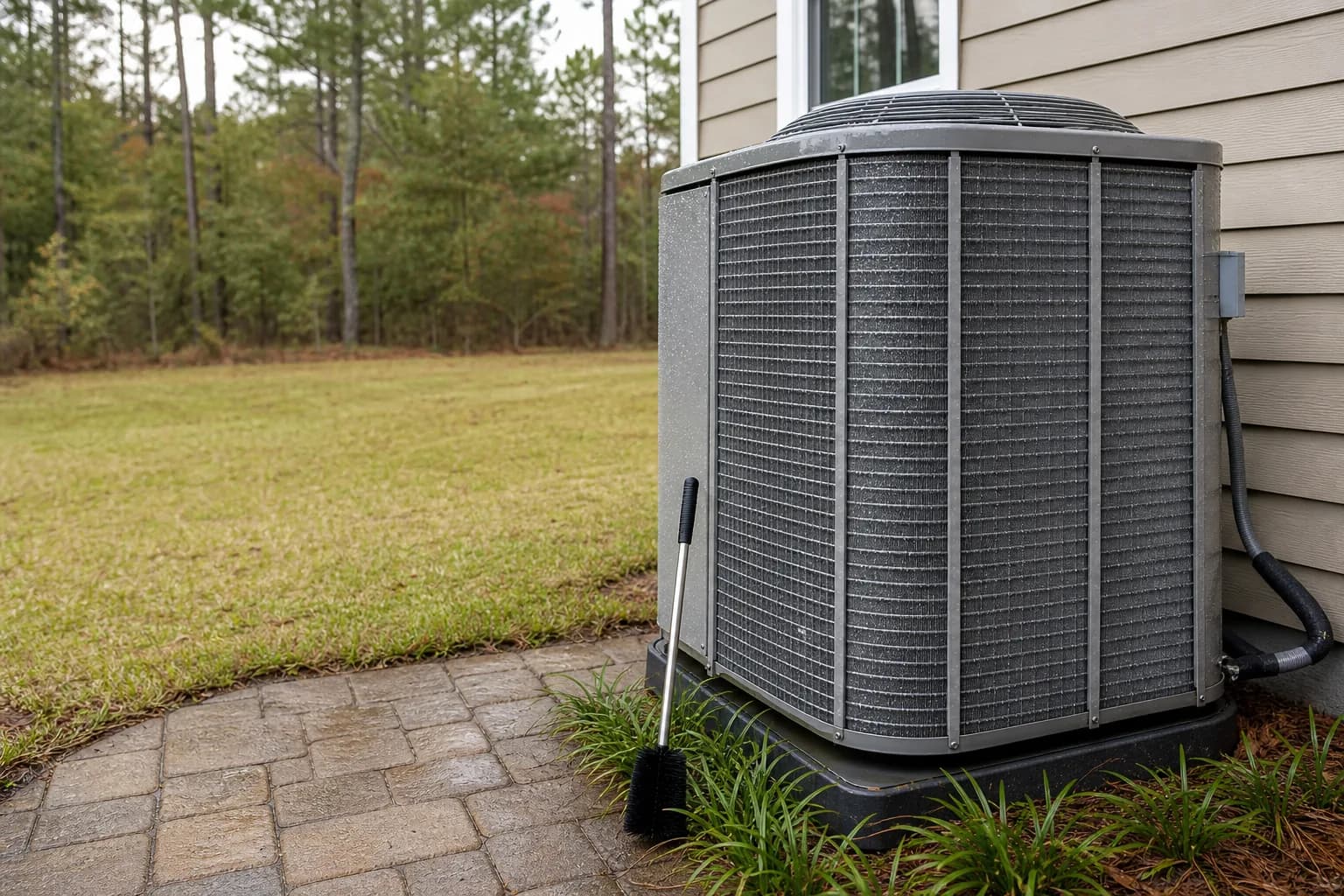
- Walk to the outdoor unit. Clear pine straw, pecan debris, and grass clippings off the coil with a soft brush or low-pressure water from the side, not the top.
- Pull the indoor cabinet cover. Look at the coil through the access slot. Check the drain pan. Listen to the blower for 30 seconds.
- Note the bill. Compare to August. If September lands more than 8 to 10 percent above the same period last year, something is off and a service call is warranted.
That is the whole list. Five mistakes, knocked down.
If any of the visual checks turn up something, call 251-383-HVAC or book through the Comfort Plan. The plan covers the September version of this check on a routing schedule that fits the inland Loxley calendar — not the coastal one.
FAQ
- Is the back-to-school HVAC reset really worth the time for an inland Loxley home?
- Yes, and arguably more than for a coastal home. Loxley afternoon highs run 2 to 4°F warmer than Daphne or Fairhope at the same hour because there's no bay-breeze cooling effect, which means the August-loaded filter and the unbalanced thermostat schedule cost a Loxley homeowner more per month than the same neglect would on the Eastern Shore. The reset takes 15 minutes and saves $40 to $90 across the September-October bills in most homes.
- How long does the back-to-school HVAC reset take?
- Twelve to fifteen minutes if you do it yourself: filter swap, four thermostat schedule edits, a 60-second visual on the coil and drain pan, and a quick pull on the outdoor disconnect to confirm the unit is clean of pine straw and pecan-orchard debris (specific to Loxley). If a Comfort Plan tech does it, count on 45 to 60 minutes including the airflow check, capacitor test, and refrigerant verification we add to the routine.
- Does Loxley really see different HVAC patterns than Daphne or Fairhope?
- Yes. Loxley's inland position 13 miles north of Mobile Bay produces afternoon highs 2 to 4°F warmer than the Eastern Shore at the same hour, longer cooling cycles, and a higher thermal load on outdoor condensers. Pecan and satsuma debris also pile up at outdoor units in ways that don't happen in beach-city subdivisions. The fundamental physics is the same; the maintenance cadence is slightly different.
- What's the single most important back-to-school HVAC task if I only have time for one?
- Replace the filter. A loaded filter pulls static pressure on the air handler high enough to cut delivered airflow by 20 to 35 percent, which means longer cycles, higher bills, and warmer rooms upstairs. Everything else on the reset list adds incremental value; the filter swap is the foundation.
Need this handled?
Straight to the service page for your town — pricing, local details and a form that reaches a technician.
More from Back To School Reset

ACExperts HVAC
We Take The Heat So You Don't Have To
Fast, honest heating and air service across Baldwin County. Speak with a technician and get on the schedule today.