
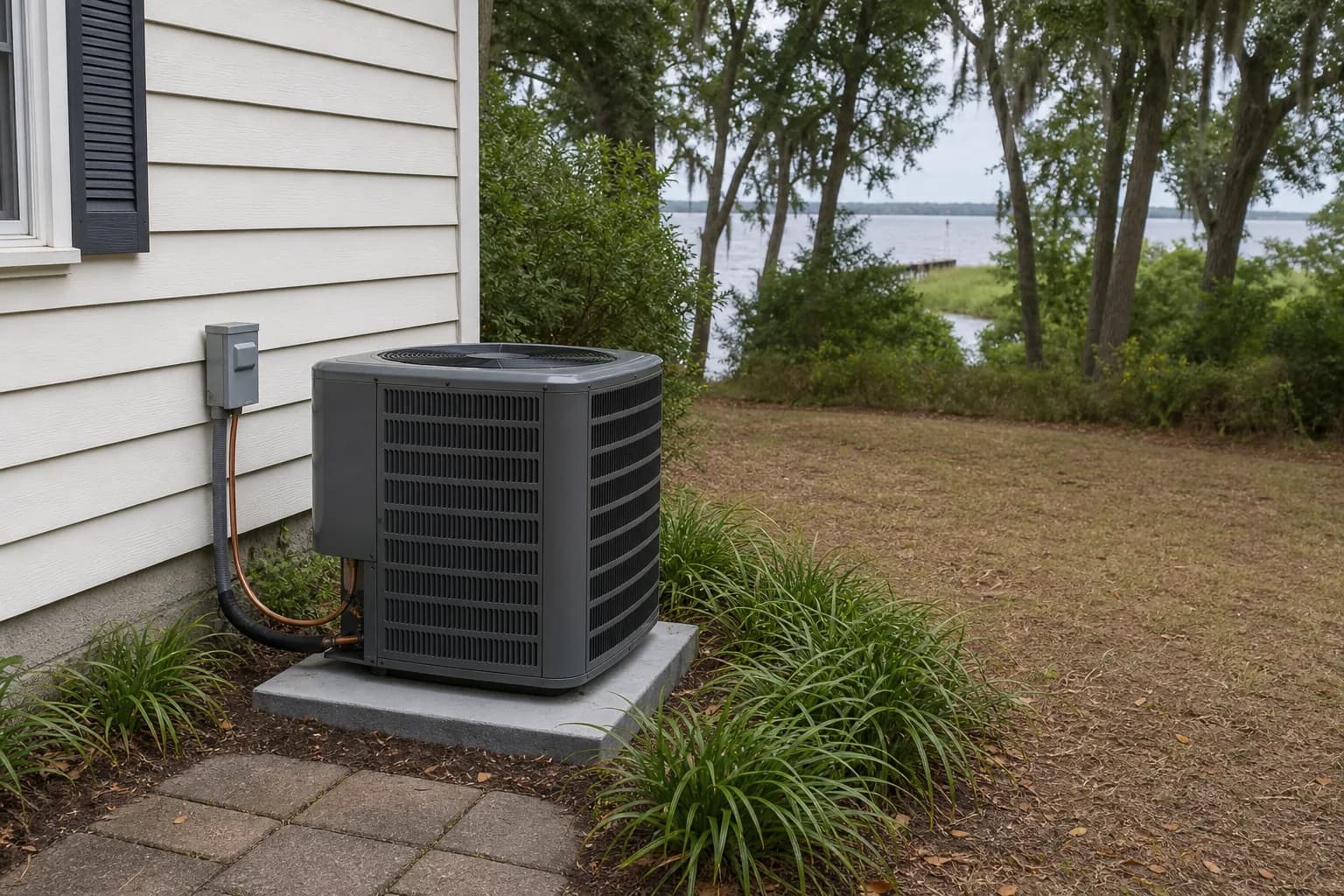
Spanish Fort AC Replacement in 2027: The New Pricing Reality
Spanish Fort AC replacement in 2027: a 3-ton turn-key install jumped from $7,200 in 2024 toward $9,400 to $11,800. The manufacturer and refrigerant math behind it.
Published 2026-07-29 · Updated 2026-07-29
Author: Landon Jahnke | ACExperts251
Reviewed by: Landon Jahnke · Owner · Alabama HVAC License AL #16117 · EPA 608 Certified
This used to work. Through 2024, a Spanish Fort homeowner could replace a 3-ton AC for $7,200 to $8,400 turn-key. Through 2025 it crept to $7,800 to $9,200. In 2026, R-410A phase-out hit. By 2027 the same install runs $9,400 to $11,800, and the equipment isn't 30% better — it's just running on different refrigerant your old line set isn't rated for.
Here's what changed at the manufacturer level, what changed at the wholesaler, and why the 2027 install in Spanish Fort isn't a price gouge — it's the new floor.
I'll walk through the generational change one layer at a time. By the end of this post you'll know exactly which of the four price-jump drivers applies to your house, which doesn't, and where you actually have negotiating room. Spanish Fort homeowners in Stillwater, Rayne Plantation, Stonebridge, Churchill, and the broader Highway 31 corridor have been asking versions of this question every week since spring. The answer is the same question whether you bought in 2002 or 2018: what generation does your system belong to, and what does the next generation cost?
The four generations of residential AC since 2010
Before pricing makes sense, the equipment timeline has to make sense. Residential split-system AC has moved through four meaningful generations in the last fifteen years, and the price you're being quoted in 2027 reflects which generation you're stepping out of and which one you're stepping into.
Generation one: 2010 to 2015 — late R-22 and early R-410A. R-22 was banned from new equipment manufacture in January 2010. Equipment built in this window is all R-410A by mandate but the design DNA is still R-22-era — single-stage compressors dominant, PSC blower motors common, copper line sets sized for R-22 working pressures and adapted for R-410A's higher pressures by using thicker-wall tubing. SEER ratings: 13 to 15 typical. A 3-ton install in 2014 ran roughly $5,400 to $6,200 turn-key.
Generation two: 2015 to 2020 — mature R-410A. Two-stage compressors became standard in mid-tier equipment. ECM blower motors moved from premium-tier to mid-tier. Manufacturers redesigned coil geometry around R-410A's higher pressures rather than just adapting it. SEER2 jumped to 14.3 to 16 standard. A 3-ton install in 2018 ran $6,400 to $7,400 turn-key. This is where most installed equipment in Spanish Fort's 1999-to-2010 spec-built subdivisions currently sits.
Generation three: 2021 to 2024 — peak R-410A with variable-speed. Inverter-driven variable-speed compressors became broadly available. Communicating thermostat ecosystems matured. SEER2 ratings of 16 to 20 became achievable in mid-tier equipment. Material costs started climbing in 2022 (copper, steel, electronics) but pricing held relatively flat as manufacturers absorbed margin. A 3-ton install in 2024 ran $7,200 to $8,400 turn-key — and this is the comparison point homeowners keep returning to when they hear 2027 numbers.
Generation four: 2025 to present — lower-GWP refrigerant transition. R-454B (Puron Advance) and R-32 replacing R-410A as the standard residential refrigerant. Equipment is mechanically similar to generation three, but redesigned for slightly different working pressures, different oil compatibility, and different service procedures. This is the generation you're buying in 2027.
The price gap between generation three and generation four is the entire conversation. So let's break that gap apart.
What's inside the $2,200 increase
A 2027 turn-key 3-ton install at $9,400 to $11,800 versus a 2024 turn-key 3-ton install at $7,200 to $8,400 is a midpoint-to-midpoint jump of about $2,300. That number is built out of four roughly equal pieces.
Piece one: equipment cost, $700 to $900
Manufacturer pricing on outdoor condenser units has moved 11% to 14% per year since 2024. Some of that is general inflation. Some of it is plant retooling cost as production lines converted from R-410A-only to R-454B or dual-rated. Some of it is electronics — variable-speed inverter boards have moved with semiconductor pricing, which has been volatile.
Across 13 years working Baldwin County HVAC, I've watched wholesale prices on 3-ton single-stage condensers from the major brands move from roughly $1,800 in 2024 to north of $2,400 by 2026, with 2027 quotes climbing further. That's a meaningful wholesale jump in 30 months, and at a solo-shop scale there's no margin cushion to absorb it — the move passes through to the install price.
Piece two: refrigerant and line set, $480 to $700
This is the piece most Spanish Fort homeowners don't see coming. R-454B requires either a brand-new line set or a documented flush-and-test of the existing copper. The flush itself is $180 to $280 in labor. If the existing line set has any oil residue from the old R-410A system that won't fully clear — common on 8+ year-old runs — the entire line set has to be replaced.
For a typical Spanish Fort two-story spec build with the air handler in the attic and the condenser on the side of the house, line set replacement runs $480 to $1,100 depending on whether the run goes through a wall chase that's accessible or one that requires drywall work. Stillwater- and Stonebridge-vintage homes (mid-2000s) tend to land at the higher end of that range because the original installations frequently routed line sets through framing cavities that aren't reachable without opening walls.
The refrigerant itself in the new system runs about $115 to $145 per pound for R-454B in 2027 compared to $85 per pound for R-410A in 2024. A 3-ton system holds 7 to 9 pounds. That's another $200 to $400 just in factory charge plus initial top-off.
Piece three: warranty-driven installation requirements, $400 to $500
Manufacturer warranties on 2026 and 2027 equipment got measurably tighter. Specific examples that affect pricing:
- Pressure-test documentation at three pressures with timestamped readings
- Vacuum-pull documentation to 500 microns held for 30 minutes
- Photographic documentation of brazed joints and drip leg installation
- Commissioning report submitted within 30 days of install
- Refrigerant-handling certification verification on every technician on the job
Each of those individually is small. Combined, they add 1 to 2 hours of skilled labor per install, plus office time for documentation submission. At typical Baldwin County skilled-labor billing rates, that translates to roughly $290 to $580 added on the labor side. None of it is padding — but it also can't be skipped without voiding the homeowner's parts warranty.
Piece four: permit, inspection, and miscellaneous, $200 to $300
Baldwin County permit fees have moved from $65 to $95 across the same window. Inspection scheduling has gotten longer (3 to 5 day waits versus next-day in 2023), which means more truck rolls per project. Disposal of the old equipment now carries a $45 fee at the recycling facility where it was free in 2024. Sales tax on materials moved with the equipment cost. Each of these is small. Stacked together they're another $200 to $300.
Add the four pieces: $700 to $900 plus $480 to $700 plus $400 to $500 plus $200 to $300. Range: $1,780 to $2,400. Midpoint: $2,090. That matches the observed pricing move from 2024 to 2027 within $200.
The math holds together. The new floor is real.
What this looks like for a specific Spanish Fort home
Take a 2,400-square-foot two-story in Rayne Plantation, built 2007, original system replaced in 2014, currently running a 14-SEER 3-ton single-stage R-410A unit that's developing a slow refrigerant leak.
2024 quote (hypothetical replacement at that point):
- 3-ton single-stage R-410A condenser: $1,840
- Matching air handler with ECM blower: $1,420
- Line set inspection (no replacement): $0
- Labor (10 hours, 2 techs): $1,650
- Refrigerant (factory charge + top-off): $580
- Permit, materials, disposal, tax: $710
- Total: $6,200 to $7,400
2027 quote (same home, equivalent equipment tier):
- 3-ton single-stage R-454B condenser: $2,640
- Matching air handler with ECM blower: $1,710
- Line set replacement (8-year-old run, flush failed): $720
- Labor (12 hours, 2 techs, with documentation): $2,180
- Refrigerant (factory charge + top-off, R-454B): $920
- Permit, materials, disposal, tax: $980
- Total: $9,150 to $11,400
The $2,950 difference between midpoints traces line by line to the four pieces above. None of it is markup. All of it is structural cost change.
For comparison on broader Baldwin County replacement math, the Foley 2027 repair pricing breakdown covers the service-side numbers, and the Baldwin County AC installation cost guide walks through the regional baseline that all of these city-specific numbers diverge from.
Where Spanish Fort homeowners actually have leverage
The new floor is real, but the floor isn't a ceiling. Three areas where 2027 installs in Spanish Fort can come in lower than the default quote:
Tonnage right-sizing. Spec-built homes in Stillwater, Rayne Plantation, and the newer Churchill phases are frequently oversized — a 4-ton system on a 1,900-square-foot floor plan that should be running 3 tons. A right-sized replacement saves $700 to $1,200 on equipment cost and produces better humidity control. A Manual J calculation is part of the free replacement estimate; if it shows your existing system is oversized, you'll hear that, and a smaller unit costs less.
Single-stage vs. two-stage vs. variable-speed. A two-stage system runs $900 to $1,400 above single-stage. Variable-speed runs another $1,800 to $2,800 above two-stage. For most Spanish Fort homes with reasonably well-designed ductwork, two-stage is the sweet spot — the variable-speed premium often doesn't recover in operating savings within the equipment's lifespan. Brick-veneer 2,000-square-foot single-story homes specifically rarely justify variable-speed.
Line set strategy. If your existing line set is 8 years old or younger, in good condition, with accessible terminations, a flush-and-test runs in the low hundreds versus several hundred more for full replacement. Test first, replace only if it fails — not as a reflex on every job.
Brand tier. A Goodman 3-ton single-stage R-454B install runs $7,800 to $8,400 in 2027 and carries the same 10-year parts warranty as the equivalent Trane or Carrier unit at $9,800 to $10,800. The lifespan and reliability gap between mid-tier and premium-tier brands is narrower than the marketing suggests, particularly for inland Spanish Fort homes that aren't dealing with the salt-air exposure that makes Fort Morgan and Orange Beach installs different conversations.
If you want to walk through your specific numbers before deciding, the ROI calculator lets you input your repair quote, system age, and energy bill to compare repair-vs-replace over a 5-year window. The same tool gets used in person on free replacement estimates.
Equipment-cost ranges in this post reflect general Baldwin County market observations and are not formal quotes for any specific home. Brand-tier pricing, refrigerant-handling regulations, and federal/state tax credits change frequently — confirm current numbers with the manufacturer, your installer, and a tax professional before making a buying decision.
What 2028 and beyond probably look like
Three forecast notes for Spanish Fort homeowners trying to plan ahead.
R-454B equipment pricing should stabilize. The big jumps from 2024 to 2027 were mostly retooling cost. By 2028, manufacturer cost structures should normalize and price increases should track general inflation (3% to 5%) rather than the structural 11% to 14% we've seen.
Labor and documentation costs will keep climbing. Skilled HVAC labor is in shortage nationally and locally. Wage pressure and certification cost increases will continue to push installation labor up 4% to 6% per year through at least 2030.
R-410A service costs will spike further. If you're keeping a generation-two or early-generation-three R-410A system through 2030, plan on refrigerant top-offs that may run $180 to $240 per pound by then. That's not a reason to panic-replace, but it's a reason to fix any known leak now rather than treating it as a recurring annual top-off cost.
The honest summary: the 2027 install price isn't temporary, it isn't a gouge, and it isn't going back to 2024 numbers. The underlying input costs have moved structurally. What you can control is brand tier, tonnage, and timing — and those three levers are the same three levers Spanish Fort homeowners have always had. The numbers behind them just got bigger.
For broader context on how the cost picture looks across the rest of Baldwin County, the Magnolia Springs mini-split pricing post walks through ductless install math for accessory-dwelling and bonus-room applications, and the Lillian hurricane prep mistakes guide covers the maintenance side that determines how long your 2027 install lasts before becoming a 2042 replacement conversation.
Spanish Fort homeowners haven't gotten worse at maintaining their HVAC. The equipment hasn't gotten dramatically better. The price tag has moved because the inputs moved. Knowing why you're paying $9,400 to $11,800 instead of $7,200 to $8,400 doesn't make the check easier to write, but it does make the decision clearer.
FAQ
- Why does my old line set matter when replacing the outdoor unit?
- R-454B and R-32 use different working pressures and different oils than R-410A. Manufacturer warranties on 2026-2027 equipment require either a brand-new line set or a flushed-and-tested existing line set with documented compatibility. In a Spanish Fort home with a 12-year-old 3/4-inch suction line buried in a wall chase, replacement is often the only path that protects the warranty — and that line set replacement runs $480-$1,100 depending on access. That's a chunk of the $2,200 jump from 2024 to 2027 right there.
- Are 2027 R-454B systems actually 30% more efficient than 2024 R-410A systems?
- No. SEER2 ratings on equivalent-tier equipment have moved roughly 5-9% between 2024 and 2027 model years. The big efficiency gains from variable-speed compression and ECM blowers were already in the market in 2022-2023. The 2027 price increase is not buying meaningfully better cooling — it's buying compliant cooling. The equipment runs on a refrigerant that doesn't trip future EPA penalties, and that's the line item homeowners are paying for.
- Should I rush a replacement before prices climb again in 2028?
- Only if your equipment is already showing real failure signs — not because of pricing. Panic-replacing a 9-year-old system to dodge a future increase rarely pencils out. A working system has 5-8 years of service life left, and the operating-cost difference between an install now and an install in two years on a healthy unit doesn't recover the $9,400-$11,800 you spent early. The exception: R-22 systems and 14+ year-old R-410A units with leak history. For those, sooner is genuinely better.
- Is there any way to keep a Spanish Fort install under $9,000 in 2027?
- Yes, but with tradeoffs. Smaller-tonnage systems (2 to 2.5 tons for tighter homes), single-stage rather than two-stage compressors, basic-tier brands (Goodman or builder-grade Carrier rather than Carrier Infinity or Trane XV), and avoiding line set replacement where the existing one passes pressure-test and flush all bring the number down. The number depends entirely on what you actually need, not on what gets quoted by default. The only way to get a real number on your specific home is a free replacement estimate — measurements, ductwork look, line set assessment, and a written quote. Call 251-383-HVAC.
Need this handled?
Straight to the service page for your town — pricing, local details and a form that reaches a technician.
Related reading

ACExperts HVAC
We Take The Heat So You Don't Have To
Fast, honest heating and air service across Baldwin County. Speak with a technician and get on the schedule today.