
Should Orange Beach Homeowners Worry About Pre-Summer Inspections?
A pre-summer inspection myth in Orange Beach is quietly costing condo owners thousands. Where it came from and what a real Gulf-front inspection looks like.
Published 2026-06-04 · Updated 2026-06-04
Author: Landon Jahnke | ACExperts251
Reviewed by: Landon Jahnke · Owner · Alabama HVAC License AL #16117 · EPA 608 Certified
"Just shut the system off for an hour every couple of weeks and turn it back on — that's all the maintenance an Orange Beach AC needs."
That's the worst advice circulating in Baldwin County HVAC right now, and I've heard versions of it from Orange Beach property managers more than once this spring. The myth is older than I am, the math is wrong, and the cost of believing it shows up in failed mid-summer installs. Let's break the legend down.
Where the bad advice came from
I traced this one back as best I could. The "shut it off occasionally" piece of folk wisdom appears to have originated decades ago when residential AC equipment was simpler — single-stage, no electronics, no variable-speed anything. The thinking was that letting the compressor "rest" reduced wear. There was a sliver of logic to it in the 1970s when contactors were oversized, capacitors were physically larger, and runtime was the dominant wear factor.
That world is gone. A 2026 condenser sitting on a Bella Luna balcony or behind a Bear Point Estates fence has a variable-speed compressor designed for long, low-stage runtime. The wear items aren't compressor cycles anymore — they're the contactor, the capacitor, the electrical connections, and most importantly the salt-driven corrosion of the coil itself. None of that gets better when you turn the system off. Some of it gets worse, because a system that isn't running doesn't dehumidify, and a humid stagnant interior is exactly what condensate pans, drain lines, and indoor coil surfaces don't tolerate.
So the folk wisdom is doing the opposite of what it claims to do. People who follow it think they're maintaining their unit. They're actually accelerating the failure mode that matters most in Orange Beach: humidity-driven mold growth on the indoor side, plus salt-driven corrosion on the outdoor side that never gets cleared off because nobody's looking at it.
Why Orange Beach specifically
The corrosion environment here is severe and unforgiving. We covered the Orange Beach landscape on the service-area page — nearly 69% of the city's housing is multi-unit condos, with the heaviest concentration of Gulf-front exposure in the entire Baldwin County footprint. Bella Luna, Perdido Grande, Phoenix on the Bay, the Cottages at Romar, and the high-rises along the Perdido Beach Boulevard corridor all sit in the most aggressive salt-spray zone in the county. Bear Point Estates and Terry Cove see slightly less direct spray but more sustained bay-borne humidity. Ono Island, as a private community, has the same bay environment with full-time residents instead of vacation rentals — different service profile, same corrosion math.
The median construction year in Orange Beach is 2000, which means a meaningful share of installed equipment is now in the 20-to-25-year range. Equipment in that age band, in this environment, without consistent inspection, fails ahead of schedule. Often well ahead.
The actual cost of skipping the inspection
Here's the math I work through with owners who push back on the inspection. A pre-summer service call carries our standard $79 service fee, and any repairs identified during the visit get quoted before work begins. For a vacation rental, you also pick up the documentation that's useful for insurance and for the next buyer. Free second opinions on any quoted repair, and free estimates on replacement scenarios — those are part of how I work the call.
The alternative is what shows up in July when something fails mid-season. A failed condenser on a Gulf-front condo with corroded coils often isn't worth repairing — the leak is in too many spots and the labor to chase it doesn't pencil out relative to a coastal-rated replacement. Replacement on a typical 2.5-ton condo system is a real chunk of money in 2026, and that assumes equipment is available during peak season. If the unit's down on a turnover Saturday with new guests checking in at 4 p.m., the rental owner is looking at refunded nights, lost reviews, and the lifetime cost of a one-star summary with the words "no AC" in it. Equipment plus labor plus lost rental nights plus the bad-review tax — the loaded cost is significant, and it's the kind of number that makes a pre-summer service call look like the bargain it actually is.
A pre-summer inspection catches the corrosion early, catches the failing capacitor before it strands a contactor, and catches the drain pan that's a year away from overflowing through a downstairs neighbor's ceiling. The expected-value math isn't close.
What an actual inspection looks like
For an Orange Beach Gulf-front unit — whether that's a high-rise condo or a Terry Cove waterfront home — here's what we work through:
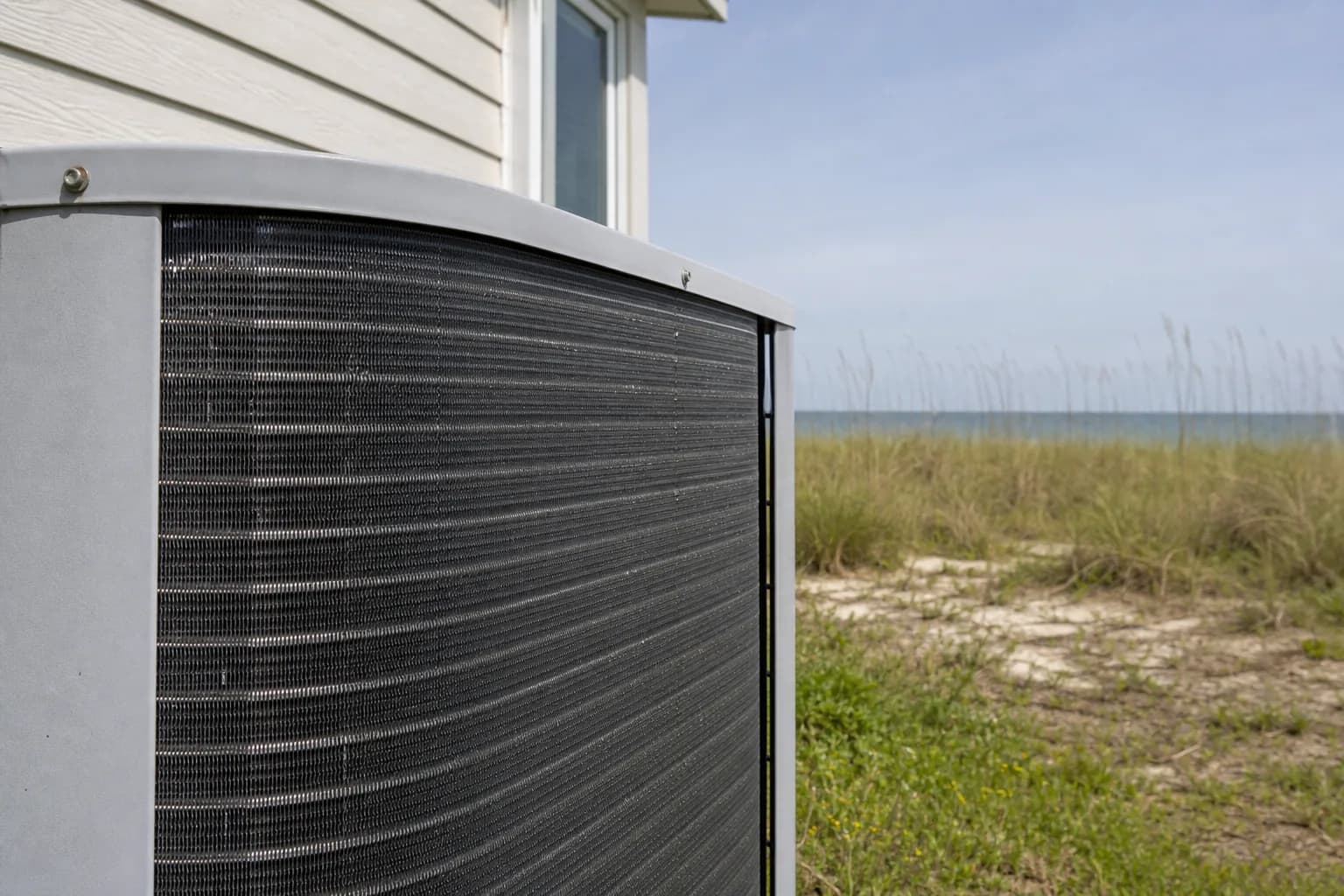
Outdoor coil rinse and corrosion check. A garden hose with a fan-spray nozzle, top-down rinse following the fin direction, takes about ten minutes per unit and removes the bulk of the salt accumulation since the last service. Then I look at the fins under good light: black streaking, white powder, fin density loss, copper showing through the aluminum coating — any of those tells me where the unit is in its corrosion lifecycle. The findings get photographed.
Contactor and capacitor under load. A worn contactor pits at the contact surface and reads abnormal resistance. A degraded run capacitor reads low microfarads — typically a 35-microfarad capacitor that's down to 30 is at the start of its failure curve. I replace either at the inspection rather than waiting for them to strand a compressor in July.
Refrigerant pressures at design conditions. With outdoor temperature in the right range (above 65°F for accurate readings), suction and head pressures tell me whether the charge is correct, whether there's a slow leak working, or whether the metering device is misbehaving. A unit that's two pounds undercharged in May will be five pounds undercharged in July, and at five pounds undercharged the compressor runs hot enough to start damaging itself.
Condensate path verification. Drain line flush with a wet-vac on the condensate output, pan inspection, secondary pan and overflow switch test if installed. In Orange Beach, where humidity drives constant condensate production, a clogged drain is one of the most common single-source service calls from May through September. Five minutes of inspection prevents a ceiling repair.
Electrical connections at the disconnect and inside the cabinet. I torque the lugs, check for heat discoloration, and replace any wire nut that shows signs of arcing or moisture intrusion. Coastal electrical environments degrade connections faster than inland — moisture creeps into terminations and accelerates oxidation.
Blower motor amp draw and ECM diagnostics. On the indoor side, a fan motor pulling above its nameplate rating is on its way to failure. ECM-equipped systems give a control-board readout of motor health, and I use it.
Filter status and airflow check. Condo units especially run filters that nobody on-site changes between bookings. A loaded filter strangles airflow, drives up indoor coil temperatures, and produces complaints that are misdiagnosed as refrigerant problems. I replace the filter and check static pressure.
That's about 75 to 90 minutes on a typical unit. The full procedure aligns with what we walk through on the preventive maintenance service page and the coastal salt-air maintenance schedule post.
The HOA conversation
If you're on a board at one of the larger Orange Beach high-rises, the conversation worth having before each summer is whether to bulk-schedule pre-summer inspections across the building. Coordinating inspection windows in April and May before the rental peak hits is the pattern that works: per-unit pricing improves when one tech stays in one building all day, the documentation helps the building's insurance posture, and the failure rate during peak season drops measurably on buildings that do this consistently.
If your HOA isn't doing this, raise it at the next meeting. Buildings that commit to bulk inspection scheduling tend to have noticeably fewer mid-summer emergencies than the ones that leave it to individual owners.
The Ono Island and Terry Cove version
For full-time residents in Ono Island or Terry Cove, the calculus shifts slightly. You're not staring down a guest check-in deadline, but you are running equipment year-round through the most aggressive corrosion environment in the county, and the failure cost is your own family's comfort rather than a refunded booking. The inspection cadence I recommend is the same — once in spring before the cooling season hits, once in fall after the worst of the summer load — and the procedure is the same. What changes is the conversation. There's more time, you ask better questions, and the recommendations tend toward longer-horizon investments like coil coatings and replacement timing.
The salt-air maintenance schedule for coastal homes and the preventive HVAC checklist for Gulf Coast homes both walk through the residential cadence in more detail.
Where the legend goes to die
Look — the just-cycle-it-off advice isn't malicious. It comes from the same place a lot of folk wisdom comes from: someone who didn't know what they were talking about said something that sounded plausible, and it spread. The fix isn't to argue with whoever told you. The fix is to schedule a real inspection in the next two weeks, document what's there, and decide on an actual maintenance cadence based on what we find.
If you've already heard from a neighbor that "we don't do anything to ours and it's been fine for ten years," that neighbor is on borrowed time. The corrosion is happening to their unit too. They just haven't paid for it yet.
For Orange Beach Gulf-front owners, the related pre-summer reading is worth a look — the Gulf Shores May heat-wave prep post covers the broader coastal pre-season window. If you'd rather just schedule the inspection, the schedule page is here, and Orange Beach gets routed throughout the spring on a rolling basis. Call 251-383-HVAC to set up a visit.
The myth is the myth. The equipment doesn't care what your neighbor told you. Get it inspected.
FAQ
- Is a pre-summer inspection really necessary on a 5-year-old Orange Beach condo unit?
- Yes — five years of Gulf-front salt exposure already shows up at the contactor and the coil, and a clean condo unit at five years is the exception, not the rule. The inspection catches the early-stage corrosion that's still cheap to fix before it becomes a refrigerant leak or a control board failure. Skipping it because the unit is 'still new' is exactly the trap that produces the emergency replacements I've seen in July across 13 years of Baldwin County HVAC work.
- What does a real pre-summer inspection cover on a Gulf-front Orange Beach condo?
- Coil rinse and visual inspection for fin corrosion, contactor and capacitor reading under load, refrigerant pressure check at design conditions, condensate drain flush and pan inspection, electrical-connection torque check at the disconnect, blower motor amp draw, filter status, and a thermostat calibration check. On a typical fan-coil-plus-condenser setup this runs roughly 75 to 90 minutes per unit. I document the findings with photos so the owner has a record.
- Is bulk pre-summer scheduling an option for HOA-managed buildings?
- Yes — building-wide inspection windows in April and May, before the rental peak hits, are a standard way larger Orange Beach high-rises handle pre-season service. I can coordinate multi-day blocks with the property manager and bill per unit. The economics work out better for owners than scattered emergency calls in July, and the documentation helps with insurance and resale records. Call 251-383-HVAC to discuss what your building needs.
- Does the just-shut-it-off-occasionally advice ever apply?
- Not really. Cycling the system off for an hour every couple of weeks doesn't reset anything mechanical, doesn't clear corrosion, doesn't flush the drain, and doesn't load-test the capacitor. It comes from the misconception that the equipment 'rests' — but residential HVAC isn't designed to benefit from rest cycles, and the actual wear items keep degrading whether the system runs or not. The advice is a comfort blanket, not a maintenance strategy.
Need this handled?
Straight to the service page for your town — pricing, local details and a form that reaches a technician.
More from Pre Summer Inspection

ACExperts HVAC
We Take The Heat So You Don't Have To
Fast, honest heating and air service across Baldwin County. Speak with a technician and get on the schedule today.