
Preventive HVAC Maintenance Checklist for Gulf Coast Homes
A homeowner-friendly preventive HVAC maintenance checklist for Baldwin County: the monthly habits, what a real tune-up covers, and why the coast is hard.
Published 2026-04-09 · Updated 2026-04-09
Author: Landon Jahnke | ACExperts251
Reviewed by: Landon Jahnke · Owner · Alabama HVAC License AL #16117 · EPA 608 Certified
Most HVAC failures we get called for in Baldwin County weren't surprises. They were slow problems that gave warning for weeks — a capacitor drifting out of spec, a drain quietly clogging, a coil getting dirtier every month — until one hot afternoon the system gave up. Almost none of those calls had to happen. They happened because nobody looked until the air stopped getting cold.
Maintenance is how you change that. The good news is a lot of it is on you, costs almost nothing, and takes a few minutes. The rest belongs to a technician with a meter and a set of gauges. Here's the homeowner-friendly version of both — what to do yourself between visits, and what a real professional tune-up should actually include. This is written for the Gulf Coast specifically, because our humidity and salt air make equipment work harder and fail faster than it does most places.
Why the Gulf Coast is harder on HVAC
Before the checklist, it's worth understanding why maintenance matters more here than it does in a dry, mild climate.
Our cooling season is long and brutal. Equipment in Baldwin County runs hard for months, not weeks, so anything marginal gets stress-tested every single day. The humidity is the second factor — your system isn't just lowering the temperature, it's pulling a huge amount of moisture out of the air, and that means more condensate flowing through the drain and more load on the coils. And closer to the water, salt in the air accelerates corrosion on the outdoor unit's coil and electrical components in a way inland equipment never deals with.
Add it up and a system here ages faster than the same unit would in a milder place. That's not a reason to dread it — it's the reason a little routine attention pays off so well.
The homeowner checklist: monthly habits
These are the things you do without calling anyone. None of it requires tools beyond a garden hose, and all of it makes a real difference.
Change the filter on a schedule
This is the single most important thing you can do, and the most commonly skipped. A clogged filter chokes airflow across the indoor coil. Starve that coil of air in our humidity and it ices over, and a frozen coil means no cold air on the day you need it most. Check the filter monthly, replace it every one to three months, and just look at it — gray and loaded means replace it, even if it's "not time yet."
Keep the outdoor unit breathing
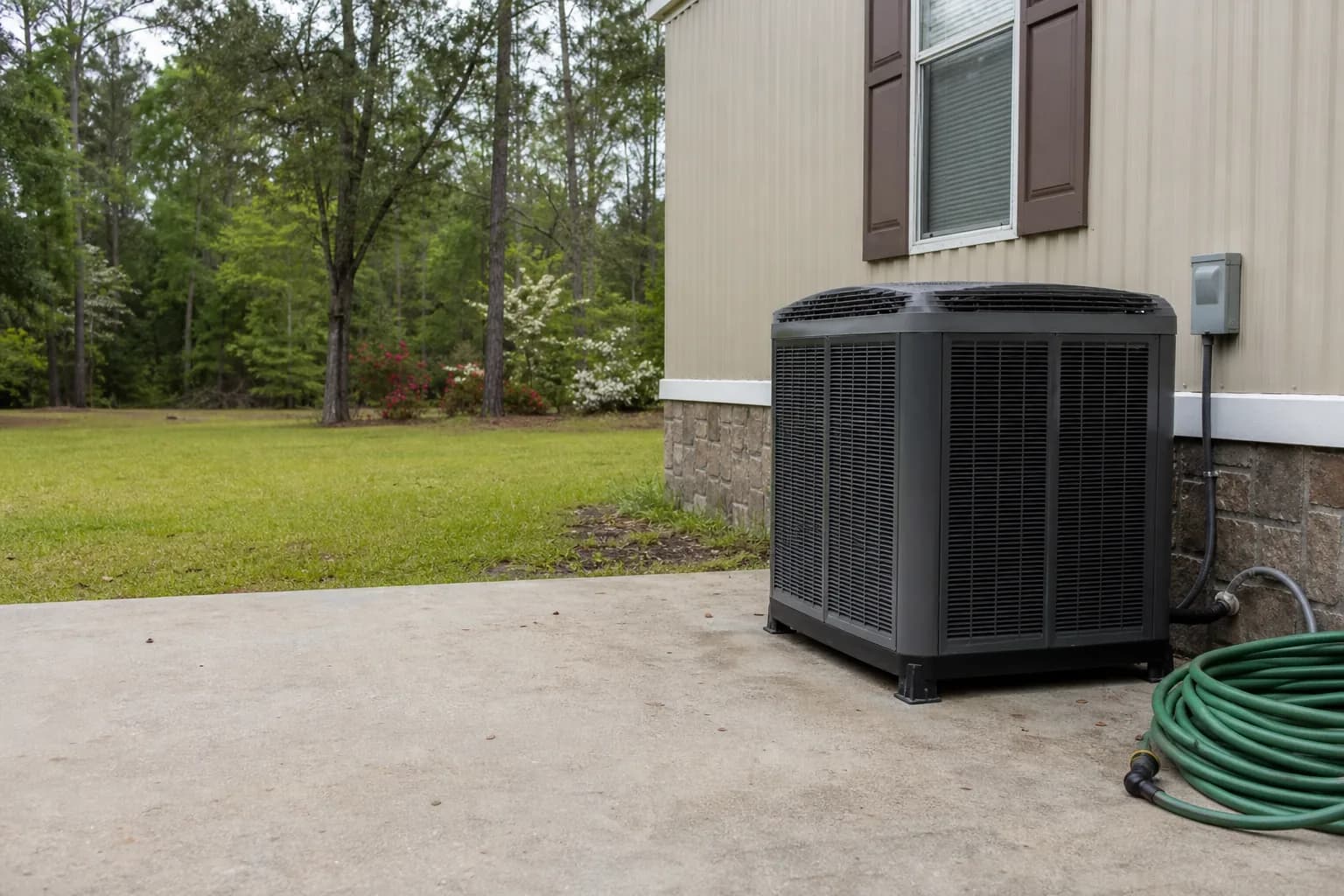
Walk out to the condenser and look at it. It needs clear air on every side to dump heat — give it a couple feet of clearance all around. Pull weeds and trim back any shrubs crowding it. Don't let mulch, grass clippings, or leaves pile against it or get sucked into the coil. A unit smothered by landscaping has to work harder for the same cooling, which means higher bills and a shorter life.
Rinse the coil during the hot months
Once a month or so in summer, kill power to the outdoor unit at the disconnect and rinse the coil with a garden hose at gentle pressure, top to bottom. This washes off the dust — and near the water, the salt — that builds up and insulates the coil against rejecting heat. Use a hose, never a pressure washer: high pressure bends the aluminum fins, and bent fins are worse than dirty ones. If you're on or near the water, this rinse is one of the highest-value things you can do for your equipment's lifespan.
Watch the condensate drain
In our humidity, your system produces a surprising amount of water, and it all goes out a condensate drain. That drain loves to clog with algae and biofilm. Check around the indoor unit for any water or staining, and if you ever see water pooling, shut the system off and call before it overflows onto a ceiling or floor. Keeping that drain clear is one of the quiet differences between a system that runs all summer and one that shuts itself down on a humid afternoon.
Pay attention to changes
You know what your system normally sounds and feels like. A new rattle, buzz, or grinding noise, a musty smell when it kicks on, longer run times to hit the same temperature, warm air at the registers, or a power bill that jumped for no reason — those are early warnings. Catching them early is the whole game. A noise investigated in April is a part; the same noise ignored until July is a no-cooling emergency.
What belongs in a real professional tune-up
Here's where the homeowner checklist ends and ours begins. A real tune-up is not a quick look and a filter swap — it's a set of measurements and tests that catch the things you can't see or feel. When we do preventive maintenance, this is the work:
- Electrical draws and connections. We measure the amperage the compressor and motors pull and compare it to the nameplate. A motor pulling high is a motor headed for failure. We also check and tighten electrical connections, which work loose and corrode over time, especially in our salt-laden air.
- Capacitor and contactor. We read the capacitor's actual microfarads against its rating — a weakening capacitor is one of the most common causes of a no-start, and it's a cheap part if you catch it before it strands you. We inspect the contactor for the pitting and welding that salt-air humidity causes.
- Refrigerant behavior. We verify the system is operating within its proper refrigerant range. We don't just "top it off" — if the charge is low, something is leaking, and the right move is to find and fix the leak, not mask it.
- Coil condition. We clean the coils properly. A dirty coil is a system fighting itself, and on the coast, coil condition is also where corrosion shows up first.
- Condensate drainage. We test the drain and clear it, and verify the safety float switch that's supposed to shut the system down before an overflow actually works.
- Safety controls and overall operation. We check the safety controls, the thermostat, and the system's overall operation start to finish, so it's ready for the season ahead.
That's the difference between a tune-up worth paying for and one that isn't. If a "tune-up" doesn't involve any measurements, it was a visual once-over, not a tune-up.
Spring and fall: the right cadence
For the Gulf Coast, the right rhythm is two professional visits a year.
Spring is the critical one. Before the cooling season puts months of full load on the system, you want every weak part found and dealt with. This is the visit that prevents the July no-cooling call. Fall is the second visit, to verify heat-pump or heating operation before the cold snaps arrive, so you're not discovering a heating problem on the first cold night.
If you only do one a year, make it spring — getting the AC checked before it's carrying full load in the heat is where the payoff is biggest.
Why a maintenance plan makes sense here
Doing this piecemeal works, but it's easy to let it slide, and the Gulf Coast doesn't forgive a skipped season the way a mild climate might. That's why we built the Comfort Plan — it puts the two yearly tune-ups on a schedule so they actually happen, and it bundles in benefits that matter: $0 service fees, no overtime fees, and 10% off repairs and replacements. There's also a warranty angle most homeowners don't think about until it bites them — most manufacturer warranties require documented annual maintenance, and a lapse can void coverage on an expensive part. The plan keeps that paper trail intact. The full details are on our maintenance plan page.
The bottom line
The systems that make it 15-plus years on the Gulf Coast aren't the lucky ones — they're the maintained ones. Do the homeowner basics: change the filter, keep the outdoor unit clear and rinsed, watch the drain, and listen for changes. Then get a real tune-up in spring and another in fall from someone who measures instead of glances. That combination catches almost every failure before it strands you in the heat.
If your system is overdue for a real look, we're glad to do it right. We run all of Baldwin County out of Silverhill, our standard service fee is $79, and second opinions on a repair you've already been quoted are free. Call 251-383-HVAC or get in touch. When something does go wrong between visits, AC repair is what we do.
FAQ
- How often should I change filters?
- For most Baldwin County homes, every one to three months — and on the shorter end of that if you have pets, run the system hard through the summer, or use a thicker pleated filter. The way to actually know is to look at it. Pull the filter and hold it up to a light. If you can't see light through it, or the media is gray and loaded, it's done. In our humidity, a clogged filter does more than waste energy — it starves airflow across the indoor coil, and a starved coil freezes into a block of ice and shuts the system down on the hottest afternoon of the year. A two-dollar filter is the cheapest insurance in the house.
- Is a professional tune-up really worth it, or is it just an oil change for my AC?
- It's worth it here in a way it might not be in a milder climate, and the difference is what a real tune-up actually includes. A real tune-up isn't a quick look and a filter swap — it's measuring electrical draws against nameplate, reading the capacitor, checking the contactor for pitting, verifying refrigerant behavior, cleaning the coils, testing the condensate drain, and checking the safety controls. On the Gulf Coast, the electrical components corrode faster from salt-laden humidity, so catching a weakening capacitor in spring is the difference between a planned part and a no-cooling call in July. A tune-up that's genuinely just a filter change isn't worth paying for. One that measures things is.
- When should I schedule maintenance — spring or fall?
- Both, ideally. Spring before the cooling season is the important one on the Gulf Coast, because that's when your system is about to carry months of brutal load and you want any weak part caught before it fails under stress. Fall is the second visit, to check heat-pump or heating operation before the cold snaps arrive. Two visits a year is the right cadence for our climate, and it's exactly what the Comfort Plan is built around. If you only do one, do spring — get the AC checked before it's pulling full load in 95-degree heat.
- What can I do myself between professional visits?
- Quite a bit, and it all matters. Change the filter on schedule. Keep the outdoor unit clear — at least a couple feet of breathing room on every side, no shrubs crowding it, no grass clippings blown into the coil. Rinse the outdoor coil gently with a garden hose during the hot months to wash off dust and, near the water, salt. Keep an eye on the condensate drain and watch for water around the indoor unit. And pay attention to changes — a new rattle, a musty smell, longer run times, a higher power bill. Those are early warnings. What you should not do is open up refrigerant lines or do electrical work; that's where the homeowner checklist stops and the call starts.
- My system seems fine — do I really need maintenance?
- A system that 'seems fine' is exactly the one maintenance is for. The whole point of preventive service is to catch the weakening capacitor, the pitting contactor, the slowly clogging drain, and the developing refrigerant issue while the system still seems fine — before any of them turn into a failure on the worst possible day. By the time you can feel a problem, it's often already a repair instead of a part. Maintenance is cheap insurance against a no-cooling call during a Gulf Coast July, and on the Comfort Plan it also keeps your manufacturer warranty intact, since most warranties require documented annual service.
Need this handled?
Straight to the service page for your town — pricing, local details and a form that reaches a technician.
Related reading

ACExperts HVAC
We Take The Heat So You Don't Have To
Fast, honest heating and air service across Baldwin County. Speak with a technician and get on the schedule today.