
May Heat Wave Prep for Gulf Shores Homeowners: 5 Quick Wins
6 things not to do before the first Gulf Shores heat wave, then 5 quick wins that help. Pre-summer AC prep for Craft Farms, West Beach, and Plantation.
Published 2026-06-02 · Updated 2026-06-02
Author: Landon Jahnke | ACExperts251
Reviewed by: Landon Jahnke · Owner · Alabama HVAC License AL #16117 · EPA 608 Certified
Six things NOT to do when prepping a Gulf Shores home for the first heat wave:
- Do not swap your filter twice in two weeks because you "saw a little dust on it."
- Do not fill the condensate pan with bleach.
- Do not "clean the coil" with the pressure washer in your garage.
- Do not cover the outdoor unit with a wrap-around tarp.
- Do not run the AC at 65°F to "shock-cool" the house when you arrive.
- Do not trust the gas station thermometer on the way down Highway 59.
Each of those breaks more than it fixes, and I'll get to why in a minute. But first, the framing matters: Memorial Day weekend in Gulf Shores brings somewhere around 6,000 weekend tourists driving up demand on every rental property in Craft Farms, Laguna Key, the West Beach corridor, and the Plantation-area condos. The first heat wave doesn't ease in. It hits. The systems that haven't been touched since October are the ones lined up for triage by 11 a.m. Saturday.
Let me unpack what NOT to do, then five quick wins that actually move the needle before the heat lands.
Why each "don't" breaks more than it fixes
Filter swap twice in two weeks. A pleated 1-inch filter has a service life that depends on hours of fan runtime, not calendar weeks. In a Gulf Shores rental running 14-hour days during Memorial Day weekend, a filter installed clean on May 20 is dirty on June 3. In an empty unit between bookings, the same filter is fine for 90 days. Swapping a filter you replaced 14 days ago is wasted money. What matters is whether the filter is loaded — look through it toward a window bulb and look. If you can't see the bulb's outline, swap it. If you can, you're fine.
Bleach in the condensate pan. Bleach corrodes the aluminum drain pan and the copper coil overflow port. Within three years of regular bleach use, we see pinhole leaks in evaporator pans that never had any drainage problem to begin with. Use a vinegar-and-water rinse, or a manufacturer-approved condensate tablet, and leave the bleach for the bathroom.
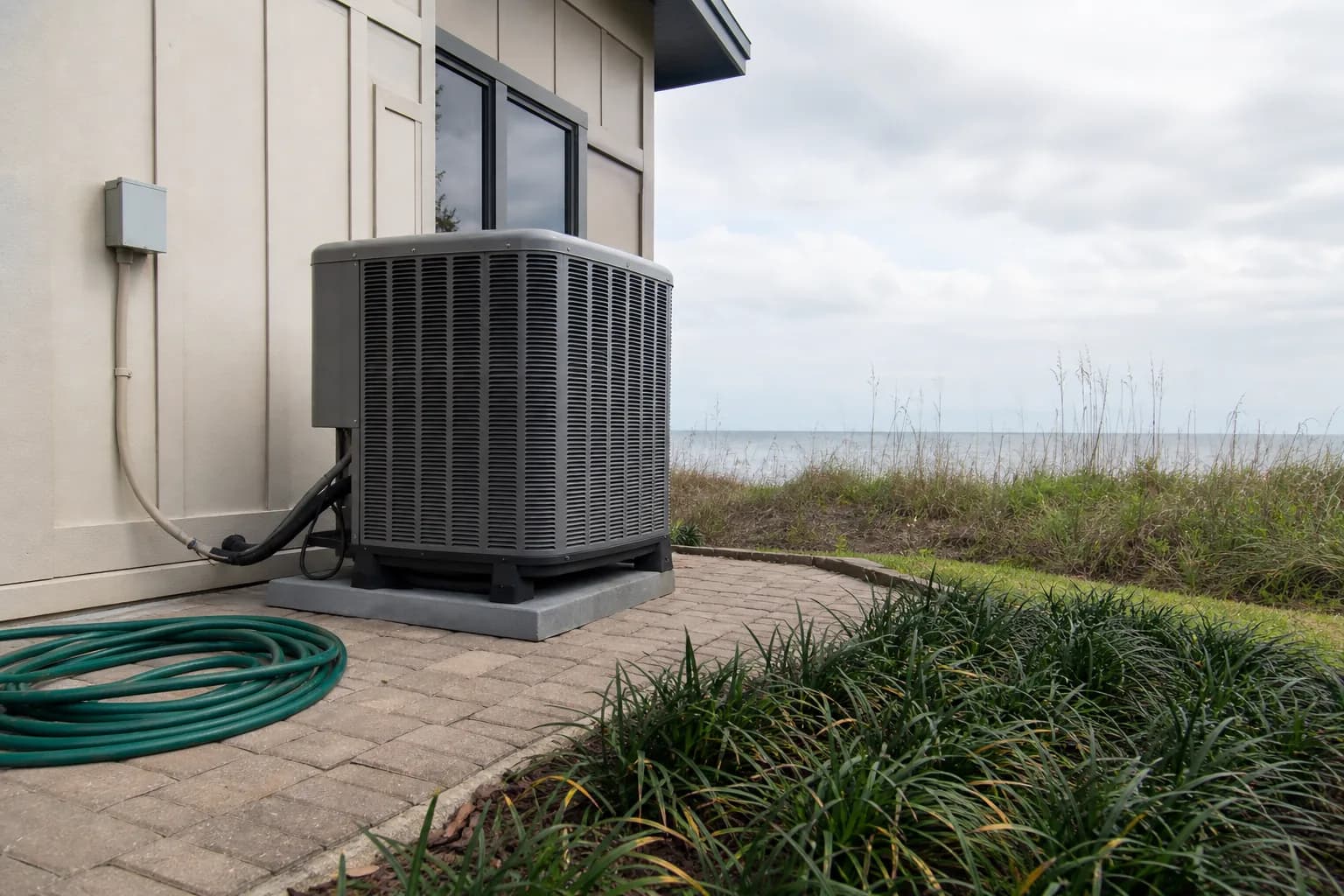
Pressure washer on the outdoor coil. Aluminum condenser fins are 0.005 inches thick. A standard garden hose at 60 PSI cleans them. A pressure washer at 1,800 PSI flattens them, and a flattened fin doesn't transfer heat. Over 13 years working Baldwin County HVAC, I've replaced Gulf Shores condensers on units that were "cleaned" by well-meaning homeowners with their driveway pressure washer — coil fins folded flat, head pressure pinned high, compressor cooked. The repair was the cleaning.
Wrap-around outdoor cover. A condenser is designed to live outside. Salt-air corrosion is the actual coastal threat, and a vinyl cover holds humidity against the cabinet 24 hours a day instead of letting it dry between rain events. The contactor pits faster, the disconnect housing rots faster, and any lizards that crawled in for shelter make a home in the cabinet over winter. If you want to keep oak leaves out, a breathable mesh top that covers only the fan grille is fine. Not a bag.
Shock-cool at 65°F. Setting a thermostat to 65°F when you arrive at a 84°F house doesn't cool the house faster. The system runs at the same capacity regardless of setpoint. What it does do is run the system continuously past the dehumidification curve, freeze the evaporator coil, and leave you with a house that's 78°F and 70% relative humidity by 11 p.m. — wetter and warmer than if you'd set 74°F and let the system come up to temperature gradually.
Gas station thermometer. The display on the BP at the I-10 split reads whatever the sun is doing to the sensor housing. It is not a measurement. The actual outdoor temperature in Gulf Shores during the first heat wave is whatever the National Weather Service buoy at the GU3 station reads — and that number is what your condenser is fighting. The point isn't the trivia. The point is that homeowners often size their reaction to a heat wave based on the worst number they saw on the drive in, then call us frantic about a system that's running fine for the actual conditions.
Now the part that matters.
Quick win #1 — Hose the outdoor coil at the start of the season
A garden hose with a regular spray nozzle, working from inside the unit out, takes 8 minutes. Pull the disconnect at the wall before you start. Spray top to bottom on all four sides until the water running out of the base pan runs clear. Don't go inside the cabinet with the spray. Don't push the spray into the fan motor. You're rinsing salt and pollen off the fin pack, not detailing the engine.
If you live within a mile of the water — which covers most of West Beach, parts of Laguna Key, and the entire Plantation strip — repeat this every 90 days through the season. The coastal salt-air maintenance schedule covers the quarterly rinse rationale in more detail, and why coastal AC units fail faster explains the corrosion mechanism that the rinse is interrupting.
Quick win #2 — Run the system for a full hour at 73°F before the first guests arrive
The systems that fail during Memorial Day weekend almost always failed during a low-load test in April that nobody ran. If your Gulf Shores property has been sitting at 78°F for the off-season, drop the thermostat to 73°F about 90 minutes before the cleaning crew arrives, listen to it, and walk through the house.
What you're listening for: outdoor unit starts within 5 seconds of the indoor blower; air temperature at the supply registers in the master bedroom is 18-22°F cooler than the return; no water dripping from any indoor fitting; no humming or buzzing from the disconnect. If the system runs for an hour and the house drops from 78°F to 73°F, you're in good shape. If it runs for an hour and the house drops to 76°F, something is short on capacity and you want to know that on a Tuesday in May, not a Saturday in June.
Quick win #3 — Check the float switch and the secondary drain line
Most Gulf Shores air handlers have a primary condensate drain that goes somewhere useful and a secondary drain that goes somewhere visible — often a small PVC stub above a window or under a soffit. The secondary drain only flows when the primary is clogged. If you see water coming out of that secondary line, you have a primary drain problem and an active overflow situation that's already inside your air handler.
Pour a cup of water into the air handler service port (most have a small access cap on top of the cabinet near the drain pan). The water should disappear into the drain within 10-15 seconds. If it pools, your primary line is clogged and you've got maybe a week before the float switch trips and shuts the system off — which it should, but it's not uncommon to find older Gulf Shores condos where the float switch has been bypassed by previous techs who got tired of the same call. Test it. The pre-summer mini-checklist for vacation rentals covers the full drain pathway sequence if you want to walk it room by room.
Quick win #4 — Set a sensible thermostat program for vacation rental cycles
A common mistake on Gulf Shores rentals: thermostat is set to 72°F when guests are present and 85°F between bookings to "save energy." The 13-degree swing forces the system to do dehumidification work it's not designed to do, and the house registers 65-70% relative humidity when it stabilizes at 85°F over three vacant days. That's the humidity range where mold becomes a problem on the air handler housing and inside the ductwork — and it shows up as a complaint from the next set of guests about a musty smell.
Better: 78°F vacant, 73°F occupied. Five-degree swing, fan in auto, run-hours documented through whatever rental management software you use. You'll see your average kWh-per-night go down, not up, because the dehumidification load is steadier and the system spends less total time pulling moisture out of soaked drywall when guests check in.
Quick win #5 — Schedule the actual professional tune-up before May 20
This is the only one on the list that I can't talk you through doing yourself. A microfarad reading on the run capacitor, a static pressure measurement at the air handler, a refrigerant superheat-and-subcool check on the outdoor side, and a thorough inspection of the contactor and disconnect for salt-air pitting — those need a meter and a gauge set, not a phone flashlight.
The window that works: schedule between May 1 and May 18. After May 20 the Memorial Day triage compresses same-day appointments hard. Before May 1 the system hasn't run enough hours to expose marginal components.
The Comfort Plan at $20 per month (or $240 per year) includes two tune-up visits per year, 10% off any repairs and replacements, $0 service fees, and no overtime fees. We write up everything we measured, so if something does fail in August you've got a baseline to compare against. The preventive maintenance service page lists what's included in a standard tune-up, and the Gulf Coast preventive checklist covers the seasonal sequence in more detail.
A note on the Plantation neighborhoods specifically
Gulf Shores Plantation, Martinique on the Gulf, and the direct-Gulf-front condo strip have a different exposure profile than Craft Farms or Laguna Key. The salt aerosol is heavier, the wind load on outdoor units is higher, and the equipment age skews older because median construction in those properties runs 1995-2005. If your unit is in that age band and that exposure zone, the spring tune-up is also a chance to get an honest read on whether the equipment is worth another season or whether you're staring down an August replacement at peak demand pricing. Our Repair vs. Replace calculator walks through the 5-year cost comparison if you want to model it before the call.
The cluster siblings on this seasonal pre-summer thread cover the Daphne and Stapleton angles — the Daphne pre-summer punch list and why Stapleton Memorial Day weekend is the wrong time to discover a failure — but the Gulf Shores playbook is its own thing because of the rental cycle. Treat the first three weeks of May as the window. After that, the heat wave decides for you.
We're in Gulf Shores most weekdays through the season. Call before the heat lands.
FAQ
- When is the first real heat wave usually in Gulf Shores?
- Memorial Day weekend, almost every year. The pattern we see across Craft Farms, Laguna Key, and the West Beach corridor is a four-to-six-day stretch starting the Friday of Memorial Day weekend where the heat index pushes 100°F and the rental occupancy goes from 30% to 95% overnight. That's the window where systems that limped through April either work or don't, and there's no quiet time to schedule a repair because every other rental owner just discovered the same problem at the same time.
- Should I cover my outdoor unit when the season ends?
- No, and especially not in Gulf Shores. A breathable mesh top to keep palm fronds and oak leaves out of the fan blade is fine if you live under heavy canopy. A wrap-around cover is a humidity trap that will rot your contactor and grow mold on the coil. The salt-air corrosion you're trying to prevent gets worse, not better, when condensation is held against the cabinet by a tarp. Leave the unit uncovered, hose the coil down quarterly, and schedule the spring service.
- How much does pre-summer maintenance cost in Gulf Shores?
- The Comfort Plan at $20 per month (or $240 per year) includes two tune-up visits per year, 10% off repairs and replacements, $0 service fees, and no overtime fees — which is the math that works out for most rental owners and full-time residents in coastal neighborhoods. For homeowners who prefer a one-off visit instead of the plan, our standard service fee is $79 and replacement estimates are free. Coil rinse-down on direct-Gulf-front properties is a service we discuss on a per-property basis and can fold into a regular maintenance cadence.
- My AC worked fine in April. Do I really need a tune-up before June?
- April load on a Gulf Shores system is somewhere between 30% and 50% of what June load looks like. A capacitor measuring 88% of rated microfarads will run a 75°F April afternoon without complaint and quit on a 92°F June Saturday with a full house of guests. The tune-up isn't about whether the system runs. It's about whether the components measure within spec under conditions you haven't loaded the system to yet. Catch the weak ones in May.
Need this handled?
Straight to the service page for your town — pricing, local details and a form that reaches a technician.
More from Pre Summer Inspection

ACExperts HVAC
We Take The Heat So You Don't Have To
Fast, honest heating and air service across Baldwin County. Speak with a technician and get on the schedule today.