
The $20 Clamp Meter Check Foley Homeowners Can Run Themselves Before Summer
Three numbers on the outdoor unit that any Foley homeowner can read with a cheap clamp meter — and how those readings tell you whether to call in May or wait until October.
Published 2026-06-10 · Updated 2026-06-10
Author: Landon Jahnke | ACExperts251
Reviewed by: Landon Jahnke · Owner · Alabama HVAC License AL #16117 · EPA 608 Certified
Most HVAC techs in coastal Alabama don't tell their customers this, but Foley homeowners can spot pre-summer trouble themselves with one $20 tool — a clamp meter from any auto parts store. Reading three numbers on the outdoor unit takes about 20 minutes and tells you whether to call in May or wait until October.
Over 13 years of HVAC work in Baldwin County I've watched the same predictable failure pattern: capacitors in the 2010-2018 spec-construction wave of Foley homes were sized to manufacturer minimum, and they fail at year 8, 9, or 10 in a Foley summer on a roughly predictable schedule. Most of those failures are catchable two months in advance with a cheap meter. Here's how.
The tool: a $19.99 clamp meter from any auto parts store
The cheap clamp meters are all functionally identical for this work. AutoZone, O'Reilly, Advance Auto, Walmart automotive department — pick any clamp meter in the $15 to $30 range. You want one that reads:
- AC voltage (the meter side, not the clamp)
- DC voltage (you won't use it for this, but it's standard)
- Capacitance, marked as µF or "uF" on the dial
- AC amperage (this is what the clamp portion is for)
That's it. Don't pay $80 for a Fluke unless you're going to do this work routinely. The auto parts store version is plenty.
You also want an insulated screwdriver — a regular flathead with a plastic handle — and a willingness to pull the outdoor disconnect first. If pulling the disconnect and discharging the capacitor doesn't feel within your comfort range, skip the DIY check and call for the $79 diagnostic visit. No shame in that.
The three numbers that tell you everything
Three readings on the outdoor unit of a typical Foley home — single-stage condenser, 8 to 16 years old, the kind installed in Glenlakes, Cypress Gates, Walker Grove, or Cottages on the Greene during the 2010-2018 build wave. Get these three right and you know whether to call in May or wait until October.
Number one: capacitor microfarad value. The capacitor is the cylindrical or oval can inside the access panel of the outdoor unit. It will be labeled with a value — for most Foley single-stage condensers, that's 35/5 µF, 40/5 µF, or 45/5 µF. The two numbers are the run-cap rating and the start-cap rating on a dual capacitor. The big number (35, 40, or 45) is what matters for this check.
After pulling the disconnect, waiting two minutes, and discharging the capacitor with the insulated screwdriver across HERM and C terminals, set your meter to capacitance. Touch one probe to HERM, the other to C. Read the µF.
If the reading is within 6% of the rated value, you're fine. Capacitor is healthy.
If the reading is 6 to 10% below rated, the capacitor is aging and will likely fail in the next 12 months. Schedule a replacement at your convenience — best handled as part of a tune-up visit.
If the reading is more than 10% below rated, the capacitor is failing now. The system might still start in May at 78°F, but it will likely fail to start on the first 92°F day. Call this week.
Number two: contactor amp draw under load. Reset the disconnect, let the system run for 5 minutes, then with the meter on AC amperage, clamp around one of the wires going to the contactor. Compare the reading to the unit's rated full-load amps (FLA), which is on the data plate on the side of the condenser.
Reading should be at or just below FLA. If it's significantly below — say 70% of FLA on a hot day — the system isn't pulling the load it should be, which usually points at a refrigerant charge problem or a coil that needs cleaning. If it's at or above FLA, the system is overworking — usually the coil is dirty or the indoor airflow is restricted.
Number three: supply voltage at the disconnect. With the system off and the disconnect pulled, set the meter to AC voltage and probe the line side of the disconnect (the side closer to the breaker panel, not the side closer to the unit). Should read 240V plus or minus 10V. If it reads under 220V or over 250V, you've got a panel-side or utility-side problem that the HVAC equipment is silently absorbing damage from. Capacitors and contactors fail dramatically faster on under-voltage.
That's it. Three numbers. Twenty minutes of work. About $20 of tool. Repeat once a year in May and you'll never be surprised by a July equipment failure.
How to act on the readings
If number one comes back more than 10% below rated, schedule a replacement that week — before the first sustained-load weekend. A capacitor replaced at a planned visit during the standard service window is dramatically cheaper than the same capacitor replaced on an early-morning emergency call after the system has already failed.
If number two comes back well below FLA on a hot day, schedule a diagnostic visit to verify refrigerant charge and inspect the coil. Charge issues and coil restrictions don't fix themselves; they get worse as the system runs harder in summer load.
If number three comes back outside the 230-250V range, the conversation isn't HVAC — it's electrical. A utility-side voltage problem damages every motor and electronic in the house, not just the AC. Call the utility for a voltage check before scheduling anything HVAC-related.
Why this information is worth sharing
Foley is the fastest-growing city in Baldwin County and a meaningful share of the housing stock is 2010-2018 spec construction with single-stage equipment. The capacitor in those condensers was often sized to manufacturer minimum. They fail at year 8, 9, 10 in a Foley summer on a roughly predictable schedule.
Homeowners who do the basic check themselves either find a clean reading (and don't need the visit) or find a problem and call early enough that the work is planned, not emergency. Both outcomes are better than the alternative — a 6:40 AM call on the first 95°F morning with the house at 84°F and the family scrambling.
A few notes specific to Foley
A couple of things that change the math here versus the rest of the county.
Foley is hotter than the coast. Eight miles inland with no bay breeze, summer high temperatures run a few degrees above what Gulf Shores and Orange Beach see. That means the system load runs longer and harder, and a marginal capacitor that would limp through a Daphne summer fails in a Foley summer. The clamp meter check matters more here than in the cooler coastal cities.
Foley housing stock includes a lot of single-stage equipment. Two-stage and variable-speed units are increasingly the standard in new construction, but the dominant installed base in Glenlakes, Cypress Gates, Cottages on the Greene, Bella Vista, and Greystone Village from the 2010-2018 build wave is single-stage. The clamp meter checks above are written for single-stage. Two-stage units have additional capacitors and the readings are slightly different — call for the visit instead of trying the DIY on a two-stage.
Walker Grove and Driftwood Lakes are different. The older 1970s and 1980s ranch homes in central Foley often have systems that have been replaced once or twice with whatever equipment was cheapest at the time. The clamp meter check still works, but the rated values may not match the original data plate if the unit was swapped without updating the labeling. Look at the actual capacitor for the rating, not the condenser data plate.
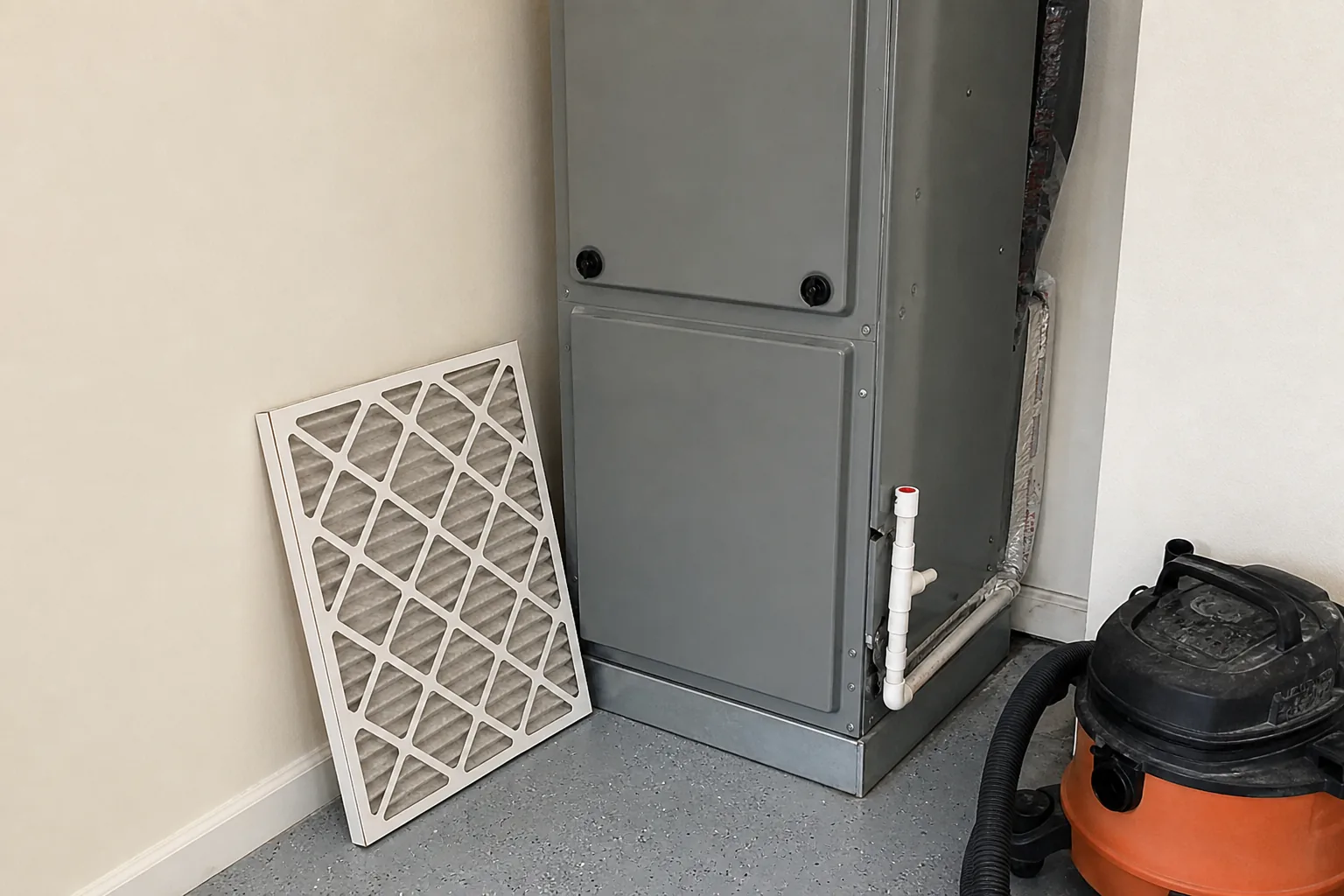
Pollen carryover is real. April pollen in Foley is heavy, and the carryover into May and June drain-line biofilm is a Foley-specific problem worth flagging. The clamp meter won't catch a clogged drain — that's a separate check. Pull the cap off the condensate drain access port, look for standing water, and if you see slime, blow it out with a wet/dry vac before the system runs hard. The companion drain-line post for Fairhope walks through the timeline; the Foley version of that timeline runs about the same speed because of the pollen-and-humidity overlap.
The straight answer
If you're a Foley homeowner with an 8 to 12-year-old single-stage condenser and you're willing to spend $20 and 30 minutes on a Saturday morning, you can catch most pre-summer problems before they become emergencies. The ones you can't catch — refrigerant leaks, internal compressor wear, blower motor bearings — are the ones HVAC techs have the right tools for, and those don't usually fail without warning anyway.
I'll do the inspection if you'd rather not — call 251-383-HVAC for a pre-summer tune-up or a $79 diagnostic-only visit, both with photos and a written report. Use the online scheduler or call.
The information is available. The homeowners who use it sleep through the heat waves. The ones who don't end up on the early-morning emergency rotation. That's the only difference.
FAQ
- Is a cheap clamp meter actually accurate enough to diagnose an HVAC capacitor?
- For the readings described here — capacitor microfarad value, contactor amp draw, and supply voltage — yes. The cheap clamp meters from any auto parts store have plenty of accuracy for go/no-go decisions. They won't replace the precision instruments used for refrigerant work, but they're more than sufficient for the three numbers a Foley homeowner needs to know whether to call in May or wait until July.
- Why would an HVAC company tell homeowners how to do their own diagnostics?
- Because the homeowners who do the basics themselves are the ones who call with real problems instead of false alarms. Truck time is the constrained resource, and informed customers make the route more efficient. Trust earned by giving real information beats trust earned by withholding it.
- What's the actual risk of a homeowner pulling the disconnect and reading these numbers?
- Lower than most people think if you follow the disconnect-pull and capacitor-discharge steps in order, higher than most people think if you skip them. Capacitors hold a charge after the system is off — that charge is what causes most homeowner injuries on this kind of work. If you're not comfortable pulling the disconnect, discharging the capacitor with an insulated screwdriver across the terminals, and confirming zero voltage with the meter, skip the DIY check and just call for the $79 visit. No one will think less of you.
- If I find a bad number, how fast should I call?
- Same week, before peak load hits. A weak capacitor reads okay at 75°F outdoor temperature and fails at 92°F. A pitted contactor will start the system in May and refuse to start it in July. The whole point of doing this in May is buying yourself the comfortable scheduling window before the calendar fills with emergency calls. Use the [online scheduler](/schedule/) and pick a slot that works for you.
Need this handled?
Straight to the service page for your town — pricing, local details and a form that reaches a technician.
More from Pre Summer Inspection

ACExperts HVAC
We Take The Heat So You Don't Have To
Fast, honest heating and air service across Baldwin County. Speak with a technician and get on the schedule today.