
5 Pre-Summer Mistakes Bay Minette Homeowners Keep Making
5 pre-summer HVAC mistakes Bay Minette homeowners make — a quick self-test to see if your system is ready for June, plus what to fix first and in what order.
Published 2026-06-09 · Updated 2026-06-09
Author: Landon Jahnke | ACExperts251
Reviewed by: Landon Jahnke · Owner · Alabama HVAC License AL #16117 · EPA 608 Certified
Score yourself, 0 to 3, on each of these:
- Filter age. 0 = changed within the last 30 days. 1 = within 60 days. 2 = within 6 months. 3 = no idea, possibly the original from when the system was installed.
- Condensate drain check this year. 0 = yes, flushed it this spring. 1 = a tech did it within the last year. 2 = sometime in the last five years. 3 = what's a condensate drain.
- Refrigerant date. 0 = current decade, R-410A or newer. 1 = system installed 2010-2015. 2 = 2005-2010. 3 = no clue, or system says R-22 on the data plate.
- Outdoor coil cleanliness. 0 = rinsed it last month. 1 = within the last year. 2 = a few years ago. 3 = there's a wasp nest in there.
Total your four numbers. You're somewhere between 0 and 12.
If you're at 0 to 4, you're ahead of most Bay Minette homes I'll see this June. Skim the rest for the parts that apply.
If you're at 5 to 8, you're in the middle of the pack. There's one or two things to handle before the heat lands.
If you're above 8, you're in the bottom quartile and you have homework. Don't panic — none of these are hard. They're the ones people skip year after year because they don't seem urgent until the day they are.
Here are the five mistakes the scorecard catches, in the order I'd fix them.
Mistake 1 — The filter that's been in there for nine months
This is the #1 most common cause of preventable summer service calls in Bay Minette, and it's not close. A loaded filter strangles airflow across the indoor coil. Strangled airflow means the coil temperature drops below dewpoint to the point where moisture freezes on the coil surface. The frozen coil chokes airflow further, runtime extends, and within a few hours you're calling because the system "isn't cooling" — which is technically true but masks the actual cause.
In a typical 1970s ranch in Old Town Bay Minette or one of the homes around the courthouse square, the filter sits behind the return-air grille in the hallway ceiling. It's easy to forget. Set a recurring 30-day reminder on your phone for May through October. A 16x25x1 pleated filter runs about $8 at any hardware store; a four-pack of better-quality MERV-8 filters runs $25 to $35. That's a year of supply for under $40.
If you've got a 4-inch or 5-inch media filter housing at the air handler, the interval stretches to 90 days, but the principle is the same — put it on a reminder, not on memory.
Mistake 2 — The condensate drain nobody's flushed
Bay Minette summer humidity is real. A 3-ton residential AC pulls a half-gallon to a gallon-and-a-half of water out of the indoor air per day during peak cooling. That water has to go somewhere, and the somewhere is a small white PVC pipe that runs from the air handler's drain pan to an outside termination — usually near the foundation, sometimes capped with a tee fitting.
The pipe runs internal biofilm. Algae, bacterial slime, the occasional dead insect. Over a year or two, that biofilm narrows the drain bore until water can't move through it fast enough. The pan overflows. If your air handler is in the attic — which is common in retrofitted-central-AC homes around Stockton Road and out toward Tensaw Heights — the overflow comes through your ceiling.
Fix: once a year, before cooling season, attach a wet-vac to the exterior drain outlet and pull suction for 30 seconds. You'll hear the line clear. Then pour a cup of distilled white vinegar (not bleach — it eats the PVC primer over time) down the access port at the air handler. Replace the cap. That's it. Five minutes, $3 in vinegar, and you've prevented one of the highest-cost preventable summer service calls in the trade.
If you can't access the air handler safely or you don't see an access port, that's a service call. The preventive maintenance service covers it.
Mistake 3 — The refrigerant from another era
Pull up the data plate on your outdoor unit. Side panel, usually, sometimes back. Read what it says under refrigerant.
If it says R-410A, you're fine. That's the standard from 2010 through 2024.
If it says R-454B or R-32, you're newer — installed late 2024 or after, under the current EPA refrigerant rules.
If it says R-22, you have a problem. R-22 was phased out of new equipment manufacturing in 2010 and out of import altogether in 2020. The refrigerant still exists, but it's expensive — recovered and recycled stock pricing has tripled in the last few years. A leak repair on an R-22 system that needs even a few pounds of charge can run $600 to $1,000 just for the refrigerant. A bigger leak makes the system uneconomic to recharge.
For a Bay Minette homeowner running an R-22 system, the question isn't whether to replace, it's when. The system is running on borrowed time and the math is: every dollar you spend on it now is a dollar you don't get back. The Bay Minette gas-vs-heat-pump post walks through the replacement options for this market specifically.
The honest counsel is: don't put more than $400 into an R-22 system, and start budgeting for the replacement. That's a real number — call us for a free replacement estimate and we'll show you the financing math.
Mistake 4 — The outdoor unit nobody's looked at since installation
Walk out to your condenser. Look at it.
What you're looking for:
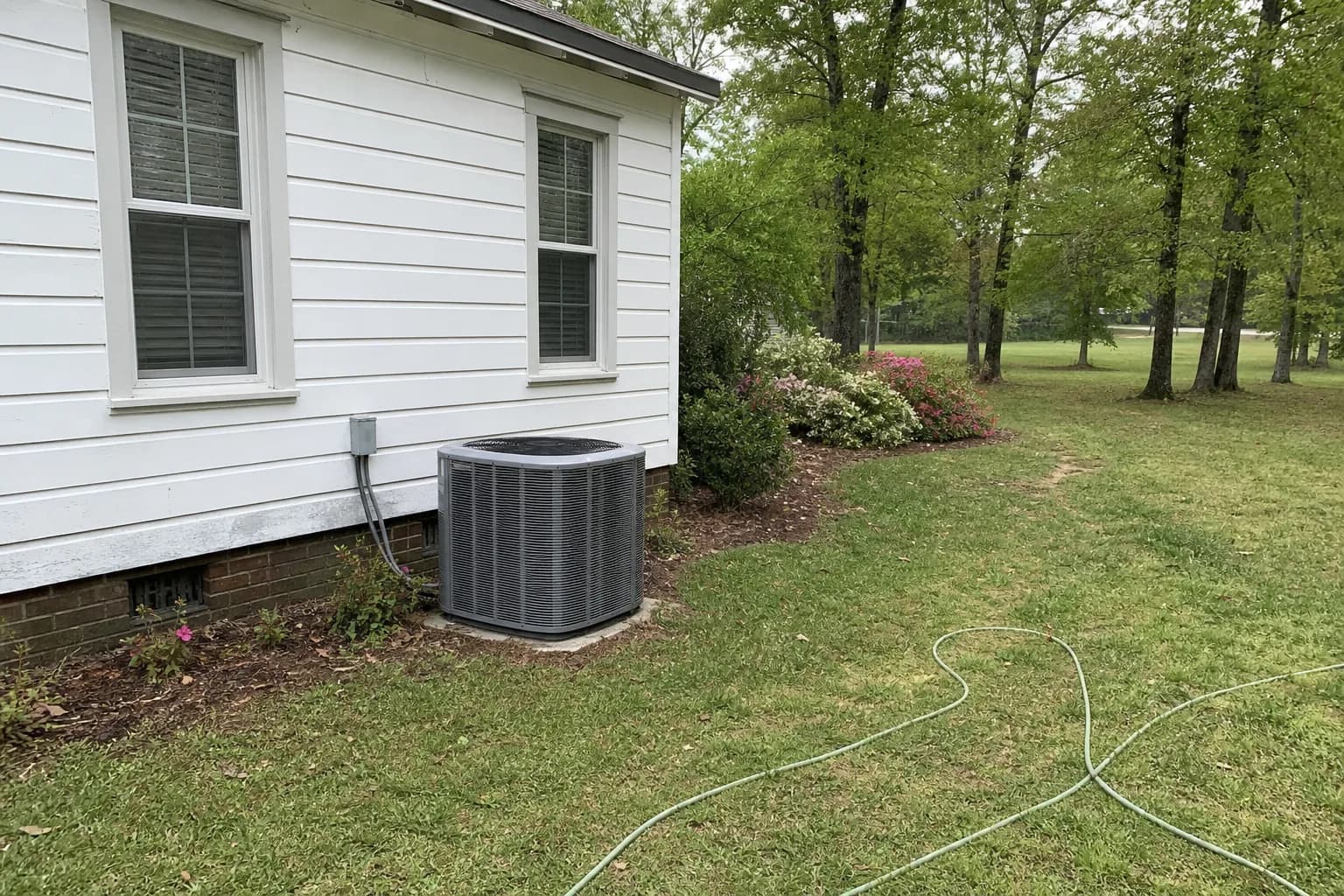
- Pine straw, leaves, lawn clippings packed into the bottom grille. This blocks airflow into the cabinet. Pull it out by hand or with a shop vac. Don't pressure-wash it.
- Fins crushed or bent. Older homes in Hand Park and Pinewood Estates take occasional weed-eater damage to the fins at the base of the unit. A fin comb (auto parts store, $8) straightens them. Bent fins reduce capacity proportionally to the area affected.
- Visible corrosion or white powder. Bay Minette is far enough inland that salt-air corrosion isn't the dominant issue, but moisture, fertilizer overspray, and basic oxidation still happen. White powder on the aluminum fins is mild and rinses off. Black streaking or copper showing through is more serious — that's a tech call.
- Wasp nests, mud dauber tubes, fire ant colonies. Open the top grille and look down into the cabinet. Anything alive in there gets handled before the season starts. If wasps, address from outside the cabinet, not by reaching inside.
- Vegetation closer than 2 feet on any side. Trim it back. A condenser starved of airflow runs hot and degrades faster.
A garden-hose rinse from the top down, fan-spray nozzle, takes ten minutes and clears the bulk of accumulated debris. Do it on a cool morning when the unit isn't running.
Mistake 5 — Skipping the duct conversation entirely
This is the one most Bay Minette homeowners don't think of as a pre-summer item, and it's the one that costs the most over the life of the home.
A meaningful share of homes in Bay Minette had central AC retrofitted in the 1970s or 1980s, after the home was already built. The ductwork that delivers the air was installed through whatever attic or crawl-space access existed at the time, often by a sub on a cost-plus job, often using sheet metal with fiberglass duct board joints sealed with cloth tape. Forty-plus years later, that tape has dried, the joints have shrunk apart, and a measurable portion of conditioned air — typically 20 to 30 percent — never reaches the rooms it's supposed to.
You feel it as: the back bedroom that never cools, the system that runs all afternoon to drop two degrees, the bill that ticks up every year while the equipment is the same equipment. Those are duct symptoms, not equipment symptoms.
A duct inspection takes about 90 minutes for a typical Bay Minette home. We pull the access panel, we look at joint condition, we measure static pressure, and we tell you whether you've got a leak problem, an undersized-return problem, or an insulation problem — or some mix. The fix range is wide: $400 to $800 for targeted joint sealing, $1,500 to $3,500 for partial replacement, $4,000 to $7,000 for a full duct system replacement. Done correctly, the comfort improvement is more meaningful than a new condenser would be.
The Foley duct conversation covers the same calculus in a slightly different market context. The principle is the same: in older inland Baldwin County homes, the duct system is often the limiting factor, not the equipment.
What the scorecard is really telling you
If you scored above 8, you're not a bad homeowner. You're a normal one. Most people don't think about HVAC until something's wrong, and most equipment is forgiving enough that the consequences take a while to show up. The Bay Minette housing stock skews older, the equipment runs hard from May through October, and the cumulative wear from skipped maintenance compounds quietly until something breaks at the worst possible time — usually a Saturday afternoon in July with the in-laws coming for dinner.
The fix sequence is the one above: filter, drain, refrigerant date, outdoor unit, ducts. None of those are hard. The first three are homeowner-doable in an afternoon. The last two might need a tech, and we route Bay Minette regularly — call us for a pre-summer tune-up and we'll handle the lot.
A couple of cluster reads that tie in: the Stockton pre-summer findings post covers what an actual diagnostic walkthrough looks like in a similar inland market, and the Foley early-catch case study shows how a small early intervention saves real money. Both worth a skim.
Score yourself again at the end of June. The number should be lower.
FAQ
- How often should I be changing the filter in a Bay Minette home in June through September?
- Every 30 days during the cooling season for a 1-inch pleated filter. If you're running a 4-inch or 5-inch media cabinet (the kind that sits in a dedicated filter housing at the air handler), the interval stretches to about 90 days. Over 13 years working Baldwin County HVAC, the cleanest indoor coils I've seen are in homes running media cabinets on a calendar reminder — once you put it on autopilot, it actually happens.
- What's a condensate drain and why does it matter?
- Every central AC pulls moisture out of the indoor air during cooling — sometimes a gallon or more per day in Bay Minette summer humidity. That water collects in a pan under the indoor coil and drains out through a small PVC line to the exterior. When the line clogs (which it does, because biofilm builds up inside it), the pan overflows. In a Bay Minette home with the air handler in the attic, that overflow ends up coming through your living-room ceiling. The fix is a yearly flush — five minutes with a wet-vac at the exterior outlet and a cup of distilled vinegar poured down the access port.
- How do I know how old the refrigerant in my system is?
- The refrigerant doesn't age, but the equipment does, and the type of refrigerant tells you the rough generation. Equipment installed before about 2010 typically uses R-22 (Freon), which has been phased out — replacement charges are expensive and parts availability is shrinking. Equipment from 2010 forward uses R-410A, and equipment installed from late 2024 forward uses R-454B or R-32 under the new EPA rules. Look at the data plate on the outdoor unit — it lists the refrigerant type. If it says R-22, you're running on borrowed time.
- Wasps in the outdoor unit — how serious?
- Pretty serious. A wasp nest inside the cabinet can block the condenser fan, foul the contactor, and create a bite hazard for whoever opens the unit next (which is usually your tech, on a service call you didn't expect). Walk around the unit before each cooling season, look up under the top grille, and if you see a nest, address it before we arrive. Don't spray pesticide directly into the cabinet — that gets sucked into the coil and into the airstream when the system runs.
Need this handled?
Straight to the service page for your town — pricing, local details and a form that reaches a technician.
More from Pre Summer Inspection

ACExperts HVAC
We Take The Heat So You Don't Have To
Fast, honest heating and air service across Baldwin County. Speak with a technician and get on the schedule today.