
Why Orange Beach Labor Day Vacation Rentals Need a Coil Rinse
Step into a Gulf-front Orange Beach condo the Tuesday after Labor Day and three indicators point at one fix. What a coil rinse does, why it's the deadline, the cost.
Published 2026-09-02 · Updated 2026-09-02
Author: Landon Jahnke | ACExperts251
Reviewed by: Landon Jahnke · Owner · Alabama HVAC License AL #16117 · EPA 608 Certified
Step into a Gulf-front Orange Beach condo on the Tuesday after Labor Day. Three things line up almost every time.
Step 1, the great-room thermostat: 76°F set, room is 79°F actual — a 3° gap that wasn't there in May.
Step 2, the condenser closet: salt film visible on the cabinet door.
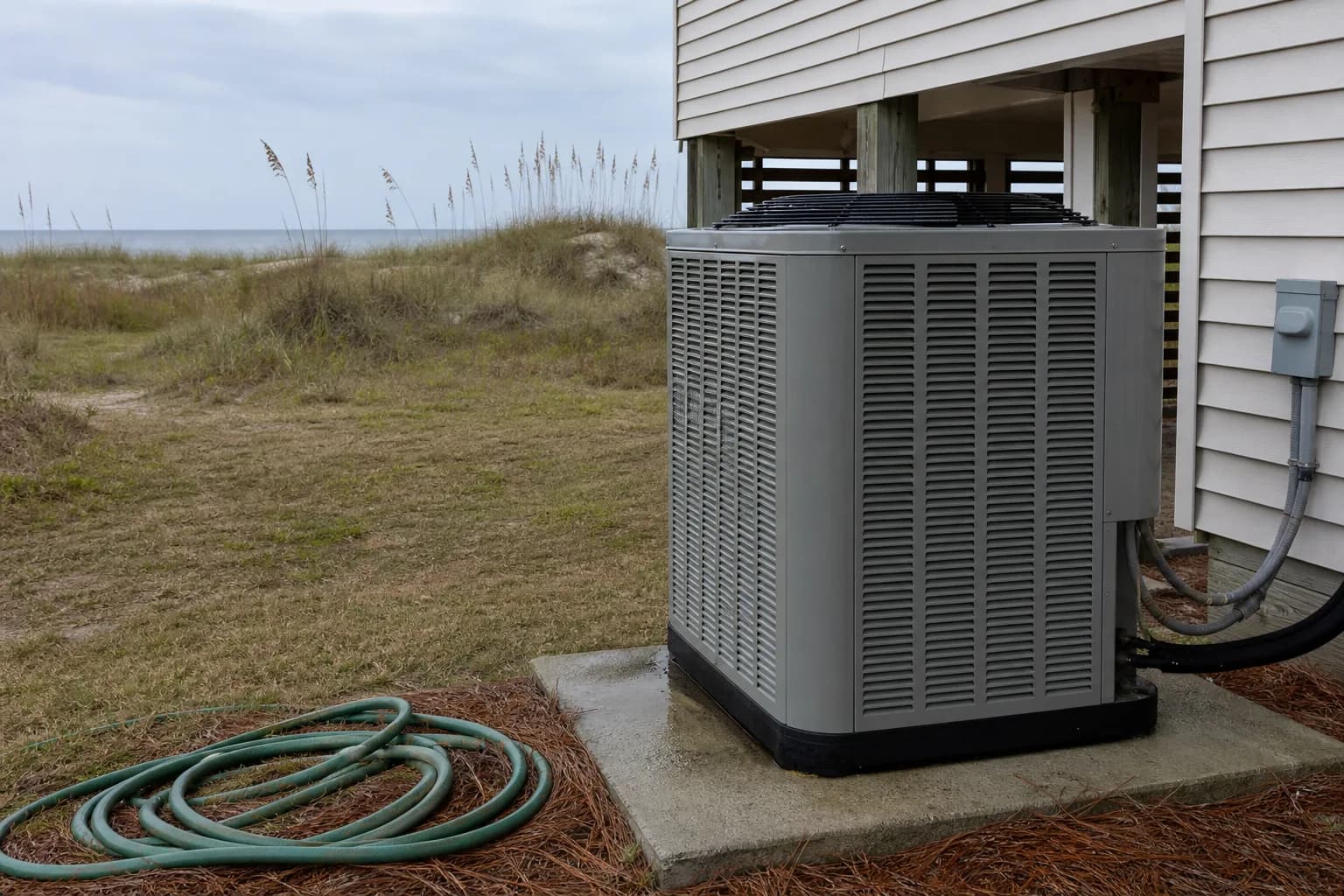
Step 3, the balcony where the outdoor unit sits: aluminum fins coated in white salt deposit, ~25% airflow loss.
The whole unit walked through, 6 minutes, three indicators all pointing at one fix.
Here's what the coil rinse does and why Labor Day is the deadline.
The setpoint gap
That 3° gap between thermostat setpoint and actual room temperature is the surface symptom of a deeper problem. The thermostat is calling for cooling. The system is running. The compressor is engaged. Cool air is being delivered through the supply registers. But the room is sitting 3° above setpoint and not catching up.
Three things can produce that gap on Orange Beach Gulf-front equipment, and the post-Labor Day version is almost always the third.
The first is undersizing — the equipment was specified too small for the heat load, and it's running flat-out without ever catching the room. Possible but rare on professionally-installed condo equipment that's been performing fine all summer.
The second is refrigerant charge — the system is running low on charge from a slow leak, and capacity has dropped. Possible, and worth checking.
The third is condenser airflow restriction — the outdoor coil is fouled and the system can't reject heat efficiently. The compressor runs the same, the indoor coil runs the same, but the outdoor coil can't dump its heat to the outside air at the rate the system was designed for. The result is reduced cooling capacity at the indoor coil and a setpoint gap that shows up exactly when ambient temperatures are highest — which is exactly the post-Labor Day window in Orange Beach.
From 13 years of working Baldwin County HVAC, the Tuesday-after-Labor-Day pattern on Gulf-front condos is so consistent that I diagnose it by walking around the equipment before I touch a gauge.
What's actually on the coil
White salt deposit on aluminum fin stock isn't decorative. It's a measurable physical layer that fouls airflow and degrades heat transfer. By post-Labor Day on a Gulf-front condo, the layer typically includes:
Sea salt aerosol. Sodium chloride deposits from Gulf spray, accumulating in the fin pack since the last rinse. The salt itself is hygroscopic — it pulls moisture from the air and creates a continuously damp film at the fin surface, which holds dust and organic matter against the aluminum.
Pollen and organic debris. Spring pollen counts are heavy on the Gulf Coast, and the condenser fan pulls airborne pollen into the fin pack across April through June. By Labor Day, that organic matter has cemented into the salt film as a unified deposit.
Hydrocarbon residue. Beach-going Gulf-front properties get a measurable hydrocarbon load from boat exhaust, road traffic, and grill smoke through the season. The residue is light individually but combines with the salt and pollen layer.
Drywall and construction dust in newer or recently-renovated units. The condenser fan pulls air from a 270-degree pattern around the unit, which means anything aerosolized in that radius (interior renovation work, balcony repainting, neighboring unit work) lands in the fin pack.
The combined deposit is what creates the visible white-and-gray crust on the fin face. By post-Labor Day, the deposit on a Gulf-front Orange Beach unit typically covers 15 to 35 percent of the fin face area, depending on exposure and rinse history. A 25 percent reading is right in the middle of that band.
What the rinse actually does
A professional coil rinse is not a hose-down. It's a structured cleaning that takes 35 to 60 minutes and follows a specific sequence.
Electrical isolation. The condenser disconnect is opened and tagged out before any water touches the equipment. Live equipment plus water plus salt is a hazard combination, and the rinse protocol treats it accordingly.
Cabinet inspection. Before the rinse starts, the tech opens the cabinet, inspects the contactor and capacitor for visible salt or moisture intrusion, and addresses anything that needs attention before water is introduced.
Surfactant application. A coil-specific cleaning solution is applied to the fin pack — typically a non-acidic, biodegradable surfactant designed to lift salt and organic deposits without damaging aluminum. The surfactant dwell time is 5 to 10 minutes.
Low-pressure rinse from the inside out. Water is applied from inside the cabinet through the fin pack toward the outside, which is the opposite direction the deposit accumulated. Outside-in rinsing drives debris deeper into the fin pack; inside-out rinsing flushes it clear. Pressure is kept low (garden-hose nozzle pressure, not pressure washer) to avoid bending the aluminum fins.
Drain check and electrical reseat. The condensate drain is checked for clear flow, the cabinet is reassembled, and the disconnect is re-energized. The system is restarted and observed for normal operation.
The whole protocol is about 45 minutes for a typical condo condenser. The visual difference is dramatic — the fin face goes from white-gray crust to clean aluminum, and you can see daylight through the pack from any angle. The performance difference is measurable: the indoor coil regains 15 to 22 percent of lost capacity, the compressor amp draw drops back to baseline, and the setpoint gap closes within 30 to 45 minutes of system operation.
For the broader Orange Beach maintenance schedule context, the Orange Beach salt-air maintenance schedule post covers how the coil rinse fits into the larger quarterly maintenance protocol, and the contactor failure post covers a separate but related failure mode that the same quarterly visit catches before it becomes a midnight call.
Why Labor Day specifically
The post-Labor Day window is the single most important coil rinse of the year for an Orange Beach Gulf-front rental, and the reason is operational rather than seasonal.
Peak occupancy concentrated June through August. Most Orange Beach rental calendars run heaviest from Memorial Day through Labor Day — three months of high occupancy, high indoor heat load (additional bodies, longer cooking, more lighting), and continuous cooling demand. The system has run more in those three months than it will in the entire rest of the year combined.
Peak ambient temperature. July and August Orange Beach ambient temperatures regularly hit 92 to 96°F with high humidity. The condenser is rejecting heat to that air, which means the temperature differential the system has to work across is at its annual maximum. Any coil fouling shows up most dramatically when the system is working hardest.
September is still a rental month, but the schedule is softer. Post-Labor Day occupancy in Orange Beach drops meaningfully — fall rental rates are lower, bookings are spread further apart, and there's typically a 1-to-3-day vacancy window between guests where a coil rinse fits cleanly. The same rinse is much harder to schedule in mid-July when every unit is booked back-to-back.
The November shoulder is too late. A homeowner who waits until November to rinse the coil has paid for two months of degraded capacity (September and October still run cooling in Orange Beach), missed the September-November rental window with a system at reduced efficiency, and let the salt deposit harden further into the fin pack. The post-Labor Day rinse catches the system at the optimal point in the calendar.
For Orange Beach rental properties operating on a tight booking calendar, the coil rinse schedule has to fit the rental schedule, and the post-Labor Day window is the cleanest fit of the year. Coordinating with property management on the timing is part of the standard call.
The financial math
A representative Gulf-front Orange Beach condo: two-bedroom, 1,200 square feet, single condenser. Here's how the math typically works out comparing a no-maintenance year to a quarterly-rinse year.
No-maintenance year:
- August electric bill: ~$387
- Indoor temperature consistently 2-4° above setpoint
- Likely 1-2 guest complaints about cooling, with a partial refund or two: ~$185
- A reasonable chance of one emergency mid-rental service call (compressor lockout from over-running): ~$345
- Total cooling-related cost above baseline: roughly $530+ for the season
With quarterly rinses:
- August electric bill: $298 to $312
- Indoor temperature at setpoint within 1°
- Zero guest complaints related to cooling
- Quarterly rinse cost across the year: roughly $700-800 annual maintenance
- Net: maintenance cost minus electricity savings minus refund avoidance minus emergency avoidance is roughly break-even to a small net gain on year one — and the operational stress reduction (no emergency calls, no guest complaints, no mid-rental refunds) compounds beyond the dollar math.
A rental owner running 4-8 Gulf-front units sees the math tilt further toward maintenance every year, because the emergency-call avoidance compounds across the portfolio.
For the comparable inland math on a different failure mode, the Spanish Fort short-cycling post and the Foley July 4 vacation rental pre-check walk through the same operational-cost framing on different equipment failures.
What rental owners specifically should ask their HVAC contractor
Three questions to surface whether your contractor is actually doing the rinse versus billing for a checklist visit.
"What's the surfactant you use, and is it non-acidic?" Real coil rinses use a labeled, non-acidic, aluminum-safe surfactant. Acid-based cleaners work faster but corrode aluminum fins over time, especially in salt-environment equipment. The contractor who can name the product (and ideally show you the bottle) is doing real work. The contractor who hedges is hosing.
"Do you take photos of the coil before and after the rinse?" Most coastal-experienced contractors do this routinely, both for their own quality verification and for property management documentation. A before-photo of a 25-percent-fouled fin pack and an after-photo of a clean fin pack is the most direct evidence of rinse performance. ACExperts includes before-after photos on rinse work orders for rental properties.
"What's your protocol if you find contactor or capacitor wear during the rinse visit?" A real coil rinse visit catches adjacent issues — contactor pitting, capacitor microfarad drift, fan motor bearing noise, condensate drain biofilm. The contractor's protocol when those show up tells you whether the rinse is part of a maintenance program or a one-off service. Plan-level contractors will surface findings, document them, and recommend or schedule the follow-up work. Drive-by contractors will charge for the rinse and miss the developing issue that fails three weeks later.
For broader Orange Beach rental operations context, the holiday refund avoidance post covers how a single proactive visit prevents a much larger downstream cost — the same logic applies to the coil rinse window.
Booking the post-Labor Day rinse
The Orange Beach Gulf-front rinse calendar fills fastest from the Tuesday after Labor Day through the third week of September. Comfort Plan members and rental properties where the rinse is built into a maintenance schedule get priority; single-rinse calls drop into the open slots.
Single-rinse pricing includes photos and a written report — same number whether the unit is Gulf-front, bay-front, or second-row. Multiple units in the same building scheduled in one visit get a per-unit discount on the second and subsequent units.
Comfort Plan members ($20/month or $240/year) get two tune-up visits per year built into the membership — for a Gulf-front rental, those visits are typically scheduled in spring and post-Labor Day, with coil rinse as part of the standard scope. Members also get $0 service fees on emergency calls, no overtime fees, and 10% off any repairs.
Call 251-383-HVAC to book the post-Labor Day rinse, or to discuss the Comfort Plan for Orange Beach Gulf-front coverage. The Tuesday-after-Labor-Day window closes fast — and the math on the rinse only works if it happens before the September fall rentals start.
FAQ
- How often should an Orange Beach Gulf-front condo get a coil rinse?
- Quarterly is the coastal cadence we recommend for direct Gulf-front exposure — every 90 days, with the post-Labor Day rinse being the most important of the four because it follows the heaviest occupancy and runtime period of the year. Quarterly works because it stays ahead of the salt accumulation curve; salt deposit becomes visible to the eye around 60 to 75 days of exposure, and electrical penalty (efficiency loss, capacity loss) starts climbing past 90 days. Bay-front and second-row units can typically run a semi-annual cadence (April and October) without significant penalty. Inland Orange Beach properties — Bear Point Estates, parts of Ono Island away from the water — can run annual.
- Can I rinse the coil myself with a garden hose?
- Light rinses with plain water are fine and actually helpful between professional services, but they don't replace the full professional rinse. Three differences: a professional rinse uses a coil-specific surfactant cleaner that breaks the salt-and-organic film a plain water rinse leaves behind, the rinse is performed with the unit electrically disconnected at the disconnect (homeowner rinses on live equipment carry electrical risk and can drive moisture into electrical components), and the technician inspects fin condition, refrigerant pressures, and electrical components during the visit — work the homeowner with a hose isn't doing. The honest answer is the homeowner rinse extends time between professional visits but doesn't replace them.
- What's the actual efficiency loss from a salt-coated coil?
- Measurable and significant. A condenser coil with 20 to 30 percent fin coverage from salt and organic deposit shows roughly 15 to 22 percent capacity loss and a corresponding rise in compressor amp draw. In Orange Beach summer conditions, that translates to a system that runs 25 to 40 percent longer to hit setpoint, with about 18 to 28 percent higher electric usage on cooling. On a typical Gulf-front condo with $280 to $340 monthly summer cooling cost, that's $50 to $95 per month in additional cost, every month, until the rinse happens. Across a five-month cooling season the math is $250 to $475 in extra electricity. A professional rinse pays for itself well before the next season.
- Can the rinse happen with guests in the unit?
- Yes, on most condo configurations. The outdoor condenser and the rinse work happen at the equipment location — typically on the balcony, in a utility closet, or in a shared mechanical space depending on the building. Guests inside the unit experience a brief AC cycle interruption (15 to 25 minutes) while the equipment is electrically isolated for the rinse. Most rental management companies coordinate the rinse during guest checkout and check-in turnover when the unit is unoccupied; the work fits inside the cleaning window without conflict. Scheduling can run either way depending on what works for the management company.
Need this handled?
Straight to the service page for your town — pricing, local details and a form that reaches a technician.
More from Labor Day

ACExperts HVAC
We Take The Heat So You Don't Have To
Fast, honest heating and air service across Baldwin County. Speak with a technician and get on the schedule today.