
5 Labor Day Mistakes Daphne Homeowners Keep Making
5 Labor Day HVAC mistakes Daphne homeowners make heading into the season's last heat — the oversights that turn a holiday weekend into a no-cooling emergency.
Published 2026-09-07 · Updated 2026-09-07
Author: Landon Jahnke | ACExperts251
Reviewed by: Landon Jahnke · Owner · Alabama HVAC License AL #16117 · EPA 608 Certified
Over 13 years working Baldwin County HVAC, the same five mistakes show up in Daphne homes every Labor Day. They aren't dramatic and they aren't expensive to fix in September — but they're reliably what turns into the November and December emergency calls I see every year. Number one is filter neglect during peak rental crossover. Number two is condensate path biofilm carryover. Number three is thermostat schedule lag heading into the cooling-to-heating shoulder. Number four is outdoor-coil debris from the late-summer pollen surge. Number five is ignoring the early electrical-warning signs that show up almost exclusively in the post-Labor-Day weeks.
Here's the supporting detail behind each one.
Mistake 1: Filter neglect during peak rental crossover
The filter situation in Daphne homes around Labor Day is uniquely bad for reasons that don't apply to other Baldwin County markets.
Daphne households see a real population swing across the holiday weekend. Vacation rentals in Lake Forest and along Scenic 98 turn over heavily. College students head back to Tuscaloosa, Auburn, and Mobile, often with parents returning from drop-off trips. Extended families gather for the long weekend. Pet visitors come with the houseguests. Lawn crews finish the late-summer growth round. The household dust and dander load across a typical Daphne home spikes from late August through the first week of September.
Filters that were marginal heading into the weekend come out of it severely loaded. A 30-day filter installed early in August is at day 30 by Labor Day weekend and routinely runs to day 40-45 before homeowners realize it. By that point, airflow restriction is causing measurable performance loss, indoor humidity is climbing, and on the warmer days the runaway-freeze risk on the indoor coil has gotten real.
The fix: Replace the filter the Tuesday after Labor Day. Set a calendar reminder. For homes with pets or regular visitor turnover, run a 60-day filter at most regardless of what the manufacturer prints on the box.
Mistake 2: Condensate path biofilm carryover
By Labor Day, your condensate drain line has been moving water continuously since early May. That's roughly four months of moisture passing through a path that's effectively a long, dark, slightly warm tube with a slow steady drip.
The biofilm that accumulates in that environment — algae, bacterial colonies, and the organic debris that drifts down through the air handler — builds slowly through the cooling season. By early September it's usually a partial restriction. By October, when cooling demand drops and the line flow slows, the slower flow gives the biofilm a chance to consolidate, and what was a partial restriction becomes a full blockage.
The full blockage hits one of two ways. Systems with float safety switches shut down — the homeowner discovers it on the first warm fall day when the AC won't run. Systems without float switches overflow into the drain pan and through the ceiling below — which is the call we get every October from somebody with a brown stain spreading on a hallway ceiling.
The Mobile Bay humidity profile in Daphne pushes biofilm formation faster than drier markets. The heavier load through summer means more accumulation. And many Daphne homes have air handlers in attic locations where condensate runs through long horizontal sections that are particularly prone to slow accumulation.
The fix: Pour a cup of distilled white vinegar into the condensate drain access (most air handlers have a small T-fitting for this purpose) once at Labor Day, again at Thanksgiving, again in February. Or vacuum the outdoor end of the drain line for 60 seconds with a wet/dry vacuum. Both are free and both prevent the October failure.
Mistake 3: Thermostat schedule lag
This one's subtle and it's expensive in dollars without anyone realizing it.
Through summer, your thermostat is set to cool the house when you're home, possibly setting back 2-3 degrees overnight or during work hours. The schedule was set in May or June for summer conditions. Labor Day comes and goes and the schedule never changes — but the conditions outside changed. September overnight lows in Daphne drop into the high 60s on the cooler nights. Daytime highs are still in the upper 80s, but the diurnal swing is wider than August.
What happens with a stale summer schedule heading into September: the system is set up to cool aggressively during the day and recover from setback in the evening. On a 90°F afternoon following a 67°F overnight, the system runs a long pull-down cycle that's totally unnecessary — the house has been gently cooling all night through the building envelope, and the pull-down is fighting a load that doesn't really exist.
Smart thermostats handle this poorly out of the box if they're not learning correctly. Programmable thermostats handle it not at all. Manual thermostats with a permanent setpoint don't have the problem but waste energy in different ways.
The fix: Pull up your thermostat schedule the week after Labor Day. Tighten the setbacks. Move the morning recovery start time later (the house is already cool — recovery doesn't need to start at 5 a.m. anymore). Push setpoints up by 1-2 degrees if comfort allows.
For more on smart thermostat behavior in shoulder seasons, the Robertsdale smart-schedule savings post covers the math.
Mistake 4: Outdoor coil debris from the late-summer pollen surge
Most homeowners think about pollen as a spring problem. In Daphne specifically, late summer brings a second pollen wave — goldenrod, ragweed, and the late-blooming grasses — that hits in late August and runs through September. Combined with cottonwood seed drift and the dust that accumulates through summer thunderstorms, the outdoor condenser coil gets a fall-specific layer that's different from the spring pollen pack.
The fall layer is stickier than spring pollen because late-summer humidity has been condensing on the coil through the season. Pollen and dust mixed with condensation residue forms a film that's difficult to rinse off without intentional cleaning, and that film reduces heat transfer at the coil — which means the system runs longer cycles for the same comfort, and compressor amperage creeps up.
By the first week of September, plenty of Daphne outdoor coils are visibly dirty when looked at from above. A garden-hose rinse from the inside out (water flowing from the inside of the coil outward, not from the outside in) clears most of the layer in 5 minutes.
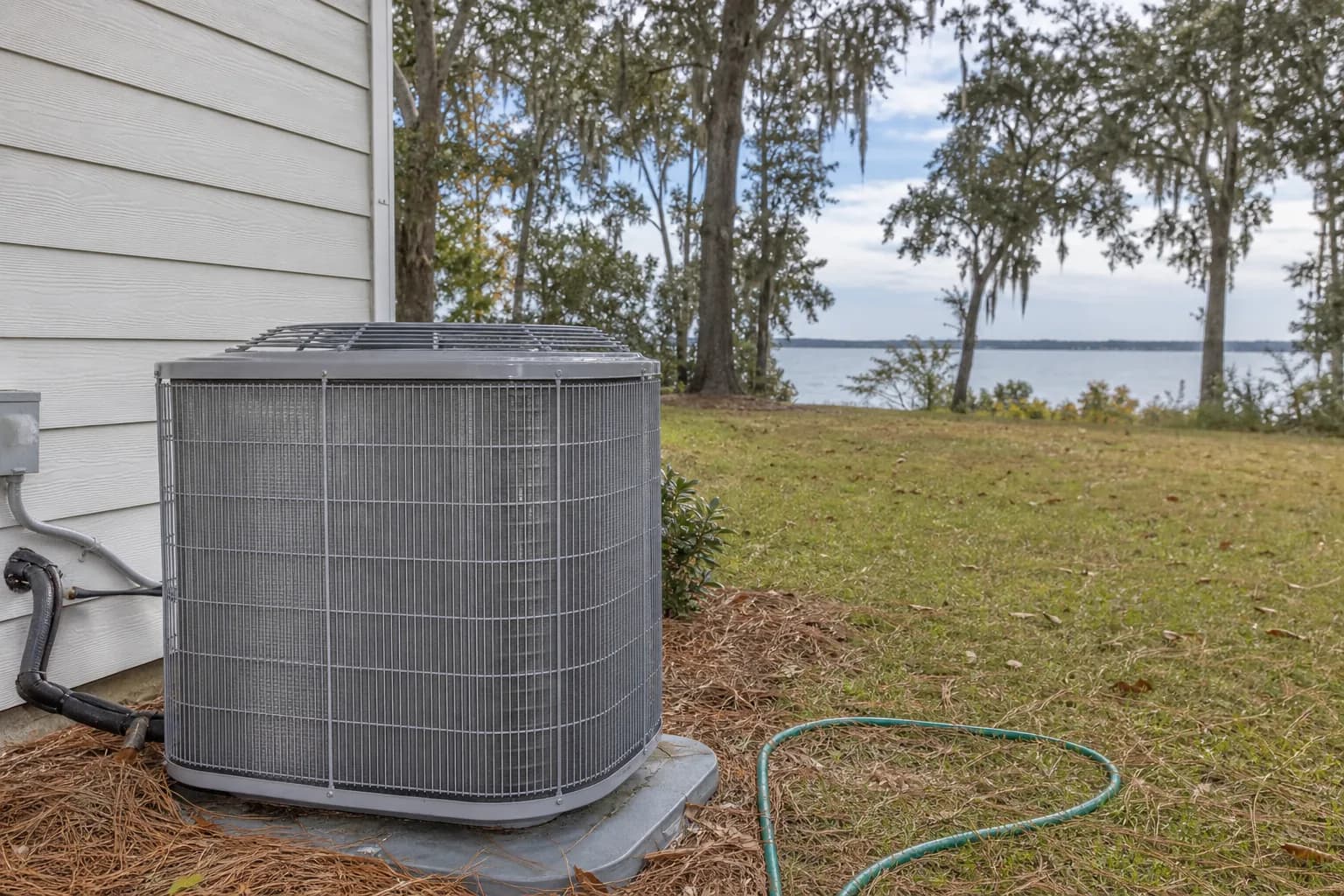
The fix: Kill the disconnect on the outdoor unit. Take the top fan grille off if you can do so safely (or just rinse from the side at an upward angle). Use a garden hose with normal household pressure — never a pressure washer, which bends the aluminum fins. Rinse the coil for 3-5 minutes from the inside outward. Restore power and run the system for a few minutes to verify normal operation. If you don't want to do this yourself, a fall maintenance visit covers it.
Mistake 5: Ignoring early electrical warning signs
The post-Labor-Day weeks are when a lot of capacitors, contactors, and start components show their first warning signs after a hard summer of cycling. Almost every winter-emergency electrical call I've ever run had warning signs the homeowner could have noticed in September if they'd been listening.
The signs:
A faint hum or buzz from the outdoor unit when nothing else is running. That's the contactor coil pulling against pitted contacts. Months from a hard failure if uncorrected.
A 1-3 second delay between thermostat call and compressor start, where you can hear the unit "trying" to start. That's a degraded run capacitor, on borrowed time.
Light flicker in the house at the moment the AC kicks on. Same root cause as the delay — capacitor degradation causing locked-rotor amperage on every start.
A breaker that's tripped once or twice over the summer with no obvious cause. Don't dismiss it. A breaker doesn't trip without reason.
These signs are quiet in September because cooling demand is dropping, but the underlying component degradation isn't going to fix itself. The system that's showing one of these signs in September is the same system that fails on a cold December night when the heat pump tries to engage in defrost mode and pulls the same locked-rotor draw the failing capacitor can't support anymore.
The fix: If you notice any of the four signs, get it checked. A capacitor replacement in September during a scheduled visit is a straightforward repair. The same component replacement during a December emergency call with no heat in the house involves displacement and waiting — much harder to live with.
For the broader pattern on electrical-component degradation, our Stapleton capacitor failure post and the Robertsdale ant-killed contactor case walk through what's happening inside the outdoor unit during these failures. The Daphne pre-summer punch list is the spring counterpart to this fall checklist, and the Daphne summer storm recovery post covers what to do when storm season has already done some damage.
What a fall maintenance visit actually does
Just to make this concrete — a fall maintenance visit includes:
- Filter inspection and replacement if needed
- Condensate drain treatment with a vinegar flush or biofilm-removal agent
- Outdoor coil rinse from the inside out
- Indoor evaporator coil inspection
- Refrigerant pressure and superheat readings to confirm correct charge
- Capacitor microfarad reading vs. nameplate (catches degradation before failure)
- Contactor inspection for pitting and corrosion
- Compressor amp draw vs. nameplate
- Blower amp draw and airflow check
- Thermostat verification and schedule review
- Heat-side preflight: igniter or defrost board operation, depending on whether you have gas heat or a heat pump
The visit takes about an hour. We document what we find and what we did with photos and written notes. Comfort Plan members ($20/month or $240/year) get two tune-ups annually included plus $0 service fees and 10% off any work that develops.
Maintenance isn't a magic trick. It's the predictable cost of catching the failures that the maintenance visit prevents, before they catch you on a cold December night.
We answer the phones during regular hours Monday through Saturday and run emergency calls around the clock, every day, including Saturdays at no extra charge. Call 251-383-HVAC to schedule.
FAQ
- Why does filter neglect spike specifically around Labor Day?
- Daphne sees a meaningful population swing across Labor Day weekend — vacation rentals in Lake Forest and along the bay see high turnover, college kids head back to Auburn or Alabama, houseguests come and go, and the household traffic and dust load shifts noticeably. Filters that were marginal in mid-August become severely loaded after the holiday weekend, especially with the late-summer pollen surge from goldenrod and ragweed in full bloom.
- What does condensate biofilm actually look like and how do I check?
- It looks like dark green-brown jelly inside the condensate drain line and pan. Algae and bacterial colonies build up wherever standing water meets organic matter. To check: locate the air handler, find the condensate drain pan, and look for discoloration in the pan or staining around the drain stub. Pour a cup of water in — if it doesn't drain promptly, you have a partial blockage. The fix at this stage is a vinegar flush or a vacuum on the outdoor end of the line.
- Is a fall maintenance visit really worth scheduling if I haven't had problems?
- For Daphne homes specifically, yes. The visit catches developing issues — capacitor degradation, contactor pitting, slow refrigerant loss, condensate drain biofilm — that are cheap to address as preventive work and expensive to address as emergency calls. The visit also documents the system condition heading into the winter heating season. Comfort Plan members ($20/month or $240/year) get two tune-ups annually included with $0 service fees.
- What does a typical fall maintenance visit cover?
- Filter check, condensate drain treatment, outdoor coil rinse, evaporator coil inspection, refrigerant pressure and superheat readings, capacitor microfarad reading versus nameplate, contactor inspection, compressor amp draw, blower amp draw and airflow check, thermostat schedule review, and a heat-side preflight (igniter or defrost board, depending on equipment). About an hour on site with written notes and photos.
Need this handled?
Straight to the service page for your town — pricing, local details and a form that reaches a technician.
More from Labor Day

ACExperts HVAC
We Take The Heat So You Don't Have To
Fast, honest heating and air service across Baldwin County. Speak with a technician and get on the schedule today.