
What an Honest Tech Charges for Father's Day Garage HVAC in Fairhope in 2026
Father's Day garage mini-split in Fairhope: a 12-point pre-installation audit, the five places DIY installs reliably fail, and what a correct system involves.
Published 2026-06-18 · Updated 2026-06-18
Author: Landon Jahnke | ACExperts251
Reviewed by: Landon Jahnke · Owner · Alabama HVAC License AL #16117 · EPA 608 Certified
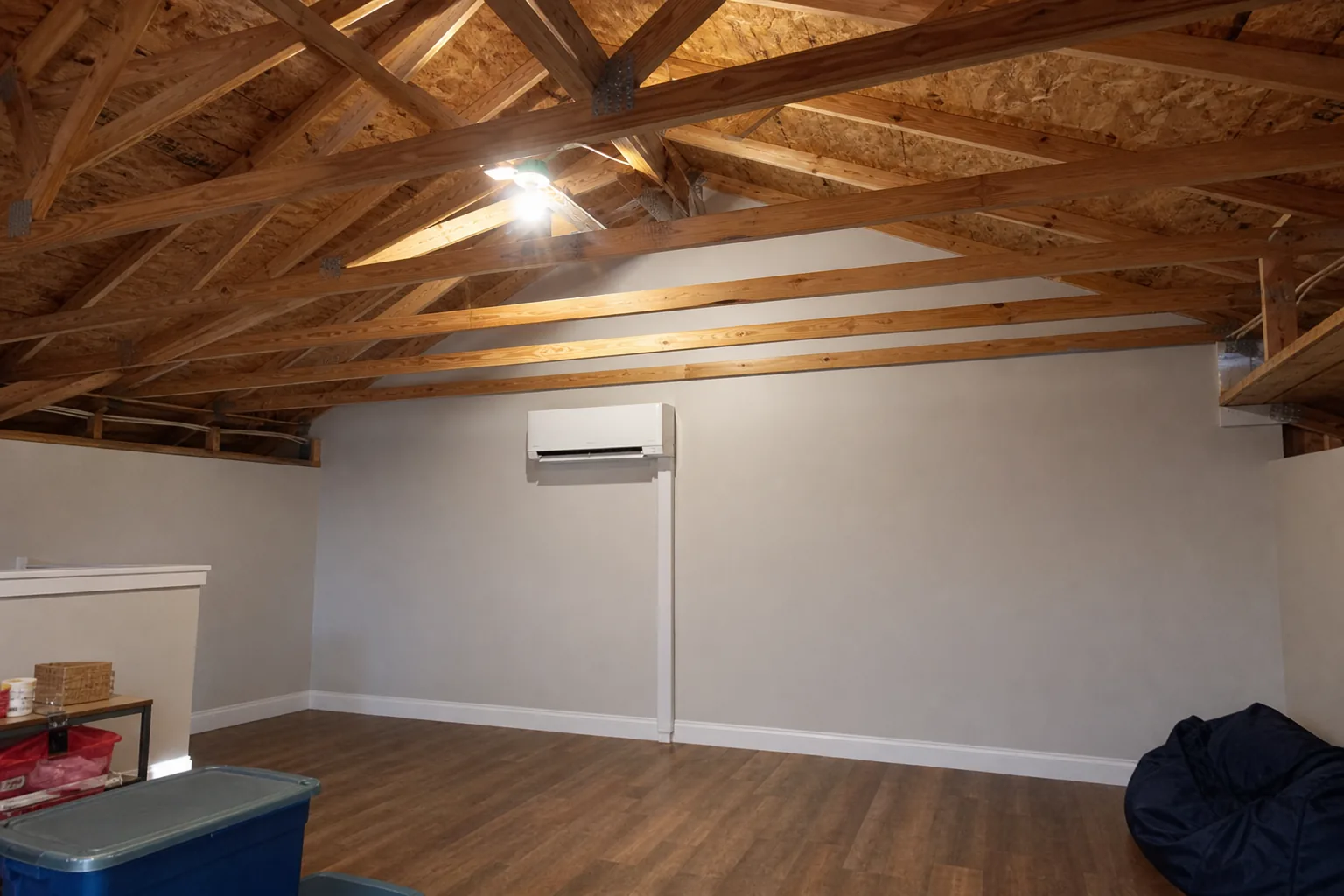
Father's Day in Fairhope brings a particular kind of project: the garage that finally gets its own AC head so it can become a workshop, a gym, a workshop-and-gym hybrid, or just a place to drink coffee without sweating through a t-shirt in July. The 12,000-BTU mini-split is the workhorse of that project, and it is also the install I see go wrong the most often when a homeowner tries to DIY it or hire it out cheap.
Over my 13 years working Baldwin County HVAC before founding ACExperts, the same five mistakes have shown up on DIY mini-split inspections, and they show up in roughly the same proportions. None of them are dumb mistakes. They are the kind of mistake a careful homeowner with the wrong tooling makes, in good faith, on a Saturday afternoon.
Here is the 12-point audit I run on a typical Fairhope garage mini-split project — and the five places the audit fails most often.
The 12-point audit
- BTU sizing for square footage
- Indoor unit clearance from ceiling
- Drain line slope of 1/4-inch per foot
- Line set length under manufacturer max
- Outdoor unit pad elevation
- Line set insulation continuity
- Refrigerant line set vacuum to under 500 microns
- Electrical disconnect within sight of outdoor unit
- Wall penetration sleeve and seal
- Indoor head levelness within 1 degree
- Outdoor unit clearance per manufacturer spec
- System commissioning under load
The four to six items that fail most often on DIY installs I get called out to inspect: drain slope, outdoor pad elevation, refrigerant-line vacuum, wall penetration, and commissioning.
The five common failures, expanded
Drain line slope. A drain that runs level after the head does not drain — it holds water, grows biofilm, and backs up during peak humidity into the pan, which then overflows. The fix once water is dripping down the wall is a re-run with proper fall and a drain catch at the lowest point. Done right at install, it is a non-event.
Outdoor pad elevation. An outdoor unit set directly on a patio slab is fine until you look at drainage during heavy rain. Water pooling at the cabinet base ages the contactor faster than it should and creates corrosion at the base of the coil that turns into a refrigerant leak years later. A composite pad set on graded gravel is the standard for a reason.
Refrigerant line vacuum. This is the dealbreaker. A mini-split line set has to be evacuated to manufacturer spec — generally below 500 microns — before refrigerant is released into it. Moisture left in the line reacts with refrigerant and oil to form acid, which destroys the compressor over a few years. The tooling required (calibrated micron gauge, two-stage vacuum pump, manifold, recovery machine) is real. "I vacuumed for ten minutes with a basic pump" is not the same thing.
This is the part of the wholesale-plus-DIY math that does not show up until year five or six.
Wall penetration. A 3-inch line-set hole through an exterior wall that is not sleeved and sealed properly wicks moisture into the wall cavity. In a Fruit & Nut historic home with original framing, that is a real wood-rot problem six months out. Done right at install, it is a 45-minute step with the correct sleeve and sealant.
Commissioning. Measure the temperature differential at the indoor head, confirm the outdoor unit is producing rated capacity, record baseline readings for warranty purposes. None of this is optional — and none of it requires expensive equipment, just discipline.
Where DIY makes sense and where it doesn't
I am not anti-DIY. Plenty of HVAC-adjacent work is genuinely fine for a competent homeowner: replacing a thermostat, swapping a filter, doing seasonal cleaning, even some duct sealing. The line gets crossed when refrigerant is part of the equation.
The micron-vacuum standard is not a contractor scam to keep DIY out. It is a physics requirement. Water and refrigerant do not get along, and the only way to know you have removed the moisture is to measure the vacuum with a calibrated gauge held to manufacturer spec. The tooling and the EPA Section 608 certification are not cheap — for a single garage install, owning that stack makes no sense.
The honest math: even if a DIY install saves you a few hundred dollars up front, if the equipment lifespan is compromised from 15 years to 6 because of moisture in the line, the loaded cost per year is worse than having it done correctly the first time.
The Fairhope-specific factors
The Fruit & Nut District has historic homes with framing that does not tolerate sloppy wall penetrations. Coastal salt air within walking distance of the Municipal Pier drives equipment selection — coastal-rated outdoor units are the standard there, not an upgrade.
Oak-canopy neighborhoods like Montrose and parts of Lakewood add a surface-water and tree-root consideration to the outdoor pad. Sometimes the standard composite pad needs to sit higher than usual.
Newer construction east of US-98 tends to have tighter envelopes and electrical service that has already been planned for higher-load equipment. Those installs go cleaner on average than the historic-home work.
Mid-life DIY culture is real in Fairhope — more capable homeowners than I see anywhere else in Baldwin County. That is a good thing. The conversations are sharper and the questions are better.
What ACExperts charges
The pricing framework is the same for every call:
- $79 service fee for a diagnostic visit, no upcharge for weekends during regular hours.
- Free estimates on replacements, including a full mini-split install quote.
- Free second opinions on quoted repairs.
- Comfort Plan ($20/month or $240/year): $0 service fees, 10% off repairs and replacements, two tune-ups per year, no overtime fees.
For a mini-split install quote, I come out, look at the access, measure the run, confirm the electrical, and put the number in writing. Equipment, line set, pad, electrical rough-in, evacuation, and commissioning are all itemized so you can see what each line of the audit costs. Specific dollar amounts depend on access, line-set length, electrical work, and whether coastal-rated equipment is appropriate — I am not going to print a fake "all-in" number here when the honest answer is "let me see it first."
The mini-split installation service page covers the equipment range and what a typical install includes.
Cluster reads worth a look
The Magnolia Springs Father's Day garage findings post covers a similar project type in a smaller-volume market. The Spanish Fort version walks through the same calculus for a different housing profile. The ductless mini-split guide for Alabama homeowners covers equipment selection in more depth than this post does.
If you want a quote on your specific Fairhope garage, schedule a consult or call 251-383-HVAC. I will run the audit, put the number in writing, and explain what each item buys.
FAQ
- What does a garage mini-split install in Fairhope actually involve?
- For a single-zone unit: properly sized equipment for the square footage, a correctly sloped condensate drain, an elevated outdoor pad, a sleeved-and-sealed wall penetration, electrical from an adequate circuit, proper refrigerant-line evacuation to manufacturer spec, and commissioning under load with documented readings. A correctly done install is a sequence of small things done right — not a single magic step. I quote in writing after a site visit because the line-set length, electrical, and access details move the number more than equipment choice does.
- Can I just buy the equipment online and pay you to install it?
- I do not do supply-only installs. Manufacturer parts warranties generally require installation by an authorized dealer using their tooling and process, so the savings on equipment usually evaporate on the first warranty-eligible failure. If you want, I will walk through the math with you against a wholesale-plus-DIY estimate and show you where the gap is.
- Why does a 1/4-inch-per-foot drain slope matter on a mini-split?
- The condensate drain on a mini-split indoor head relies on gravity. Without enough fall on the drain line, water does not move fast enough during peak humidity and the pan backs up. In Fairhope's summer humidity that backup ends up dripping down the garage wall or — worse — through the wall back into the indoor unit's electrical compartment. It is the single most common DIY install fail-point and it usually does not show up until the first really humid week of June.
- How long does a Fairhope garage mini-split installed correctly last?
- Manufacturer design life is in the 15-year range. Real-world life depends on coastal exposure, maintenance cadence, and how well the original install was commissioned. Fruit & Nut homes within a mile of the bay tend to see the shorter end of the range; inland Fairhope properties tend to see the longer end. Coastal coil rinses and an annual tune-up move the number meaningfully.
Need this handled?
Straight to the service page for your town — pricing, local details and a form that reaches a technician.
More from Fathers Day

ACExperts HVAC
We Take The Heat So You Don't Have To
Fast, honest heating and air service across Baldwin County. Speak with a technician and get on the schedule today.