
Should Spanish Fort Homeowners Worry About Father's Day Garage HVAC?
A Spanish Fort dad asked Nextdoor whether he could install his own garage mini-split. The honest answer he didn't get: yes, for about 60% of the work. Here's where the line is.
Published 2026-06-15 · Updated 2026-06-15
Author: Landon Jahnke | ACExperts251
Reviewed by: Landon Jahnke · Owner · Alabama HVAC License AL #16117 · EPA 608 Certified
A common Father's Day question on Spanish Fort neighborhood forums: "I want to put a mini-split in my detached garage workshop. The instructions look manageable. Can I do this myself?"
The honest answer that rarely gets posted: yes, you can — for about 60% of the install. The other 40% is where Spanish Fort homeowners turn a DIY project into a reinstall.
Here's the line.
What you can actually do yourself
The 60% is the part that looks hard and isn't.
Mounting the indoor unit. A 12,000 BTU wall-mount head weighs 22 to 30 pounds. The mounting bracket is a strip of stamped steel with four lag points. If you can find studs in a stick-framed garage wall or anchor properly into a CMU block wall, you can mount the head correctly. The head needs to be level within a 1/8-inch tolerance side-to-side so the condensate drains, and at the right height — typically 7 feet off the floor for a residential garage — so air discharge isn't dumping straight down on a workbench.
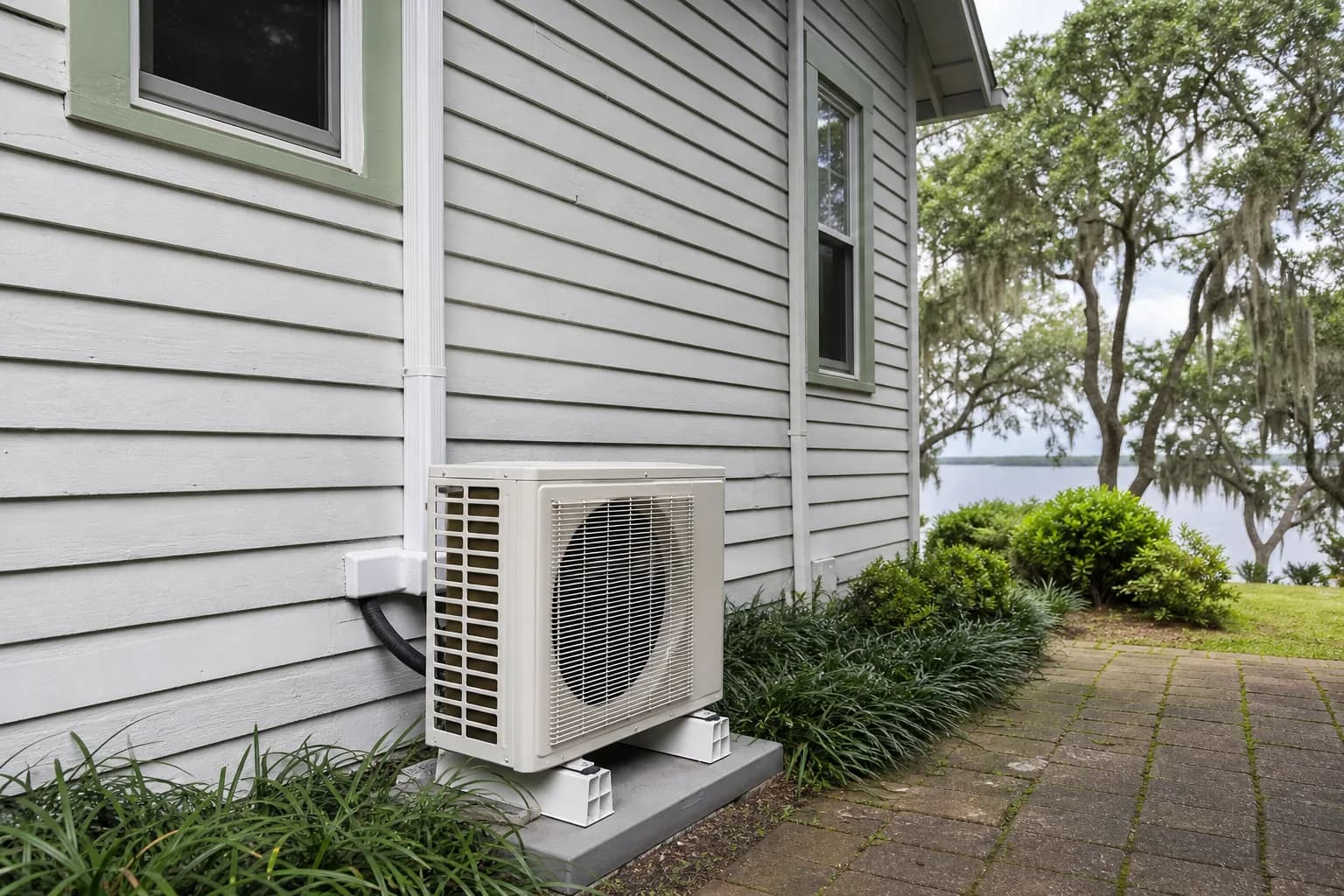
Mounting the outdoor condenser. Wall bracket or ground pad, both work. The pad needs to be level. The unit needs to be at least 6 inches off the ground for drainage and snow clearance (which doesn't apply much in Spanish Fort, but the standard exists for a reason). Distance from the indoor unit matters because of the line set length — most 12,000 BTU units come pre-charged for 25 feet, and you're penalized in efficiency or charge if you go over.
Running the line set chase. This is the visible exterior conduit that protects the refrigerant lines, the drain line, and the control wiring as they go from indoor to outdoor unit. A pre-formed line set cover kit (Slimduct or similar) snaps together, lags to the wall, and looks reasonably professional. The actual line set inside the chase is paired insulated copper tubing — pre-flared on most kits — and the work of running it is just careful routing without kinks or sharp bends.
Routing the condensate drain. The indoor unit produces water. That water has to go somewhere — typically out the wall through the line set chase, then to a gravel pit, a French drain, or a daylight discharge into a flowerbed where it won't pool against the foundation. Standard 5/8-inch PVC, regular slope of 1/4 inch per foot.
That's the 60%. Everything above is accessible to a homeowner who can read a level and use a drill. None of it is what fails the install.
Where the line is — the 40% that breaks DIY installs
Electrical. You need a dedicated 240V circuit, typically 20A or 25A depending on the unit. That circuit needs a breaker added at the panel, properly sized wire run from the panel to a disconnect at the outdoor unit, and the disconnect itself wired correctly. If you don't hold an Alabama electrical license, this is the part you're not legally supposed to do for permitted work — and a Spanish Fort permit office will catch the missing inspection on a closing inspection if you ever sell the house.
The cost of doing this part right: a licensed electrician for two to three hours. The cost of doing it wrong: a 240V miswire that toasts the inverter board on first startup. Replacement boards are expensive and not warranty-covered when the failure traces to install-time miswire.
Vacuum-down on the line set. This is the one nobody talks about and it's where 70% of DIY mini-splits start their slow death.
The line set you just ran needs to have all air and moisture pulled out of it before refrigerant flows in. The standard is a vacuum pull to 500 microns of mercury (Hg), held for 30 minutes without rise. That requires a proper two-stage vacuum pump rated for the duty (not a brake-bleed pump, not a single-stage HVAC supply-house rental that bottoms out at 1,500 microns), a digital micron gauge, and the patience to wait the 30 minutes.
What happens if you skip it or do it poorly: residual moisture in the line set reacts with refrigerant under pressure to form acidic compounds that corrode the compressor windings from the inside. The system runs fine for 12 to 24 months, then fails with what looks like a random compressor death. The warranty claim gets denied because acid-test on the compressor oil shows the contamination.
Refrigerant charge verification. Pre-charged systems are calibrated for a specific line set length — usually 25 feet — and you need to add or release refrigerant if your run is longer or shorter. Adding refrigerant requires a manifold gauge set, a scale, and a refrigerant cylinder. Releasing refrigerant requires a recovery machine if you want to do it legally; venting R-32 or R-410A refrigerant to atmosphere is an EPA violation that carries fines.
For a typical Spanish Fort garage with an 18-foot line set on a 25-foot pre-charge, you'd vent about 2 ounces of refrigerant. Doable for a homeowner with a recovery setup and a proper scale. Not doable with the bicycle pump in the garage.
Commissioning and warranty registration. Most quality manufacturers — Mitsubishi, Daikin, Fujitsu, Bosch — require an authorized installer to register the warranty. Self-install warranties drop from 12 years parts coverage to 2 years parts coverage, and labor is excluded entirely. On a $1,800 unit, that's a $1,000 hidden cost the first time anything goes wrong.
What an honest pro install covers in Spanish Fort
For a Stillwater, TimberCreek, Stonebridge, or Rayne Plantation detached garage in the typical 400-600 square foot range with insulated walls and ceiling, the turnkey install scope covers:
- Equipment. A 12,000 BTU 22-23 SEER inverter unit, manufacturer-direct.
- Installation labor (HVAC). Mounting, line set routing, vacuum-down, charge, commissioning, and warranty registration.
- Electrical. Licensed electrician for the breaker, disconnect, and wire run.
- Materials and miscellaneous. Line set cover, drain materials, mounting hardware, and cleanup.
The variance in real-world pricing comes from distance-from-panel on the electrical run, equipment tier, and whether the existing panel has room for a new 240V circuit.
A DIY equivalent saves the install labor and electrical-coordination cost up front — and gives most of that savings back when the system fails outside the reduced warranty window. The gap is what the vacuum-down, the charge verification, the commissioning, and the warranty registration cost. For a real quote on your specific Spanish Fort garage, call 251-383-HVAC — replacement estimates are free.
When DIY actually makes sense
It does. There are real Spanish Fort scenarios where DIY mini-split is the right move.
You're outfitting a workshop that you genuinely don't care about long-term comfort in. A garage where you sand boards three weekends a year doesn't need a 14-year service life. A two-year DIY install that gets you through the project window is fine.
You already own a vacuum pump, a manifold set, and have done HVAC work before. Plenty of retired tradesmen in Spanish Fort fall in this category. If you have the tools and the experience, you have the 40%.
You're doing it as a learning project and the cost of failure is acceptable. This is rare but real. If a hands-on lesson in why vacuum-down matters is what you signed up for, that's a legitimate choice.
The garage is small enough that a window unit is the actual right answer. A 200 square foot single-bay garage workshop probably wants a window unit, not a mini-split. Mini-splits really start making sense at 350+ square feet, year-round use, and a workspace you actually care about.
When DIY doesn't make sense
Conditioning a finished garage workshop that you spend 10+ hours per week in. This is most Spanish Fort detached-garage scenarios in TimberCreek and Stillwater. Workshop, gym, hobby space, home office overflow. You'll feel every degree of inadequacy on a 92°F afternoon, and you'll feel the install quality every summer for the next decade.
Your garage shares a wall with the house. Now there's a thermal bridge consideration, a sound transmission consideration, and a permit-trail consideration that DIY rarely handles correctly. Get it inspected.
You don't have a 240V panel slot or the panel is already loaded. Adding the circuit might require a service upgrade, which is a significant separate conversation that's not part of any DIY mini-split kit. Find out before you buy the unit.
You're putting it in a vacation rental garage. The first guest review that mentions the garage AC isn't working is going to cost you more than the install savings.
The honest Father's Day recommendation
If your dad — or you, dad — wants the mini-split for a real workshop, get it installed by a pro and write it up as the gift. The pro install gets you a system that runs for the equipment's design life, has warranty backing the whole time, and doesn't trip the breaker on the refrigerator while he's running the table saw. The mini-split installation service page covers the install scope — free replacement estimates.
If your dad genuinely wants the project — wants to do the install himself — buy him the better tools instead of the lesser-quality unit. A real two-stage vacuum pump, a digital micron gauge, and a proper torque wrench for flare connections will last him 25 years and let him do the job right. That's the gift that supports the project rather than predetermining its failure.
ACExperts works Spanish Fort on a regular routing. If you want a free in-home assessment for what a garage mini-split would actually look like at your house — Stillwater, TimberCreek, Stonebridge, Rayne Plantation, or anywhere else — call 251-383-HVAC. Office hours are Monday-Saturday 8am-6pm.
The line between DIY and pro on a garage mini-split isn't where the mounting bracket goes. It's where the vacuum pump connects.
This post is general guidance, not a tax, insurance, or financing recommendation. Talk to a licensed advisor for your specific situation.
FAQ
- What does a professional garage mini-split installation cost in Spanish Fort?
- Single-zone 12,000 BTU systems for a typical detached garage workshop — 400 to 600 sq ft, insulated walls and ceiling — quote into a real range that varies with equipment tier, electrical scope, and line-set distance. The install includes the unit, line set, proper mounting hardware, electrical disconnect, licensed electrician for the breaker work, vacuum and charge process, commissioning, and warranty registration. DIY kits cost less for the equipment alone, but the manufacturer warranty drops on a self-install and most of the work that distinguishes a system that runs 12 years from one that fails in 18 months happens during the part you can't see in the YouTube videos. Replacement estimates are free — call 251-383-HVAC.
- Can I really install a mini-split myself in my Spanish Fort garage?
- You can do the rough mounting, run the line set chase, and route the drain line — that's roughly 60% of the work and the part where DIY is realistic for a homeowner with basic tools and patience. The remaining 40% is electrical work that needs a licensed electrician for the breaker and disconnect, vacuum-down to 500 microns with a proper vacuum pump (not a HVAC supply-house rental that won't pull below 1500), and refrigerant verification on systems that ship pre-charged for 25 feet of line set when you're running 18 feet. Skip any of those and you're either operating a system at reduced capacity or voiding the manufacturer warranty before it ever runs.
- How long does a properly installed garage mini-split last in Spanish Fort?
- 12 to 15 years for a quality 22-23 SEER inverter unit installed correctly, with annual maintenance. The longevity depends almost entirely on the install quality and the maintenance schedule. Across 13 years of Baldwin County HVAC work, I've seen DIY mini-splits fail early when the line set was kinked, the vacuum pull was incomplete, and the indoor coil iced up enough to crack the drain pan. I've also seen older professionally installed units in TimberCreek and Stillwater garages still measuring close to original capacity many years out.
- Do garage mini-splits handle Spanish Fort summer humidity?
- If they're correctly sized and correctly installed, yes. A 12,000 BTU unit in a 500 sq ft insulated garage with the door closed will pull humidity into a comfortable RH range within an hour. The failure modes are oversizing (too much capacity short-cycles before dehumidifying) and undersizing (running continuously at high RH and never satisfying the load). Spanish Fort's tight build culture means most newer garages are reasonably insulated, but if the door is open most of the day, no mini-split sized for the closed-door condition will keep up.
Need this handled?
Straight to the service page for your town — pricing, local details and a form that reaches a technician.
More from Fathers Day
- How One Orange Beach Homeowner Caught Father's Day Garage HVAC Trouble Early — A Mini-Split's Biography
- 5 Father's Day Garage Mistakes Bay Minette Homeowners Keep Making
- What an Honest Tech Charges for Father's Day Garage HVAC in Fairhope in 2026
- Magnolia Springs Garage Mini-Splits: 13 Years of Failure Patterns

ACExperts HVAC
We Take The Heat So You Don't Have To
Fast, honest heating and air service across Baldwin County. Speak with a technician and get on the schedule today.