
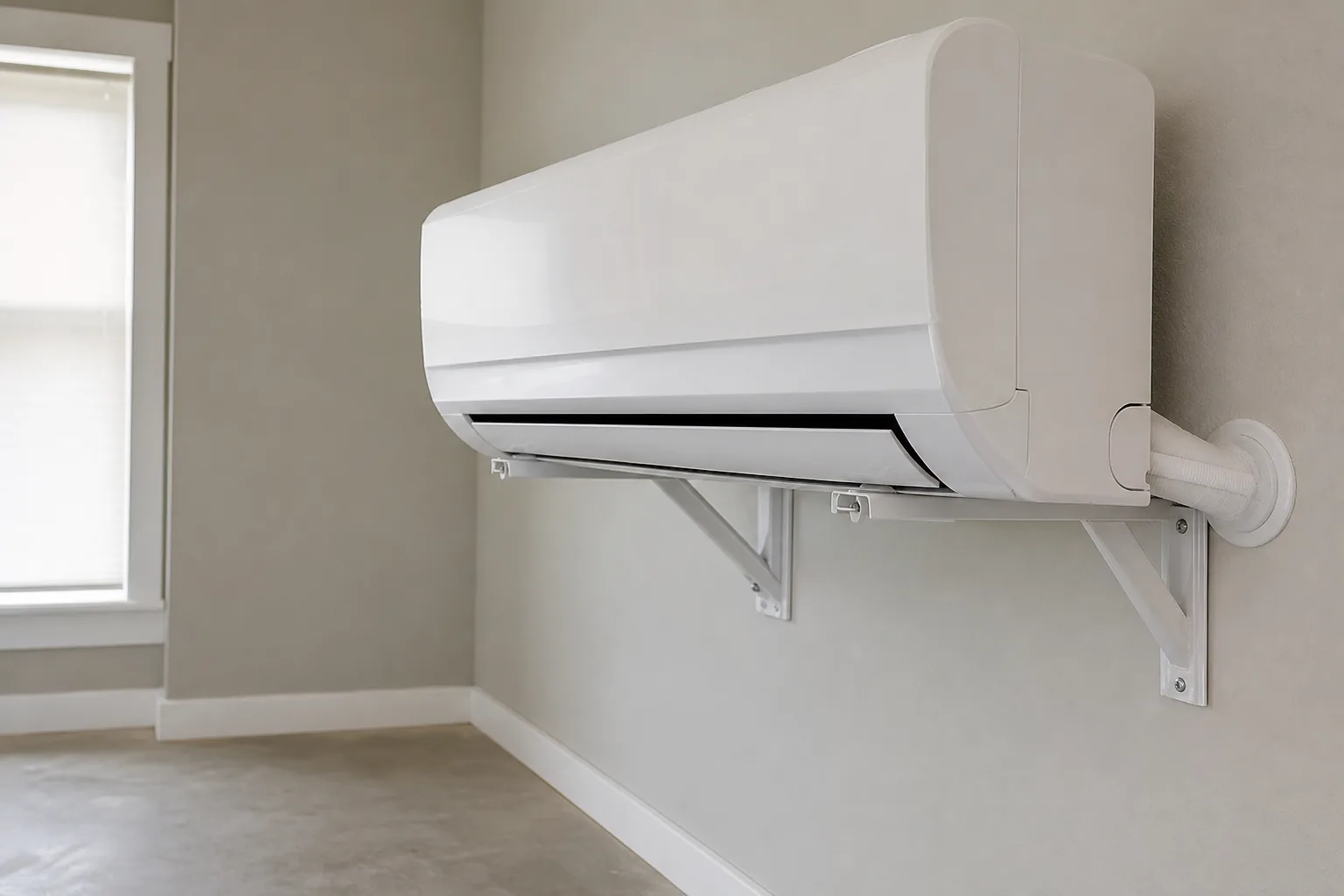
Father's Day Garage HVAC Project for Lillian Homeowners
A Father’s Day garage mini-split for Lillian homeowners runs about $1,800 to $2,400 installed and gives 8-10 years of workshop comfort. Why timing matters.
Published 2026-06-11 · Updated 2026-06-11
Author: Landon Jahnke | ACExperts251
Reviewed by: Landon Jahnke · Owner · Alabama HVAC License AL #16117 · EPA 608 Certified
$240 buys you 40 hours of summer comfort lost to a breakdown response. A 12,000-BTU mini-split in your Lillian garage runs $1,800 to $2,400 installed and gives you 8 to 10 years of weekend workshop time. The math is generous — but the trick is whether you spend the $240 in May or in August. Father's Day weekend is the line between the two prices.
Here's what I mean.
The timing math
A garage mini-split installed before peak summer is a planned project. Schedule it on a weekday, the equipment is in stock at the regional supply houses, the install commissions correctly, and the homeowner gets a system that's quiet, balanced, and ready for the first 95-degree afternoon in July. Total project cost: $1,800 to $2,400 for a single-zone 12,000-BTU setup on a typical Lillian detached garage.
A garage mini-split discussed in late July, after the homeowner has spent three weekends sweating through workshop time and decided enough is enough, is a different project. Equipment availability tightens during peak season because demand statewide spikes. Contractor schedules are stacked with emergency calls and replacement work, so scheduling pushes into August or September. The same project costs the same to install — but the workshop time you wanted in June, July, and early August is already gone. That's the $240 figure: roughly six lost weekends at four hours a weekend, valued at the cost of postponing the projects you wanted to do in there.
The Father's Day window is when the timing pivots. Equipment is still readily available, the install schedule still has slots, and the project clears in time for the back half of summer. A week later, none of that is true to the same degree. Two weeks later, the math has shifted into the next season.
Why a Lillian garage specifically
A few things about Lillian's geography make the garage mini-split conversation different from other parts of Baldwin County.
First, the housing. Lillian's bay-front and second-home character means a lot of detached structures — workshop sheds, boat-storage outbuildings, garage workshops, the occasional carriage house. Spanish Cove has a notable concentration of dedicated workshop garages compared to other Baldwin County subdivisions. Perdido Beach properties along the bay frontage tend toward larger lot footprints with multiple outbuildings. Josephine and the rural acreage to the north skew toward big detached pole barns set up as combined garage-and-workshop space. Each of those structures is a candidate for spot conditioning.
Second, the climate. Lillian's bay-front exposure means salt air drives equipment selection — coastal-rated outdoor units are worth the modest premium for any property within a half-mile of Perdido Bay. Heat pumps work exceptionally well here because winter lows rarely drop below 30°F, and a mini-split's heat-pump mode handles the few cold mornings each year without the auxiliary heat strips that get expensive in colder zones. The climate is, frankly, ideal for ductless heat-pump technology — better than most of the country.
Third, the demographics. A meaningful share of Lillian property owners are retirees, second-home owners, or out-of-state folks managing rental properties from elsewhere. The garage mini-split conversation often happens during a visit, gets noted as "we should do this," and then sits for a year or two while life happens. Father's Day weekend is one of the times of year people are physically at the property, looking at the garage, with a Saturday afternoon clear and time to make a decision. That's not an accident — it's why the project tends to come up this weekend specifically.
What you actually get
A 12,000-BTU single-zone mini-split for a typical 2-car detached garage at Spanish Cove or along Perdido Bay Boulevard delivers:
- Steady cooling capacity to roughly 480 square feet of average-insulated garage space, comfortably reaching 72°F to 76°F set point even on a 95°F afternoon.
- Heating capacity for the few sub-50°F mornings Lillian sees per winter, without strip heat or auxiliary fuel.
- Inverter-driven operation that ramps capacity up and down rather than cycling on/off, which means quiet, steady, dehumidified air rather than the on/off blast of a window unit.
- Sound levels at the indoor head around 28 to 35 dB on low fan speed — quieter than a refrigerator, well below conversation level for woodworking, mechanical work, or anything else where you want to hear the equipment you're using.
- A 10-year manufacturer parts warranty on the major components when registered through us at install.
- 8 to 10 years of expected service life under typical Lillian conditions, longer if maintained on a coastal cadence.
What you don't get: a system that survives without basic seasonal maintenance. Coil rinses, filter cleaning, and an annual tech visit are still part of the deal — the mini-split installation service page walks through the maintenance cadence in detail.
The actual install
For planning purposes, here's what the project looks like from first call to when the system is running:
Day of consultation. Site visit to measure the space, look at the wall where the indoor head will mount, look at the exterior wall where the outdoor unit will sit, check panel capacity and circuit availability, talk through aesthetics (line-set cover routing matters more on a clean garage than people realize), and write a quote. About 45 minutes on site, no charge for the visit on quoted projects.
Equipment order. For standard equipment in stock at the regional supply, install can typically schedule within 7 to 10 business days. For coastal-rated equipment for bay-front properties, add 3 to 5 days. Out-of-state owners can authorize remotely with a written quote and email approval.
Install day. Project takes 4 to 6 hours start to finish. The sequence: indoor head mount and electrical rough-in, line-set penetration through the wall (a 3-inch hole with proper sleeving), outdoor unit pad set, line-set run with proper insulation and UV-resistant cover, electrical from the panel to the outdoor unit, refrigerant evacuation and pressure test, refrigerant charge to manufacturer spec, system commissioning and start-up under load. The system has to produce the rated capacity at the indoor head — verified with a temperature differential measurement — before commissioning is complete.
Walkthrough. At the end of the visit you get the remote, the manual, the warranty registration confirmation, and a five-minute walkthrough on filter cleaning and what to call about. Most owners don't need to think about the system again until the first annual tune-up.
The Lillian variations
A couple of property-type-specific notes:
Spanish Cove garages tend to be detached, single-story, with electrical service routed from the main house panel through the yard. Verify the outbuilding sub-panel has at least one open 240V/20A slot before assuming a standard install — older sub-panels sometimes need an upgrade before higher-capacity equipment can land.
Perdido Bay frontage properties with bay-side garages need coastal-rated outdoor equipment. The salt-corrosion environment is comparable to Gulf Shores and Orange Beach, and standard residential-grade aluminum coils show meaningful corrosion within 3 to 5 years. The coastal-rated step-up is roughly $200 to $300 at install and meaningfully extends service life.
Josephine pole barns are a different conversation. Larger square footage, often poorly insulated, and the load calculation needs to account for the actual building envelope rather than a residential rule-of-thumb. A Manual J-style room load calc for any space above 600 square feet — usually lands at 18,000 to 24,000 BTU rather than 12,000.
Out-of-state owner properties are routine. Direct billing to the owner, photo documentation, communication through whatever channel the owner prefers, and coordinated access through property managers, cleaning crews, or lockboxes. The Lillian service area page covers the out-of-state owner workflow in more detail.
The two-zone question for larger Lillian properties
A lot of Lillian property owners ask whether they should run a single-zone unit per outbuilding or a multi-zone system that handles the garage, a bonus room over the garage, and a workshop shed off one outdoor unit. The answer is usually project-specific, but the rough heuristic:
Single-zone makes sense when: you're conditioning one space, the run between the outdoor and indoor units is under 50 feet, and the loads are predictable. Cost runs roughly $2,000 to $2,500 for a 12,000-BTU setup.
Multi-zone makes sense when: you've got two or more spaces being conditioned simultaneously, the cumulative tonnage is at least 1.5 tons, and the spaces have different occupancy patterns (e.g., the garage gets used Saturday morning and the bonus room runs all evening). Multi-zone equipment costs more upfront — figure $4,500 to $6,500 for a 2-zone setup with two indoor heads — but the operating cost per zone drops because the inverter compressor can match capacity more precisely.
For a typical Spanish Cove property with a detached garage and an attached bonus room, the usual recommendation is two single-zone systems rather than a multi-zone, because the failure mode of a multi-zone is that you lose all zones simultaneously when the outdoor unit fails. Two simple single-zone systems give you redundancy. The math is close enough either way that it comes down to homeowner preference and how much electrical service is available.
After-install: the maintenance cadence that actually works
Mini-splits are reliable, not maintenance-free. The cadence for a Lillian garage system:
Monthly during use months. Pull the indoor head's washable filters, rinse them in the sink, dry them, put them back. Five minutes. Skipping this is the #1 cause of premature performance loss.
Quarterly for bay-front properties. Garden-hose rinse the outdoor unit's coil from the top down, fan-spray nozzle, on a cool morning when the unit isn't running. Clears salt accumulation before it works into the fin material.
Annually. Full tech visit. Indoor coil rinse with manufacturer-approved cleaner, refrigerant pressures at design conditions, contactor and capacitor check, drain function verified, full documentation. Runs about 60 to 75 minutes per system.
For owners on the Comfort Plan, the annual visit is included and scheduling gets coordinated around your usage pattern — for second-home owners, the visits get timed to your typical visit windows so you're there for the conversation.
Where Father's Day fits
The holiday angle isn't the point. Father's Day weekend is just a useful pivot point because it's late enough in spring that summer is unmistakably here and early enough that the work can still be done before peak. If you're a Lillian property owner and you've been thinking about garage conditioning for two summers running, this is the weekend the math says go. A week later, the math is still pretty good. By the third week of July, the math has rotated.
The cluster reads worth a look: the Gulf Shores Father's Day mini-split tutorial walks through where DIY makes sense and where it doesn't, and the Spanish Fort version covers the same project type for a different housing profile. Both useful.
If you want a quote for your specific garage, the schedule page is here, or you can call 251-383-HVAC to route a consult out to Lillian. Sundays are closed; the consult lands the week after Father's Day Sunday, which still puts you well inside the timing window. The math holds.
FAQ
- What size mini-split does a typical Lillian detached garage need?
- For a 2-car detached garage of around 400 to 480 square feet with average insulation, a 12,000-BTU (1-ton) mini-split handles the cooling load through Lillian summers. Bigger workshop sheds at 600 to 800 square feet step up to an 18,000-BTU unit. Insulation matters more than square footage at the margins — a fully insulated, drywalled garage runs lighter than a stud-and-bare-block one of the same size.
- Can I run the indoor head off the garage's existing 120V circuit?
- Most 12,000-BTU mini-splits are dual-voltage and will run on 120V or 240V depending on how they're configured at install. A standard garage 120V/20A circuit is enough for a 1-ton unit if it's not shared with a refrigerator or compressor. For an 18,000-BTU and larger, plan on a dedicated 240V/20A circuit. Panel capacity and circuit availability get confirmed during the in-home consultation.
- What does a real installed cost look like for a Lillian garage in 2026?
- For a 12,000-BTU single-zone mini-split with a 25-foot line set, standard outdoor pad mount, basic electrical from an existing panel circuit, and full commissioning: $1,800 to $2,400 installed in 2026. Bay-front Lillian properties (Spanish Cove, Perdido Bay frontage) add roughly $200 to $300 for coastal-rated equipment. 18,000-BTU units run $2,400 to $3,200 installed. A quote under $1,500 usually means corners are getting cut somewhere — the line set, the commissioning, or the warranty.
- How long does the install take, and do I need to be home?
- Single-zone garage installs take 4 to 6 hours start to finish for a typical Lillian setup. Yes, site access is needed for the full window — drilling a 3-inch line set penetration through the wall, mounting the indoor head, setting the outdoor unit on a pad, running the electrical, vacuuming the line set, charging refrigerant, and commissioning. Out-of-state owners can authorize work over the phone with a written quote sent before work starts.
Need this handled?
Straight to the service page for your town — pricing, local details and a form that reaches a technician.
More from Fathers Day

ACExperts HVAC
We Take The Heat So You Don't Have To
Fast, honest heating and air service across Baldwin County. Speak with a technician and get on the schedule today.