
Ductless Mini-Split Guide for Alabama Homeowners
When a ductless mini-split is the right call for a Baldwin County home, how zoning actually works, what good installation looks like, and the questions to ask before you sign a quote.
Published 2026-04-08 · Updated 2026-04-08
Author: Landon Jahnke | ACExperts251
Reviewed by: Landon Jahnke · Owner · Alabama HVAC License AL #16117 · EPA 608 Certified
"Can you just put a mini-split in the back room?" is one of the most common calls we get across Baldwin County, and it's usually the right instinct for the wrong reason. The homeowner has a room that's always too hot or too cold, the central system clearly isn't reaching it, and a ductless head feels like the obvious fix. Sometimes it's exactly that. Other times the real problem is undersized ductwork or a system that was never balanced, and a mini-split would be a bandage on a different wound.
This is the guide we'd give a neighbor: when ductless genuinely wins, how zoning works in plain language, what a good install looks like versus a bad one, and the questions worth asking before you sign anything. No spec-sheet worship and no upselling — just how to make a smart decision for an Alabama home.
What a ductless mini-split actually is
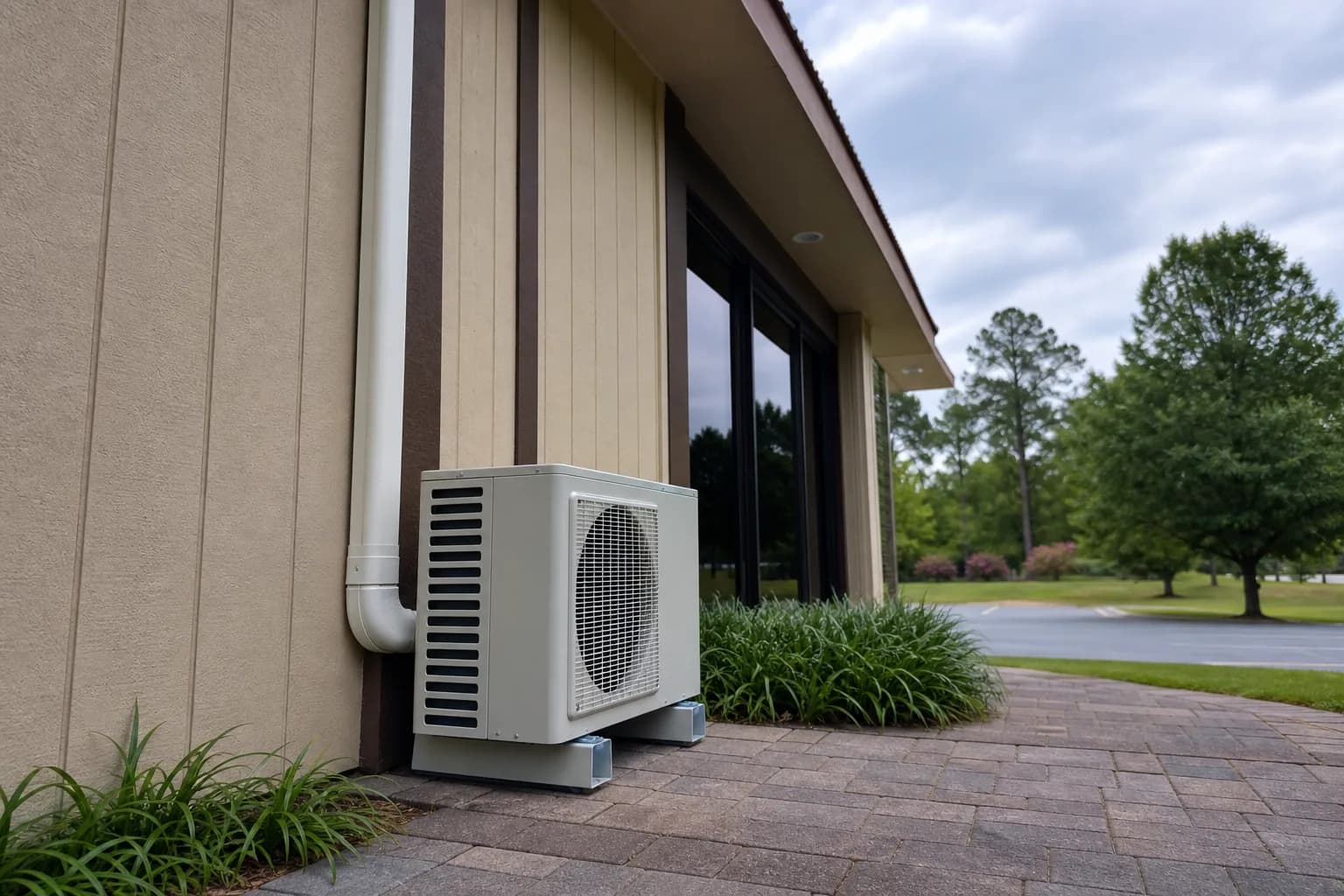
A ductless mini-split is a heat pump split into two pieces connected by a refrigerant line set instead of ductwork. Outside sits a compact condenser. Inside sits one or more "heads" — most often a wall-mounted unit up near the ceiling, though floor-mount and ceiling-cassette styles exist for rooms where a wall head won't work. A small bundle of refrigerant lines, a control wire, and a condensate drain run between them through a hole in the wall not much bigger than a fist.
Because there are no ducts, there are no duct losses. That matters a lot here. A typical duct system running through a hot Baldwin County attic leaks air and soaks up heat before it ever reaches the register. Ductless skips that whole problem and drops conditioned air straight into the room. The inverter-driven compressor is the other half of the story: instead of slamming on at 100% and shutting off, it modulates, running long and slow at low output to hold a steady temperature. On a mild spring day that's the difference between a system that sips power and one that hard-cycles all afternoon.
And because it's a heat pump, it heats as well as cools — which for our winters is usually all the heat a space needs.
When ductless is the right call
Ductless isn't always the answer, but there are situations where it's almost always the smart one.
Additions and bonus rooms
When you bonus-out a garage, build an addition, or finish a room over the garage, the existing central system usually wasn't sized to carry it. Extending ductwork into a new space is often expensive, disruptive, and underperforming. A dedicated mini-split conditions the new space on its own, independent of the rest of the house, and you only run it when you're using the room.
Homes with no ductwork
Plenty of older Baldwin County homes were built without central ducts, or with a patchwork that barely works. Retrofitting ductwork into a finished home means tearing into ceilings and closets. A multi-zone ductless system delivers whole-home comfort without any of that demolition — a head in each zone, lines run discreetly along the exterior.
The one room that's always wrong
Sun-baked west-facing rooms, a primary bedroom at the far end of a long duct run, a sunroom, a home office over the garage — every house seems to have one room the central system can't satisfy. Rather than re-engineering the whole duct system to fix one room, a single mini-split head gives that space its own thermostat and its own cold air.
Garages, workshops, and shops
A conditioned garage or workshop is one of the most popular ductless installs we do. There's rarely a duct path to a detached structure, the load is independent from the house, and you want to be able to shut it off when you're not out there. A single head sized to the space does the job.
How zoning actually works
"Zoning" gets thrown around loosely, so here's the plain version. Each indoor head is its own zone with its own remote and its own setpoint. You can run the bedroom head at one temperature and leave the living room head off entirely. That independent control is the whole point of ductless, and it's where a lot of the energy savings come from — you're not conditioning rooms nobody's in.
A single-zone system is one outdoor unit feeding one indoor head. Simple, efficient, ideal for a single problem room or a garage.
A multi-zone system is one outdoor unit feeding several heads — typically two to five — each controlling a different area. This is how you do a whole house or a multi-room addition with ductless. The outdoor unit has to be sized to handle the combined load of the zones running at once, and each head sized to its room.
The mistake we have to talk people out of regularly: hoping one big head in a central room will condition the whole house. It won't. Cold air doesn't turn corners and crawl down hallways into closed bedrooms. If you want comfort in a room, that room needs its own head. Plan zones around the spaces you actually want to control, not around saving the cost of one more head and regretting it every summer.
Why correct sizing is the whole ballgame
Bigger is not better with a mini-split — it's actively worse. An oversized head cools the room to setpoint fast, then shuts down before it has run long enough to wring the humidity out of the air. In a Gulf Coast climate where the humidity is half the comfort problem, that leaves you with a room that's technically cool but clammy. Short-cycling also wears the equipment and throws away the part-load efficiency that made you choose an inverter system in the first place.
Correct sizing comes from a real load calculation that accounts for the room's square footage, ceiling height, insulation, window area and orientation, and how exposed the space is. A west-facing sunroom with a wall of glass has a very different load than an interior bedroom of the same size. Any installer who quotes a head size off square footage alone, without asking about your windows and insulation, is guessing. We do the load math because guessing is how rooms end up muggy.
What a good installation looks like
The equipment matters, but the install matters more. A mid-tier unit installed correctly will outlast a premium unit installed badly. Here's what separates the two:
- A deep vacuum, held and verified. Before any refrigerant flows, the line set and indoor coil get evacuated to pull out air and moisture, then held to confirm the system holds. Moisture left in the lines turns acidic and eats a compressor from the inside. This step takes real time and there's no shortcut. It's the single biggest predictor of whether a mini-split lasts.
- Charge set by weight, not by feel. Manufacturers specify the refrigerant charge by weight for the line-set length on your job. A quality install weighs it in to spec. Charging by gauge pressure alone is faster and less accurate.
- Flare connections made and torqued correctly. The refrigerant lines connect with flare fittings that have to be cut clean and torqued to spec. A weak flare is a slow leak waiting to happen.
- Line set routed and protected. Outside, the lines should run neatly and be protected in a cover where they're exposed, not draped across the wall like an afterthought. It should look installed by a pro because the routing also protects the lines.
- Condensate handled properly. The indoor head produces water, and that water has to drain somewhere with a proper slope or a condensate pump. A bad drain shows up as water stains on your wall a month later.
- The electrical done right. The outdoor unit needs the correct circuit and disconnect. We verify the panel can carry the load before the job, not after.
When we finish a mini-split installation, commissioning isn't an afterthought — it's the part that determines whether you're calling us back in three years.
Questions to ask before you sign a mini-split quote
A few questions sort the careful installers from the fast ones quickly:
- "Did you do a load calculation for this room, or size it off square footage?" The right answer involves your windows and insulation, not just the room dimensions.
- "What's the line-set length, and is the charge adjusted for it?" Longer runs need more refrigerant by weight. If they don't know the length, they can't have set the charge correctly.
- "How long will the vacuum cycle take?" "We pull a vacuum and hold it" is the answer you want. "We're in and out in a couple hours" on a multi-zone job is not.
- "What warranty comes with the equipment, and what's your workmanship warranty?" Quality manufacturer warranties run long when the unit is registered, and the installer should stand behind their own labor too.
- "Single-zone or multi-zone for what I'm trying to do — and why?" The honest answer ties zones to the rooms you want to control.
Cost, in plain terms
We won't throw made-up numbers at you, because the honest answer is that a mini-split quote depends on real variables: how many zones you need, the size and type of each head, how far the line set has to run, whether there's masonry to drill or an electrical upgrade required, and the efficiency tier of the equipment. A single head in a room with the electrical already nearby is the low end. A multi-zone whole-home system with long runs to a detached garage is the high end. The honest way to handle it is to walk the job and quote it in writing. Our HVAC cost guide walks through the factors that move the number, and we offer financing through Synchrony Bank when a project calls for it.
What you should be wary of is a number quoted over the phone before anyone has seen the space. Line-set length and zone count drive ductless pricing more than anything else, and neither can be known sight-unseen.
The bottom line for Alabama homeowners
A ductless mini-split is one of the best tools we have for the right job: an addition, a ductless home, a stubborn problem room, or a garage you want to live in. It's efficient, it heats and cools, and in our humid climate the inverter modulation is a genuine comfort advantage when the unit is sized right. The whole thing rises or falls on two decisions — correct sizing and a careful install. Get those right and a mini-split is a 15-to-20-year comfort upgrade. Get them wrong and it's a muggy room and an early failure.
If you've got a room that's never right or a project that doesn't fit the central system, we're glad to take a look and tell you honestly whether ductless is the move. Free estimates on installations, and free second opinions if another shop already quoted you. We work all of Baldwin County out of Silverhill — call 251-383-HVAC or reach out here. For more on heat-pump and ductless options, see our heat pump and mini-split service page.
FAQ
- Are mini-splits efficient?
- Yes — especially when they're sized and commissioned correctly. A ductless mini-split has no duct losses to fight, and a typical duct system in a Baldwin County attic loses a meaningful share of its conditioned air to leaks and to the heat soaking into uninsulated runs. A mini-split puts the conditioned air directly into the room. The inverter compressor also ramps up and down instead of hard-starting at full blast, so it sips power at part load on a mild Gulf Coast spring day instead of cycling on and off. The catch is that efficiency on the spec sheet only shows up in your house if the unit is the right size for the room and the installer pulled a proper vacuum and charged it by weight. An oversized or sloppily commissioned mini-split throws away most of the efficiency you paid for.
- Will one mini-split head cool my whole house?
- Almost never, and that's the most common mistake we see. A single wall head conditions the room it's in and, partially, whatever opens directly off that room. It will not push cold air around a corner, down a hallway, and into closed bedrooms. If you want a whole-home ductless system you need a multi-zone setup — one outdoor unit feeding several heads, one per area you actually want to control. Trying to heat and cool a 1,600-square-foot house off one big head in the living room ends with a freezing living room and warm bedrooms. Match a head to each zone you care about.
- Mini-split or central air for an Alabama home?
- It depends on whether ductwork already exists and what you're trying to solve. If your home already has decent ducts and a working air handler, replacing a central system with central equipment is usually the simpler, lower-cost path. Mini-splits win when there are no ducts (older homes, additions, garages), when one room is always the wrong temperature, or when you want independent control of a space without running the whole system. For a new addition or a converted bonus room, ductless is frequently the obvious answer. We'll tell you straight which one fits your situation on a free estimate — there's no version of this where we push ductless onto a house that's better served by central air.
- Do mini-splits heat as well as cool on the Gulf Coast?
- For our climate, yes — comfortably. A ductless mini-split is a heat pump, so it both cools and heats. Baldwin County winters are mild enough that a properly sized mini-split heat pump handles heating without breaking a sweat most of the season. The handful of hard cold snaps we get each winter are exactly where a quality cold-climate-rated head earns its keep, because it keeps delivering real heat when the cheap units start to fade. If heating performance matters to you, that's a conversation to have when you pick the equipment — not all heads hold capacity the same way when the temperature drops.
- How long does a mini-split installation take?
- A straightforward single-zone install — one head, one outdoor unit, a short line set through an exterior wall, electrical already in place — is usually a single-day job. Multi-zone systems, long line-set runs to a detached garage, masonry penetrations, or an electrical sub-panel add time. The part we never rush is the vacuum cycle and the charge. Pulling the system down to a deep vacuum and holding it confirms there's no moisture in the lines, and charging by weight to the manufacturer's spec is what makes the system last. A fast install that skips those steps is the kind of job that fails in year three.
Need this handled?
Straight to the service page for your town — pricing, local details and a form that reaches a technician.
Related reading

ACExperts HVAC
We Take The Heat So You Don't Have To
Fast, honest heating and air service across Baldwin County. Speak with a technician and get on the schedule today.