
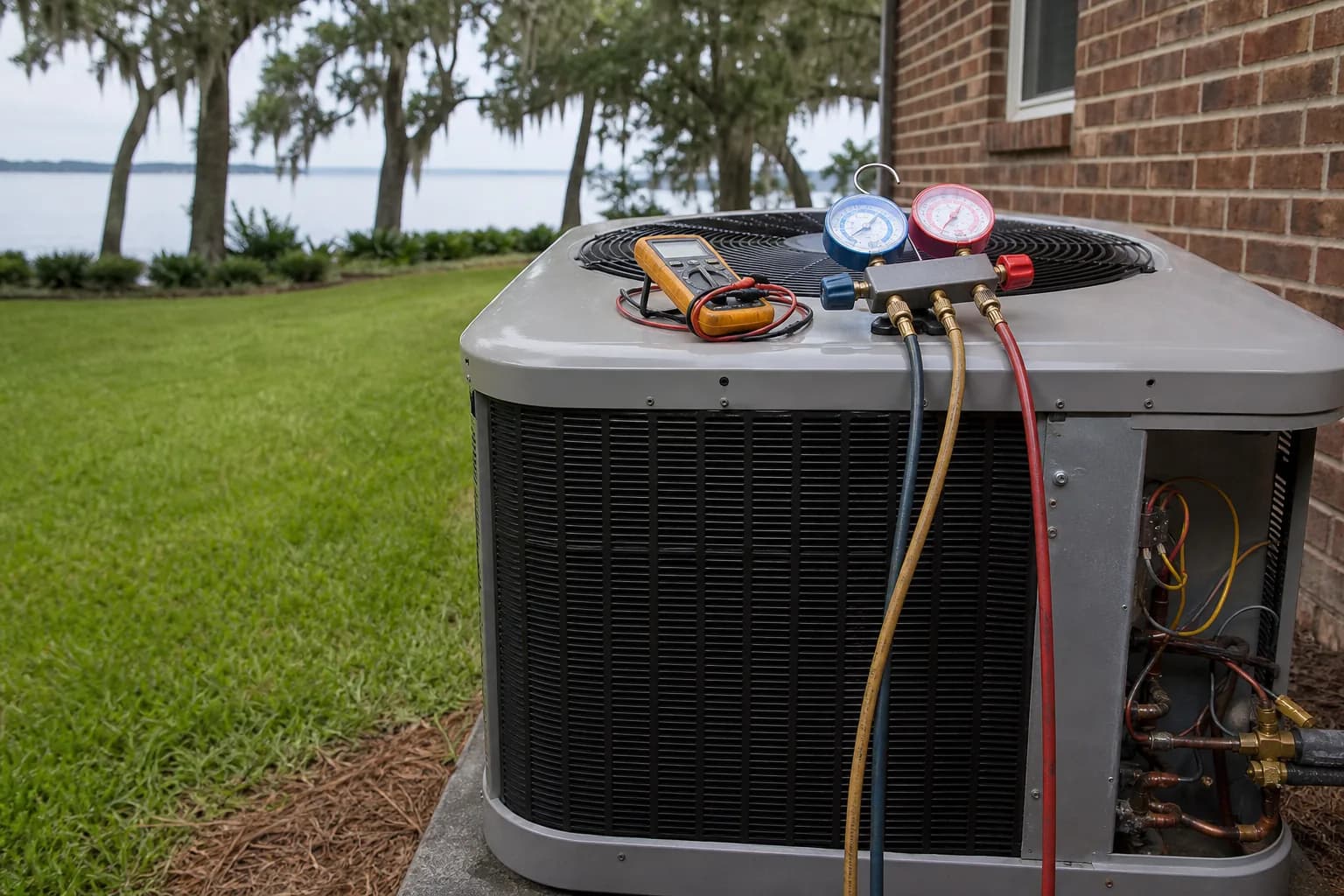
The Fairhope Frozen Evaporator Coil Walkthrough: Don't Just Flip the Switch
Frozen evaporator coil in Fairhope: two diagnostic questions and one decision. Flip the breaker without them and a small repair can become a compressor swap.
Published 2026-08-21 · Updated 2026-08-21
Author: Landon Jahnke | ACExperts251
Reviewed by: Landon Jahnke · Owner · Alabama HVAC License AL #16117 · EPA 608 Certified
A healthy Fairhope evaporator coil in August looks like this: aluminum fins evenly aligned, no visible ice, modest condensation on the cabinet exterior, supply-air register temperature 18F to 22F below return-air temperature, no whistle from the airflow.
A frozen coil looks like this: solid ice across the front of the coil, water in the secondary drain pan, supply-register temperature within 5F of return-air.
The difference between the two is two diagnostic questions and one decision. Over 13 years working Baldwin County HVAC, I've watched enough frozen-coil calls walk through the same predictable pattern to write the walkthrough out cleanly. Here it is.
Frozen-coil calls are one of the more common emergency calls in Fairhope from late July through early September, and a meaningful share of them arrive at the emergency-call stage because the homeowner did the worst possible thing first: noticed weak airflow, got frustrated, flipped the breaker off and back on, and walked away. Two days later the system is in worse shape, the compressor has been stressed running against the iced coil, and the repair has gone from a small service visit to a much larger one.
Knowing what good looks like before talking about the failure is the right starting point.
Healthy state, in detail
In a Fairhope home running a typical 3-ton system on an August afternoon, the air handler is moving roughly 1,200 cubic feet of air per minute through the evaporator coil. Return-air entering the coil is at indoor temperature — say 76F if the thermostat is set to 73F and the house is recovering. Supply air leaving the coil is 56F to 58F. That's an 18F to 20F differential, which is the spec range for healthy operation.
Visually, the coil itself: aluminum fins running vertically, copper tubes running horizontally through the fin pack, the entire face of the coil shows a uniform pattern of moisture beading. The cabinet around the coil is cool to the touch but not iced. The condensate drain pan below the coil is wet but not overflowing. Water runs steadily out the primary condensate line — typically a 3/4-inch PVC line that runs to a sink, a floor drain, or an exterior termination.
Sound: a steady airflow whoosh, no whistling, no rattling. The blower wheel inside the air handler is running at the speed appropriate for cooling mode — usually somewhere between medium and high on a multi-tap PSC blower, or 600 to 1,000 RPM on a variable-speed ECM blower.
Smell: nothing distinctive. A neutral, slightly metallic faint odor is normal. Anything that smells musty, sour, or earthy indicates biological growth and is a separate (related) problem covered in the musty-smell post.
That's the baseline. If your coil deviates from any of those characteristics — temperature differential, visual appearance, sound, drainage — something is wrong, and the walkthrough below tells you what.
The two diagnostic questions
When you pull the access panel off the air handler and look at a frozen coil, the first instinct is "fix it now." The right instinct is "what caused it?" Flipping the system off-then-on, or pouring warm water on the coil to speed the thaw, doesn't address the underlying cause. The freeze will return.
Two questions get you to the cause most of the time.
Question one: when did you last change the filter?
Restricted airflow across the evaporator coil is the single most common cause of freezing in Fairhope homes. The mechanism is simple: the coil is designed to extract heat from a specific volume of air at a specific velocity. If the airflow drops below that target — because the filter is loaded with dust, pollen, or pet dander — the coil overshoots its design temperature and the surface drops below 32F. Water condensing on the coil freezes instead of draining. Once a thin layer of ice forms, airflow drops further, and the freeze accelerates.
In Fairhope specifically, this happens fast in spring (oak and pine pollen overload basic 1-inch fiberglass filters in a few weeks during peak pollen) and slow in summer (gradual dust accumulation over a couple of months). By late August, a filter that was changed in May is full.
If the answer to question one is "I don't remember" or "May" or "I think we have a fresh one in the garage but I haven't put it in," the cause is almost certainly airflow restriction. Fix sequence:
- Turn the system off (thermostat to OFF, not just COOL setpoint adjusted)
- Pull the existing filter, inspect it, replace with a clean filter
- Run the system in fan-only mode (FAN: ON) for 30 to 60 minutes to thaw the coil
- After the coil is fully thawed (verify by sight — no visible ice), turn the system back to COOL and observe for the next 24 hours
A solid share of frozen-coil calls in Fairhope homes resolve completely with this sequence. If the freeze returns within 24 to 48 hours despite a fresh filter, you're not in the airflow-restriction category and the actual cause is one of the others below.
Question two: when was the last refrigerant service or maintenance?
The second most common cause of frozen coils is low refrigerant charge. Mechanism: refrigerant is what carries heat away from the coil to the outdoor condenser. If the system is undercharged — typically due to a slow leak — the suction pressure drops, the coil temperature drops below 32F, and the freeze starts. The pattern looks identical to filter restriction from the homeowner's perspective: weak airflow, ice on the coil, cabinet sweating.
The difference is what fixes it. A refrigerant problem doesn't get better with a fresh filter. The system will thaw, run for a day or two, and refreeze.
If your answer to question two is "never had refrigerant service" or "we had a top-off two summers ago and the system was fine for a while," the cause is likely refrigerant. This one needs a technician. Pressure measurements, leak detection, and refrigerant addition all require certified handling equipment that homeowners don't have access to.
In Fairhope's older housing stock — particularly the Fruit & Nut District homes with retrofit AC installations from the 1980s and 1990s — refrigerant leak rates run higher than average because the line sets are aging and the flare connections at the air handler often loosen over time.
If your answer to question two is "had full maintenance in May and the tech said charge was good," the cause is probably not refrigerant. Move to the next decision below.
The decision
Once you've answered both questions, the decision is:
Path A — homeowner-fixable, this visit: Filter was the cause, you replaced it, the coil thawed, the system has run normally for 48 hours with no return of the freeze. Done. No service call needed. Set a calendar reminder to check the filter every 30 to 45 days during pollen and high-cooling months.
Path B — call within the week: Filter wasn't the cause OR refilling the filter didn't resolve it. Schedule a diagnostic visit within 7 days. The system can usually run between now and then if you keep an eye on it and turn it off immediately if you see ice form again.
Path C — call today: The coil refroze within hours of thawing, OR you can see standing water in the secondary drain pan (which means the primary drain is also blocked and water is overflowing into the secondary), OR the system is making any unusual sounds (compressor short-cycling, hard-start clicking, blower screech). These indicate a multi-failure situation where running the system further risks compressor damage. Turn it off and call.
The walkthrough is just those three paths.
What's actually in path B and path C
For homeowners curious about what I actually do once I arrive on a frozen-coil call, the diagnostic sequence is:
Step 1: visual inspection (10 minutes). Pull access panels, photograph the coil, document ice extent and pattern. Ice pattern tells a lot — uniform ice across the entire coil face suggests airflow or charge issues, ice concentrated on one circuit suggests a refrigerant distribution problem or partial coil restriction.
Step 2: airflow measurement (10 minutes). Static pressure measurement at the supply plenum and return plenum. Healthy total external static pressure for residential systems is 0.5 inches water column or less. A reading above 0.7 inches suggests airflow restriction (filter, coil, ductwork). A reading below 0.3 inches suggests blower problems or duct disconnection.
Step 3: refrigerant pressure measurement (15 minutes). Hook gauges to the service ports, read suction pressure, discharge pressure, ambient temperature. Compare measured values to manufacturer's chart for the specific equipment. Subcool and superheat readings tell whether the system is undercharged, overcharged, or has a different problem.
Step 4: thaw and re-test (30 to 90 minutes depending on ice extent). With the system off and blower running for thaw, I have the chance to inspect the now-visible coil for cleanliness, fin damage, biological growth, and any obvious leak indicators (oil staining at brazed joints, refrigerant odor, visible damage).
Step 5: repair recommendation (10 minutes). Based on what I found, I walk through the options — drain clear, refrigerant top-off with or without a leak repair, coil chemical wash, blower diagnostic — and quote every line in writing on the spot before any work is done.
The diagnostic visit is the standard $79 service fee. I don't pad the diagnostic with unnecessary work. Some frozen-coil calls end with me telling the homeowner the system is fine — a one-time event caused the freeze, the filter is good, refrigerant is on charge, drainage is clear — and I leave with no repair work performed. The fee is what it costs to be sure. Free second opinion if another company has already given you a number on a frozen-coil repair.
What homeowners do that makes it worse
A few common mistakes that turn a small repair into a much bigger one.
Pouring warm water on the coil to speed the thaw. This sounds reasonable and feels productive. It's not. Warm water cracks the brazed joints in the coil due to thermal shock, creates puddles on the floor, and accelerates corrosion on the aluminum fins. The right thaw is patient — system off, blower running on fan-only, time. Two hours of patience saves you from years of accelerated coil corrosion.
Running the system "just for a few hours so the dog doesn't get hot." When the coil is iced, the airflow across the indoor coil drops to almost nothing. The blower motor is working against essentially a closed pathway. Compressor pressure climbs. Refrigerant returning to the compressor is liquid rather than vapor (slugging). Slugging compressors fail. A few hours of running against an iced coil can take out a compressor that should have had years left. The dog will be fine in a 79F house for the time it takes to thaw. The compressor will not survive hours of slugging.
Tapping the coil to break up the ice. Aluminum fins bend when struck. Bent fins reduce airflow further, which guarantees the freeze returns next time. I've seen homeowners reach for ice scrapers, screwdrivers, and even kitchen tools to "help" the thaw. Don't do this. The ice melts naturally if left alone.
Closing supply vents to "force" the air to the iced room. This is the same problem in reverse. Closed supply vents reduce total system airflow, which makes freezing more likely, not less. If a room is uncomfortable because the airflow is unbalanced, the right answer is balanced ductwork (a real fix), not a homeowner-closed vent (which makes everything worse).
Fairhope-specific factors
A few things that make frozen-coil calls more common in Fairhope than in some inland Baldwin County cities:
Older housing stock with retrofit ductwork. As covered in the Fairhope historic home HVAC sizing post, the Fruit & Nut District and Downtown Historic homes often have retrofit duct systems with undersized returns. Undersized returns reduce system airflow, which tips coils into freezing under conditions that wouldn't freeze a properly-sized system.
Salt-air corrosion of outdoor components. Bay-proximity salt exposure (covered in the pollen and HVAC post) causes refrigerant leaks at flare connections and pinhole leaks in copper. Slow leaks lead to slow undercharge, which leads to gradual coil freezing — often over weeks rather than days, which makes it easy for homeowners to miss until the freeze becomes obvious.
Pollen loads in spring. Heavy oak and pine pollen in March through May overloads filters and develops biofilm on coils. The biofilm survives summer and continues to degrade airflow even after pollen season ends. By July or August, filters are clogged faster than expected and coils that should be clean aren't. The drain line clog post covers the related drainage-side issues that often accompany frozen coils.
For broader context on the diagnostic-side decisions for Baldwin County homeowners, the warm air from a Spanish Fort AC post covers the related symptom (warm supply without ice yet visible), and the hard-start kit post covers the compressor-side failures that frozen coils sometimes cause when ignored.
The summary, for the homeowner standing in front of a frozen coil right now
Read this in order:
- Turn the thermostat to OFF.
- Set the fan to ON.
- Pull the filter, inspect it, replace if dirty.
- Wait 60 minutes minimum, longer if the ice was extensive.
- Verify visually that all ice has cleared from the coil.
- Turn the thermostat back to COOL with the original setpoint.
- Observe for 48 hours.
If the freeze doesn't return: you were path A. You're done. Set a 30-day filter reminder.
If the freeze returns: you were path B or path C. Schedule the diagnostic visit. The $79 service fee today is much cheaper than the compressor call you'll make in two weeks if you keep flipping the breaker.
The two questions plus the decision is the entire walkthrough. Most Fairhope homeowners who follow it solve their frozen coil within 90 minutes or know within those 90 minutes that they need me. The ones who skip the questions and reach for the breaker are the ones who end up with the compressor replacement.
Don't be that homeowner. Call 251-383-HVAC.
FAQ
- Can I just turn the system off and let it thaw, then turn it back on?
- Sometimes — if the underlying cause was a one-time event (filter clogged from a recent renovation, brief blower failure, vent left closed). But if the underlying cause is structural (low refrigerant, dirty coil, undersized return), turning the system back on will refreeze the coil within 8 to 24 hours, often worse than before. The walkthrough in this post tells you which scenario you're in. Flipping the breaker without diagnosing is a coin flip with compressor damage on the wrong side.
- How long does a frozen coil take to thaw?
- Depends on how thick the ice buildup is. A light frost on the leading edge of the coil thaws in 30 to 60 minutes with the system off and the blower running on fan-only. A solid block of ice covering the entire coil face takes 4 to 8 hours, and you should not run the blower against a solid ice block — the airflow restriction is too high and you'll stress the blower motor. The fastest safe thaw is system off, blower off, room air circulating naturally, drain pan emptied periodically. Patient is faster than rushed.
- What's the actual repair cost difference if I run the system frozen and damage the compressor?
- A failed compressor on a residential split system is a multi-thousand-dollar repair, including refrigerant recharge, evacuation, and labor. On older systems or systems still running R-22, the conversation usually shifts to full system replacement, which is multiples of the compressor cost. Compare that to a frozen-coil diagnostic and underlying repair caught early — typically a fraction of either of those — and the math for stopping at the diagnostic step is clear. Every repair gets quoted in writing before any work is done.
- Do all frozen coils need a service call, or are some homeowner-fixable?
- Some are homeowner-fixable when caught early. The walkthrough below identifies which ones — specifically, frost from a clogged filter that's already been changed, or frost from a temporarily closed supply vent that's been reopened. Those scenarios need a thaw and observation, not a service call. The rest need a technician — refrigerant issues, blower problems, dirty coils, drainage problems, and undersized returns are not safely DIY territory. The walkthrough tells you which side you're on within 15 minutes.
Need this handled?
Straight to the service page for your town — pricing, local details and a form that reaches a technician.
More from Frozen Coil

ACExperts HVAC
We Take The Heat So You Don't Have To
Fast, honest heating and air service across Baldwin County. Speak with a technician and get on the schedule today.