
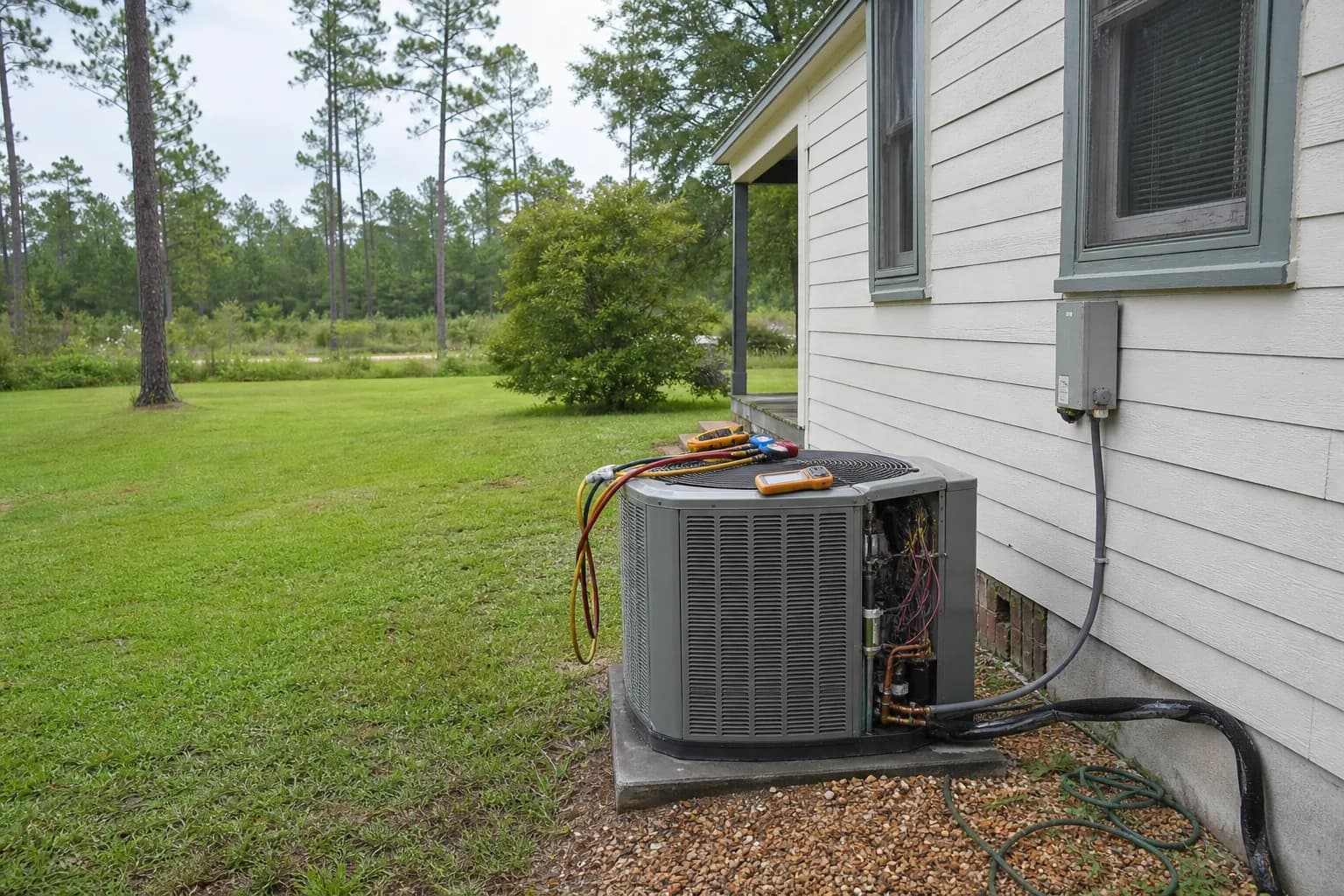
The Stockton Drain Pan Overflow That Soaks a Hallway Ceiling
The failure mode that destroys hallway drywall in Stockton homes: a clogged drain line, a stuck float switch, and an air handler over finished living space.
Published 2026-08-17 · Updated 2026-08-17
Author: Landon Jahnke | ACExperts251
Reviewed by: Landon Jahnke · Owner · Alabama HVAC License AL #16117 · EPA 608 Certified
Here's the failure mode that quietly destroys hallway drywall in Stockton homes off Highway 59. Three things have to go wrong simultaneously. They do.
A typical setup: the air handler sits in a closet between the kitchen and the master bedroom hallway, with the indoor coil's primary drain pan directly over a stretch of hallway drywall. The install included a secondary auxiliary pan beneath the primary, and a float switch on the auxiliary pan that's supposed to cut power to the air handler if water reaches it. Two-layer protection. Code-compliant.
On a Tuesday afternoon in August, with nobody home and the AC running on its summer schedule against high outdoor humidity, the system runs hard. The primary drain line — a 3/4-inch PVC run that exits the closet, runs horizontally through the attic, and discharges to the side of the house — has been quietly building biofilm at a low spot where the pipe sags between two attic joists. Today is the day the biofilm completes its job and stops flow. Water backs up in the primary pan, crests the lip, and starts dripping into the auxiliary pan. The float switch in the auxiliary pan should trip and shut the system down.
It doesn't, because mineral deposits from the condensate water — Stockton well water carries enough mineral content to leave precipitate behind — have cemented the float in the down position. The auxiliary pan fills. Water spills out the front-right corner onto the closet floor and pools above the hallway drywall. By the time anyone gets home, the hallway ceiling has a brown stain across two drywall panels and water is still dripping. The HVAC system, of course, is still running.
That's the failure mode. Repair is a separate drywall contractor on top of the HVAC work, and the long-tail cabinet corrosion on the air handler itself means the unit is going to fail earlier than it should have. A routine drain clear before the summer would have prevented the entire chain.
The upstream cause, in detail
Three things failed simultaneously to produce the wet ceiling. Removing any one of them would have prevented it.
Cause one: the primary drain line was never serviced. In Baldwin County humidity, a drain line without periodic clearing builds biofilm at every low spot. Several years with no clear, no flush, no biocide is enough time for a colony to fully clog a sag in the line.
Cause two: the auxiliary float switch was mineral-locked. Float switches need to actually move. The Stockton water table runs higher iron and calcium than coastal Baldwin County municipal supply, and condensate water from the coil carries trace mineral content that precipitates out as the water sits in the auxiliary pan during normal operation. Over years, that precipitate cements the float. By the time it needs to work, it can't.
Cause three: the air handler is over finished living space without redundant protection. A primary pan with a clogged drain. An auxiliary pan that's supposed to catch the overflow. A float switch that's supposed to shut everything down before the auxiliary pan fills. Three layers of protection, all of which have to fail for water to reach drywall — and on this Tuesday, all three did, in sequence, over the course of a couple hours.
The third cause is the design lesson. Two-layer protection over finished space is code-compliant. Three-layer is what I'd install for my own family. The third layer is a second float switch — placed on the auxiliary pan but with its own independent circuit cut to the thermostat, so even if the primary float fails, the second one still kills the call for cooling.
What the homeowner could have caught
Six things, any one of which would have prevented the failure.
The musty smell weeks earlier. A "wet cardboard" smell at the bedroom registers is the drain line biofilm beginning to colonize aggressively. Smell at registers should always be diagnosed within a week.
The system shutting off briefly on random afternoons. Thermostat history that shows unexplained short off-cycles — well under a minute — is the auxiliary pan float trying to trip but bouncing back as the float partly frees itself. Repeated trip-and-recover behavior is a precursor to total stick.
The bill creep. A restricted drain causes the coil to operate slightly flooded — a small pool of water in the primary pan that the coil sits above. Flooding reduces evaporator heat transfer and forces longer cycles. The bill noticed before the homeowner did.
The water stain that had been visible at the bottom of the closet for weeks. Closets don't get opened much in summer. The lower cabinet seam often shows old rust streaks consistent with a slow cabinet leak that's been happening intermittently for weeks. Worth a look any time you're in the closet.
The condensate line discharge. The drain line typically exits to a flowerbed or a gravel patch on the side of the house. That spot should have visible drips during peak afternoon cooling. If the bed is dry on a hot afternoon, the line is blocked. Worth a fifteen-second walk around the house once a week in summer.
The skipped annual maintenance visit. This is the foundational cause. Several years of no professional drain clears, on a Stockton home with well water and a long attic run, is the condition that lets the rest of the failure unfold.
For the Stockton-specific seasonal context on what shows up on routine visits here, the 12 Stockton pre-summer calls post walks through the cluster of issues common in this area. For the broader humid-Baldwin-County moisture story, the Spanish Fort tight build humidity post covers a different version of the same coil-side moisture problem.
What the repair looks like and what the math is
A call like this on the HVAC side is several hours on site: drain clear with a wet/dry vac at the discharge end and a nitrogen blowout at the cleanout port, biocide flush, both float switches replaced with new (don't gamble on cleaning a stuck switch — they're cheap parts, just swap), saturated insulation jacket pulled off the air handler base and the cabinet treated for biofilm, standing water vacuumed from the auxiliary pan, and any small condensate leak at the trap sealed.
The drywall repair is a separate contractor. Cleanup, drywall, paint, and carpet pad replacement on a hallway ceiling like this typically runs into the thousands.
For exact pricing on a drain clear, float switch replacement, or full water-damage assessment, call 251-383-HVAC. The service fee is $79 and replacement estimates are free.
The long-tail cost is the unit itself. A 2018-era air handler that's spent months in intermittent moisture comes back with corrosion at the cabinet bottom and heat-exchanger insulation damage. The brown stain on the cabinet doesn't come off; it's been baked in. The unit may still function, but it's now a much-shorter-life replacement candidate instead of a unit you'd expect to run another decade. That's the long-tail cost of a single drain clog.
The two-float-switch standard, and what changed in how we approach Stockton homes
Three things worth knowing if you're a Stockton homeowner reading this.
Two float switches on every install or replacement where the air handler sits above finished living space. Code minimum is one. Two, on independent circuits, gives you redundancy on the exact failure mode where the first switch is stuck.
Drain-line cleaning is a standard line item on every preventive maintenance visit for any system past its early years. The cleaning isn't optional on north Baldwin County properties where well water and long attic runs combine.
A tighter inspection cadence for attic air handlers. Drain inspection at every visit, full clear and flush on a regular interval — especially on properties with well water and long attic runs. This is what the Comfort Plan at $20/month or $240/year is built for.
For the broader emergency-side context on Stockton response timing, the Stockton Fourth of July triage post covers when to call versus when to wait for a daytime visit.
The 90-second test for your own home
Walk to the air handler closet. Open the cabinet front. Three things to look for.
Standing water in the primary pan? Should be dry or slightly damp at most. A pool of water means the drain is partly clogged.
Visible biofilm or sludge in the primary drain port? If you can see brown or black slime at the entrance to the drain line, the line itself is worse.
Float switch presence and accessibility? Locate the small white plastic box on the side of the drain line or attached to the auxiliary pan. Note whether it's there at all (it should be), and whether the float can be moved by gentle finger pressure (it should move freely).
If any of those raise a flag, schedule a drain clear. A small cleaning bill versus several thousand in hallway repair plus a unit that's now on a shorter replacement runway — the math isn't subtle.
Call 251-383-HVAC for a drain inspection or sign up for the Comfort Plan and we'll handle it on a regular cadence.
FAQ
- How do I tell if my Stockton AC drain line is clogging before the ceiling falls?
- Three early signs. One: musty smell at supply registers, which means biofilm is colonizing the drain pan and the line. Two: water or rust streaks visible inside the air handler cabinet at the bottom seam. Three: the system intermittently shutting off mid-cycle for no obvious reason — that's the float switch in the secondary pan doing its job. Any of those, schedule a drain clear within the week. Don't wait.
- What does a Stockton drain line clear cost?
- For exact pricing on a drain clear with line flush, vacuum, and biocide treatment, call 251-383-HVAC. The service fee is $79 and we'll write the repair quote against the actual configuration. If access is restricted (attic air handlers, encapsulated closets, manufactured home configurations) the labor scales up. Compared to what a hallway-ceiling repair costs once the drywall has dropped, the math favors the drain clear by a wide margin every time.
- Why do Stockton homes seem to clog drain lines faster than Daphne or Fairhope?
- Two factors. One: Stockton's older housing stock and rural acreage often have longer drain-line runs through unconditioned attics, with more horizontal distance and more low-spot opportunities for biofilm to settle. Two: well water on many Stockton properties carries different mineral content than municipal supply, and that mineral content interacts with humid attic conditions to accelerate biofilm. Same physics as the coastal cities, different rate.
- Should I install a secondary float switch if my Stockton home doesn't have one?
- Yes, if the air handler is anywhere above finished living space — attic, bonus room, second-floor closet. A float switch installed in the secondary pan is a small addition that prevents the exact failure mode this post describes. If the air handler is in a basement or garage where overflow lands on a floor drain or concrete, lower priority but still recommended for the early-warning value.
Need this handled?
Straight to the service page for your town — pricing, local details and a form that reaches a technician.
More from Drain Line Clogs

ACExperts HVAC
We Take The Heat So You Don't Have To
Fast, honest heating and air service across Baldwin County. Speak with a technician and get on the schedule today.