
Fairhope Historic Home HVAC Sizing: Why Bigger Isn't Better in the Fruit & Nut District
Sizing HVAC for a Fairhope Fruit & Nut District home — why oversizing leaves it clammy at 72°F, why ductwork matters more than equipment, and how we get it right.
Published 2026-05-05 · Updated 2026-05-05
Author: Landon Jahnke | ACExperts251
Reviewed by: Landon Jahnke · Owner · Alabama HVAC License AL #16117 · EPA 608 Certified
Fairhope is two towns wearing one name, at least where HVAC is concerned. There's the Fairhope of the Fruit & Nut District, Pittman Court, and the downtown historic district — Craftsman bungalows and Victorian cottages on pier-and-beam foundations, plaster walls, single-pane windows, and heating-and-cooling systems that got retrofitted into the house decades after it was built. Then, a few blocks east past Greeno Road, there's the Fairhope of Rock Creek, Stone Creek, and the newer subdivisions: spray-foam insulation, low-E double-pane glass, and tight envelopes that hold conditioned air the way a cooler holds ice.
Those two Fairhopes need opposite things from an air conditioner. And the most expensive mistake I see in either one starts the same way — a contractor sizing the new system off the old system's nameplate, or off a rule of thumb, instead of off the house actually in front of them. Over thirteen years working Baldwin County HVAC, I've watched that single shortcut cause more clammy-at-72°F complaints, more short-cycling, and more equipment dying years early than just about anything else.
So before we talk equipment, let's talk about why bigger isn't better, and why a historic Fairhope home in particular rewards getting the sizing exactly right.
The Fairhope housing-stock split that drives the math
The sizing calculation runs in opposite directions for the two halves of town, and it's worth understanding why.
Historic homes often need more capacity than the original retrofit installer specified, because the envelope leaks. Single-pane windows, gaps around hundred-year-old millwork, a vented crawl space underneath, an attic that breathes — all of that pulls in hot, humid Gulf Coast air the system then has to deal with. The cooling load on a leaky 1910 bungalow can genuinely be higher per square foot than the number a quick estimate would land on.
New construction almost always needs less capacity than the spec sheet suggests, because the envelope is tight. A Rock Creek or Stone Creek home built to current energy code barely leaks at all, which is great for the power bill but means the air conditioner's real job has shifted. It's not fighting a flood of outdoor air anymore. Its main job is pulling moisture out of the air that's already inside — and moisture removal is a slow, patient process that a too-big system never gets around to.
Get those backwards (undersize the leaky historic home, oversize the tight new build, which is exactly what happens when nobody runs the numbers) and both houses are uncomfortable in different ways. The county is full of both mistakes.
Why oversizing leaves a house clammy at the right temperature
This is the one that surprises people, so it's worth walking through slowly.
An air conditioner removes humidity only while the indoor coil is cold and air is moving across it. That's the dehumidification window. A correctly sized system runs a long, steady cycle — the coil stays cold for a good while, moisture keeps condensing out of the airstream and draining away, and the house ends up both cool and dry.
An oversized system does the opposite. It's got so much brute cooling capacity that it slams the air temperature down to setpoint in ten or twelve minutes and then shuts off — long before the coil has been cold long enough to wring much moisture out. The thermostat reads 72°F and is perfectly happy. Meanwhile the indoor relative humidity is still sitting north of 60%, and 72°F at 60% humidity feels muggy, sticky, and somehow not cool. So the homeowner's instinct kicks in: set the thermostat lower. Which makes it worse — now the system slams to the new lower number even faster, short-cycles even harder, and spends even less time in the dehumidification window.
That's the trap. You can't out-thermostat an oversizing problem. The fix isn't a colder setpoint or a bigger unit; it's a right-sized one that runs longer cycles. A two-stage or variable-speed compressor loafing along at half capacity for thirty minutes pulls far more moisture out of a house than a single-stage unit blasting at full tilt for twelve. When we do an AC installation on a tight Fairhope home, that's usually the lever — we measure the actual indoor humidity during the assessment and match the equipment to the real load, not to whatever was bolted to the slab before.
In a historic home, the ducts come before the equipment
Here's the part most replacement quotes skip entirely. Before I'll recommend equipment for a Fruit & Nut District or Pittman Court home, I want to see the duct system, because in these houses the ducts are usually the bigger story.
Original retrofit ductwork in an unconditioned crawl space or a hot attic tends to do three things after a few decades: it loses insulation, it pulls apart at the joints and takeoffs, and it stays sized for equipment that's no longer in the house. The result is leakage — a meaningful share of the conditioned air you're paying to make never reaches the rooms. It dumps into the crawl space or the attic instead. So when a homeowner tells me "the back bedroom never gets cold no matter what I set it to," the air conditioner is frequently working fine. The duct system is the actual problem, and a bigger unit would just leak more cold air faster.
The instrument that tells the story is static pressure at the air handler. If a system spec'd to run at half an inch of water column is actually fighting nearly a full inch, the ducts are strangling it — restricting airflow, dropping capacity, and shortening the life of the blower and compressor. Sealing those joints and re-insulating the runs delivers more comfort improvement, dollar for dollar, than upsizing the equipment ever could. There's a fuller walk-through of how to verify all this in reading a Manual J like a homeowner — the five numbers that tell you whether a contractor actually sized your system or just guessed.
When the architecture wins and mini-splits are the right call
Pier-and-beam foundations limit access to ductwork from below. Plaster walls and original trim limit what you can cut into without doing real damage to why you bought the house in the first place. Sometimes the honest answer is that running new central ductwork through a historic Fairhope home would cost more, look worse, and perform no better than the alternative.
That alternative is usually ductless. A mini-split system puts conditioned air directly into the space without needing ducts at all, which makes it the right tool for additions, sunrooms, bonus rooms, converted attics, and that one stubborn room the central system has never reached. You preserve the plaster, you preserve the architecture, and you get modern, quiet, variable-speed comfort that handles humidity well by design. I'd rather put a small ductless head in a sunroom than tear a chase through a ninety-year-old wall to drag a duct out there. The house tends to agree.
For whole-home situations where the central system stays but can't quite keep up with humidity on its own — common in the tighter new-construction half of Fairhope — a dedicated dehumidifier tied into the ductwork is the structural fix. It runs independently of the cooling cycle, so it pulls moisture even when the house doesn't need more cooling. That's a different post, but it's the same underlying principle: match the tool to what the house actually needs.
The salt-air layer sitting on top of all of it
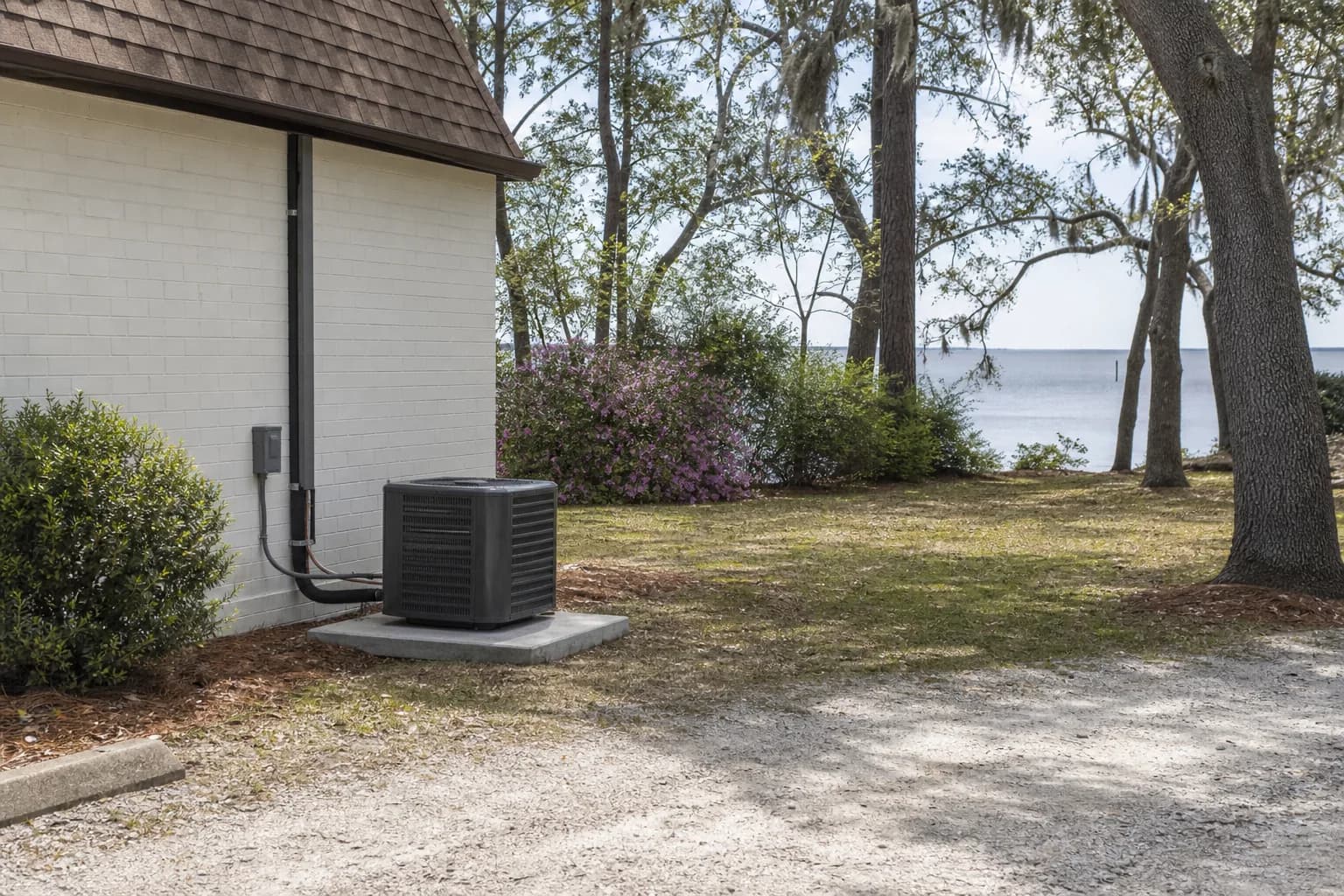
Fairhope carries some of the highest salt-air exposure in Baldwin County. The bay is close, the breeze is constant, and salt is hard on outdoor equipment — it pits contactors, eats aluminum condenser fins, and corrodes the copper connections at the coil. Near the water, that can pull the functional life of an outdoor unit down from the fifteen-to-twenty years you'd expect inland to more like ten to twelve without good maintenance.
This loops back to sizing in a way that isn't obvious. An oversized unit that short-cycles is already running its compressor and contactor through more starts and stops than it should. Add salt corrosion to a component that's getting hammered by short-cycling, and you've stacked two life-shortening problems on the most expensive part of the system. A right-sized unit that runs smooth, steady cycles and gets its coil cleaned on a schedule is the one that actually reaches the back half of its service life on the coast. For homes near the bay, we add coil-corrosion and electrical-connection checks to the regular maintenance visits for exactly this reason.
How we actually size a Fairhope home
When I come out for a replacement on a historic home, the visit is deliberately unhurried — Fairhope homeowners tend to know their houses well and ask good questions, and the homes earn the patience. We start by measuring the things that actually drive the load: the envelope, the windows, the insulation, the crawl space or attic condition, and the real indoor humidity. We look hard at the existing ductwork and take a static-pressure reading. Then we run the load calculation against the house in front of us instead of the nameplate on the old unit.
From there the recommendation falls out of the numbers. Sometimes it's a smaller, smarter, variable-speed system than what's out there now. Sometimes it's keeping the equipment and fixing the ducts. Sometimes it's a ductless head for the room the central system was never going to reach. Estimates on replacements are free, and if another company already handed you a quote, second opinions on it are free too — "it's old, get a bigger one" is not a load calculation, and you deserve the real math before you spend five figures. The Fairhope service-area page has more on how the historic-versus-new split shapes the work across town, and there's a companion piece on furnace repair on a historic Fairhope home that covers the heating side of these same old houses.
The short version: in a Fairhope historic home, bigger is not better. The right-sized system that runs long and steady, breathes through ducts that actually carry air, and gets kept clean against the salt will out-comfort and outlast a big one every time. If you're weighing a replacement, call 251-383-HVAC. We answer emergency calls 24/7, every day, and our regular scheduling hours for assessments and non-urgent work are Monday through Saturday, 8am to 6pm. An old house deserves the careful version — that's the whole job.
FAQ
- How do I know if my Fairhope AC is oversized?
- Three signs stack up. The system reaches setpoint fast (under about fifteen minutes) and shuts off. The house still feels clammy at the temperature you set. And the utility bill stays high despite the short runtime, because all that stopping and starting is the least efficient way to run a compressor. We measure the temperature split across the coil and the indoor relative humidity during the in-home assessment to confirm it before recommending anything — oversizing is the single most common sizing error we see in this county, and you can't fix it by setting the thermostat lower.
- Can I retrofit ductwork in a 1908 Fairhope Craftsman without damaging the architecture?
- Sometimes — it depends on the specific home. We assess crawl-space access, attic access, and the existing duct routing during the consultation. For homes where running new central ductwork would mean tearing into plaster or original millwork, ductless mini-splits often deliver better comfort with zero architectural damage, because they don't need ducts at all. We talk through both options honestly and let the house decide rather than forcing a one-size answer onto a home that predates forced-air heat.
- What's the right SEER rating for a Fruit & Nut District home?
- For most historic Fairhope homes, a mid-tier efficiency unit is the sweet spot. Chasing the highest SEER2 number on the shelf rarely earns back the equipment cost in our climate's cooling load — and the bigger comfort gain comes from variable-speed staging that handles humidity, not from a higher efficiency rating bolted onto a single-stage system that still short-cycles. We'd rather put the budget into right-sizing and duct sealing than into a number on a brochure.
- Why does my historic home cool unevenly room to room?
- Usually the ducts, not the equipment. Original retrofit ductwork in a pier-and-beam crawl space or an unconditioned attic tends to leak at the joints, lose its insulation jacket over the decades, and stay sized for equipment that's long gone. When a back bedroom never cools, the AC may be working perfectly while a real share of the conditioned air is leaking into the crawl space before it ever reaches the room. We measure static pressure and look at the duct system before we ever talk about a bigger unit.
- Does salt air off Mobile Bay change the sizing conversation in Fairhope?
- It changes the equipment-life conversation more than the sizing math, but the two are related. The Fruit & Nut District is within walking distance of the Municipal Pier, and the Point Clear corridor faces the bay directly, so outdoor condensers near the water corrode faster — fins, coil connections, and contactors all age early. That's an argument for a right-sized, well-maintained unit you keep clean rather than an oversized one you replace early. We fold coil and electrical-corrosion checks into maintenance for homes near the water.
Need this handled?
Straight to the service page for your town — pricing, local details and a form that reaches a technician.
Related reading
- Gulf Shores Vacation Rental HVAC: The Checklist That Prevents Friday-Checkout Failures
- Orange Beach Salt-Air HVAC Maintenance: The Schedule That Doubles Equipment Life
- Spanish Fort Tight-Build Humidity: Why Your New Home Feels Clammy at the Right Temperature
- Spanish Fort Thanksgiving HVAC Prep: 4 Things to Check Wednesday Night

ACExperts HVAC
We Take The Heat So You Don't Have To
Fast, honest heating and air service across Baldwin County. Speak with a technician and get on the schedule today.