
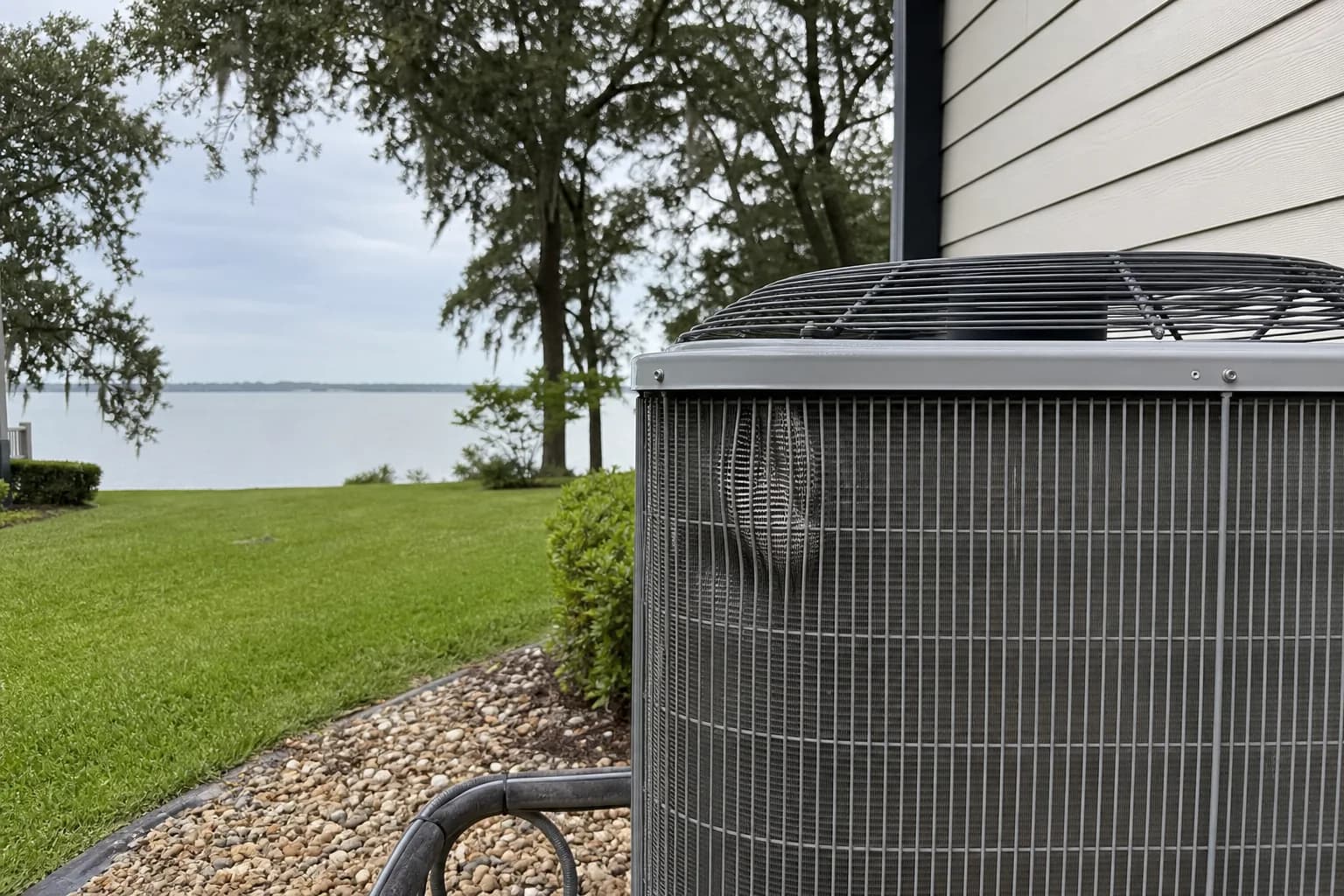
How a Fairhope Drain Line Clogs in 9 Pollen-Heavy Days — A Decision Tree at Every Node
How a Fairhope AC drain line clogs over 9 pollen-heavy days, and the decision tree for when it's still a DIY fix versus a service call. Spring oak pollen edition.
Published 2026-06-25 · Updated 2026-06-25
Author: Landon Jahnke | ACExperts251
Reviewed by: Landon Jahnke · Owner · Alabama HVAC License AL #16117 · EPA 608 Certified
If your Fairhope AC's drain line is clogged on Day 1, check the float switch — if it's tripped, you have 30 minutes before the secondary drain pan fills. If you're at Day 3, the indoor coil is starting to grow biofilm that won't clear from a vinegar flush alone. By Day 9 — and Fairhope's spring oak pollen makes Day 9 happen faster than Day 14 inland — the entire condensate pathway is colonized and the cleaning becomes a service call instead of a DIY.
Here's the decision tree at every node. I'll walk you through Day 1 through Day 9, the symptoms at each stage, the right action, and the cost of waiting one more day. Read it like a flowchart, not a story. The point is to know exactly which node you're standing on when you read this.
Day 1 — pollen lands, biofilm starts
You won't notice anything yet. The system has been running normally. The condensate is flowing the way it's supposed to flow. But the spring oak pollen carryover from March and April — heavier in the Fairhope Fruit & Nut District than anywhere else in Baldwin County — has been depositing on the outdoor coil all spring. Once the cooling season ramps and indoor humidity climbs, that pollen-fed substrate starts feeding biofilm in the indoor drain pan.
Symptom: none.
Decision node: preventive. Schedule the homeowner monthly drain treatment — pour 1 cup of distilled white vinegar into the indoor access port (the T-fitting near the air handler with the cap on top) once a month June through September. Cost: $5/year for a gallon of vinegar.
Cost of skipping: the line will be at Day 4 within four weeks if you skip preventive treatment.
Day 2 — flow slows, float switch is the early warning
The biofilm in the trap of the drain line is now thick enough to slow drainage. Water backs up in the pan slightly. The float switch — a small device clipped onto the secondary drain pan or the primary, depending on installation — sits at a level that triggers when water gets too high.
Symptom: system shuts itself off mid-cycle. Thermostat may show "low voltage" or just "off." Indoor temperature starts climbing. You walk to the air handler closet and see the float switch in the tripped position.
Decision node — IF FLOAT SWITCH TRIPPED:
Action 1: Don't reset and ignore. The float switch tripping means water is high in the pan. Reset without addressing the cause and you'll trip it again in 20 minutes, then again in 15, then the secondary pan will fill faster than the float can keep up.
Action 2: Find the outdoor drain termination — white PVC pipe sticking out of the house at ground level on whatever side of the home the indoor unit is on. Apply a wet/dry shop vac to the end of the pipe, hold for 60 to 90 seconds, listen for the "slurp" of water coming through. That's the clog clearing.
Action 3: Pour 1 cup white vinegar into the indoor access port. Wait 10 minutes. Then reset the float switch.
Time budget: 30 minutes. About 25 minutes of which is finding the shop vac and the access port if you've never done this before. Cost: $0 if you own a shop vac, $5 for vinegar.
Cost of skipping or just resetting the float without clearing: the line clogs harder by Day 3, and you've now got water that sat in the line for an extra day giving biofilm extra growth time.
Day 3 — biofilm thickens, the vinegar window narrows
If you cleared the Day 2 clog with the shop vac, you're back to Day 1 — the line is clear, biofilm is minimal, monthly preventive treatment will hold. If you didn't, or if you missed the float switch warning entirely, you're now on Day 3.
Symptom: float switch trips repeatedly. Water around the base of the air handler. If the unit is in an attic, you may see a stain forming on the ceiling below.
Decision node — IF SYMPTOMS RECURRING:
Action 1: The shop vac is still effective at this stage but needs to be applied for longer — 2 to 3 minutes, possibly with a second pass after a 5-minute soak with vinegar.
Action 2: Vinegar treatment becomes mandatory, not optional. 2 cups instead of 1, poured directly into the indoor access port.
Action 3: Verify the secondary drain pan is dry. If it has standing water, the primary clog is bad enough that water has overflowed the primary and entered the secondary.
Time budget: 60 to 90 minutes. Cost: $0 to $25 (you may need to buy a longer hose adapter for the shop vac if your outdoor termination is in an awkward spot).
Cost of skipping: Day 4 is where the real trouble starts.
Day 4 — water on the floor, biofilm has structure
The biofilm is no longer a thin film. It's developed matrix structure — visible as a slimy, gel-like layer if you could see inside the pipe. The matrix anchors the biofilm to the pipe wall, which means simple flushing doesn't dislodge it. Water is now actively accumulating.
Symptom: standing water in the air handler closet, on the closet floor, or pooling near the unit. Possibly a wet stain on a ceiling below the unit if it's in an attic. Float switch may be permanently tripped.
Decision node — IF STANDING WATER PRESENT:
Action 1: Towels, immediately. Stop the property damage from getting worse.
Action 2: Vacuum the line as before. This will partially work — the matrix biofilm is still soft enough to be pulled by suction, but you may need three to five passes.
Action 3: Vinegar is no longer enough on its own. Try a 1:1 vinegar-to-hot-water mixture, poured generously into the access port, allowed to sit for 30 minutes, then vacuumed at the outdoor termination. Cost of mixture: $5.
Action 4: Check the secondary drain pan. If it has water, you need to drain it manually — most have a drain plug or a hose connection.
Time budget: 2 to 3 hours including soak time. Cost: $5 to $30. Property damage cost if you don't act: hundreds to low thousands in drywall, paint, and possible flooring.
Cost of skipping: the matrix biofilm at Day 5+ stops responding to homeowner methods entirely.
Day 5 — musty smell appears, biofilm starts metabolizing
By Day 5 the biofilm in the drain line has reached the point of producing volatile organic compounds — the smell. You'll notice it when the system fan kicks on. It's a wet, sour, mildewy smell, distinct from the lighter "first-cycle dust" smell some systems produce in spring.
Symptom: musty smell from supply registers. May be most noticeable in rooms with the largest registers or closest to the air handler. Standing water issues continue.
Decision node — IF SMELL PRESENT:
You're now at the threshold where DIY methods have a meaningful failure rate. A good portion of Day 5 cases respond to aggressive vinegar-and-vacuum treatment. The rest require mechanical clearing and possibly biocide treatment in the drain pan.
Action 1: One last DIY attempt — full vinegar flush, 30-minute soak, vacuum pull, repeat once. If the smell goes away within 24 hours, you cleared it. If it doesn't, escalate.
Action 2: Call for the $79 diagnostic visit if the smell persists. I'll bring the CO2 cartridge gun, which clears the line mechanically in about 4 minutes, and treat the drain pan with biocide.
Time budget: 24 hours of waiting after DIY attempt, then escalate if needed.
Cost of skipping: Day 7+ becomes a multi-component cleaning, not just a drain line.
Day 6-7 — drain pan biology, system efficiency drops
Biofilm in the drain pan itself starts forming. The pan now has standing water (because the line is so clogged it can't drain), the water is warm (because it's sitting under a cooling coil), and the pollen-fed substrate is feeding bacterial growth in the pan.
Symptom: smell intensifies, particularly when system has been off and then kicks on. System efficiency is now measurably lower because the indoor coil has organic film building on the underside. Cooling capacity may drop 8 to 15%.
Decision node — IF EFFICIENCY DROPS NOTICEABLE:
You're past the homeowner-fix window. Even mechanical drain line clearing won't restore the system to full efficiency, because the indoor coil itself now has biofilm.
Action 1: Service call. I come out, mechanically clear the drain line (CO2 cartridge gun), drain and treat the pan (biocide), and inspect the indoor coil. If the coil is light to moderately fouled, I clean it in place. If it's heavy, it may need to be pulled for a full chemical wash. I quote the cleaning after I see the condition.
Time budget: half-day service visit.
Cost of skipping: Day 9+ adds duct contamination to the list.
Day 8 — secondary pan fills, ceiling damage probable
If your indoor unit is in an attic — common in older Fairhope historic homes where retrofit air handlers got placed wherever they fit — the secondary drain pan is now your last defense between the system's water and your ceiling. By Day 8, that pan is either full or full-and-overflowing.
Symptom: wet ceiling stain expanding rapidly. Possibly active dripping. The float switch may have stopped tripping because the water has overflowed past the switch's detection level.
Decision node — IF CEILING DAMAGE PRESENT:
This is now a property emergency, not just an HVAC issue. The system itself is the underlying cause but the immediate problem is water damage.
Action 1: Turn the system off at the thermostat immediately. Don't try to keep cooling the house — every minute the system runs is more water on the ceiling.
Action 2: Call 251-383-HVAC. Emergency calls run day or night, every day. I'll prioritize.
Action 3: While waiting, towel the standing water in the air handler closet, place a bucket under the dripping ceiling, and document the damage with photos for your homeowner's insurance.
Time budget: half-day service visit. Drywall and ceiling repair are separate trades.
Cost of skipping: Day 9+ adds mold remediation to the list.
Day 9 — colonized line, expensive cleaning, possible duct contamination
By Day 9, the entire condensate pathway is colonized. The drain line, the drain pan, the indoor coil underside, the air handler interior insulation, and possibly the first six to twelve feet of supply duct have biofilm or mildew growth.
Symptom: musty smell now constant, not just at startup. Visible mildew on supply register vents possible. Some homeowners report respiratory irritation, increased allergy symptoms, or asthma triggering.
Decision node — IF DAY 9 OR LATER:
Full system decontamination, not just a drain cleaning.
Action 1: Service call. Comprehensive evaluation: drain line mechanical clearing, pan replacement if pitting is bad, coil chemical wash, blower wheel cleaning, air handler interior insulation inspection (and replacement if mildewed), and duct cleaning at the supply registers nearest the air handler. Pricing scales with how much needs to be touched — I quote it after I see it.
Time budget: full-day service visit, sometimes split across two days.
Cost of further skipping: the Fairhope spring pollen and HVAC post walks through the IAQ implications of letting it go further. It's not pretty.
The Fairhope-specific accelerator
Most cities don't go from Day 1 to Day 9 in 9 calendar days. In Fairhope, they can.
Three factors compound here that don't compound this way anywhere else in Baldwin County:
The oak canopy. Live oaks and water oaks line the streets of the Fruit & Nut District, the Lakewood neighborhood, Montrose, and most of the historic core. Oak pollen output peaks the second and third weeks of March and lingers in the air through April and into May. Pollen settles on outdoor units, gets pulled into the system, and provides the organic substrate that feeds biofilm growth all summer. Inland Baldwin County cities like Robertsdale don't have this canopy density.
Bay-driven humidity. Fairhope's bay proximity means indoor humidity loads run higher year-round than inland cities. Higher humidity feeds biofilm faster. The Mobile Bay salt-air corrosion patterns covered in the coastal post compound the problem from a different angle — the equipment fights aging from outside while biofilm grows from inside.
Older retrofit drain lines. A lot of historic Fairhope homes — particularly in the Fruit & Nut District — have HVAC drain lines that were installed during retrofits decades ago. These are often undersized PVC, sometimes with sub-optimal slope, sometimes terminating in difficult-to-access locations. A drain line that should drain readily often drains slowly even when clean, which means biofilm has more time to establish.
These three factors mean a Fairhope drain line that started Day 1 in the second week of June can hit Day 9 by the last week of June if nothing is done. The same line in Stockton or Bay Minette might take 3 to 4 weeks to reach Day 9.
What to do this week
If you live in Fairhope and you haven't pulled the cap off your indoor drain access port to look in the last 30 days, do that this week. If the water is clear and flowing, you're at Day 1 — pour a cup of vinegar in, monthly through September, and you'll likely never see Day 9. If the water is cloudy or smells, you're at Day 4 or 5, and you have a window of about 48 hours to clear it yourself before escalating.
If you don't have a wet/dry vac, the Comfort Plan covers two visits a year that include drain line clearing, pan treatment, and a check of the line slope and termination. $20/month or $240/year, includes 10% off repairs and replacements, $0 service fees, and no overtime fees. The math works for any Fairhope home with the oak-canopy-bay-air combination, which is most of them.
The decision tree above is the field reference. The two big nodes — float switch tripping (Day 2) and standing water present (Day 4) — are the two moments where homeowner action saves the most money. After Day 5 it's my visit. Before Day 2 it's prevention.
Pay attention to your house. Oak pollen on the outdoor unit isn't just a curb-appeal issue. It's the timer starting on the drain line.
FAQ
- Can I really clear a clogged drain line myself on Day 1 or Day 2?
- Yes. A wet/dry shop vac at the outdoor termination of the drain line, run for 60 to 90 seconds, will clear most early-stage clogs. The trick is finding the outdoor termination — usually a white PVC pipe sticking 6 to 12 inches out of the side of the house at ground level, sometimes routed under landscaping. Pour a cup of distilled white vinegar into the indoor access port (the T-fitting near the air handler with the cap on top) afterward to address any biofilm starting to grow upstream. Total cost: $0 if you own a shop vac, $5 for the vinegar.
- Why do Fairhope drain lines clog faster than the Eastern Shore average?
- The oak canopy. Fairhope's tree cover — particularly the Fruit & Nut District, the Lakewood and Montrose neighborhoods, and any block within walking distance of downtown — is dense live oak and water oak. March-April pollen settles on outdoor units, gets pulled into the system through normal operation, lands on the indoor coil, washes down with condensate, and lodges in the trap of the drain line. Inland cities without the oak canopy don't get the same load. The bay-air humidity then accelerates biofilm growth on the pollen-fed substrate.
- Will a vinegar flush actually do anything past Day 3?
- Less and less as days pass. Vinegar at Day 1-3 is a perfectly fine prophylactic and will dissolve light biofilm. By Day 5-6 the biofilm has matrix structure that vinegar can soften but not fully remove. By Day 9 the line is colonized — the biofilm is anchored and the only reliable cleaning is mechanical (CO2 cartridge, nitrogen blow-out, or full line replacement). On heavily clogged lines I use a CO2 cartridge gun — fast, no chemicals, no pulling apart the air handler.
- How do I know which day I'm on without a calendar?
- Three signals. Day 1-2: float switch trips, system shuts off, you reset it and it runs again. Day 3-4: water around the air handler closet or indoor unit, sometimes a wet ceiling stain if the unit is in the attic. Day 5-7: musty smell when the system kicks on, which means biofilm is now releasing volatile compounds. Day 8-9+: wet sheetrock, sustained drips, and the float switch may stop tripping at all because the secondary pan has filled and is overflowing rather than catching the problem.
Need this handled?
Straight to the service page for your town — pricing, local details and a form that reaches a technician.
More from Drain Line Clogs

ACExperts HVAC
We Take The Heat So You Don't Have To
Fast, honest heating and air service across Baldwin County. Speak with a technician and get on the schedule today.