
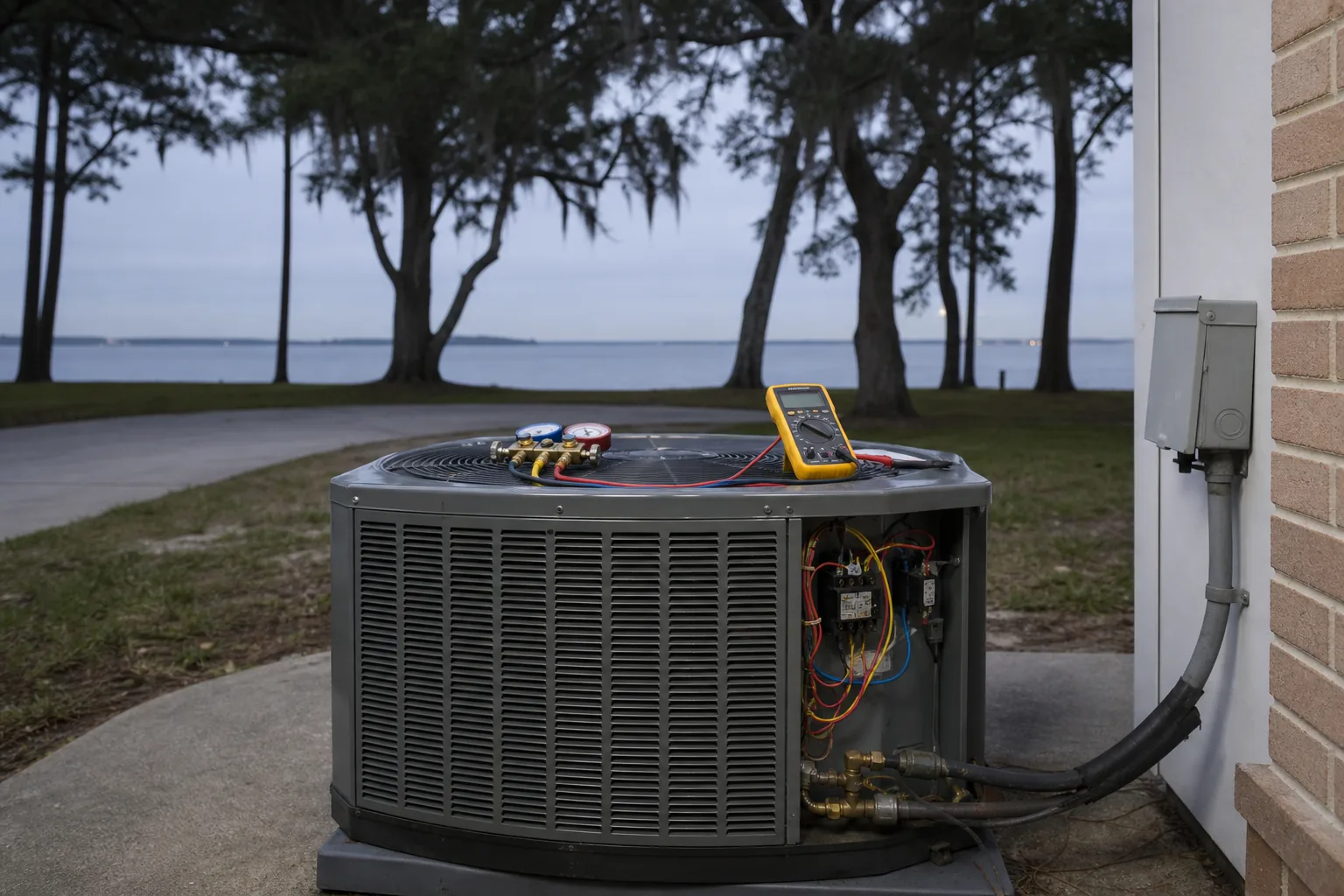
Warm Air From a Spanish Fort AC: 11 Causes Ranked by Likelihood
Warm air from a Spanish Fort AC: 11 causes ranked by how often we see them in Baldwin County. Diagnose in order, fastest first, since most are in the top three.
Published 2026-07-13 · Updated 2026-07-13
Author: Landon Jahnke | ACExperts251
Reviewed by: Landon Jahnke · Owner · Alabama HVAC License AL #16117 · EPA 608 Certified
Ranked from most likely to least likely cause of warm air from a Spanish Fort AC, drawing on 13 years of Baldwin County HVAC work: #1 frozen indoor coil, #2 dirty or clogged filter, #3 capacitor failure, #4 thermostat in heat mode by accident, #5 outdoor fan motor seized, #6 refrigerant leak, #7 contactor stuck open, #8 disconnect switch tripped, #9 control board failure, #10 reversing valve stuck (heat pumps), #11 ductwork disconnected.
Here's how to diagnose each one in order, fastest first. Most homeowners find theirs in the top three causes — meaning a 10-minute self-check and a clear answer for the tech on the phone. The bottom four require a service call but are at least worth knowing exist so you can rule them in or out.
Why these specific eleven, in this specific order
Spanish Fort housing skews newer than most of Baldwin County — median construction year 1999, heavy weight in 2000-onward subdivision growth across Stillwater, Stonebridge, Rayne Plantation, TimberCreek, and Audubon. The failure profile reflects that. Newer systems running through tighter envelopes with marginally undersized returns produce a different distribution than the older retrofit-AC homes you'd see in Robertsdale or Bay Minette.
Frozen indoor coil is the single most common cause I see in Spanish Fort warm-air calls. Far more often than in an older retrofit market, the airflow restriction at the indoor coil is the airflow-engineering legacy of production-builder ductwork — undersized returns, long flex runs, and tight closet air-handler placements.
Diagnostic order matters because the cheapest tests rule in or rule out the most common causes. Walk the order in sequence. Don't skip ahead.
Cause #1 — Frozen indoor coil
How to confirm at home: Turn the system off at the thermostat. Wait fifteen minutes. Open the air handler access panel (usually in a closet, attic, or garage) and look at the indoor coil. If you see ice, frost, or condensation puddles on the access panel, that's your cause.
What to do before the tech arrives: Set the thermostat to fan-only mode (system off, fan on) for 2 to 3 hours. The fan blows warm indoor air across the iced coil and thaws it.
What the tech does: Identifies why the coil froze. The four common reasons in Spanish Fort: dirty filter, dirty coil face, undersized return air, or low refrigerant. The first three are airflow problems. The fourth is a refrigerant problem masquerading as an airflow problem because low charge produces low coil temperature even at correct airflow.
Cost to fix: varies by what airflow problem is driving the freeze — filter and basic coil clean on the low end, deep coil clean with refrigerant adjustment and a return-air recommendation on the high end. Call 251-383-HVAC for a written quote after diagnosis.
Cause #2 — Dirty or clogged filter
How to confirm at home: Pull the filter. Hold it near a flashlight beam. If you can't see light through it clearly, replace it. Many Spanish Fort homes use 1-inch pleated filters that should be replaced every 60 to 90 days during summer; a filter that's been in place for 6 months is functionally a felt mat.
What to do: Replace with a new filter of the same nominal size and a MERV rating between 8 and 11. Higher MERV ratings restrict airflow more, which can cause the same problems as a clogged filter on Spanish Fort production-build systems with marginal returns.
What the tech does, if you call: Replaces the filter, runs static pressure measurements to confirm airflow is back in spec, and recommends a filter cadence appropriate to your specific home.
Cost to fix: a few dollars if you do it yourself. Our $79 service fee covers the diagnostic if a tech comes out, with any further repair quoted in writing before work starts.
Cause #3 — Capacitor failure
How to confirm at home: Listen at the outdoor unit during a thermostat call for cooling. A failed capacitor produces a humming sound for 5 to 30 seconds with the fan not spinning, then either the system gives up and the breaker trips, or the fan starts hesitantly. A capacitor on its way out (not yet fully failed) produces a slight delay between the contactor click and the fan spin-up.
What to do: Don't try to replace it yourself. Capacitors hold a lethal charge even when disconnected. Call.
What the tech does: Powers off, discharges the capacitor with a proper bleed resistor, microfarad-tests the cap, replaces it with a Mars or Genteq part rated for coastal conditions.
Cost to fix: varies by capacitor type and rating — call 251-383-HVAC for a written quote. The Daphne capacitor failure pattern post walks through the underlying mechanism.
Cause #4 — Thermostat in heat mode by accident
How to confirm at home: Look at the thermostat. Mode setting should say "COOL" or "AUTO" — if it says "HEAT," the system is calling for heat and the heat strips or heat pump is producing warm air on purpose.
This sounds embarrassing, but it shows up more often than people expect. The common scenarios: a houseguest changed the thermostat setting; a smart thermostat was reset and defaulted to heat mode; or a homeowner adjusted settings during a power outage and missed the mode toggle.
What to do: Switch to "COOL." Confirm the cooling setpoint is below current room temperature. Wait 15 minutes for the system to start a cooling cycle.
Cost to fix: $0.
Cause #5 — Outdoor fan motor seized
How to confirm at home: Walk to the outdoor unit during a thermostat call for cooling. If you hear the compressor running (a low hum) but the fan blade is not spinning, the fan motor is either seized or its capacitor side has failed. The system will short-cycle on the high-pressure switch within 2 to 4 minutes.
What to do: Turn the system off at the thermostat. Running it with a non-spinning condenser fan damages the compressor.
What the tech does: Confirms the motor is seized (versus just a fan-side capacitor failure), replaces the motor, replaces the dual-run capacitor as part of the same service.
Cost to fix: depends on motor horsepower and brand — call 251-383-HVAC for a written quote after diagnosis.
Cause #6 — Refrigerant leak
How to confirm at home: Hard to diagnose without gauges. The signature is a gradual decline in cooling performance over weeks or months — not a sudden failure. The supply air temperature drops less and less below the thermostat reading. Eventually you reach the warm-air threshold.
What to do: Call. Don't add refrigerant yourself.
What the tech does: Confirms low charge with gauges, leak-tests with electronic detector or UV dye, repairs the leak (most common in Spanish Fort: Schrader cores at the service valves, indoor coil failures on systems past year 12), evacuates and recharges to spec.
Cost to fix: ranges widely — a Schrader core fix and small recharge is on the cheap end; an indoor coil replacement on an older R-22 system where refrigerant cost dominates the bill is on the high end. Call 251-383-HVAC for a written quote after diagnosis. Often discoverable through proper tune-ups before it presents as a full failure.
Cause #7 — Contactor stuck open
How to confirm at home: Walk to the outdoor unit. Listen for a click when the thermostat calls. If you hear no click and no compressor or fan activity, the contactor is failing to close. If the breaker hasn't tripped, the issue is mechanical or electrical at the contactor itself.
What to do: Call. Don't open the outdoor unit panel without proper training.
What the tech does: Confirms the contactor is failing to close, replaces it with a 30-amp single-pole part, tests the system through several cycles to confirm reliable closure.
Cost to fix: call 251-383-HVAC for a written quote after diagnosis.
Cause #8 — Disconnect switch tripped
How to confirm at home: The outdoor disconnect is the small box mounted on the wall next to the outdoor unit. Open it. Look at the cartridge fuses or breaker inside. A tripped or pulled disconnect kills power to the outdoor unit while the indoor unit continues running, producing warm-air-blowing symptoms because the air handler is moving air across an uncooled coil.
What to do: If the disconnect is in the off position, push it back to on. If the fuses are blown, don't replace them yourself — that requires confirming why they blew. Call.
What the tech does: Confirms whether the disconnect was simply switched off (sometimes by lawn crews, sometimes by a previous tech who forgot to reset it) or whether the fuses are blown for a real reason. Replaces fuses, traces the underlying cause if applicable.
Cost to fix: $0 if it's just a switched-off disconnect. If fuses blew and the cause needs investigation, our $79 service fee covers the diagnostic and any further repair is quoted in writing first.
Cause #9 — Control board failure
How to confirm at home: Indoor air handler shows no LED activity or shows a flash code visible through the access panel. Outdoor unit may or may not be running independently — control board failures sometimes affect just one half of the system.
What to do: Call. Don't reset the system multiple times — repeated power cycling can damage other components.
What the tech does: Reads the diagnostic flash code or connects a service tool to the board, confirms the failure, sources a replacement board (often a 2-to-5-day lead time for less common units), installs and tests.
Cost to fix: depends on the board and the unit — call 251-383-HVAC for a written quote after diagnosis.
Cause #10 — Reversing valve stuck (heat pumps only)
If your Spanish Fort home is on a heat pump rather than a straight central AC, the reversing valve is the component that switches between heating and cooling modes. A stuck valve produces warm air in cool mode because the system is effectively stuck in heat mode regardless of thermostat setting.
How to confirm at home: Check the outdoor unit. Heat pumps have a brand and model number that typically includes "HP" in the designation, or you can check the data plate for "heating capacity" specs in addition to cooling specs.
What the tech does: Tests the reversing valve solenoid, confirms whether the valve itself is mechanically stuck or whether the solenoid has failed, repairs accordingly. Reversing valve replacements can be involved — sometimes the right answer is a system replacement conversation if the unit is older.
Cost to fix: a solenoid swap is on the cheap end; a full valve replacement with refrigerant recovery and recharge is on the high end. Call 251-383-HVAC for a written quote after diagnosis.
Cause #11 — Ductwork disconnected
How to confirm at home: Walk through the house. Are some rooms cold and others warm? Is there air blowing into the attic or crawlspace that you can hear or feel? In Spanish Fort attic ductwork installations, a single disconnected supply trunk can dump 30% of the cooled air into the attic instead of the bedroom.
What the tech does: Pressure-tests the ductwork, identifies the disconnection, repairs and seals.
Cost to fix: depends on location and severity — call 251-383-HVAC for a written quote after diagnosis.
What this list means for a Spanish Fort homeowner
Most warm-air calls in Spanish Fort resolve in the top three causes — frozen coil, dirty filter, and capacitor failure — and most homeowners can self-diagnose at least the first two in under fifteen minutes. Adding the thermostat-mode check covers nearly every common cause.
What's left is a long tail spread across the remaining causes, none of which dominate. This is where the diagnostic call earns its money. A tech with a multimeter, gauges, and the right parts on the truck can rule them in or out within 30 to 60 minutes.
The cluster on this page goes deeper. The pre-summer HVAC punch list for Daphne homeowners covers the prevention work that catches the top three causes before they present as warm air. The salt-air maintenance schedule covers the bay-influence component on the eastern shore that affects Spanish Fort more than homeowners realize. And the seven signs your AC needs repair before it quits post covers the broader symptom spectrum.
Calling for diagnosis in Spanish Fort
If you've worked through the top four self-checks and your system is still blowing warm air, call 251-383-HVAC. Our Spanish Fort service covers the full diagnostic order with written reports.
The diagnostic is our $79 service fee in Spanish Fort. The most likely outcome is a moderate repair quoted in writing before any work starts. The unlikely-but-possible outcome is a larger repair on an older system, at which point the Repair vs Replace calculator becomes the right next conversation. Replacement estimates are free.
Eleven causes. The top three account for most calls. The remaining eight are why we still send a tech.
Diagnose the cheap stuff first. Call when you've ruled it out.
FAQ
- How do I tell if my Spanish Fort AC is blowing warm air or just under-cooling?
- Hold a thermometer in the air coming out of a supply register for 90 seconds with the system running steadily. Compare it to the thermostat reading. A healthy system in 90°F outdoor weather should produce supply air 18 to 22°F cooler than the return air — so if your thermostat reads 76°F, the supply register should read 54°F to 58°F. If the supply air is within 5°F of the thermostat reading, the system is either not cooling at all (warm air) or barely cooling (severely under-charged or under-airflow). If the supply air is 12°F to 17°F cooler than the thermostat, the system is running but underperforming, which is a different conversation than 'warm air' — that's usually charge or coil cleaning, not a failure.
- Why is the frozen indoor coil the most common cause in Spanish Fort?
- Tight modern construction. Spanish Fort housing skews newer — median construction year 1999, with significant 2010-onward growth in Stillwater, Stonebridge, and Rayne Plantation. Production-built homes often have undersized return-air systems that restrict airflow across the indoor coil. When airflow drops below the threshold needed to keep the coil above 32°F at the pressure the system is operating, ice forms. Ice further restricts airflow. The cycle compounds within 2 to 6 hours of running and the homeowner notices warm air at the registers. The fix is the underlying airflow problem — not just thawing the coil and walking away. Coil clean, filter swap, and sometimes a return-air upsize. The return-air sizing problem is so common in Spanish Fort spec construction that we treat it as a default suspect on warm-air calls there.
- How do I tell the difference between a frozen coil and a refrigerant leak when both produce warm air?
- Frozen coil: turn the system to fan-only for 2 to 3 hours, then turn cooling back on. If supply air temperature returns to normal (18 to 22°F drop) and stays normal for at least 30 minutes of run time, you had a frozen coil and the underlying cause is airflow-related. Refrigerant leak: same fan-only thaw cycle, then turn cooling back on, but supply temperature only briefly recovers to normal before drifting back toward warm. The recovery happens because the slightly thawed coil temporarily has enough refrigerant for full cooling, but the leaked-out refrigerant means the system can't sustain it. A pressure gauge confirms — low-side pressure on a leaking system reads consistently low even at steady state. We bring the gauges. The homeowner can do the fan-only test before calling.
- Should I run my Spanish Fort AC at all if it's blowing warm air?
- Conditional. If you can hear the outdoor unit running (compressor and fan both engaged) and the indoor airflow is normal, you can run the system in fan-only mode safely while you wait for service — that thaws any iced coil and prevents the indoor humidity from climbing while the cooling is offline. If you hear the outdoor unit cycling rapidly (on for 2 to 4 minutes, off for 5, repeating) or you hear unusual noises like a hum without the fan starting, shut the system off completely until a tech arrives. The cycling pattern means the safeties are tripping, and continuing to run it stresses the start components every cycle.
Need this handled?
Straight to the service page for your town — pricing, local details and a form that reaches a technician.
More from Warm Air Blowing

ACExperts HVAC
We Take The Heat So You Don't Have To
Fast, honest heating and air service across Baldwin County. Speak with a technician and get on the schedule today.