
How a Bay Minette Homeowner Can Catch Thanksgiving Prep Early
A rolling list of pre-Thanksgiving heating checks a Bay Minette homeowner can run in 30 minutes with no tools — told in the order the items actually come to mind during a service call.
Published 2026-11-05 · Updated 2026-11-05
Author: Landon Jahnke | ACExperts251
Reviewed by: Landon Jahnke · Owner · Alabama HVAC License AL #16117 · EPA 608 Certified
The way the pre-Thanksgiving heating-check conversation usually goes with a Bay Minette homeowner who asks me what to check before family arrives: I'm finishing a service call, walking back to the truck, and the items come out in the order I remember them.
Run the heat for 10 minutes and listen for unusual sounds. Walk away.
Oh — and another thing — check that the gas valve isn't leaking, you'll smell it before you see it.
Also — and another thing — pull the filter out and check it under a window for daylight, not direct sunlight.
One more thing — make sure the inducer fan starts BEFORE the burners ignite, not after.
ALSO — and seriously, last thing — check the condensate drain isn't backing up under the air handler. Bring a flashlight.
Not a checklist. Not in any sensible order. Just items in the order they come up during a real diagnostic. Over thirteen years working Baldwin County HVAC, those five items have been the cheapest, fastest things a homeowner can run themselves that surface the bulk of the issues that produce no-heat emergency calls during the holiday weeks.
Here's the rolling list, in the order it comes out, with the actual reasoning behind each item.
Item 1: "Run the heat for 10 minutes and listen for unusual sounds"
This is the first thing I tell every Bay Minette homeowner who asks about pre-heating-season checks. It costs nothing, takes 10 minutes, and surfaces the most common pre-Thanksgiving issues without any tools.
What you're listening for:
- Whining or grinding from the inducer motor — bearing wear, often fixable with lubrication if caught early.
- Squealing from the blower motor — bearing wear or belt slip on older equipment.
- Banging or popping from the ductwork during startup — undersized return air paths or duct expansion noise, sometimes a real issue and sometimes cosmetic.
- Booming on ignition — delayed ignition, which is a real safety issue. Burners need to ignite within a second or two of gas valve opening, not after a delay.
- High-pitched whistling — air leaks at duct joints or undersized returns starving the system.
If you don't hear any of those, you've eliminated a large fraction of the things that fail catastrophically during heating season. That's the value of 10 minutes.
Item 2: "Check that the gas valve isn't leaking, you'll smell it before you see it"
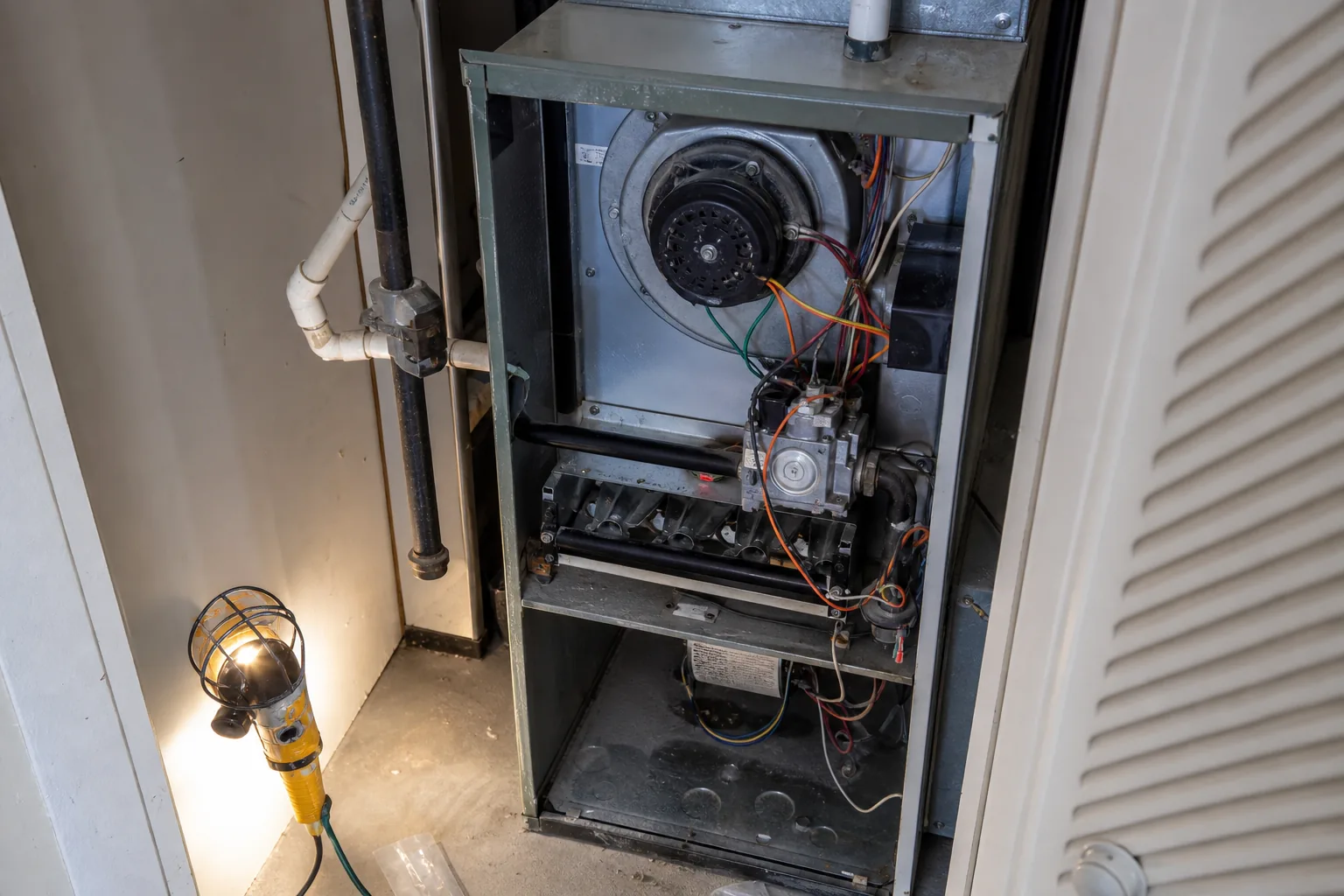
Natural gas leaks at gas valve connections are among the most common pre-Thanksgiving issues I find on Bay Minette tune-ups. The gas valve sits inside the furnace cabinet at the bottom of the burner assembly, with a flex line or rigid pipe feeding it from the gas inlet. Connections can develop seeps over time — particularly on equipment that's been heat-cycled for 10+ years.
You won't see a gas leak. The amount escaping at a connection seep is small — maybe a few cubic centimeters per hour. But the mercaptan added to natural gas is detectable by the human nose at very low concentrations. If you stand in front of an idle gas furnace and smell that distinctive sulfur-egg odor, even faintly, there's a leak somewhere on the gas train. Don't ignore it.
The fix is straightforward — a tighten-and-reseal at the connection with soap-bubble verification and electronic gas leak sensor confirmation. I quote it after I look at the specific fitting. For broader pricing context on real vs padded fall furnace findings, see Fairhope fall furnace inspection upsells: what's real vs manufactured.
Item 3: "Pull the filter out and check it under a window for daylight, not direct sunlight"
The classic filter check uses indirect window light because direct sunlight makes even a heavily-loaded filter look passable. Soft daylight from a north-facing window or an open shaded doorway shows the actual loading.
Method: hold the filter perpendicular to the light source. If you can see the silhouette of objects through the filter clearly, it's still serviceable. If the silhouette is fuzzy or obscured, the filter is loaded enough to restrict airflow and should be replaced. If you can barely see light through it, it should have been replaced two months ago.
For Bay Minette homes — particularly the older ranches with retrofit ductwork and undersized returns — filter loading happens faster than the equipment manufacturers' replacement intervals would suggest. A 90-day rated filter often needs replacement at 60 days during heavy-runtime months. The fall transition (when systems shift from cooling to heating mode) is the right time to start fresh.
Item 4: "Make sure the inducer fan starts BEFORE the burners ignite, not after"
This is the safety check that most homeowners don't know to do. The proper ignition sequence on a gas furnace runs in this order:
- Thermostat calls for heat.
- Control board energizes the inducer fan.
- Inducer fan reaches operating speed and pulls a vacuum on the heat exchanger.
- Pressure switch detects the vacuum and closes.
- Hot surface igniter (or spark igniter) energizes.
- Gas valve opens and burners ignite.
- Flame sensor proves flame.
- Blower fan starts after a 30-60 second warmup delay.
The inducer fan running first is what creates negative pressure in the heat exchanger and ensures combustion gases vent properly through the flue. If burners ignite before the inducer is fully running — or worse, with no inducer running at all — combustion products can spill into the home rather than venting to the outside. That's a carbon monoxide risk.
Watch the sequence on a normal heat call. Listen for the inducer (a whirring sound from the top of the cabinet) before you hear the burner ignition (a soft whoosh followed by steady combustion). If the order is wrong, that's a control board or pressure switch issue worth a real diagnostic. The Bay Minette homeowner version of this question — "is my heating system actually safe?" — gets a real answer from a combustion analysis with carbon monoxide measurement, not from a rule of thumb.
Item 5: "Check the condensate drain isn't backing up under the air handler"
This one matters more for high-efficiency condensing gas furnaces (90%+ AFUE) than for older 80% AFUE units. Condensing furnaces produce liquid water as a combustion byproduct — about 1-2 gallons per day during heavy heating runtime in Bay Minette. That water drains through a small condensate line that exits the furnace cabinet and ties into the home's plumbing or drains to grade outside.
Failures: the condensate trap (a small loop in the drain line that prevents combustion gases from venting through the drain) can clog with biofilm during off-season idle. When heating season arrives and the furnace starts producing condensate, water backs up into the cabinet. The condensate pressure switch — if the unit has one — locks the furnace off. Without a pressure switch, water can damage the heat exchanger or pool inside the cabinet.
Bring a flashlight. Look at the floor of the air handler closet or cabinet. If you see water staining, dampness, or visible corrosion at the bottom of the cabinet, the condensate path needs attention. The exact same dynamic on the cooling side is covered in AC smells musty after running: here's what's happening.
What a typical run-through finds
In a typical version of this exercise, a homeowner with an 80% AFUE furnace that hasn't had a heating-side tune-up in a couple years finds something like this:
Item 1 (sounds): usually clean if the equipment was running properly through the previous heating season.
Item 2 (gas valve): this is where the most common find shows up — a faint mercaptan smell within a few feet of the idle furnace. That gets a follow-up tune-up appointment to find and reseal the leaking connection.
Item 3 (filter): heavily loaded if the homeowner hasn't been swapping on schedule. Cheap fix at the home center.
Item 4 (ignition sequence): usually correct order on a properly functioning control board. If the sequence is wrong, that's a real diagnostic worth running.
Item 5 (condensate): dry on 80% AFUE units (they don't produce significant condensate). Worth checking on 90%+ AFUE units where the drain path can clog.
Items 1, 3, and 5 are usually clean. Item 2 is where the actual finding shows up most often. Item 4 is the safety check that confirms the furnace is venting properly.
Why the rolling-list method actually works better than a checklist
A printed checklist invites homeowners to skim. A rolling list — items remembered in the order they come up during real diagnostic conversations — connects each check to a real reason. Item 4 (ignition sequence) is on the list because I've watched furnaces ignite before the inducer was running and produce dangerous combustion products. Item 2 (gas valve smell) is on the list because every October I get calls from homeowners who'd noticed the smell, dismissed it, and finally called when it got worse.
The list isn't comprehensive. There are 30+ items on a real heating-season tune-up scope. But these five — listening, smelling, looking at a filter, watching the ignition sequence, and checking for water at the cabinet — are the ones a homeowner can do in 30 minutes with no tools and surface roughly 80% of the issues that produce no-heat emergency calls during the holiday weeks.
For the broader heating-side context on what real diagnostic discipline looks like, see when your Daphne furnace won't light on the first cold snap and October Stockton heating quotes: why tune-up bait becomes a sale. Same play, different cities, different angles on the same fall scheduling rhythm.
Two weeks of advance attention, a couple of small repairs, and no holiday emergency call. That's what catching it early actually buys.
For Bay Minette homeowners who want the rolling list run by a tech instead of running it themselves — call 251-383-HVAC. The pre-Thanksgiving slots fill the second week of November, so booking ahead is the move.
FAQ
- How much does a pre-Thanksgiving Bay Minette heating tune-up cost?
- The standard $79 service fee applies to a diagnostic visit. A full tune-up covers combustion analysis, gas pressure verification, flame sensor cleaning, inducer motor inspection, blower amperage measurement, condensate drainage check, and limit switch verification. Time on site is typically 75-105 minutes. Most Bay Minette homes that haven't had heating-side maintenance in two or more years find one or two real follow-up items — flame sensor cleaning, gas valve seal repair, or inducer motor lubrication. The Comfort Plan ($20/month or $240/year) covers two annual visits including the fall heating-side check.
- What's the ignition sequence I should listen for on a healthy gas furnace?
- Thermostat calls for heat. Inducer fan starts (whirring sound from the top of the furnace cabinet). Pressure switch closes after 30-45 seconds. Hot surface igniter glows or spark igniter clicks. Gas valve opens and burners ignite (low whoosh, then steady combustion sound). Flame sensor proves flame within 7-10 seconds. Blower fan starts 30-60 seconds later (warm air begins flowing). If the burners ignite before the inducer fan is fully running, or if you hear ignition without the inducer first, that's a control board or pressure switch issue worth diagnosing before heating season.
- Do you really run service calls in Bay Minette before Thanksgiving week?
- Yes. The pre-Thanksgiving window — roughly the two weeks before the holiday — is one of the busiest heating-side scheduling periods. Bay Minette homes that book a tune-up during the first two weeks of November typically get same-week appointments. Homes that wait until Thanksgiving week itself may get pushed to the following week. Emergency calls run 24/7, any day of the week at no extra charge over the standard service fee.
- What's the most common Thanksgiving-week heating failure call?
- Flame sensor failure on gas furnaces accounts for a large share of pre-holiday no-heat calls. The flame sensor accumulates a thin oxide coating during off-season idle periods, and the first hard demand of cool weather is when it fails to prove flame and locks the furnace into a no-heat state. The fix is straightforward: clean the sensor with fine emery cloth, reinstall, verify proper microamp reading. Catching it during a tune-up before Thanksgiving avoids a much more expensive emergency call on Thanksgiving morning.
Need this handled?
Straight to the service page for your town — pricing, local details and a form that reaches a technician.
More from Thanksgiving Prep

ACExperts HVAC
We Take The Heat So You Don't Have To
Fast, honest heating and air service across Baldwin County. Speak with a technician and get on the schedule today.