
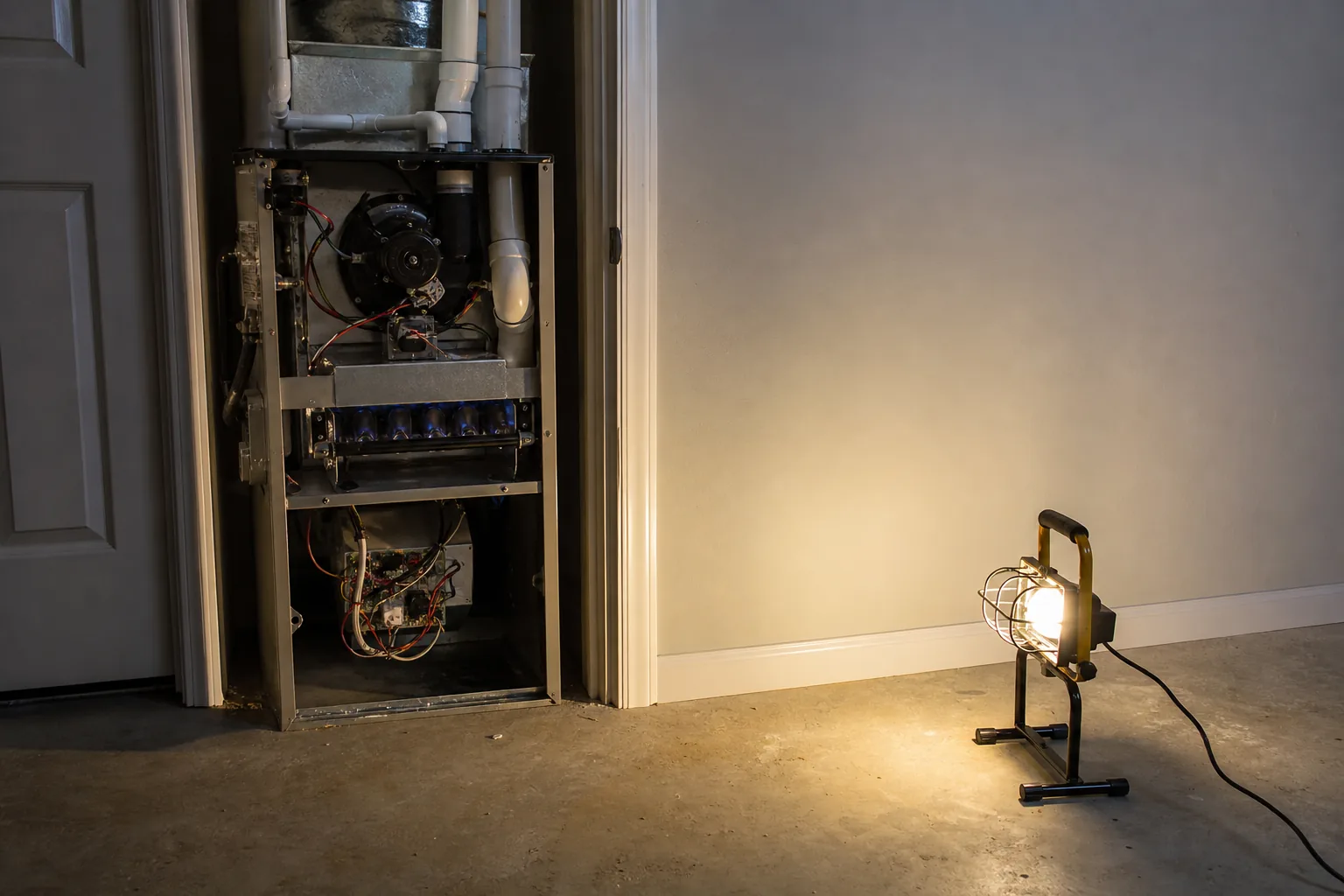
When Your Daphne Furnace Won't Light on the First Cold Snap
The first real cold front of the season hits Daphne and the furnace fires, runs ten seconds, then quits. Here's what's actually happening and how furnace repair sorts it out.
Published 2026-06-06 · Updated 2026-06-06
Author: Landon Jahnke | ACExperts251
Reviewed by: Landon Jahnke · Owner · Alabama HVAC License AL #16117 · EPA 608 Certified
The first genuine cold front of the season slides across Mobile Bay, the temperature drops into the 30s overnight, and you reach for the thermostat for the first time since spring. The furnace fires. You hear the burners catch. Warm air starts at the register. Then, ten seconds later, everything shuts off. A minute passes. It tries again. Same thing. After the third attempt, silence — and the house is getting cold.
This is one of the most common heating calls we take across the Eastern Shore, and the good news is that the usual cause is small and fixable. The frustrating part is the timing: it almost always shows up on the first cold night, when you least want to be standing in front of a dead furnace. Here's what's happening inside that cabinet, and how we sort it out.
Why the first cold snap is when furnaces quit
A Daphne furnace sits unused for a long stretch. We don't get sustained heating demand here from roughly late March until the first real front in November or December, and in a mild year that's the better part of eight months of the equipment doing nothing at all. Things degrade quietly while a furnace sits, and you don't find out until the moment you ask it to run.
The Eastern Shore's weather pattern makes it worse. We don't get a gradual cool-down that eases a furnace back into service over a few weeks. We get warm afternoons right up until a front pushes through and drops us 30 degrees overnight. The first time the furnace is asked to do real work is also the first time anything marginal gets tested — and marginal parts fail under load, not during a gentle 60-degree evening.
The short-cycle pattern, decoded
When a furnace fires and then quits a few seconds later, over and over, the control board is doing exactly what it's built to do: it lit the burners, waited to confirm a flame, didn't get clean confirmation, and shut the gas off for safety. The question is why it isn't getting that confirmation. A few usual suspects, roughly in the order we see them:
A dirty flame sensor. This is the leading cause, and it's a maintenance item more than a true failure. The sensor is a thin rod sitting in the flame, generating a tiny electrical current that tells the board "yes, there's fire." Months of dormancy let an oxide film build on the rod, the current drops below the threshold the board trusts, and the board cuts the gas even though the flame is right there. Cleaning or replacing the sensor usually restores normal operation.
A cracked hot-surface igniter. The igniter is a brittle silicon-carbide element that glows orange to light the burners. It fails with age and thermal cycling, and when it cracks, the furnace either won't light at all or lights inconsistently. These are a wear part with a finite lifespan, and the first cold start of the season is a classic time for a marginal one to give out.
A stuck or lazy pressure switch. The pressure switch confirms the draft inducer is actually pulling combustion gases through the heat exchanger before the board allows ignition. If the inducer bearings stiffened over the summer, or a tube to the switch is blocked, the switch never closes and the furnace refuses to fire — or fires and faults out.
Airflow strangled by a forgotten filter. A one-inch filter that's been in place since spring is choked with months of Daphne pollen and dust. Poor airflow across the heat exchanger trips a high-limit safety and shuts the burners down. This one you can rule out yourself in two minutes: pull the filter, hold it up, and if you can't see light through the pleats, replace it before you do anything else.
What you can check before you call
A few things are genuinely worth doing yourself, and they sometimes solve it outright:
-
Confirm the thermostat is actually calling for heat. Set it to Heat, then push the setpoint several degrees above room temperature. It sounds obvious, but a thermostat bumped to Cool or a dead set of thermostat batteries is a real and common false alarm.
-
Change the filter. If it's loaded, a fresh filter may be all it takes. Write the date on the new one with a marker so you know when it went in.
-
Check the breaker and the furnace switch. Most furnaces have a switch that looks like a light switch on or near the unit. Make sure it wasn't flipped off, and confirm the breaker hasn't tripped. Power flickers during a front are common on the Eastern Shore and can leave a control board sulking until it's reset.
-
Stop resetting it after a couple of tries. If the furnace keeps locking out, leave it off and call. Repeated forced restarts on a furnace that can't prove flame is the one part of this that isn't worth pushing.
If the filter is clean, the thermostat is set right, the power is on, and it still won't stay lit, the next step is a diagnostic. This is not a guess-and-replace situation — flame sensors, igniters, and pressure switches produce overlapping symptoms, and the right fix starts with reading what the system is actually doing.
How furnace repair works when we get there
When we come out for a heating repair call in Daphne, the visit starts with a combustion and safety check, not a parts swap. We carbon-monoxide test every gas furnace we touch, regardless of age, because a furnace that won't light and a furnace with a compromised heat exchanger can look identical from the thermostat. We confirm the heat exchanger is sound, read the flame current, check the igniter, verify the pressure switch and inducer, and look at airflow before we tell you what it needs.
Our service fee is $79, and we quote any repair in writing before we start the work — including when the repair is a flame-sensor cleaning that takes fifteen minutes. If the diagnosis points toward replacement on an older system, we'll say so plainly and give you a free estimate, and we offer free second opinions if you've already been quoted a repair somewhere else and it didn't sit right. The Daphne housing stock spans a lot of equipment eras, and the honest repair-or-replace answer in Historic Malbis is often different than it is out in Jubilee Farms or The Reserve at Daphne.
Get ahead of it next time
The cleanest fix for the first-cold-snap furnace failure is to never have it surprise you. Running the furnace for fifteen minutes on a cool October evening — well before you actually need the heat — flushes the system, burns the dust off the heat exchanger, and surfaces a weak igniter or a dirty flame sensor while the schedule is still open and the weather isn't against you. A fall heating check does the same thing more thoroughly, and the ACExperts Comfort Plan folds two seasonal visits and priority routing into $20 a month or $240 a year, which is built exactly for catching this stuff in the off-season.
The preventive maintenance page covers what a seasonal visit includes, and if you want the cross-county version of this same dynamic, the Robertsdale Thanksgiving furnace post walks through why central Baldwin furnaces tend to fail on the worst possible night. The Daphne service area page has more on how the Eastern Shore's housing eras change the heating picture from one neighborhood to the next.
If the heat is out right now
If you're reading this with the furnace dead and the house dropping, the number is 251-383-HVAC and we answer emergency calls 24/7, every day. A real no-heat call in an occupied home on a cold Daphne night gets moved up the queue. For a routine repair or a tune-up that isn't an emergency, we'll get you on the calendar during regular hours — Monday through Saturday, 8am to 6pm.
The first cold snap is going to come whether the furnace is ready or not. Test it before the front does.
FAQ
- Why does my Daphne furnace fire up and then shut off after a few seconds?
- The most common cause is a dirty flame sensor. That thin metal rod sits in the burner flame and confirms to the control board that there's actually a fire before it keeps the gas valve open. After months of sitting unused through a Daphne spring and summer, the sensor builds an oxide film and stops reading the flame current correctly. The board sees no proof of flame, shuts the gas off as a safety measure, and tries again — fire, run a few seconds, shut down, repeat. After three tries most furnaces lock out for an hour. A cracked hot-surface igniter and a stuck pressure switch produce similar short-cycle symptoms, so the fix starts with a diagnostic, not a guess.
- Is it safe to keep hitting the reset and letting the furnace try again?
- A few cycles won't hurt anything — the safety logic is doing its job. But repeatedly resetting a furnace that keeps failing to prove flame means raw gas is being introduced into the burner chamber on each attempt before the board cuts it. That's exactly the scenario the lockout exists to prevent. If the furnace has locked out more than once, stop resetting it and call us. And regardless of why it's misbehaving, make sure you have a working carbon monoxide detector within fifteen feet of every sleeping area. With any gas furnace, that's not optional.
- My furnace is over 20 years old. Should I repair it or replace it this winter?
- It depends on the heat exchanger condition and the combustion test, not the age alone. We carbon-monoxide test every gas furnace we work on, and a sound 20-year-old furnace with an intact heat exchanger can be worth a repair. The honest economic line we use: if your repair costs over the last couple of years are climbing toward 35 to 40 percent of replacement cost, replacement is usually the smarter spend. We run those numbers with you on the spot and give you free estimates on replacements so the decision is yours, not a sales pitch.
- It's the middle of the night and the heat is out. Can you come now?
- Yes. We answer emergency calls 24/7, every day, at 251-383-HVAC. A true no-heat situation in an occupied Daphne home on a cold night gets prioritized. For routine furnace tune-ups and non-urgent repairs, our regular scheduling hours are Monday through Saturday, 8am to 6pm.
Need this handled?
Straight to the service page for your town — pricing, local details and a form that reaches a technician.
Related reading

ACExperts HVAC
We Take The Heat So You Don't Have To
Fast, honest heating and air service across Baldwin County. Speak with a technician and get on the schedule today.