
Should Silverhill Homeowners Worry About Thanksgiving HVAC Prep?
Probably yes — but only if you fall into one of three categories. Here's how to tell which group you're in.
Published 2025-11-25 · Updated 2025-11-25
Author: Landon Jahnke | ACExperts251
Reviewed by: Landon Jahnke · Owner · Alabama HVAC License AL #16117 · EPA 608 Certified
Should Silverhill homeowners worry about Thanksgiving HVAC prep? Probably yes — but only if you fall into one of three categories. The rest of the town is fine to skip the panic. Here's how to tell which group you're in before twenty cousins show up Thursday.
Over 13 years working Baldwin County HVAC, the Thanksgiving-week call pattern has been consistent. The Wednesday-night and Thursday-morning emergencies don't come from the whole town evenly — they cluster on three specific home types. If your house doesn't match any of the three, your heating system is statistically very likely to make it through the holiday without a problem, and you can spend Wednesday night brining the turkey instead of standing in the attic with a flashlight. If your house does match, the cost of fifteen minutes of prep work this week is the difference between a working heating system on Thursday and a service call on a holiday.
Category 1: Older homes with retrofit gas or LP furnaces
This is the largest of the three risk groups in Silverhill, and it's a function of the housing stock here. Silverhill was founded in 1897, the People's Supply Store has been standing since 1902, and a meaningful share of the homes around Hoiles Heights, Camellia Woods, Elizabeth Gardens, and the streets immediately around the original schoolhouse are pre-1980 construction. Most of those homes had central HVAC retrofitted decades after they were built — gas furnaces installed in basements, crawl spaces, or utility closets that weren't designed around them.
The defining problem with retrofit heating in older Silverhill homes is dormancy. Down here, the furnace sits unused from late February through the second week of November — eight, nine, sometimes ten months without a single firing. That's enough time for a cracked heat exchanger to pass condensate moisture into the burner compartment and start corroding the gas valve. It's enough time for mice and palmetto bugs to nest in flue terminations. It's enough time for dust to settle into the inducer fan blades to the point where the pressure switch can't pull a clean draft on first ignition.
Every fall I get the same call from the same kind of homeowner: "Furnace ran fine last winter, but when I bumped it on this morning it just clicks and won't fire." Nine times out of ten, that's a pressure-switch trip on a debris-blocked flue, a dirty flame sensor, or — worst case — a cracked heat exchanger that the previous tech missed. None of those are Thanksgiving-week fixes if you wait until Wednesday to discover them.
If your home is in this category, run the heating system for fifteen to twenty minutes early in the week. Today, ideally. Stand near the unit; you should hear the inducer come up first, then the ignitor heat-cycle, then the burner ignite with a soft whoosh, then the blower start about thirty to forty-five seconds later. If any of those sounds is missing, off-rhythm, or accompanied by a smell of unburned gas or scorched dust beyond the first minute, kill the thermostat and call. The post-storm walk-through I wrote for Silverhill HVAC restart covers the same kind of structured listen-test for AC equipment; the principle on the heating side is identical.
LP propane homes get an additional checkbox: tank level. A 250-gallon tank at 20% — typical for households who haven't called for a fill since spring — will burn through faster than expected once nightly lows in Silverhill settle into the 30s. Check the gauge Wednesday afternoon. Suburban Propane and Ferrellgas both schedule emergency Thanksgiving deliveries, but you'll wait longer and pay a holiday rate.
Category 2: Heat pumps relying on auxiliary strips that nobody has tested
This is the second-largest risk group, and it's heavily represented in Silverhill's newer subdivisions — Twin Lakes, Silver Oaks, Pecan Grove, Lake Langley, the spec construction along East Silverhill Estates. Heat pumps here are common for the same reason they're common across most of Baldwin County: they handle cooling and heating from one piece of equipment, the operating cost is favorable in our climate, and Baldwin EMC's electric rates make the math work better than most of the South.
Heat pumps in central Baldwin run pure heat-pump mode comfortably down to about 35°F outdoor. Below that, the indoor coil's auxiliary electric resistance heat strips need to engage to make up the gap. Late-November nighttime temperatures in Silverhill regularly drop to 32-38°F, which is right at the threshold where aux strips earn their keep. The trouble is that aux strips are the part of the system that nobody tests. They sit idle nine months a year same as the gas furnaces in Category 1, and when they don't kick on at 4 a.m. Thursday morning, the homeowner doesn't know it's happening — they just wake up to a 64°F house and a heat pump that's been running continuously for six hours.
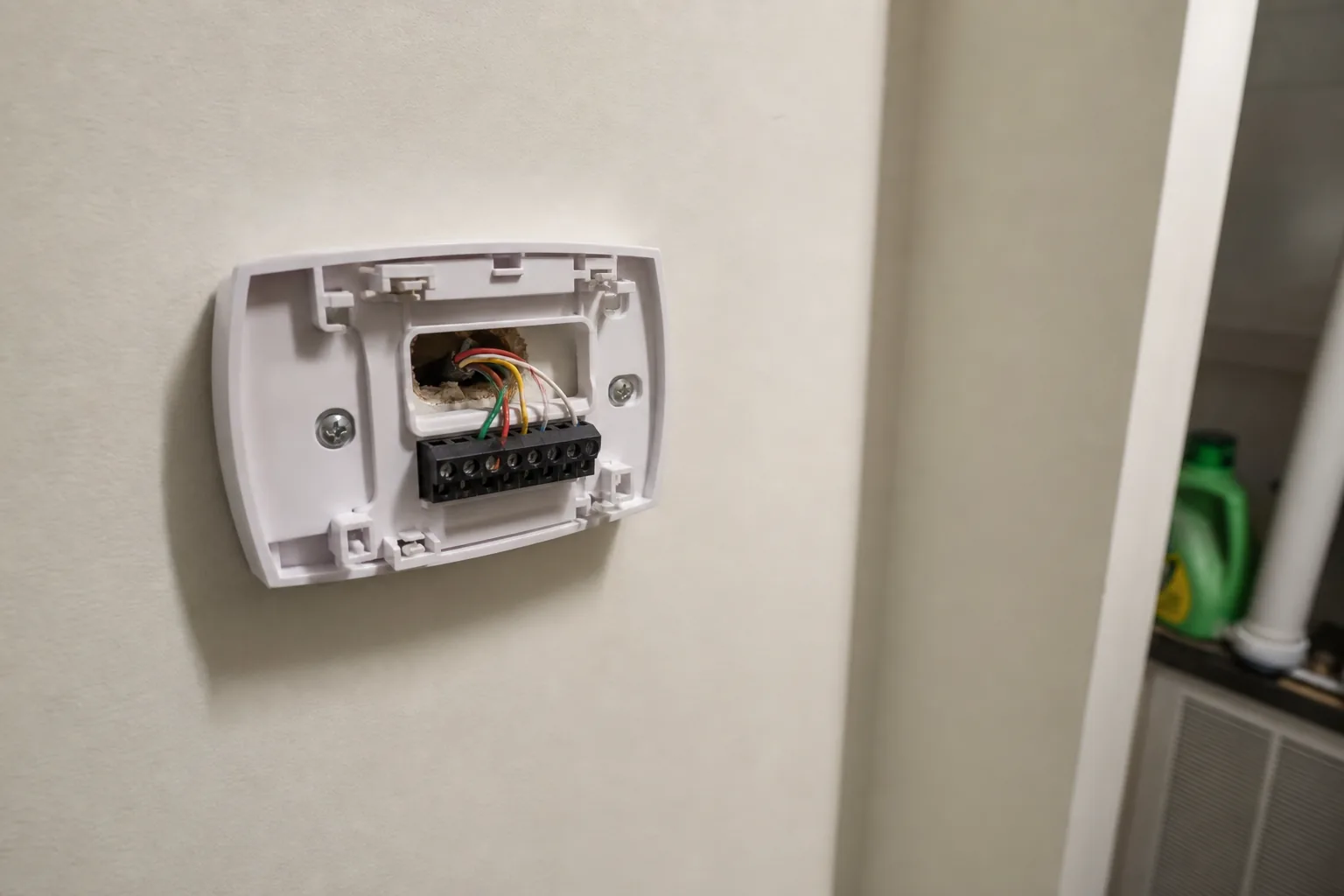
Five-minute test, do it tonight: walk to your thermostat. Drop the setpoint three or four degrees below current room temperature, then raise it back up to four or five degrees above current. Within a few minutes the display should show "AUX," "EM HEAT," "Stage 2," or some equivalent indicator that the strips are engaged. Walk to a supply register and feel the air temperature; aux heat raises supply temp from the heat-pump-only ~95-100°F up to the 110-130°F range. The difference is obvious if you put your hand under the register before and after.
If aux heat doesn't engage, the most likely failure points are a tripped sequencer, a stuck high-limit switch, or — surprisingly common — a thermostat configuration error from when the previous owner or a contractor swapped it out. None of those are homeowner-fixable on Thursday morning, but all of them are normal heating repair calls if caught Monday or Tuesday. A similar thermostat-and-aux-heat diagnostic shows up in the Loxley houseguest heat-load post for households expecting big extended-family gatherings.
Category 3: Houses hosting more than twelve guests with the heating system already marginal
This is the smallest of the three groups but the most predictable. Silverhill's Scandinavian-American heritage shows up at Thanksgiving in family-sized gatherings that look closer to a Robertsdale farm dinner than to the four-person table the typical HVAC load calculation assumes. If you're hosting twenty cousins from Mobile, Pensacola, and Birmingham — and a meaningful share of Silverhill households are — your house operates under a heating profile it was never sized for.
Twenty bodies generate roughly 8,000 BTU/hr of latent and sensible load, and on a cold Thanksgiving morning that's actually working against your heating system, not for it. Wait, working against? Yes — the body heat warms the air enough to cycle the heat pump or furnace off prematurely while the building shell stays cold, leaving the floors, walls, and untouched bedrooms colder than they would be with a smaller crowd. Then guests congregate in the kitchen and family room while the guest bedrooms — where Aunt Patricia is napping — pull two or three degrees below setpoint and stay there.
The fix isn't a bigger furnace. It's airflow planning. Walk the house Wednesday night. Confirm every supply register is open and unblocked. Check that the central return — usually in the hallway near the bedrooms in Silverhill ranch houses — isn't covered by a coat tree, a folding chair, or an extra dining-room table that got moved to make space. In the houses where the heating system is already marginal — older equipment, original ductwork from a 1970s retrofit, units sized for the original family of four — the difference between a comfortable Thursday and a cold one is usually whether the airflow distribution works, not whether the furnace itself is healthy.
If your existing system is marginal year-round and you've been thinking about replacement anyway, the post-Thanksgiving conversation is a good time to walk through options. The math on heating installation for older Silverhill homes often has more to do with duct condition than with equipment selection — same pattern I wrote about for Robertsdale Thanksgiving Eve furnace failures, where the underlying duct system is doing more harm than the equipment.
The homes that don't need to worry
If your home doesn't fit any of the three categories — newer construction, modern heat pump that's been tested already this season, twelve or fewer guests, no LP supply concerns — your heating system is statistically very likely to handle Thanksgiving without intervention. Spend the time on the brisket instead.
That said, the one universal pre-holiday check that takes ninety seconds and applies to every category: pull your filter, check it against a bright lamp, and replace it if you can't see clearly through it. A clogged filter on Thanksgiving morning is the single most common reason a properly working heating system underperforms during a houseful of guests, and it's the cheapest fix in HVAC. Pleated four-inch filters at the air handler run $25-45 at the Foley Lowe's; one-inch return-grille filters are $8-15.
What an actual Thanksgiving call looks like
For context, so the process isn't a surprise if it does come to that:
A Thursday morning emergency call in Silverhill is dispatched out of our normal route — we're based here, so the geography works in your favor. The diagnostic service fee is $79 and is credited toward any repair we perform. Common Thanksgiving-week diagnoses are capacitor or sequencer faults on heat pumps that won't bring aux heat online, pressure-switch trips on gas furnaces with debris-blocked flues, and — on older equipment — heat-exchanger cracks that push the conversation toward replacement rather than repair. A genuine heat-exchanger crack on a furnace older than fifteen years almost always points to replacement.
Compare that against the alternative: spend fifteen minutes Monday or Tuesday running the system, identify any issue that surfaces, and let us schedule a normal weekday visit. The difference between the two paths is the difference between Thursday afternoon at the dinner table and Thursday afternoon waiting for the tech.
If you're in our Silverhill service-area route and you want a fall heating tune-up booked before the holiday, call 251-383-HVAC. We answer the line directly during normal business hours, and Comfort Plan members get the seasonal tune-up included as part of the plan. The seasonal tune-up is what catches the Category 1 and Category 2 problems early, and it's why the homeowners on the plan rarely show up in the Wednesday-night call list.
Have a good Thanksgiving. Hope the heat works and the cousins behave.
FAQ
- I have a 1970s ranch in Silverhill with a gas furnace I haven't run since February. Do I need to worry?
- Yes, more than most. Older gas furnaces in central Baldwin sit idle for eight to nine months a year, and the first call to fire them up in November is when problems show. Cracked heat exchangers, blocked flue terminations, sluggish pilots, and dust accumulation in the burner compartment are the four things that catch homeowners off guard. Run the furnace for fifteen minutes a few days before Thanksgiving — not on Thursday morning — to let any issues surface with time to fix them.
- We have a newer heat pump in a Silverhill subdivision. Do the same rules apply?
- Different risk profile. Heat pumps don't have the dormant-furnace problem, but they have an auxiliary-strip problem. Silverhill nighttime temps in late November regularly drop into the 30s, which is right at the threshold where heat strips need to engage. If they don't engage on a 32°F morning, the house slowly loses temperature against a continuously running compressor. Worth a five-minute thermostat test before twenty guests arrive.
- Is LP propane any different from natural gas for Thanksgiving prep?
- The combustion side is similar but the fuel-supply side matters more. A meaningful share of Silverhill homes outside the central grid run on LP — Suburban Propane, Ferrellgas, smaller local providers — and tank levels matter. A 250-gallon tank at 20% in mid-November will run down faster than the homeowner expects when a cold snap stacks heating demand on top of holiday cooking. Check your tank level Wednesday night.
- Can you do a pre-Thanksgiving heating tune-up if I call this week?
- Sometimes, depending on how full the schedule is the week of. We try to leave Tuesday and Wednesday before Thanksgiving with some flex for last-minute calls, but the holiday weeks book heavily. Comfort Plan members get prioritized routing. Call 251-383-HVAC and we'll tell you honestly what we can fit in.
Need this handled?
Straight to the service page for your town — pricing, local details and a form that reaches a technician.
More from Thanksgiving Prep

ACExperts HVAC
We Take The Heat So You Don't Have To
Fast, honest heating and air service across Baldwin County. Speak with a technician and get on the schedule today.