
Stapleton Labor Day HVAC Audit Before Snowbird Season
A Labor Day HVAC audit in Stapleton before snowbird season: 22 minutes with a flashlight and clamp meter on the disconnect, fan, float switch, and thermostat wiring.
Published 2026-09-01 · Updated 2026-09-01
Author: Landon Jahnke | ACExperts251
Reviewed by: Landon Jahnke · Owner · Alabama HVAC License AL #16117 · EPA 608 Certified
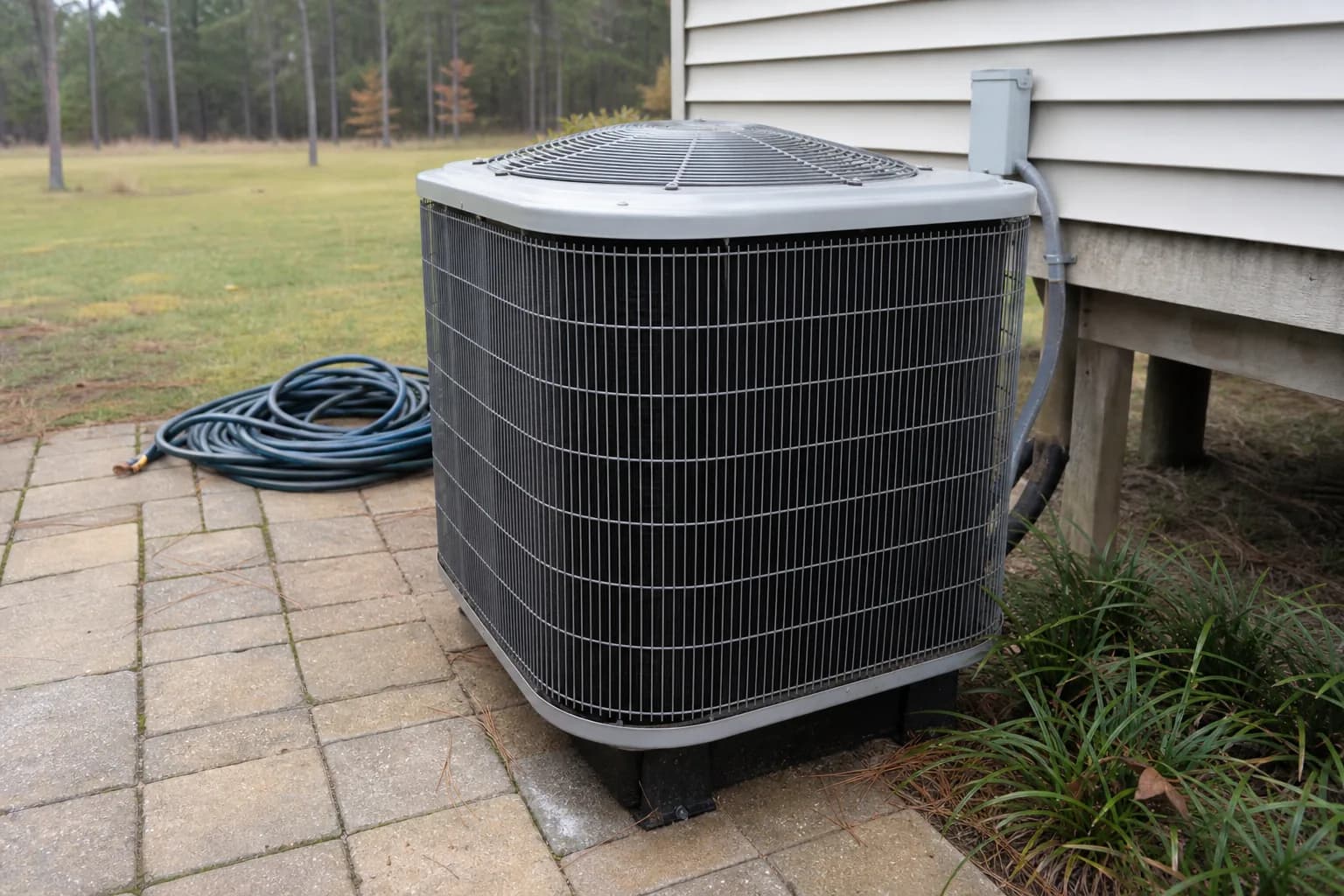
Walking through a Stapleton home Labor Day weekend with a flashlight in one hand and a clamp meter in the other. First stop: outdoor disconnect — voltage check, contact integrity. Second: top of the condenser — fan blade, capacitor cover, condensate from the bedroom AC drips. Third: indoor air handler closet — float-switch test. Fourth: thermostat wiring at the wall plate. Fifth: the snowbird's mailbox to confirm she's coming Nov 1. The audit takes 22 minutes and tells you whether the system survives until April.
Here's exactly what we look at.
Stop 1 — The outdoor disconnect
The disconnect box is the gray panel mounted on the exterior wall near the condenser unit, usually within 6 feet of the equipment per code. Off-season failures here are a leading cause of why a Stapleton heat pump won't come on in late October when the snowbird returns and bumps the thermostat for the first cold night.
What the flashlight catches first: signs of moisture intrusion at the bottom seal of the box, ant trails inside the cabinet, evidence of wasps or mud daubers building inside the housing. The Stapleton agricultural-zone homes especially get insect activity here — pasture and pine-corridor properties off Hwy 287 see wasps year-round.
What the clamp meter measures next: line voltage with the disconnect closed but the system off, then again with the system in cooling mode if it'll start. Healthy reading is 240V plus or minus 5%. Anything outside that is a service-side issue, often Baldwin EMC's distribution transformer, sometimes a corroded weatherhead connection, occasionally a meter base problem. Low voltage explains a lot of equipment-side complaints that get blamed on the AC.
What the visual check confirms last: the disconnect blades are intact, the contact surfaces are bright (not pitted or oxidized), the fuses are correct amperage for the equipment data plate, and the conduit seal at the top of the box hasn't pulled away from the building. A pulled-away seal lets water track inside the cabinet over winter — which is a Stop 1 fail that we don't see until the next service call.
Stop 2 — The top of the condenser
Climb the stepstool, get over the cabinet, look down at the fan blade and the top of the coil with the flashlight at a low angle.
The fan blade. Pine needle accumulation on the leading edge of each blade is normal in north Baldwin County. Hairline cracks at the hub or visible deformation on a blade tip is not. A cracked fan blade that survives one more season is also a balance issue that vibrates the motor bearings and shortens the motor life by a meaningful margin. The replacement blade is the inexpensive line item; the fan motor it saves is the expensive one.
The capacitor cover. Pop the panel that covers the run capacitor and contactor. Look for swelling on the top of the capacitor, visible electrolyte staining anywhere on the cabinet around it, or a contactor with arc-pitted contact faces. Microfarad reading on the capacitor with the meter — we want 95% or above of rated capacitance for a system entering its third winter. The Foley two-minute mystery walks through what happens when capacitance drops below 90%.
Condensate from the bedroom AC. This is the surprise stop. A lot of Stapleton homes — particularly the older Hwy 59 corridor properties and the manufactured-home conversions — have a window-mount or PTAC unit serving a back bedroom that drips condensate onto the ground or onto the side of the building right where the homeowner doesn't look. Saturated soil at the base of the cabinet is a corrosion accelerator on the steel base pan and the lower coil hairpins. A 90-second redirect of that drip with a section of vinyl tubing extends the cabinet life by years.
Stop 3 — Indoor air handler closet, float switch test
Inside the house, find the air handler. In most Stapleton site-built homes it's in a hall closet, attic platform, or garage corner. Manufactured homes have it in a dedicated mechanical closet, typically central to the floor plan.
The float switch is a small plastic device clipped to the side of the secondary drain pan or installed in-line on the primary condensate drain. Its job: kill power to the condensate pump (and on properly wired systems, to the entire cooling call) if water rises in the pan above a safe threshold. Off-season clogs from biofilm buildup are the primary failure mode that this device protects against.
The test takes 90 seconds: disconnect the float switch from its bracket, hold it in the elevated position that simulates a pan-full condition, watch the system at the thermostat. If the air handler shuts off within a few seconds, the switch is wired correctly and functional. If nothing happens, either the switch is dead, or someone wired around it during a service call, or the circuit was never connected during the original install.
Across 13 years of Baldwin County HVAC work, this test fails frequently enough — across both site-built and manufactured homes — that it runs on every audit.
Stop 4 — Thermostat wiring at the wall plate
Pull the thermostat off the base plate. Most Stapleton homes have either a Honeywell or Ecobee on the wall, occasionally a Trane ComfortLink or a Carrier Infinity on newer installs.
Look for: insect activity inside the wall plate (this is a Stapleton issue more than a coastal-city issue), corrosion on the screw terminals, loose connections that have backed out as drywall has shifted seasonally, and any evidence of mouse damage to the thermostat cable inside the wall cavity.
The clamp meter goes on the 24V transformer secondary side at the wall plate to verify the control voltage is in spec. 24V plus or minus 2V is normal; anything below 22V indicates a transformer that's loaded down or wired into too long a run, both of which cause intermittent thermostat behavior in the cold-weather call cycle. Heat-pump systems with reversing-valve issues sometimes show up as control voltage problems first, before the actual valve fails.
The wire labels at the back of the plate get verified against the function. R, C, Y, G, W, O/B, Y2 — a properly labeled Stapleton heat pump install has all seven where appropriate. A surprising number of homes have unlabeled or mislabeled wiring from a previous DIY thermostat swap, and the audit is the time to fix it because the next time someone needs it correct is during a service call when wrong wiring extends the diagnostic by 25 minutes.
Stop 5 — The mailbox
Walking back to the truck, we stop at the mailbox to confirm the snowbird homeowner's return date. This sounds like a soft step but it isn't. The audit's value depends on the next-occupancy timeline.
If she's coming Nov 1, we want any flagged items resolved by Oct 25 — that's roughly 8 weeks of scheduling runway and almost everything fits comfortably into normal-rate scheduling without rush premiums.
If she's coming Dec 15, we have time for a real heat-pump heating mode load test on a cold night in early December, which requires actual outdoor temperatures below 50°F to run properly and produces data we can't get on a Labor Day weekend.
If she's not coming back until April, we recommend leaving the system in vacation-occupied mode at 78°F cool with the fan circulating to keep humidity below 60%, and we schedule a mid-February drive-by check on the Comfort Plan rotation.
The mailbox stop also catches the practical: forwarded mail piling up means the property has been unoccupied longer than the homeowner realized, which means HVAC runtime has been minimal, which means the pre-occupancy wake-up will need extra attention to prevent humidity-related comfort complaints in the first 48 hours of return.
What the audit produces
A written single-page report with five line items, one per stop, and a green / yellow / red status. The report goes in the homeowner's email, on the truck's records, and into the Stapleton city service file. If the homeowner is on the Comfort Plan, the audit findings feed into the spring tune-up checklist so we walk in knowing what to verify first.
Yellow items get a recommended timeline ("schedule before Oct 15") and a prepared cost. Red items get a same-day or next-day repair conversation with transparent pricing so the homeowner can decide on the spot whether to proceed.
Why Labor Day weekend, not later
Three reasons the timing matters in Stapleton:
Equipment is still being run hard. Late-August duty cycle conditions are similar enough to peak summer that the audit catches the same failure modes the equipment has been operating under. Wait three weeks and the cooling load drops, marginal components stop revealing themselves, and items that would have failed the audit pass it because the system isn't being asked to do as much.
Scheduling runway is generous. Labor Day weekend is the start of about 10 weeks of comfortable service-call scheduling before the back-half-of-October snowbird arrival surge and before any cold-snap heating calls. A red flag identified Sept 1 has 6 to 8 weeks to be addressed at non-emergency rates.
The Stapleton Hwy 59 routing density is favorable. Late summer through early fall, the truck routes through Stapleton, Stockton, and Bay Minette consistently for both summer cooldown calls and pre-fall maintenance bookings. Drive time is at its best of the year here, which translates to the homeowner's bill not absorbing additional travel time. The Stapleton service area page walks through the routing detail.
What red flags actually look like
Across 13 years of Baldwin County HVAC work, most homes audit clean or green-with-one-yellow. The minority with a red flag tend to cluster around a few specific items, in rough order:
- Float switch non-functional or jumpered out
- Run capacitor measuring below ~88% of rated capacitance
- Outdoor disconnect with wasp activity inside the cabinet
- Condensate line with biofilm requiring chemical clear before fall
- Thermostat C-wire missing on a system that needs one for proper heat-pump control
Each of those is a multi-hundred-dollar fix at most when caught during the audit. Each of those becomes a multi-thousand-dollar fix when caught during a service call after a failure. The math is simple — and the Stapleton capacitor failure pattern walks through how the same failure-mode physics drive the spring and summer call distribution as well.
Booking the audit
Booking runs through the standard service-call channel: $79 service fee for the visit, no upcharge for Saturday inside emergency hours, free second opinions on any quotes that come out of the visit. Comfort Plan members get $0 service fees and the audit work folded into their fall tune-up at no extra charge. Same-day scheduling is available most weeks; Labor Day weekend itself fills early. Call 251-383-HVAC or use the online scheduler at /schedule/.
The flashlight, the clamp meter, the float-switch test, the mailbox check. Five stops, 22 minutes, a written report. The systems that pass it generally make it to April. The systems that fail it generally don't — and the audit is what catches the difference while the calendar still has time to do something about it.
FAQ
- How long does the Stapleton Labor Day audit take?
- The on-site visit averages 22 to 28 minutes for a typical site-built Stapleton home and 30 to 40 minutes for a manufactured home with sealed-combustion gas furnace. The longer time on manufactured homes is mostly furnace-side — combustion chamber inspection, vent clearance verification, and propane regulator integrity checks add about 10 minutes. The audit produces a written checklist the homeowner keeps, with photos of any flagged items and a clear pass/marginal/replace recommendation on each component.
- Is this the same as a Comfort Plan tune-up?
- It overlaps. The Comfort Plan includes 2 tune-ups per year; for a Stapleton snowbird home the fall tune-up gets focused around the off-season failure modes this audit targets. Non-members can book a standalone diagnostic visit at the $79 service fee. Either way, the work is written up and the homeowner keeps a copy.
- Why before snowbird season specifically?
- Snowbird arrival in north Baldwin County typically runs late October through mid-November. A system that limps through the back end of August is much harder to schedule a real repair on once the seasonal occupancy returns and demand for fall service climbs. Catching marginal components in the first week of September gives 6 to 10 weeks of comfortable scheduling before either the homeowner returns to a property or the heating-mode demand starts. Late October emergency calls quote different than early September scheduled work.
- What's the most common item that fails the audit on Stapleton homes?
- Float switch on the air handler condensate pan. Across 13 years of Baldwin County HVAC work, a meaningful share of north-county audits turn up a float switch either stuck in the open position, wired around with a jumper, or installed but never tested. The float switch is the inexpensive part that prevents a thousands-of-dollars ceiling-and-drywall claim when a condensate line clogs in the off-season and the pan overflows into a closet ceiling. Manufactured homes tend to be slightly worse on this check than site-built.
Need this handled?
Straight to the service page for your town — pricing, local details and a form that reaches a technician.
More from Labor Day

ACExperts HVAC
We Take The Heat So You Don't Have To
Fast, honest heating and air service across Baldwin County. Speak with a technician and get on the schedule today.