
After a Daphne Summer Storm: When to Restart Your AC (and When to Wait)
After a Daphne summer storm, grid power-cycling — not wind — is the top cause of AC failures. The safe-restart steps, what to check first, and when to kill power.
Published 2026-05-05 · Updated 2026-05-05
Author: Landon Jahnke | ACExperts251
Reviewed by: Landon Jahnke · Owner · Alabama HVAC License AL #16117 · EPA 608 Certified
The morning after a summer storm rolls across Mobile Bay and through Daphne, the question on most homeowners' minds is simple: the power's back, the house is getting warm, can I flip the breaker and let the AC run? The honest answer is almost always not yet — and the next two or three hours after the lights come back are the most expensive window in the entire storm cycle. More post-storm AC failures trace to that impatient restart than to anything the wind did.
I want to walk through what actually breaks during a Daphne storm, the safe way to bring your system back, and the specific symptoms that mean stop and pick up the phone. Most of this you can do yourself with a flashlight before you ever call me, and the parts you can't do, I'd rather you not attempt anyway.
What actually breaks during a Daphne storm
It's almost never the wind. Outdoor condensers are engineered to take serious gusts and driving rain — they are not the fragile part of the system during a tropical storm or a hurricane brushing the bay. The real damage source is grid power-cycling. As transformers blow, substations switch over, and Alabama Power works to restore feeders, the grid flickers on and off through the storm and all the way through the recovery period. Every one of those restarts asks the compressor to fire up against a refrigerant charge that hasn't had time to equalize, and slugs it with liquid it can't immediately handle. Every start pulls a hard amperage spike that burns the run capacitor a little more and stresses the compressor windings and contactor. By the third or fourth flicker, you've shortened that equipment's life by years without the wind touching it.
Daphne adds two local wrinkles. First, the bay. Neighborhoods along Scenic Highway 98 sit on bluffs facing the water, and even communities several miles inland get salt-laden air that corrodes contactors, coil connections, and cabinet hardware. A storm-stressed contactor in a salt-aged unit near the bay is starting from a weaker baseline than an inland one. Second, lightning. A strike near the home — even a few hundred yards off — can fry control boards, capacitors, contactors, and the thermostat's low-voltage circuit. Lightning damage usually shows up the next morning as "it was running fine before the storm and now it won't start at all." Sometimes it's the outdoor unit, sometimes the indoor air handler's control board, sometimes the thermostat itself, and diagnosing it means testing each component rather than guessing. The variety of housing across Daphne — newer tight builds in Jubilee Farms and The Reserve, older retrofit systems in Historic Malbis and Old Daphne — means no two post-storm calls look quite the same.
Before the storm: the one thing that helps most
If you have any warning a storm is coming, the single best move is to shut the AC off at the breaker before it hits. Not the thermostat — the breaker. Killing power at the panel takes the compressor and control board out of the line of fire entirely, so the grid can flicker all it wants during landfall and recovery without your equipment trying to start into it. That one step prevents the majority of the power-cycling damage I described above.
Skip the tarp. Wrapping the outdoor unit traps moisture against the cabinet and the electrical compartment and does more harm than the rain ever would. The condenser is built to get wet. It is not built to start repeatedly against an unstable grid, which is exactly what the breaker shutoff protects against.
The safe-restart procedure
When the storm has passed and power is back, work through this in order. Don't rush it.
Wait for stable grid power. Do not restart the AC during the first six to twelve hours after the lights come back. Alabama Power is still re-establishing feeders and capacity in that window, and the grid will keep flickering. Each flicker damages the compressor a little more, so the waiting is the whole point. If anyone in the neighborhood is still seeing the lights blink, you're not on stable power yet.
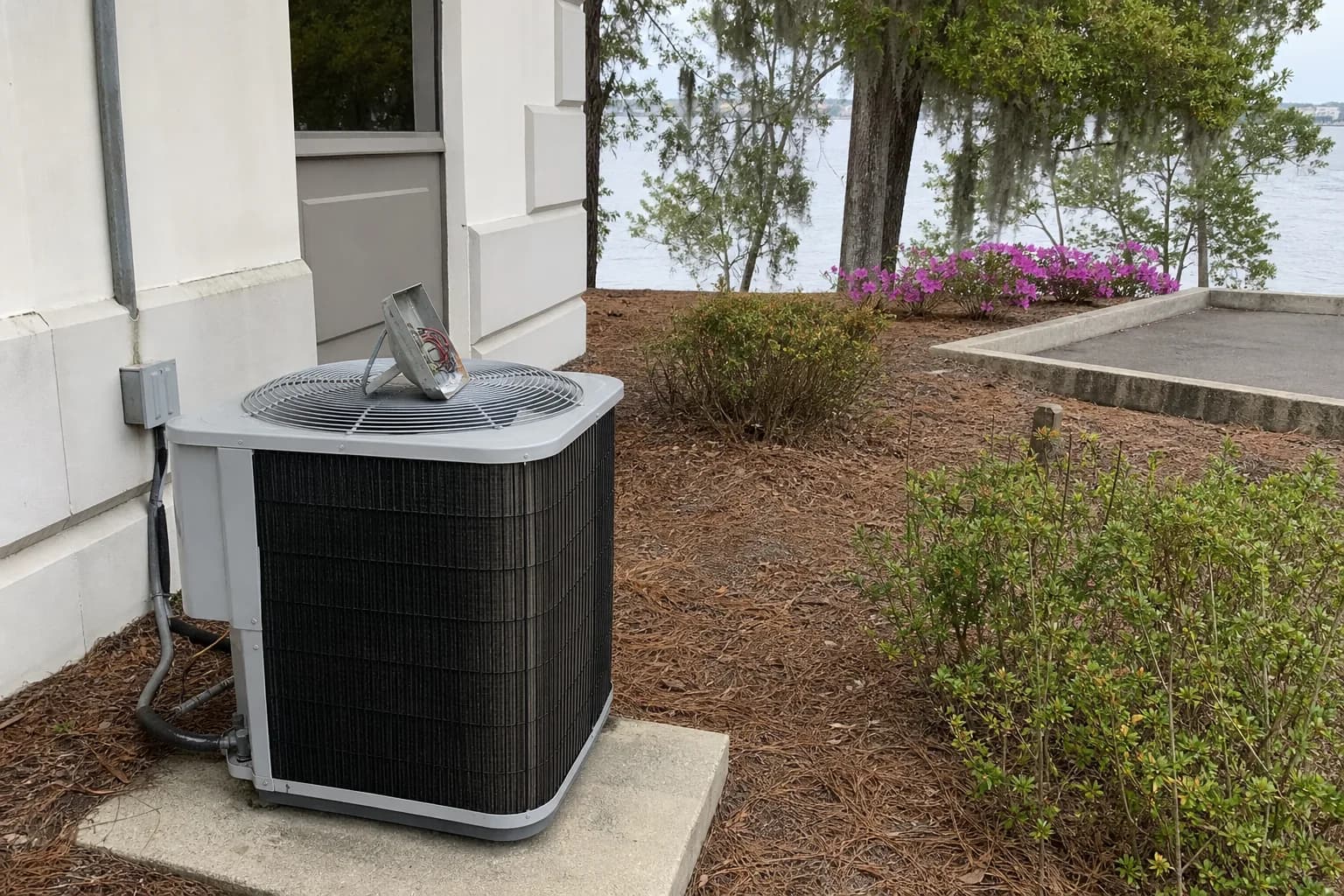
Inspect the outdoor unit visually. Bring a flashlight even in daylight — you're looking into shadowed corners. Walk the condenser. Look for debris packed into the coil fins, a bent or jammed fan blade, water sitting in the electrical compartment, a concrete pad that shifted or tilted when the ground saturated, downed branches leaning on the cabinet. Daphne soils soften when they're soaked, and a condenser that's tilted more than a finger-width off level stresses the compressor mounts and the line-set flares. If anything looks wrong, leave the breaker off and call.
Restore power one breaker at a time. Outdoor disconnect first — that's the small box on the wall next to the condenser. Flip it on and listen for thirty seconds; the unit shouldn't run on its own without a thermostat call. Then the indoor air handler breaker at the panel, and wait another minute.
Bring the temperature down gently. Set the thermostat eight to ten degrees above whatever the room currently reads and let the system find its rhythm over the next two to four hours. A hard dive from 84°F straight to 72°F is exactly the situation that smokes a contactor already stressed by the storm. Watch and listen during that first cycle: the outdoor fan should spin smoothly, the compressor should start with one firm hum and settle into steady operation. Repeated clicking, grinding, or a loud sustained hum with no fan spinning means kill the breaker.
Symptoms that mean stop and call
If after restoring power you see any of the following, shut the system down at the breaker and don't keep cycling it — running a damaged system is how a fixable problem becomes a replacement.
- The outdoor compressor hums loudly but the fan blade doesn't spin. That's almost always a failed run capacitor, one of the most common post-storm part failures, and continued operation will cook the compressor windings within an hour.
- The system short-cycles on and off every thirty seconds or so. That points to a failed contactor, a thermostat low-voltage problem, or a refrigerant-pressure issue from a line set damaged in the storm. None of them improve by leaving the system running.
- You get cool air for five or ten minutes, then warm air. That's usually a refrigerant-charge problem — a slow leak that opened during the storm, or a flooded compressor that isn't pumping. It needs gauges on it.
- You smell anything electrical or see smoke from the outdoor unit. Stop. Don't restart. Call.
- The breaker trips and you reset it and it trips again. One trip can be a transient. Two is suspicious. Three means something is drawing fault current and you risk a fire by resetting it again.
For any of those, that's our emergency HVAC service — call 251-383-HVAC. We answer emergency calls 24/7, every day, and after a named storm we triage by severity so the genuinely-without-cooling households get worked first. Most post-storm failures are honest AC repairs — a capacitor, a contactor — caught early before a stressed compressor runs itself into the ground.
Why patience pays off here specifically
There's a pattern to how storm damage surfaces, and it's worth knowing because it explains the waiting. The failures that turn up within forty-eight hours of restart tend to be the modest ones — capacitors and contactors, parts we carry on the truck and can often replace on the same visit. The failures that turn up a week or two later tend to be compressors: units that survived the storm itself, got started up wrong against a flickering grid, ran damaged for days, and finally seized. Those are the major repairs and replacements that didn't have to happen. The whole point of the restart discipline is to keep your equipment out of that second category.
Surge protection at the outdoor disconnect is the upgrade I recommend after every named-storm season. It's the single most cost-effective change a Daphne homeowner can make to reduce the odds of the next storm taking out a control board, and there's a fuller breakdown of the math in the Robertsdale surge-protector post. The Daphne service-area page covers more on how the bay-proximity and salt-air factors shape the work across town, from the Scenic 98 bluffs to the newer subdivisions inland.
The ACExperts Comfort Plan folds two seasonal tune-ups, priority scheduling, and ten percent off repairs and replacements into $20 a month or $240 a year — and on a maintenance plan, the storm-prone parts get looked at and cleaned before storm season rather than during the scramble after it. Members get prioritized routing when call volume spikes, which matters most in exactly the 48-to-72-hour window after a storm when everyone's calling at once.
Your job after a Daphne storm isn't to get the AC running fast. It's to get it running right. The rest is patience, a flashlight, and a phone call before you flip the breaker. Call 251-383-HVAC any time — we answer emergency calls 24/7, every day, and our regular scheduling hours for non-urgent work are Monday through Saturday, 8am to 6pm.
FAQ
- Should I cover or wrap my outdoor AC unit before a storm?
- No. Outdoor units are built to handle wind and rain — they are not the vulnerable component during a storm, and a tarp traps moisture against the cabinet and electronics, causing more harm than it prevents. The right move is to shut the system off at the breaker before the storm arrives. That protects the compressor and control board from voltage spikes and from the grid power-cycling that does the real damage during landfall and recovery. Cover the unit only against falling-debris risk, never wrap it tight, and never leave a tarp on once the weather passes.
- How long after the storm before I can safely turn the AC back on?
- Wait until grid power has been stable and continuous for at least 6 to 12 hours — not flickering, not dropping out. Alabama Power keeps re-establishing feeders and capacity for hours after the lights first come back, and each flicker stresses the compressor as it tries to start against a refrigerant charge that hasn't equalized. Once power is genuinely steady, restore breakers one at a time (outdoor disconnect first, then the indoor air handler), set the thermostat 8 to 10°F above the current room temperature, and let the system catch up gradually over a couple of hours rather than asking it to dive to 72°F right out of the gate.
- Can I run my AC on a portable generator after a Daphne power outage?
- Only on an inverter-style generator rated for inductive loads with clean sine-wave output and enough continuous wattage to handle the compressor's startup surge. Standard contractor-grade generators put out dirty power and voltage spikes that damage HVAC compressors and control boards. If you are running on a generator at all, set the AC to a higher temperature and let it cycle gently rather than asking it to cool the house aggressively, because the startup surge is where generator damage happens. When in doubt, leave the AC off the generator and prioritize the refrigerator instead.
- Does Daphne see worse storm damage near the bay than inland?
- The wind exposure is higher for homes along the Scenic Highway 98 bluffs and the bay-facing neighborhoods, but the bigger HVAC threat across all of Daphne is the grid — long outages and repeated brownouts during recovery do more cumulative compressor damage than a single gust does. Salt air near the bay adds a corrosion factor on top, which means storm-stressed contactors and connections in those neighborhoods were often already aging early. So the restart discipline matters everywhere in Daphne, not just on the water.
- Is lightning damage covered the same as a normal AC repair?
- We diagnose it the same way regardless of cause — test each component, find what failed, and quote the repair in writing before we begin. Whether a lightning-related failure is covered is a question for your homeowner's insurance, not us; we're happy to document what we find so you have it for a claim. A surge protector installed at the outdoor disconnect is the single most cost-effective upgrade to reduce the odds of this kind of damage next time, and it's the change we recommend most after any named-storm season.
Need this handled?
Straight to the service page for your town — pricing, local details and a form that reaches a technician.
Related reading
- Fairhope Historic Home HVAC Sizing: Why Bigger Isn't Better in the Fruit & Nut District
- Gulf Shores Vacation Rental HVAC: The Checklist That Prevents Friday-Checkout Failures
- Orange Beach Salt-Air HVAC Maintenance: The Schedule That Doubles Equipment Life
- Spanish Fort Tight-Build Humidity: Why Your New Home Feels Clammy at the Right Temperature

ACExperts HVAC
We Take The Heat So You Don't Have To
Fast, honest heating and air service across Baldwin County. Speak with a technician and get on the schedule today.