
Daphne Pre-Summer HVAC Punch List for May
Pretend it's June 30, 95F outside, your Daphne thermostat reads 79F, and the AC has been running since 3 PM. The May version of you can prevent that scene entirely.
Published 2026-06-01 · Updated 2026-06-01
Author: Landon Jahnke | ACExperts251
Reviewed by: Landon Jahnke · Owner · Alabama HVAC License AL #16117 · EPA 608 Certified
Pretend it's June 30, 95F outside, your Daphne home reads 79F at the thermostat, and the AC has been running non-stop since 3 PM. You have three contractors open in tabs and one of them is offering a $79 same-day diagnostic. Your kids are sweating on the couch. The dog won't move off the tile floor. Your wife is asking, in that particular tone, whether you ever scheduled the maintenance you talked about in April.
The version of you reading this in May can prevent that scene entirely. Below is the punch list — what to check, what to schedule, what to fix before the first real heat wave. Most of it costs nothing. The parts that cost money pay for themselves the first July afternoon you don't make a panicked phone call.
Why Daphne specifically
Daphne is not a generic Gulf Coast city. The Eastern Shore microclimate creates an HVAC profile you don't see elsewhere in Baldwin County, and the May punch list looks different here than it does in Foley or Gulf Shores for three reasons:
The bay is closer than people think. Lake Forest, parts of Old Daphne, the bluff homes along Scenic Highway 98, Bellaton, and TimberCreek all sit close enough to Mobile Bay that salt-laden southwest winds reach the outdoor condenser. That salt accelerates corrosion on aluminum fins and copper line connections. By June, a winter's worth of salt buildup is already eating efficiency. May is when you get it off before the unit has to work hard.
The housing stock spans 60 years. Historic Malbis and Old Daphne carry retrofit ductwork from the 1970s and 1980s — undersized returns, partially disconnected joints, uninsulated runs through hot attics. Jubilee Farms, The Reserve at Daphne, and Hope Vineyard are the opposite — tight modern envelopes, spray foam, low ventilation rates. The May checks are different for each, and the failure modes in July are different too. The Daphne service area page covers the housing-era context in more detail.
The first real heat wave usually hits the second week of June. That's two to three weeks after Memorial Day, which means anyone scheduling a tune-up the day after the holiday is already behind. May is the window. By the time June 8 rolls around, the contractor calendar is full and the diagnostic queue is stacking up.
The punch list, in order
The list below is sequenced by what blocks what. Do them top down. If you only get through the first three, you're still ahead of 80% of the homes in your subdivision.
1. Walk the outdoor condenser
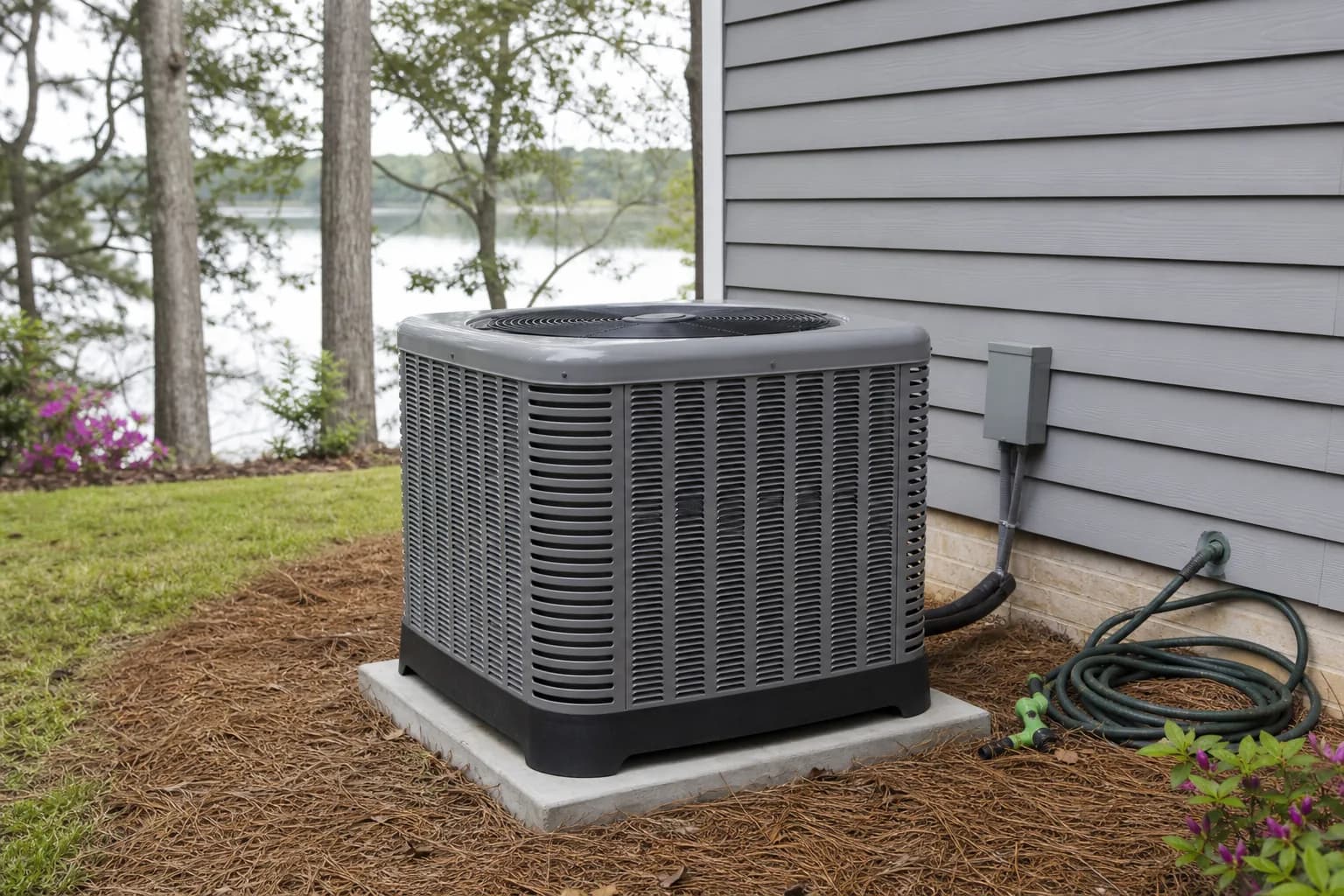
This is a five-minute job and it's the single best thing you can do today. Go look at your outdoor unit.
What you're checking for: pine straw and oak leaves packed against the coil fins; pollen and yellow dust caked over the side panels; a depression around the pad where settling has tilted the unit; the disconnect box on the wall behind the unit (is the cover on, are the wires not corroded, is the box not full of wasp nests); the refrigerant line set insulation (is the foam intact or has the UV broken it down); and the area within three feet of the unit on all sides (cleared or overgrown).
If the coil fins are visibly fouled, gently rinse from the top down with a garden hose at moderate pressure. Don't use a pressure washer — you'll bend the fins and that's a real, irreversible airflow problem. If you see pinch points where fins have been bent (kid with a Wiffle bat, branch impact, foot of a ladder), leave them and mention it when we come for the tune-up. We have a fin comb. You probably don't.
If the disconnect box has wasp nests inside it — and if you're in TimberCreek, Bellaton, or anywhere with mature trees, it might — kill the breaker first, knock the nests down with the unit cold, and call us if you see scorch marks on the contacts. Scorched contacts mean an electrical issue beyond a wasp problem.
2. Pull the indoor filter and look at it
Standard 1-inch return filter, 16x25 or 20x25 depending on the system. Pull it out. Look through it toward a window. If you can't see daylight through the pleats, replace it now and replace it again in 30 days.
Daphne pollen season runs into mid-May for the late grass and pecan, and the cottonwood drift along the bay shoulder lasts another two weeks past that. A filter that looked clean on April 1 is loaded by May 15. Loaded filters restrict airflow, ice the coil, freeze the line, and turn into the call we get on a 92F afternoon when the homeowner thinks the AC has died. It hasn't died. The filter strangled it.
For homes in Hope Vineyard, The Reserve, and Jubilee Farms with tight envelopes and high IAQ expectations, this is also the right moment to consider stepping up to a MERV 11 in a 4-inch media cabinet — but only if your duct system can handle the static pressure. We measure that during the tune-up. The indoor air quality service page has more on filter and ventilation choices.
3. Test the thermostat and the cold air
Turn the thermostat down 4 degrees below current room temperature. Wait three minutes. Walk to the largest supply register in the room you're standing in and put your hand under it.
What you should feel: noticeably cold air, steady flow, no fluttering or pulsing. The temperature differential between supply and return air should be 16-22 degrees F when the system is properly charged and the airflow is correct. If you have a meat thermometer, you can measure this — stick it in a register for two minutes, then in the return grille for two minutes. The delta is your number.
If the cold air feels weak, fluttering, or only marginally cold, you have one of three problems: a refrigerant charge issue, an airflow restriction (filter, blower wheel, ductwork), or a coil that's partially iced from prior airflow restriction. Any of those is a service call, and it's much cheaper to find it now than at 4 PM on July 12.
4. Look at the air handler closet
Most Daphne homes have the air handler in a closet, attic, or garage utility space. Open the access panel area and look (don't open the panel itself unless you've done it before).
What you're looking for: standing water in the secondary drain pan under the unit; rust streaks down the side of the cabinet; a wet patch on the drywall behind the unit; the primary condensate line (PVC, usually 3/4 inch) running out of the unit. Follow that line to where it terminates outside. Is water dripping out when the system is running? It should be. If it isn't, the line is clogged.
A clogged condensate line is the #1 cause of summer service calls in Daphne. The bay-side humidity means systems pull a lot of water out of the air, and the drain biofilm grows fast. By July, a half-blocked line backs up, the float switch trips, the system shuts down, and you call us. Five minutes with a wet/dry vacuum on the outdoor termination clears it. Do it now.
5. Schedule the tune-up
This is the one that's not free. A full preventive maintenance visit runs in the standard Baldwin County range and covers the things you can't check yourself — refrigerant pressures, superheat and subcooling readings, electrical amp draws on the compressor and blower, capacitor microfarad reading, contactor pitting check, indoor coil inspection, blower wheel cleaning if needed, condensate line treatment.
The point of doing it in May, not June, is twofold. First, our calendar isn't slammed yet — you can pick your day. Second, if we find something that needs a part, we have time to source and install it before you're depending on the system. Catching a marginal capacitor in May is a different experience than catching it in July when the same capacitor has just stranded you on a 96F afternoon. The preventive maintenance service page covers what's included, and the Comfort Plan rolls two visits and priority routing into $20/month or $240/year.
The neighborhood-specific tweaks
The standard punch list above applies to every Daphne home. A few additions if you're in specific neighborhoods:
Lake Forest, Bellaton, and TimberCreek (mid-age construction). The original equipment in many of these homes is now 15-20 years old. If yours is in that range and you haven't replaced it, the May tune-up is also the moment to ask honestly: how many more summers are we asking from this unit? The answer is fine if the unit is healthy. But if the technician finds a marginal compressor or a leaking coil, you want to be having the replace-versus-repair conversation in May, not in July when you're forced into whatever can be installed Monday.
Old Daphne and Historic Malbis (older retrofit). The duct system matters more than the equipment here. Ask the technician to inspect the attic ductwork specifically — separated joints, loose insulation, mouse damage, places where flex duct has slumped or been crushed. Air that escapes into a 130F attic isn't cooling your house. Homes in this housing era often lose a significant share of system capacity to duct leakage, and equipment replacement won't fix it.
Jubilee Farms, The Reserve at Daphne, Hope Vineyard (newer construction). The risk here isn't equipment failure — it's commissioning. Spec construction means the lowest-bid HVAC subcontractor installed the system, and "passes inspection" doesn't mean "correctly tuned." Ask for a static pressure measurement, room-by-room airflow check, and indoor humidity reading. New systems in tight envelopes that hold humidity above 55% are a setup for biofilm and mold complaints by August. The Spanish Fort tight-build humidity post covers the same dynamic in a neighboring city.
Anywhere along Scenic Highway 98. The salt air piece is real. Add a quarterly outdoor coil rinse to your routine — five minutes with a garden hose, top to bottom, four times a year. We can also apply a corrosion-inhibitor coating to the coil during a tune-up, which extends the practical lifespan of the outdoor unit by several years in coastal exposure zones.
The cluster context
This post is part of the pre-summer inspection cluster. Two siblings cover related geographies: the Gulf Shores May heat wave prep post walks through five quick wins for coastal homes with shorter response windows, and the Stapleton Memorial Day weekend post explains why holiday-weekend failures are uniquely brutal in north Baldwin County. If you're a Daphne homeowner with a rental property in Gulf Shores or family in Stapleton, both are worth a read.
For the broader seasonal context, the preventive HVAC maintenance checklist for Gulf Coast homes is the cross-county baseline. The why coastal AC units fail faster post covers the corrosion physics in more detail than this one had room for.
What to do in the next 48 hours
Three things, in order:
First, walk outside. Look at the unit. Knock down a wasp nest if you have to. Rinse the coil if it's fouled. Five minutes.
Second, change the filter. Whatever's in there is loaded. Put a fresh one in and write the install date on the frame in Sharpie.
Third, call us at 251-383-HVAC and book the tune-up for any open day in the next two weeks. Mention the Daphne May punch list and ask for the pre-summer inspection. We'll bring a static pressure gauge, a manifold set, an amp clamp, and a clipboard. We'll leave you a written report. If we find something, we quote it before we touch it. If we don't find anything, you spend the next four months not thinking about your AC.
That's the goal. The June 30 scenario at the top of this post happens to people who didn't do the May version. Don't be one of them.
FAQ
- When is the latest I can do a pre-summer tune-up in Daphne and still get ahead of the heat?
- Mid-May is the practical deadline. Daphne sees its first sustained mid-90s afternoon by the second week of June in most years, and the bay's lagging humidity peak rolls in right behind that. A tune-up after the first heat wave hits is no longer a tune-up — it's a diagnostic on a system that's already been pushed past whatever its weak point was. If you're reading this in late May, schedule for the next available week. If you're reading this in June, schedule the next available day and ask for an inspection plus diagnostic in one visit.
- What does the $79 service fee cover versus a tune-up?
- The service fee covers the call-out for a specific symptom you've noticed — system not cooling, weird noise, water under the air handler, breaker tripping. We test, identify the cause, and quote the repair in writing before any work begins. A tune-up is preventive: full performance check, refrigerant pressures, electrical readings, coil cleaning, filter assessment, condensate clear, capacitor check. Different scope, different price, and most homes need both at some point in the system's life.
- Should I be worried if my Daphne system runs nonstop on a 90-degree day?
- Not necessarily. A correctly sized residential AC in Daphne should run nearly continuously when the outdoor temperature exceeds the design load (around 92F here). What matters is whether it's holding the indoor setpoint while running. If the thermostat reads 76F on a 95F day with the system running constantly, that's normal. If the thermostat is climbing past setpoint while the system runs, that's a refrigerant, airflow, or capacity problem and worth a call.
- Does salt air from Mobile Bay really matter for a Daphne home that's not directly on the water?
- More than people expect. Salt air follows prevailing southwest winds inland for several miles, and homes anywhere along the Scenic 98 corridor or within 2-3 miles of the bluff get a meaningful dose. The corrosion shows up first on outdoor coil fins and electrical contactors. Annual coil cleaning and a contactor inspection catch this early — before a pinhole refrigerant leak or a failed contactor turns into an emergency call in August.
Need this handled?
Straight to the service page for your town — pricing, local details and a form that reaches a technician.
More from Pre Summer Inspection

ACExperts HVAC
We Take The Heat So You Don't Have To
Fast, honest heating and air service across Baldwin County. Speak with a technician and get on the schedule today.