
How an Ant Can Kill a Robertsdale Contactor (and How to Stop It)
Argentine ants kill more central Baldwin County HVAC contactors than almost any single cause. Here's why they get in, the damage, and how to stop it before summer.
Published 2026-07-14 · Updated 2026-07-14
Author: Landon Jahnke | ACExperts251
Reviewed by: Landon Jahnke · Owner · Alabama HVAC License AL #16117 · EPA 608 Certified
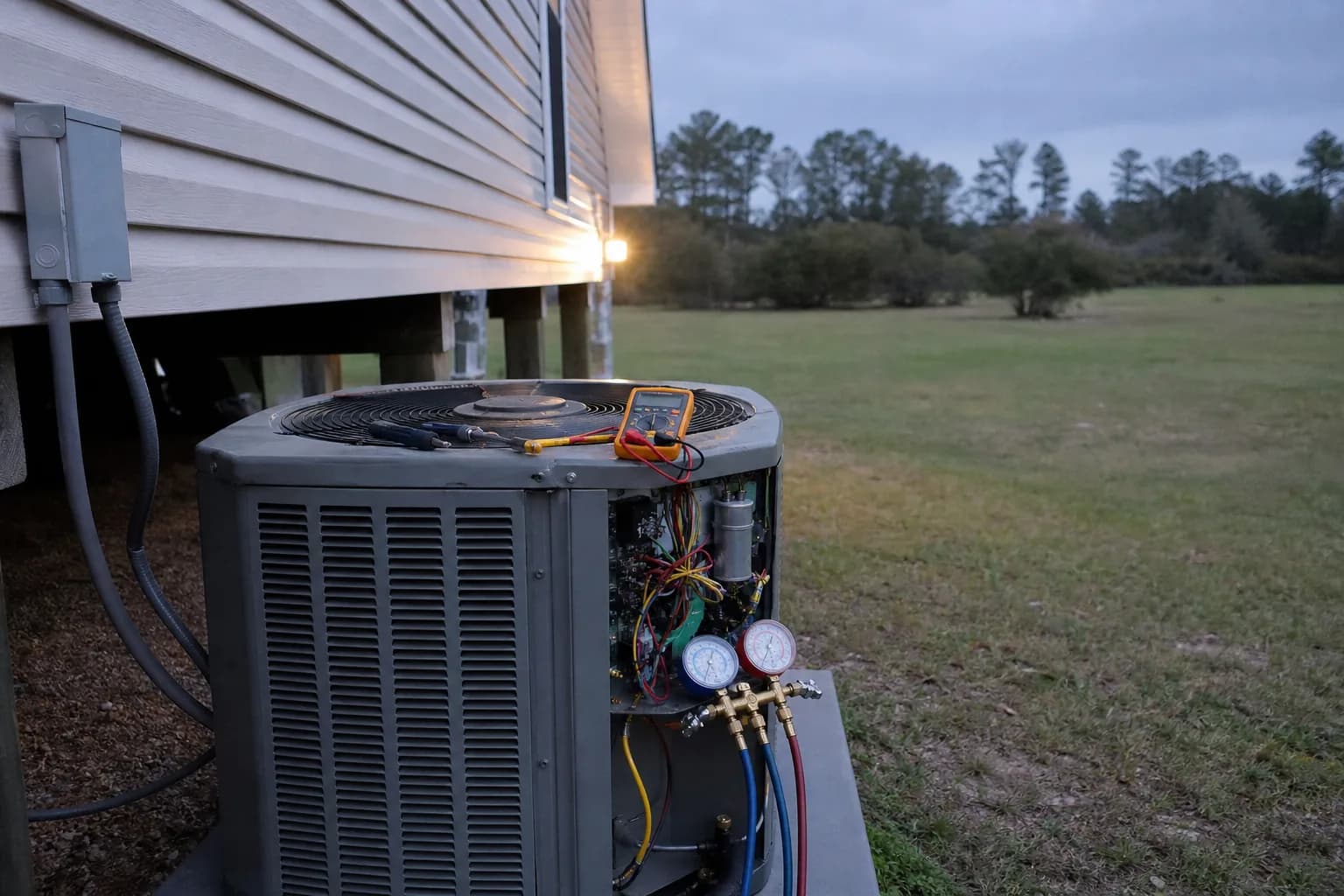
Over thirteen years working Baldwin County HVAC, the call I take more often than almost any other in July and August along the Highway 59 corridor is the contactor swap on an outdoor unit that's been overrun with Argentine ants. Pulling the cover and finding hundreds of dead ants pressed between the contacts is so common in central Baldwin County that I've learned to suspect it before I've even opened the access panel.
This post explains why ants kill contactors in Robertsdale specifically, what an ant-killed contactor looks like, and what to put around your outdoor unit before peak summer to keep them out.
What the contactor actually does
The contactor is a switching device — basically an industrial relay — that lives inside the outdoor unit's electrical compartment. It takes a 24-volt signal from the indoor thermostat ("turn on") and uses that small signal to close a heavy mechanical contact that connects 240 volts of line voltage to the compressor and the outdoor fan motor.
Two physical contact surfaces (the "contacts") slam together when the coil energizes, and snap apart when it de-energizes. Every cycle is a small mechanical event with a faint arc as the contacts make and break. Over years, the contact surfaces develop pitting — tiny pock marks in the metal — but in normal operation that pitting is slow and predictable, and a contactor lives 8-12 years.
What ants do is accelerate that pitting cycle from gradual end-of-life wear to catastrophic failure in a matter of days.
How an ant ends up between two contact surfaces
The path is short and the timing is unfortunate.
A worker ant from a colony that's set up shop near the condenser pad enters the electrical compartment through one of the cable entry points — the line voltage knockout, the low voltage harness opening, or sometimes a gap at the access cover. The compartment is warmer than outside ambient (the contactor coil dissipates a few watts when energized), and that warmth is an attractant during cooler morning hours.
The ant explores. It crosses the contactor housing, looking for the same things ants always look for: warmth, moisture, food residue. The contact surfaces themselves — two plates separated by a few millimeters when open — are accessible. The ant walks across the gap.
Then the thermostat calls. The 24-volt coil energizes. The contacts slam closed. The ant is pinned between two pieces of copper or silver-tipped contact material with 240 volts running through it. The arc carbonizes the body instantly, leaving a carbon residue on the contact surfaces.
One ant is barely a measurable problem. But the pheromones the dying ant releases — alarm pheromones in particular — attract the colony. Over the next 24-72 hours, dozens to hundreds of additional ants follow the trail. Each one that gets pinned during a contactor cycle adds to the carbon layer.
Eventually one of two things happens: the carbon layer is thick enough that the contacts can't make a clean electrical connection (the compressor won't start, or starts and stalls), or the carbon layer fuses the contacts together (the compressor runs continuously, won't shut off when the thermostat calls off, and either freezes the indoor coil or trips the high-pressure switch).
Either way, the homeowner calls.
Why Robertsdale specifically
This problem isn't unique to Robertsdale, but it's particularly dense in central Baldwin County for three reasons.
Argentine ant density. The Argentine ant (Linepithema humile) is the dominant invasive ant species across the Gulf Coast, and Baldwin County is squarely within their preferred range. Argentine ants form supercolonies — meaning workers from one colony don't fight workers from neighboring colonies — and population densities along the Highway 59 corridor through Robertsdale, Loxley, and Summerdale are among the highest in the area. Ant-driven contactor failures are noticeably more frequent inland along that corridor than they are in coastal cities like Gulf Shores.
Older outdoor units. Robertsdale's housing stock skews toward homes built in the 1960s through the 1980s with retrofit AC. The outdoor units in those homes are often 12-18 years old, and the gasketing on the electrical access covers degrades over time. Newer units have tighter sealing at the cable entries and the access covers; older units don't, and the gaps that open up over time are exactly the size that ant workers traverse.
Ground-level installations near vegetation. A lot of Robertsdale homes have outdoor units sitting at ground level on a concrete pad against the foundation, with shrubs or beds within 18 inches of the unit. That's prime ant habitat. Units installed on raised pads with a 36+ inch buffer from vegetation see meaningfully fewer ant problems.
The pattern shows up most in older neighborhoods with established vegetation against the foundation and original-vintage outdoor units. It's the combination — high local ant density, older equipment, vegetation against the pad — that makes a unit a target.
The diagnostic signature
If you suspect ant damage but you're not opening up the contactor yourself, here's what to look for from outside the unit:
Recent random shutoffs. The system stops cooling, you reset the breaker, it runs again for some hours and stops again. This is the classic stuck-or-arcing contactor pattern, ant-driven or otherwise.
Compressor that won't shut off. Thermostat says off, but the outdoor unit keeps running. Welded contacts. The breaker becomes the only way to stop it. This is dangerous — a compressor running with the indoor coil trying to manage a too-cold house can freeze and produce slugging on the next cycle.
Audible buzz from the outdoor unit when nothing else is running. The contactor coil is energized but the contacts aren't quite making clean contact. The buzz is the coil trying to pull the armature against a fouled contact face.
Visible ant trails on the condenser pad or up the refrigerant lines. This one is the obvious one. If you walk up to the unit and see ants in motion, the contactor is at risk regardless of whether the symptoms have appeared yet.
When I open the electrical compartment, the visual confirmation is immediate. A clean contactor at end-of-life shows uniform gray-silver pitting on the contact surfaces. An ant-killed contactor shows black-brown carbonized residue with embedded debris that won't wipe off. Sometimes you can count individual bodies on the contact face under a magnifier. Once you've seen the residue, the diagnosis is settled.
What to put around the outdoor unit before peak summer
Three measures, in order of effectiveness.
1. Granular ant bait around the perimeter, 12-18 inches from the pad. Standard granular bait products with fipronil, hydramethylnon, or borax-based active ingredients work. Distribute a perimeter ring around the unit pad, not directly on or under the equipment. Refresh every 3-4 weeks during the active season (April through October in Robertsdale). The bait kills the colony, not just the workers in transit, which is the only durable solution.
2. Sealing the access cover with a quality gasket. If your unit's electrical access cover doesn't have an intact rubber or foam gasket, replace it. I do this during regular service calls when I notice it. A clean gasket eliminates one of the primary entry points without affecting any electrical function.
3. Vegetation buffer. Pull mulch and bedding plants back at least 24 inches from the condenser pad. Ant colonies establish themselves in mulched beds and use mulch as a humidity-stable nesting medium. A clean buffer of bare ground or thin gravel between the bed and the equipment reduces colony establishment near the unit.
What not to do:
Don't spray pesticide directly into the electrical compartment. This is the most common DIY mistake. The pesticide residue itself can foul the contactor surfaces and cause the same symptoms as the ants did. The residue can also degrade insulation on wiring over time.
Don't seal the cable entry points with caulk or expanding foam. Those entries exist for cable routing and ventilation. Sealing them entirely traps heat and moisture inside the electrical compartment, which causes its own failure modes.
Don't ignore visible ant activity hoping it'll resolve. Ant colonies don't move on without being treated. Once they've established a trail to the equipment, they'll continue using it through the season, and the damage compounds.
What I do during a service call when I find ants
The repair is usually straightforward but specific.
I replace the contactor with an OEM-spec unit (or a high-quality aftermarket equivalent for older systems where OEM is no longer manufactured). I inspect the start capacitor, the run capacitor, and the low-voltage harness for carbonized residue transfer — when ants have been bad, residue can migrate beyond the contactor itself. I document the entry points and recommend gasket replacement if the access cover is compromised. I confirm the contactor is sized correctly for the compressor amp draw, since undersized contactors fail faster regardless of ant activity.
Then we have the bait conversation. I don't sell pest control products and I'm not a licensed pest applicator. I point homeowners to standard hardware-store granular baits and to local pest control services for severe colony situations.
A clean contactor swap with no secondary damage is straightforward. With secondary damage to the cap or wiring, the work expands. The pre-summer service call that catches the early signs and treats the surrounding area before damage accumulates is the $79 diagnostic plus a small box of granular bait from the hardware store — much cheaper than the in-season emergency.
For more on how the contactor fits into the broader outdoor-unit failure picture, the Foley hard-start kit guide covers the related compressor-side diagnostics. If you've got an aging system showing intermittent symptoms, the Baldwin County AC longevity guide helps frame the repair-vs-replace conversation.
Sometimes it's ants. Bait the perimeter before they prove it at your house. Call 251-383-HVAC Monday through Saturday during regular hours.
FAQ
- Why do ants get into AC contactors in the first place?
- Two reasons, and they compound. First, contactors generate small amounts of heat and a faint electromagnetic field when energized — both are attractants for several ant species, particularly Argentine ants and crazy ants common in central Baldwin County. Second, the contactor housing has openings for the line voltage wires, the low-voltage thermostat wires, and the contact mechanism itself, and those openings are exactly the size ants prefer to traverse. Once one ant gets pinned between the contacts during a closure event, the pheromones released attract others, and the failure cascades.
- What does an ant-killed contactor look like when you open it up?
- Distinctive. The contact surfaces show carbonized residue with embedded insect remains — usually a black or dark brown crust that won't scrape clean because the pitting underneath is permanent. The contactor often welds itself in the closed position because the carbonized layer reduces the contact's ability to break the circuit cleanly, which means the compressor runs continuously even when the thermostat calls off. Confirming the diagnosis is sometimes a matter of counting bodies under a magnifier — and yes, sometimes it's literally hundreds.
- Will an ant-bait product near my outdoor unit harm the AC?
- Granular and gel ant baits placed 12+ inches from the condenser pad are safe and effective. They don't interact with HVAC equipment chemically or electrically. The mistake to avoid is spraying pesticide directly on or inside the contactor — that creates a residue layer that itself can foul the contacts and cause the same symptoms as the ants did. Bait the perimeter, not the equipment.
- How much does ACExperts charge for an ant-driven contactor replacement?
- The standard $79 service fee applies to the diagnostic. Repair pricing varies with the unit's model, amp rating, and whether the ants have caused secondary damage to wiring or capacitors. I quote the repair after I see what's there. Free second opinions on quoted repairs.
Need this handled?
Straight to the service page for your town — pricing, local details and a form that reaches a technician.
More from Contactor Failure

ACExperts HVAC
We Take The Heat So You Don't Have To
Fast, honest heating and air service across Baldwin County. Speak with a technician and get on the schedule today.