
Silverhill Back-to-School HVAC: Patterns From 13 Years in Baldwin County
If you do one thing the week kids head back to school in Silverhill, set a 4-event thermostat schedule. The rest of the findings are here, but that's the move.
Published 2026-08-07 · Updated 2026-08-07
Author: Landon Jahnke | ACExperts251
Reviewed by: Landon Jahnke · Owner · Alabama HVAC License AL #16117 · EPA 608 Certified
If you only do one thing in your Silverhill home the week kids go back to school: set your thermostat to a 7-day, 4-event schedule (wake / leave / return / sleep). Not a smart geofence. Not "Auto." A simple programmed schedule.
That single action accounts for most of the savings the rest of this post will discuss. Here are the patterns I've seen on back-to-school-week HVAC calls over 13 years working Baldwin County before founding ACExperts — composite, not a customer-by-customer audit — but if your eyes are glazing already, schedule programming is the move.
What back-to-school HVAC calls actually look like
The mix on these calls is some scheduled tune-ups and a lot of complaint calls — "system running but not cooling," "high bill last month," "house feels humid even when AC is on." The diagnostic patterns repeat year over year. A small set of categories accounts for most of the work.
Pattern 1 — Filter loaded past the point of usefulness
A meaningful share of late-August calls find filters that haven't been changed since spring. In Silverhill — where summer pollen, dust, and humidity all layer on the filter media — a 60-day filter that's been in for 110 days is functionally a wall. Static pressure across the air handler routinely reads above 1.0 inches WC against a design spec around 0.5. The blower is working overtime to pull air through, the cooling coil is starved of return air, and the system short cycles because the supply registers can't deliver cooling fast enough.
A filter change at the visit drops static pressure back toward spec and lets the system run a normal cycle within minutes. Almost always free at the diagnostic.
Pattern 2 — Drain trap clog
Silverhill humidity in August produces enough condensate that a partially clogged drain trap will cap and overflow. A pattern I see repeatedly: a primary drain pan with standing water; sometimes the overflow safety has already shut the system down, sometimes it's days from doing so.
Drain trap clearance with a wet-dry vac and a vinegar flush is part of every tune-up. Cleared preventively in spring or fall, it's part of the visit. As an emergency line item it's a separate quote. The math is consistently in favor of the maintenance approach.
Pattern 3 — Capacitor drift past tolerance
Run capacitors that have drifted measurably from nameplate are common late-summer findings. None have failed yet — the systems are still running — but the drift rate suggests failure inside 60 to 90 days, which is exactly when end-of-summer wear catches up to capacitors that have been carrying a heavy season's cooling hours.
Preemptive replacement is a routine service call. Final pricing on parts and labor is provided in writing.
Pattern 4 — Thermostat schedule misconfigured or absent
This is the headline finding and the reason for the post's opening. A surprising share of Silverhill homes have thermostats running on "Auto" or on a schedule that doesn't match the household's actual occupancy.
The most common pattern: a smart thermostat installed a couple of years ago, geofencing turned on, but never configured with a schedule. Geofencing alone misses the morning wake bump and the overnight setback, both of which contribute their own efficiency. The result is systems running at occupied setpoint through 8-hour empty windows.
Reprogramming to a 4-event schedule (wake / leave / return / sleep) typically produces meaningful annualized savings — variable by home size and occupancy pattern. The largest savings come on bigger homes with longer empty windows; smaller homes with partial work-from-home schedules see less.
Pattern 5 — Indoor blower wheel coated with debris
Older Silverhill homes — especially the pre-1970 stock with returns sized smaller than current standards — pull more lint and dust through the blower than newer homes. Visibly coated blower wheels, blade pitch effectively reduced, airflow measurably below spec.
A blower wheel cleaning is roughly an hour of labor and usually comes up during a tune-up rather than as a separate ticket. The airflow gain is substantial — often double-digit percentage improvements at the supply trunk, measured with an anemometer.
Pattern 6 — Refrigerant slightly low, but not from a leak
Subcooling readings a few degrees below manufacturer spec on 8-to-11-year-old equipment with no UV-dye evidence of an active leak. Older equipment often loses small amounts of refrigerant through Schrader valve cores or service-port packing rather than through a coil leak. A small top-off restores capacity for another 1 to 3 years; UV dye injection lets us verify on a future visit whether a real leak develops. Pricing on the top-off and dye is provided in writing.
Pattern 7 — Outdoor unit smothered in pine tags
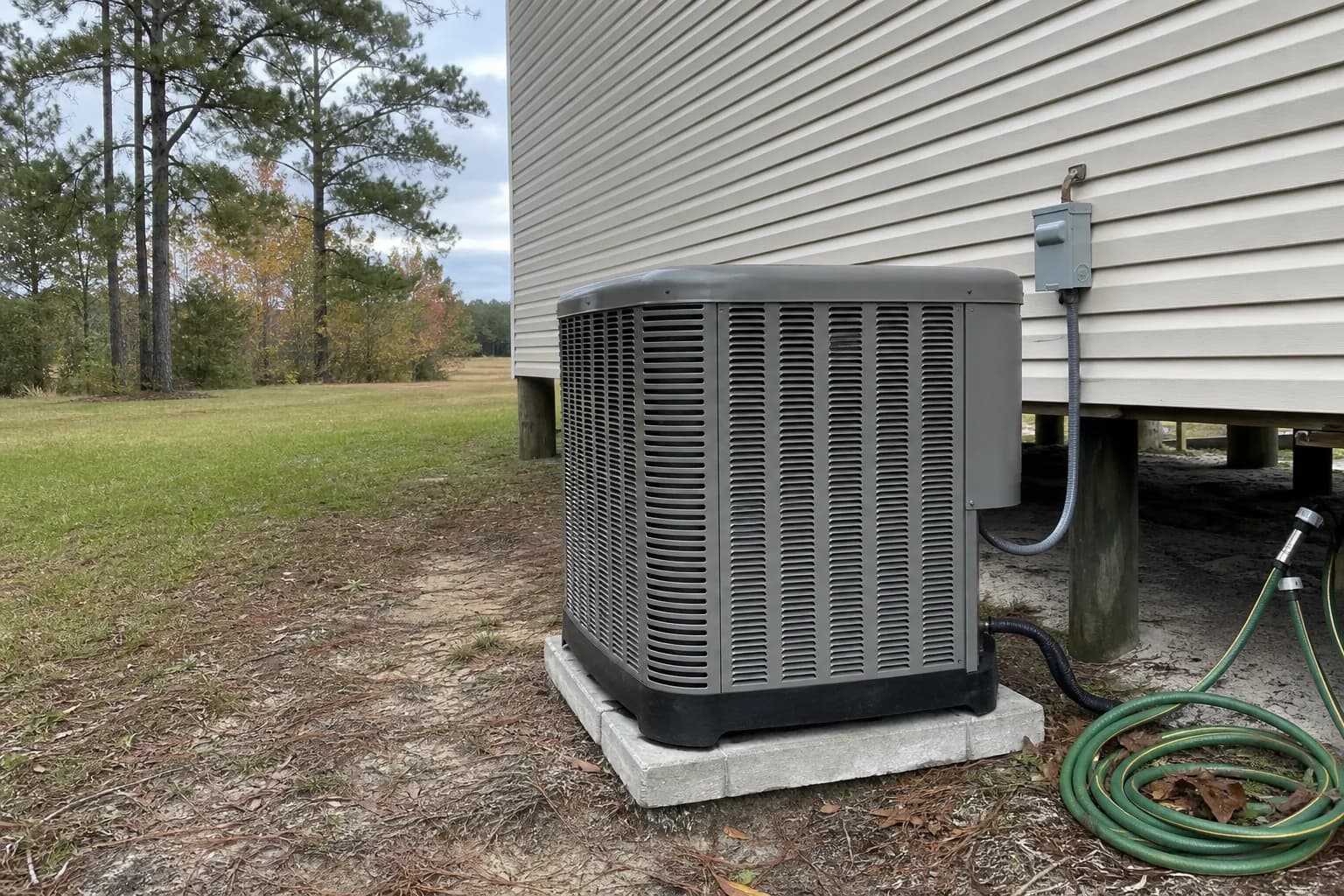
Late August in central Baldwin County drops a heavy second pine-tag layer on outdoor coils. Condenser fins partially blocked — not enough to cause an immediate failure, but enough to lift discharge pressure and reduce capacity at peak afternoon load.
A coil rinse with coil-safe cleaner and a garden-hose spray restores normal pressures within minutes. Five-minute fix at the visit.
Pattern 8 — Condenser fan blade damage
Occasionally an outdoor unit shows a fan blade with a visible chip — usually from a stick that blew into the cage during a summer storm. The blade is still spinning but vibrating noticeably. Replacing the blade prevents what would otherwise be a bearing failure inside a few months. Not back-to-school-specific, but the visit timing catches it before it becomes a 2 a.m. call.
Pattern 9 — Old programmable thermostat with dead battery backup
A basic programmable thermostat that lost its schedule when the battery died, with the homeowner unaware. The thermostat still works manually. Battery replacement is trivial; re-programming the schedule is the conversation that matters.
Pattern 10 — Returns sized for the original system, not the current one
Original-construction return-air sizing meant for a 2-ton system, current 3-ton equipment installed. The undersized returns force the blower to work harder and limit total airflow.
This isn't a same-visit fix. It requires duct work — a return upgrade in the wall or a new return run. I document it with airflow readings and a proposed scope; the customer schedules it for a calmer maintenance window. Final pricing is provided in writing.
Pattern 11 — Float switch tripped but not reset
A system that shut down on a float switch trip (overflow safety) earlier in the week and the homeowner power-cycled the breaker without finding the cause. Drain pan full again on arrival. Drain trap clear, pan dried, float switch tested, system running. The homeowner now knows what the float switch does and what to look at if the system shuts down again.
Pattern 12 — Surge protector at the disconnect, missing or burned
Silverhill sits in the high-lightning-strike zone for the Gulf Coast. Homes without a surge protector at the outdoor disconnect — or with a surge protector that took a hit and burned silently — are common findings. Surge protector installs are routine; pricing depends on the model and is provided in writing.
What these calls have in common
Across the pattern: the equipment is mostly fine. End-of-summer wear has taken a small toll, and a couple of components are on the edge, but the bigger story is that the systems are being asked to do the wrong job. Empty houses cooled to occupied setpoints. Filters past replacement. Drain traps caking up unnoticed. Schedules that haven't been thought about in years.
The combined "thermostat schedule + tune-up + maintenance items" approach often produces meaningful annual savings against modest visit-and-parts costs. The math repeats every year and most Silverhill homeowners don't run it.
What goes on the calendar in early August
If you live in Silverhill, the simple back-to-school calendar:
Week before school starts: Replace the air filter. Spend 15 minutes programming a 4-event schedule on whatever thermostat you have. Walk around the outside of the house and clear pine tags off the condenser cage.
Week 1 of school: If you don't already have one, schedule a fall tune-up for sometime in September. The visit catches the late-summer wear and tunes the schedule against your household's real routine.
Week 3 of school: If anything feels off — humidity, run-time, a noise that wasn't there before — call. Late August into September is exactly the window when small problems become obvious, and intercepting them before October is when the heating-season transition starts.
How Silverhill back-to-school differs from beach cities
A note on geography: Silverhill is 20 miles inland. The back-to-school cooling load profile here is hotter than what Foley, Gulf Shores, or Orange Beach see during the same week, because the bay-breeze moderation that pulls afternoon temperatures down at the coast doesn't reach this far inland. Empty-house cooling at occupied setpoint is more expensive in Silverhill than in a comparable Foley home.
The Foley summer post and the Gulf Shores summer cost post cover those coastal patterns. The Orange Beach holiday post is rental-focused but covers similar geography.
The one-line action
If you skipped to the bottom: program a four-event thermostat schedule before the second week of school. Do it on a Sunday afternoon. It takes 15 minutes. The wake / leave / return / sleep pattern with a 4°F empty-house setback delivers most of what a tune-up visit would save you, plus everything we'd save on the equipment side stays available.
If you want the visit anyway, the Comfort Plan page has the program details. The Silverhill service area page has the city-specific notes — Silverhill is ACExperts headquarters, and the truck rolls through every neighborhood here regularly.
Final pricing on parts, labor, financing terms, and any applicable tax or insurance treatment is provided in writing on each job. This post is general guidance from 13 years of career experience, not a property-specific quote.
Call 251-383-HVAC. We answer 24/7, any day of the week, including Saturdays at no extra charge.
FAQ
- Why does back-to-school week trigger HVAC service calls in Silverhill specifically?
- Three overlapping reasons. First, summer use has put roughly 1,800 hours on the equipment since June, and end-of-summer is when wear shows. Second, the household routine changes — empty house during school hours instead of continuous occupancy — and equipment that was masking problems with continuous run-time stops masking them when cycling. Third, Silverhill's older housing stock means many systems are running with retrofit ductwork that compounds late-summer airflow issues. The calls cluster in the second and third week of school every year.
- Is a thermostat reprogramming visit something I have to schedule separately, or is it part of a tune-up?
- It's part of a fall tune-up at no extra charge. We program the schedule with the homeowner present so the household can adjust it later. The $79 service fee covers a single visit; the Comfort Plan covers two tune-ups per year plus 10% off repairs and replacements. Final pricing on any additional work is provided in writing.
- What if my Silverhill home doesn't have a programmable thermostat?
- Replacement and installation pricing varies with the thermostat model — basic 7-day programmable, Wi-Fi smart thermostat, or smart thermostat with humidity control suited to older Silverhill homes that struggle with humidity load. We install during the same visit as a tune-up so there's no second trip charge. The quote is in writing before any work.
- Are these patterns unique to Silverhill or do they apply more broadly across Baldwin County?
- Most apply broadly — the back-to-school reset pattern is universal in Baldwin County school-year households. The Silverhill specifics are around older housing stock (late 1800s through 1980 construction dominates) and the duct conditions that come with retrofit central AC in homes built before central air existed. A Foley or Loxley home with similar age would show similar findings; a newer Gulf Shores rental would not.
Need this handled?
Straight to the service page for your town — pricing, local details and a form that reaches a technician.
More from Back To School Reset

ACExperts HVAC
We Take The Heat So You Don't Have To
Fast, honest heating and air service across Baldwin County. Speak with a technician and get on the schedule today.