
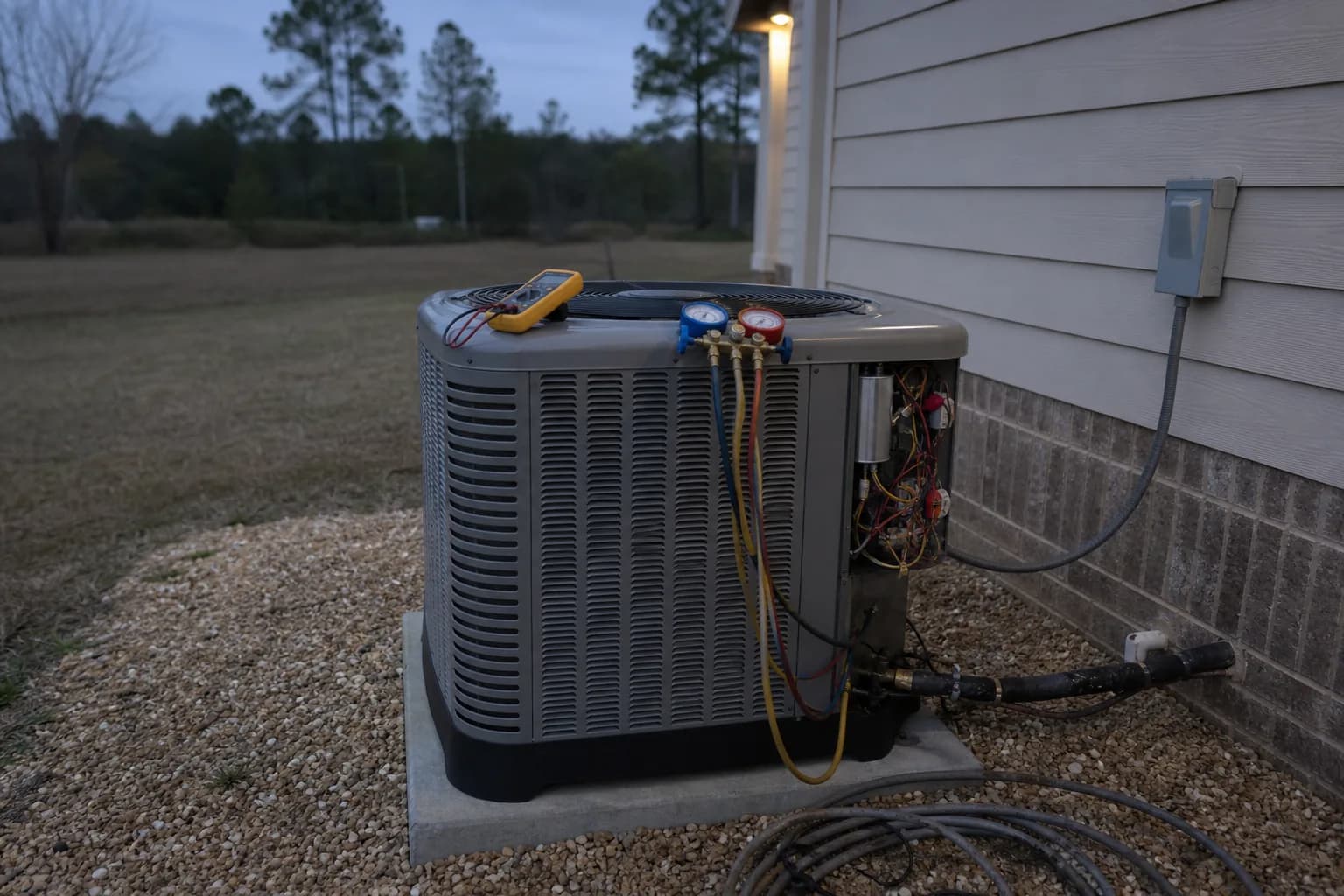
The Welded-Contact Symptom on a Bay Minette Condenser
How to recognize a welded-contactor failure on a Bay Minette outdoor unit: the multi-month warning curve, the symptoms most homeowners miss, and what to do.
Published 2026-10-23 · Updated 2026-10-23
Author: Landon Jahnke | ACExperts251
Reviewed by: Landon Jahnke · Owner · Alabama HVAC License AL #16117 · EPA 608 Certified
Your Bay Minette AC has been trying to tell you something for the last few months. Every time you killed the breaker for a thunderstorm and turned it back on, the contactor stuck closed for an extra fraction of a second. Every time you came home to a too-warm house when the thermostat said you shouldn't have, the contactor was welding itself shut a little more. The AC was talking the whole time. Most homeowners aren't listening — not because they're careless, but because nobody told them what the symptoms sound like.
Here's what to listen for and what to do when you finally hear it.
The contactor is the high-voltage relay inside your outdoor condenser that closes when the thermostat asks for cooling. It carries 240 volts to the compressor and the outdoor fan motor. When it's working, it opens and closes cleanly thousands of times each cooling season. When it starts to fail, it does so in a recognizable pattern over the course of a few months — and the homeowners who catch it early can usually pinpoint the exact week the symptoms started, once they know what to look for.
This post walks the failure curve from the first quiet warning through the welded-shut emergency, with the specific Bay Minette details — older retrofit installations, longer outdoor disconnect runs, the housing-stock specifics that affect how this failure presents in this market.
The multi-month warning curve
Stage one: the half-second hesitation
The first symptom is the one nobody catches. You set the thermostat down a couple degrees on a hot afternoon. You hear the indoor blower kick on within a second or two. You expect to hear the outdoor unit start within another second or two. Instead there's a brief pause, then the unit fires up.
That pause is the contactor coil energizing but the contact pads not closing cleanly. Pitting on the silver-cadmium pads has reached the point where the magnetic pull-in force has to work harder to bridge the gap. It's still working. It just isn't working cleanly.
Most homeowners never notice this. The ones who do tend to be the people who use the porch a lot — they're outside near the condenser, they hear the cycle from twenty feet away, and the rhythm changes by half a beat. If your AC has been making a slightly different start-up sound for the last month or two and you can't quite name what's different, this is probably it.
Stage two: the storm-cycle hangover
Bay Minette gets summer thunderstorms. A lot of Bay Minette homeowners kill the breaker on the outdoor disconnect when lightning is close, then re-energize the breaker after the storm passes. That's the right move — surge protection on the AC is rare and lightning damage is expensive. But it puts your contactor through a stress test.
A pitted contactor that gets re-energized cold sometimes sticks closed for an extra second or two on the first cycle. You won't see it from inside the house. What happens is: breaker comes back on, thermostat is calling for cool, contactor pulls in, runs normally, thermostat satisfies, contactor tries to open... and doesn't quite open. It opens a couple of seconds late. The compressor and fan keep running for those couple of seconds after the call has stopped.
You won't notice a 2-second hang. You'll notice an 8-second hang. By this stage of the failure curve, you're getting longer hangs after thunderstorm cycles. The pattern: the system runs normally during the storm cycle, then runs slightly long after the next satisfaction event. This shows up in Bay Minette homes off Stockton Road, in older Wilkins Creek installations, and on retrofit systems in the courthouse-square neighborhoods.
Stage three: the temperature drift
The contactor is now sticking closed for a minute or more at a time after the call ends. Now you can see it on the thermostat. You set the cool point at 72. The system runs, satisfies, the indoor blower stops, the outdoor unit keeps running for another minute, and the thermostat reading drops a couple degrees below setpoint before everything shuts off.
The opposite happens too: the contactor sometimes fails to close on a call, the system doesn't start when it should, and the indoor temp rises several degrees above setpoint before something jiggles loose and the system finally fires up. Coming home to a too-warm house when the thermostat was set to a comfortable number — that's this stage. Most homeowners interpret this as "the AC isn't keeping up" or "I think we're undersized" or "maybe we need a new thermostat." Those are reasonable interpretations. They're also wrong. The diagnostic question for any temperature-vs-setpoint mismatch in an aging system is: is the contactor cycling cleanly?
Stage four: the welded-shut event
Eventually the pitted contact pads pit deep enough that on one cycle, the contacts arc across the pit instead of bridging it cleanly. The arc transfers metal between the pads and welds them together. From that moment forward, the contactor is electrically closed regardless of whether the coil is being commanded. The thermostat can call for off. The disconnect can call for safety lockout. None of it matters. As long as the breaker is on, 240 volts is being delivered to the compressor and the outdoor fan.
The symptoms at this point are unmistakable if you know to look:
- Outdoor fan runs continuously, regardless of thermostat
- Compressor runs continuously, regardless of thermostat
- Indoor coil eventually freezes solid because the indoor blower cycles off when the call satisfies but the outdoor unit doesn't
- Frozen coil melts when the system finally trips on a high-pressure or freeze-stat lockout
- Water pours out of the air handler condensate line at non-AC-running times
- Power bill in the next billing cycle is dramatically higher than the same month a year prior
What to do when you finally hear it
The moment you confirm a welded contactor — meaning the outdoor unit is running with the thermostat off, or the disconnect at the unit is on but the system is still drawing power somewhere it shouldn't — do this in order:
- Cut the breaker at the main panel for the outdoor condenser. Not the disconnect at the unit; the breaker at the panel. This guarantees power is removed even if the disconnect itself has issues.
- Leave the indoor blower running for thirty to sixty minutes if the indoor coil was iced. The melting ice will produce a lot of condensate. Make sure the drain line is clear.
- Don't re-energize the breaker to "see if it's still doing it." Welded contactors don't unweld. Each minute of additional run time adds compressor wear without producing useful cooling.
- Call for service. Contactor replacement is a short repair. For exact pricing against your specific unit, call 251-383-HVAC. The service fee is $79 and emergency hours run 24/7, every day, with no weekend upcharge during regular hours.
What the tech should do on the diagnostic
A good contactor diagnostic isn't just "swap the contactor." The pitted contact pads are a symptom. The cause is usually one of three things, and a tech who doesn't check all three is going to be back replacing the next one in a year or two.
Cause one: capacitor degradation. A weak capacitor produces high inrush current at compressor start, which arcs the contactor pads worse than they should. The capacitor should get tested with a meter on every contactor call.
Cause two: control transformer voltage. The 24-volt coil voltage on the contactor should sit in a healthy band. Below the lower end of that band, the contactor doesn't pull in cleanly and arcs more. Bay Minette retrofit installations sometimes have undersized or aging control transformers that produce low coil voltage. This gets metered on every contactor call.
Cause three: short-cycling. A system that's oversized for the load short-cycles many times more often than a properly-sized one. That's multiples of the contactor wear. If the new contactor goes back into a system that's still short-cycling, it'll fail again on schedule. The fix here is a duct and load assessment, sometimes followed by equipment right-sizing on the next replacement.
We've covered the related failure modes in the Foley builder-grade failure cascade post and in the Daphne weekend invoice walkthrough — same diagnostic principles apply across the Stapleton and Stockton service areas too, though those rural routes occasionally show different failure timing because of the manufactured-home and retrofit-electrical specifics.
The honest budget line
If you're a Bay Minette homeowner reading this and recognizing the first or second stage of symptoms — congratulations, you're early. Schedule a diagnostic now. The visit covers metering the capacitor, the contactor coil voltage, and the supply-line amperage. The service fee is $79 and the contactor swap, if needed, gets quoted in writing before any work happens.
If you're recognizing the third stage — temperature drift, post-storm cycling weirdness — schedule this week. The welded-shut event is statistically likely within weeks of the onset of stage-three behavior.
If you're already at the fourth stage — the unit is running when it shouldn't be — kill the breaker right now and call 251-383-HVAC. Emergency calls are answered day or night, every day, including weekends. Bay Minette is on the regular routing through Stapleton and the courthouse-square corridor.
FAQ
- Is a welded contactor a safety risk or just an inconvenience?
- Both, but the safety risk is real. A welded contactor means 240 volts is being held to the compressor and condenser fan whenever the breaker is on, regardless of what the thermostat is calling for. If the indoor air handler is off but the outdoor unit is running, the system can run a vacuum on the suction line, freeze the indoor coil, dump water onto a hot blower motor, or run the compressor without proper oil return until it locks up mechanically. Cut the breaker on a welded contactor immediately and call for service — don't try to ride out the rest of the day.
- Can I tell from inside the house that my Bay Minette outdoor unit has a welded contactor?
- Yes, with two simple checks. First: walk outside and listen at the condenser when the thermostat is set well above the indoor temp (so it shouldn't be calling for cooling). If the outdoor unit is humming or running, the contactor is stuck closed. Second: cycle the thermostat from cool to off. The outdoor fan should stop within fifteen to thirty seconds. If it keeps spinning indefinitely, the contactor isn't releasing. Either symptom means service before you run the system again.
- How long can a welded contactor sit before it kills the compressor?
- Hours to days, not weeks. The compressor on a stuck-closed contactor runs without proper thermostat control, which means it runs through indoor coil freeze-ups, low refrigerant pressure events, and short-cycling that the safety controls would normally prevent. Compressor damage from a welded contactor typically shows up within a few days of continuous run. If you find one, kill the breaker immediately and don't power it back up until a tech has installed the new contactor and verified amperage and pressure readings.
- Is contactor failure something Bay Minette's older housing stock sees more of than the coastal cities?
- Slightly more, for two reasons. First, retrofit installations from the 1970s and 1980s sometimes use undersized 24-volt control transformers that produce dirty contactor coil voltage, which accelerates pad pitting. Second, older outdoor disconnect boxes near the condenser sometimes lose their weatherseal, letting humidity into the contactor enclosure. Bay Minette doesn't have the salt-air component that Spanish Fort and Daphne see, but the retrofit-era electrical issues are real and visible during diagnostic.
Need this handled?
Straight to the service page for your town — pricing, local details and a form that reaches a technician.
More from Contactor Failure

ACExperts HVAC
We Take The Heat So You Don't Have To
Fast, honest heating and air service across Baldwin County. Speak with a technician and get on the schedule today.