
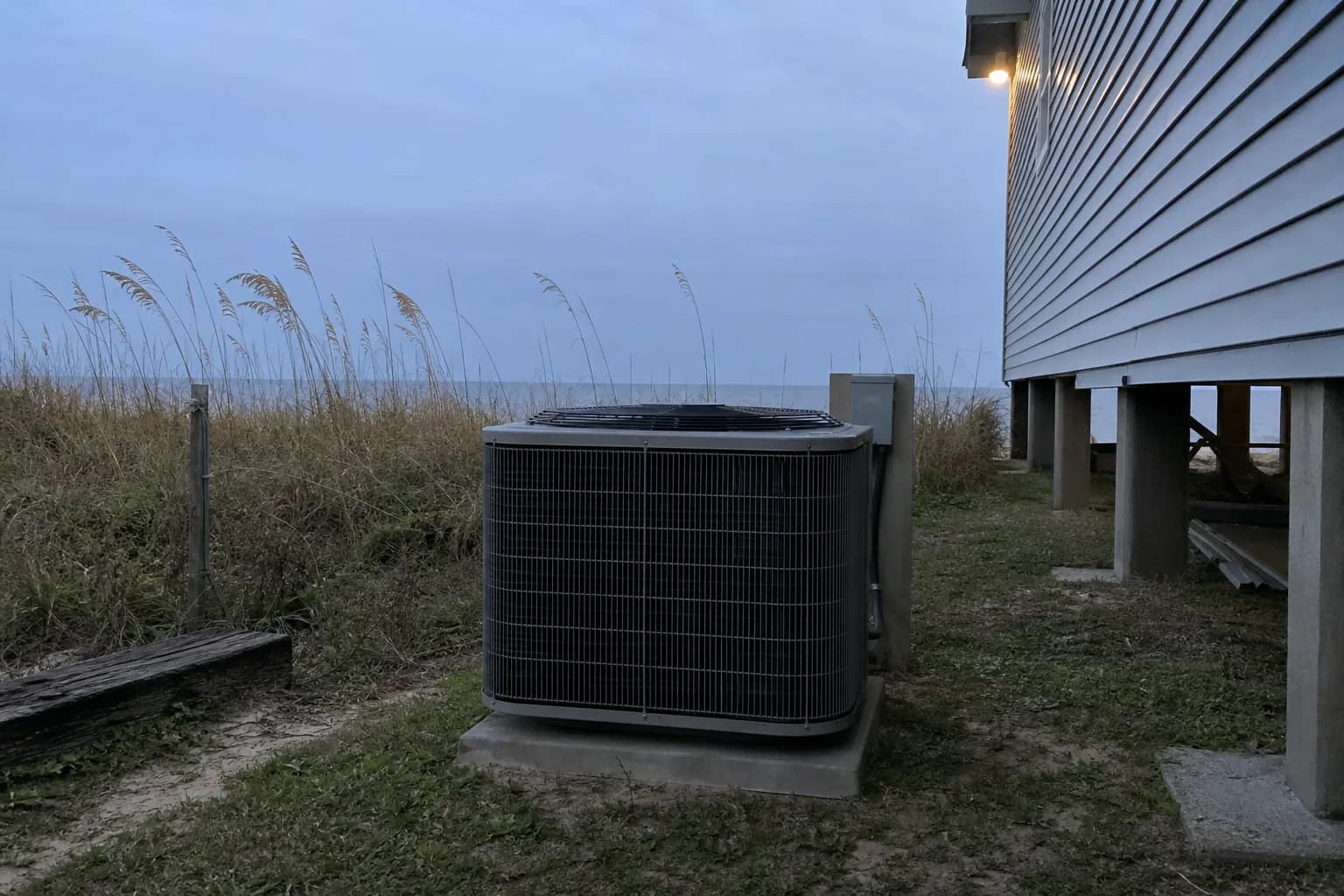
Why an Orange Beach AC Is Running But Not Cooling
An Orange Beach AC that runs but blows lukewarm gets billed as a refrigerant top-off — then billed again next year, same season. What to ask before you pay twice.
Published 2026-10-21 · Updated 2026-10-21
Author: Landon Jahnke | ACExperts251
Reviewed by: Landon Jahnke · Owner · Alabama HVAC License AL #16117 · EPA 608 Certified
A pattern I hear in Orange Beach a few times every fall: a homeowner whose AC is running but blowing lukewarm gets billed several hundred dollars for "refrigerant" — and then gets billed again, the same time of year, the next year, for the same thing. Two seasons, two invoices, same fix that wasn't a fix.
Here's what every Orange Beach homeowner should know before paying for that fix a third time.
Refrigerant doesn't wear out. It doesn't evaporate slowly through October air. It doesn't leak in the summer and re-seal in the winter. If a system needed refrigerant last October and needs it again this October, the refrigerant didn't go anywhere mysterious — it leaked out through a hole that was there both times. The only difference between the two invoices is that the homeowner paid twice to mask a problem that costs a single repair to actually fix once.
Here's the longer version, because the longer version is what saves you the third invoice next October.
The "running but not cooling" symptom is a category, not a diagnosis
A central air conditioner that hums along outside but blows lukewarm air at the registers is showing one symptom. That symptom can come from at least eight different root causes, in roughly this descending order of frequency in Orange Beach:
- Failed or weakening run capacitor. The compressor or fan motor isn't starting cleanly. Salt-air pitting accelerates this in coastal Orange Beach.
- Welded or pitted contactor. The high-voltage contacts that pass current to the compressor have corroded or failed to make a clean connection.
- Dirty condenser coil. Salt-and-dust crust on the outdoor unit blocks heat rejection. The compressor runs but can't dump heat.
- Frozen evaporator coil. A dirty filter starved airflow, the indoor coil iced over, and now the system is essentially running through a block of ice.
- Refrigerant leak. An actual leak somewhere — line set, evaporator coil, condenser coil, service port. Always paired with a cause, never standalone.
- Failed compressor valves. The compressor is spinning but not building pressure. Common in 12+ year coastal systems.
- Stuck reversing valve on heat-pump systems where the valve is locked between modes.
- Thermostat or control-board fault sending an incorrect call to the equipment.
A diagnostic that walks down that list and rules each item in or out — with measurements, not guesses — is the difference between fixing the problem once and paying $400 every fall. The AC repair service page covers the diagnostic protocol in more detail.
Why the $400 refrigerant invoice keeps reappearing
Here's the mechanism nobody explains to homeowners.
When a tech adds refrigerant to a system that has a small leak, the system goes back to working. The refrigerant fills the void, pressures normalize, the air gets cold again. The homeowner is happy. The invoice gets paid. Everyone moves on.
But the leak is still there. It might be a pinhole in the evaporator coil from formicary corrosion (common in 8-12 year systems). It might be a chafe point on the line set where it touches the condenser cabinet. It might be a Schrader valve core that's barely seating. It might be a brazed joint that wasn't fully flushed during the original installation 14 years ago.
Whatever it is, the leak rate determines how long the "fix" lasts. A small leak loses a handful of ounces over a summer. The system limps through. Late summer arrives, ambient temperatures drop, the system cycles longer to maintain setpoint, and the now-marginal charge can't deliver design capacity. Lukewarm air at the registers. October phone call. New invoice.
The Orange Beach version of this story has an additional wrinkle: salt-air corrosion accelerates aluminum-fin and copper-coil degradation in ways that inland systems don't experience. Direct Gulf-front condos and Bear Point homes within sight of the water are seeing pinhole leaks in 6-9 year coils — versus 12-15 years in Foley or Bay Minette. The leak shows up earlier, comes back faster, and gets dismissed as "topping off" until someone finally measures.
What a real Orange Beach diagnostic looks like
When we get called for a "running but not cooling" complaint in Cotton Bayou, Bella Luna, Ono Island, or any of the dozens of Orange Beach condo and home neighborhoods we work in, the first 20 minutes do not involve a refrigerant gauge. Here is the actual sequence:
Step 1: thermostat and call verification (3 minutes). Is the system actually calling for cooling? Is the setpoint below room temperature? Does the air handler respond to the call? On heat-pump systems, is the reversing valve in the correct position? A surprising number of "no cooling" calls are thermostat configuration issues from a guest in a vacation rental.
Step 2: indoor inspection (5 minutes). Pull the filter. Visual inspection of the evaporator if the cabinet allows. Drain pan condition. Float switch position. Static pressure reading at the air handler. If the filter is collapsed or the coil is iced over, we stop here — the answer is upstream, and adding refrigerant to a frozen coil is malpractice.
Step 3: outdoor electrical (4 minutes). Capacitor microfarad reading against nameplate spec, both for the run capacitor and any start capacitor. Contactor resistance check on the line side and load side. Visual inspection of the disconnect, fuses, and wire terminations for salt-air pitting. In Orange Beach, this is where a meaningful share of "no cooling" calls resolve — a $35 capacitor restored to spec, system runs correctly, no refrigerant added.
Step 4: outdoor mechanical (4 minutes). Coil condition. Fan motor draw under load. Cabinet ground continuity. Refrigerant line set inspection for chafe, kinks, and insulation integrity.
Step 5: refrigerant verification, only after the above is clean (4 minutes). Subcool measurement against the manufacturer's chart for the indoor and outdoor temperatures we're seeing. Superheat measurement at the suction line. If both are within manufacturer spec, the charge is correct and the problem is upstream of refrigerant. If subcool is low, we look for why before we add — leak search with electronic detector, dye injection if needed, joint inspection.
That sequence takes 20 minutes. It tells us — with measurements written down — what is actually happening. It is the only honest way to handle a "running but not cooling" call.
The salt-air variable in Orange Beach specifically
The Orange Beach service area page covers this in the context of the city's housing stock — nearly 69% multi-unit condos with significant Gulf-front exposure, plus full-time waterfront communities like Ono Island and Terry Cove. The salt-air corrosion environment changes the diagnostic priority in three ways:
Capacitors fail earlier. The salt-laden humidity that infiltrates outdoor cabinets accelerates electrolytic capacitor degradation. We see capacitors at 40-60% of nameplate microfarad in 4-6 year condos that, in inland Foley, would still be at 90% at the same age. The actual fix is a cheap part. The misdiagnosis is a much larger refrigerant invoice for the wrong problem.
Contactors weld and pit. The high-voltage contacts inside the contactor are constantly making and breaking under load. In salt-air environments, the contact surfaces oxidize between cycles. Eventually they either weld closed (compressor runs continuously even without a call) or fail to make clean contact (compressor doesn't start, or starts intermittently). Both produce intermittent "running but not cooling" symptoms.
Coils develop pinholes earlier. Aluminum fins corrode visibly within 18-24 months of installation in direct Gulf-front exposure without coastal coating. Copper U-bends develop formicary corrosion within 6-10 years. When the leak is real, it's usually traceable to a specific point on the coil — and the question becomes whether to repair, retrofit a new coil, or replace the system. Salt-air leak repairs that ignore the underlying corrosion environment will leak again within 2-3 years from a different point.
What to ask the tech standing in your driveway
If you're staring at a second-year-running refrigerant invoice, here's the conversation to have on the third call:
- "What was my subcool reading and what should it be at these temperatures?" A real answer is a number against a chart. A non-answer is "it was low." The non-answer means no measurement was taken.
- "Did you do a leak search before adding refrigerant?" Electronic leak detector, dye injection, ultrasonic, soap-bubble on suspect joints — any of these are valid. "I just topped you off" is not.
- "What was the capacitor reading on my run capacitor?" Microfarads against nameplate. If they didn't measure, that's the first thing they should have measured before touching refrigerant.
- "If I have a leak, where is it?" "Probably the coil" is a guess. A real diagnosis points at a location with evidence — oil residue, dye trace, electronic detector hit.
The Comfort Plan catches most of these issues before they show up as October emergencies. Two visits a year with documented capacitor microfarads, contactor condition, refrigerant subcool, and coil condition build a baseline that makes the next "running but not cooling" call solvable in 15 minutes instead of an hour of refrigerant-billed guesswork.
The conversation worth having
When the recurring "topped off again" story comes up around the neighborhood, the right follow-up question is always the same: did the tech tell you what was actually wrong before adding refrigerant? "It was low" isn't a diagnosis — low because of what? In Orange Beach specifically, capacitors and contactors fail earlier than refrigerant leaks happen. And if it really is a leak, it's leaking somewhere, and that somewhere needs fixing once instead of paying for the same band-aid every fall.
For nearby cities running similar coastal-condition diagnostics, the Foley service area page, Gulf Shores city page, and Spanish Fort city page cover the geography where this same pattern shows up. The AC installation service page covers what proper commissioning looks like for the next system, which is the point at which you avoid a decade of recurring fall invoices entirely.
Phone line answers Monday-Saturday 8am-6pm, with emergency calls day or night, every day, including Saturdays at no extra charge. Same-day service in Orange Beach when routing allows. Diagnostic visit is $79, with free second opinions on repairs you've already been quoted. We carry common capacitors and contactors. If the answer is "your capacitor is at 22 microfarads on a 45 microfarad nameplate," we can have you cooling again in the same visit — without the refrigerant invoice you've already paid twice.
FAQ
- If my Orange Beach AC is running but blowing warm air, is it always low refrigerant?
- No — and that assumption is exactly how a homeowner gets billed $400 twice for the same fix. In Orange Beach specifically, where salt-air pitting accelerates electrical-component failure, a weak run capacitor or a contactor with welded contacts will produce the same lukewarm-air symptom. So will a clogged condenser coil pulled down by salt and dust. So will a frozen evaporator from a dirty filter. Refrigerant is the third- or fourth-most-likely cause in a coastal condo or bay-front house — not the first. A diagnostic that doesn't measure capacitor microfarads, contactor resistance, static pressure, and superheat-subcool before adding refrigerant is not a diagnostic, it's a guess with a hose.
- Why does the same problem keep coming back the same time of year?
- Because the underlying cause was never diagnosed. If a system needed refrigerant in October 2024 and again in October 2026, the refrigerant didn't 'wear out' — it leaked. Leaks don't repair themselves over the winter and reappear in fall. They get worse. The October timing is the tell: shoulder-season runtime stresses the system differently than peak summer, and a small leak that was masked by sustained June-August load becomes obvious when the system cycles longer in October. Two $400 invoices for the same symptom in the same season is a pattern. The pattern points at a leak the first tech didn't find.
- What does an honest Orange Beach diagnostic actually cost?
- Our standard diagnostic is $79, with free second opinions on quoted repairs. That covers a structured inspection: capacitor microfarad reading against nameplate, contactor resistance check, refrigerant subcool and superheat measurement against the manufacturer's chart, condenser coil condition assessment, evaporator inspection where access permits, drain line check, static pressure across the air handler, and a look at the disconnect for salt-air corrosion. If we find a leak, we tell you where and what it costs to fix versus replace, in writing. We do not add refrigerant to a known leak without the homeowner choosing that path knowingly.
- How long should refrigerant last in a properly sealed Orange Beach system?
- The full design life of the equipment — typically 10-15 years on the Gulf Coast, faster in direct salt-spray exposure. Refrigerant is not a consumable. It does not deplete with use. A sealed system that was properly charged at installation and has not been opened or damaged should hold its charge until the day the compressor fails or a coil develops a leak. If you're 'topping off' a coastal Orange Beach system every 12-24 months, you have a leak — and the salt-air environment here makes copper coil pinholes one of the most common leak sources. Find the leak. Fix it once.
Need this handled?
Straight to the service page for your town — pricing, local details and a form that reaches a technician.
More from Warm Air Blowing

ACExperts HVAC
We Take The Heat So You Don't Have To
Fast, honest heating and air service across Baldwin County. Speak with a technician and get on the schedule today.