
5 Hurricane Prep Mistakes Lillian Homeowners Keep Making
5 hurricane-prep mistakes Lillian homeowners make with their HVAC — what to actually worry about on Perdido Bay, from 13 years working Baldwin County systems.
Published 2026-06-22 · Updated 2026-06-22
Author: Landon Jahnke | ACExperts251
Reviewed by: Landon Jahnke · Owner · Alabama HVAC License AL #16117 · EPA 608 Certified
Within a 4-mile radius of the Lillian Bridge — Perdido Key on one side, Lillian on the other — the same hurricane-prep questions come up every June. Over 13 years working Baldwin County HVAC, the patterns in those questions tell you more about what to actually worry about than any FEMA checklist will.
The recurring callers cluster into roughly the same groups every year. Full-time Spanish Cove residents who lived through Sally and want to know whether their prep routine is still right. Out-of-state rental owners managing bay-front properties remotely. Snowbirds who've driven back north for the summer and want to know what to do about a condenser sitting unattended through hurricane season. Recent retirees on Perdido Beach facing their first season. Neighbors referred over after fence-line conversations about generator sizing.
What they all have in common: a clear sense that hurricane prep matters, and a meaningful gap between what they're actually doing and what would actually protect their HVAC equipment. The five mistakes below are the recurring concerns in those conversations.
Mistake #1: Treating wind as the only threat
Most hurricane-prep conversations start with some version of "what should I tie down" or "do I need a hurricane cover for the condenser."
That's not the wrong question, but it's not the most important one. Direct wind damage to outdoor HVAC equipment in Lillian is real but rare — the cabinet itself is heavy, the pad anchors hold reasonably well, and the failure mode is usually projectile damage rather than the unit being torn loose. A pine branch through the coil. A patio chair slamming the cabinet. A fence section blowing into the unit.
The bigger threat is electrical. Storm-driven voltage chaos — induced surges from nearby strikes, switching transients during grid restoration, sustained over-voltage during partial recloses — does meaningful damage to modern HVAC equipment. The control board on a variable-speed system is an expensive part. A failed compressor on a 6-year-old unit is a major repair. One of those failures pays for surge protection many times over.
What that looks like in practice: a two-stage surge protection installation, with a Type 2 protector at the main panel and a secondary protector at the HVAC outdoor disconnect. For a Lillian home, especially bay-front or anywhere on Baldwin EMC service with longer post-storm recovery windows, the math is straightforward. The Robertsdale surge protector breakdown walks through the same calculation in more detail; the same logic applies in Lillian with the added factor that southeast Baldwin County tends to be lower-priority on the grid restoration sequence than the Daphne-Fairhope corridor.
So yes, tie down the patio furniture. Yes, bring the planters in. But don't stop there. The electrical prep matters more than the wind prep for HVAC equipment specifically.
Mistake #2: Leaving the system on through the storm
A common variant of the prep question: "I leave the AC running during the storm because I can't sleep without it" or "I want the house to stay cold so the food doesn't spoil."
Don't.
The reasoning is straightforward. During a hurricane and the recovery period that follows, the grid voltage is unstable. Reclosers along the feeder line cycle on and off as crews work to restore service. Each cycle exposes plugged-in equipment to a voltage event — sometimes a brownout, sometimes a spike, sometimes both within a fraction of a second. Compressors do not tolerate that abuse. Capacitors weaken with each event. Control boards see voltage transients that are exactly the kind of thing they're not rated for.
The right shutdown sequence for a Lillian home before a named storm:
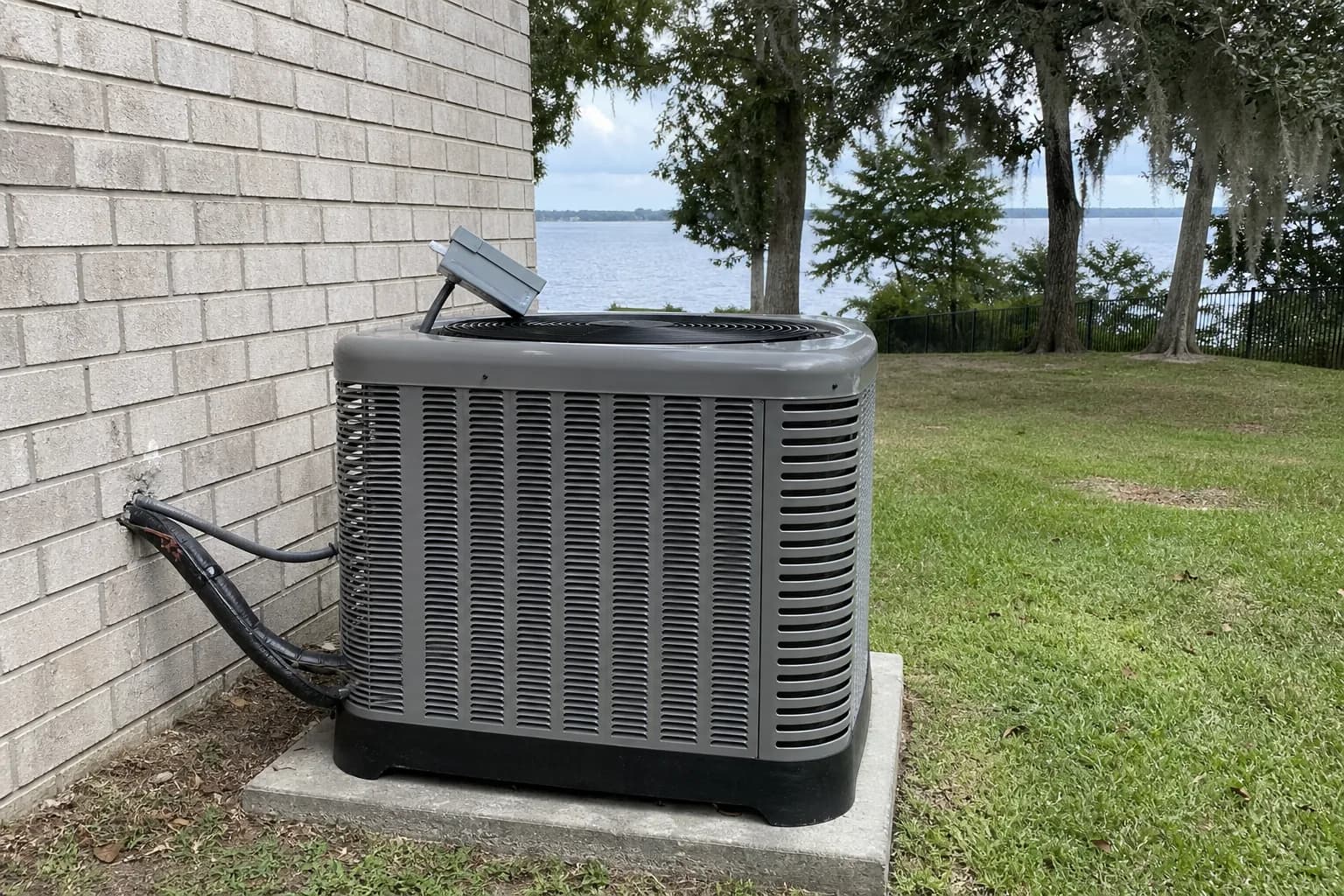
T-minus 6 hours from worst-of-storm. Set the thermostat to off. Wait for the system to stop running. Then flip the outdoor disconnect at the unit (the gray box on the wall behind or beside the condenser). Then flip the air handler breaker at the main panel. This isolates the system from the grid completely.
During the storm. Leave it off. Do not flip breakers back on if the lights flicker on briefly — that's the grid finding its footing, not stable utility power.
After the storm. Wait 6-12 hours for stable utility power before flipping anything. Walk the outdoor unit before re-energizing — look for embedded debris, shifted pad, water in the electrical compartment, displaced cabinet panels, branches against the cabinet, salt spray accumulation on the coil. Anything off — leave it off and call us.
This sequence protects the equipment from the dirty-power problem entirely. The food spoilage concern is real but smaller than people think — a closed refrigerator holds temperature for 4-6 hours and a closed freezer for 24-48 hours. Cooler with ice solves the rest. The Orange Beach hurricane prep post walks through the same shutdown sequence with more detail.
Mistake #3: Trusting the generator to run the AC
Generator questions come up in most prep conversations. The recurring version: "Can my 7,500-watt portable run my AC?"
The answer is almost always no, even though the math looks like it might work.
A typical 3-ton residential AC pulls 6,000-8,000 watts of inrush current at compressor startup before settling to a 3,000-3,500 watt running load. A 7,500-watt portable generator can produce that running load steadily, but the inrush spike will trip the generator's overload protection or sag the voltage enough that the compressor fails to start — the contactor pulls in, the compressor stalls, the overload heats up, and you've damaged the start winding.
Even when a portable generator does start the compressor, the dirty power output (non-pure sine wave, voltage drift, frequency variation) damages the control board and compressor windings over time. A few days of generator-fed operation can shave years off the equipment's lifespan in ways that don't show up immediately.
The honest options:
Inverter-style generator rated 7,500 watts continuous and above. These produce clean sine-wave power and can support a residential AC if you let it cycle gently — meaning don't ask the system to drop the house from 88F to 72F immediately. Set the thermostat to 80F, let it run, and accept that the house will be warm but not unbearable.
Soft-start kit on the AC. A capacitor-based soft-start module retrofits to the outdoor unit and reduces compressor inrush current by 60-70%. With a soft-start kit installed, a 5,000-7,000 watt portable generator can reliably start the compressor. The kit is a modest add-on at install or as a retrofit and is worth considering for any Lillian home that depends on a generator during outages.
Standby generator with automatic transfer switch. The right answer for full-time residents and many rental properties. A 14-22kW standby unit on natural gas or propane runs the entire house including HVAC, transfers automatically when grid power fails, and produces clean inverter-grade power. Installation is a major project, but for bay-front rental properties where lost rental days during outages stack up fast, the math often works.
For most Lillian homeowners with an existing portable generator, the realistic plan is: refrigerator, freezer, fans, lights, charging stations, and accept that the AC stays off until utility power returns. The Loxley hurricane prep post walks through the same generator math from an inland perspective.
Mistake #4: Forgetting that Perdido Bay opens to the Gulf
A common assumption: "I figured being on a bay rather than the Gulf meant I was sheltered."
Lillian is on Perdido Bay, which opens to the Gulf of Mexico via Perdido Pass at Orange Beach. That's a wide-open hydraulic connection. Storm surge driven by southwest wind across the Gulf pushes water through Perdido Pass and up Perdido Bay. By the time it reaches Lillian, the surge has lost some height but gained miles of fetch. Bay-front homes in Spanish Cove, Perdido Beach, and along Perdido Bay Boulevard have flooded in major hurricanes, with surge depths reaching multiple feet in some bay-front parcels.
For HVAC equipment, the implications are specific:
Outdoor units mounted at ground level on bay-front parcels are surge-vulnerable. A condenser sitting on a 4-inch pad at ground elevation goes underwater in a 24-inch surge. Saltwater into the cabinet ruins the contactor, the start capacitor, the run capacitor, the compressor windings, and the fan motor — typically all of them. Replacement of a flooded unit is a major expense.
Wall-mount or elevated stand placement is the right answer for new installs. A condenser on a wall bracket 36 inches above grade, or on a custom elevated stand, survives the same surge intact. Retrofitting an existing ground-mounted unit to elevation is a modest project and is worth doing during the next maintenance visit if you're in a surge-vulnerable location.
Salt-laden surge water leaves residue even after it recedes. Even if the unit doesn't fail immediately from saltwater immersion, the residual salt on internal electrical components accelerates corrosion and shortens lifespan dramatically. A unit that took a saltwater dip almost always needs replacement within 12-18 months even if it limps along initially.
The full coastal-rated equipment conversation — coil coatings, cabinet finishes, electrical connection sealing — is also more relevant in Lillian than people expect. Perdido Bay salt exposure is comparable to Gulf Shores or Fort Morgan. The orange beach salt-air maintenance schedule covers the maintenance cadence; same logic applies on this side of the bay.
Mistake #5: Not having a plan when the house is empty
The most common absentee-owner question: "what do I do when I'm not there."
This is the Lillian-specific piece. A meaningful share of Lillian housing is second homes, vacation rentals, or snowbird residences. The owner is not on-site for half or more of hurricane season. When a storm is forecast and the owner is in Indiana or Pennsylvania, the prep work doesn't happen by itself.
The realistic plan for absentee owners:
Designate a local point of contact with property access. A neighbor in Spanish Cove, the cleaning crew that turns the rental, a property manager, a relative who lives in Foley or Daphne. Someone with keys, the ability to walk the property, and authority to execute a basic shutdown. Pay them for the service if it's not a friend favor.
Pre-authorize HVAC contractors to enter and work without case-by-case approval. A written authorization on file with us — owner name, property address, contact info, scope of authorized work, billing arrangement — means we can respond to a post-storm restart call or pre-storm shutdown without playing phone tag across time zones. This is a 10-minute conversation when you set up the maintenance plan.
Keep digital photos of equipment serial plates in a cloud folder accessible from your phone. When a named storm causes equipment damage, insurance claims move faster when you can email model and serial numbers same day. Take the photos this week, store them in Google Drive or iCloud, and you'll thank yourself later.
Build pre-storm shutdown into the rental turnover checklist. If you have a property manager, the standard pre-storm protocol should include: thermostat to off, outdoor disconnect pulled, outdoor furniture stored or tied down, photos of property condition for insurance baseline. Make this an automatic part of the turnover checklist when a named storm enters the cone.
The Lillian service area page covers the rental-owner specifics in more depth — billing arrangements, lockbox access coordination, property management software integration. We work this way routinely.
The cluster context
This post is part of the hurricane-prep cluster. Two siblings cover the same season from different geographies: the Orange Beach hurricane prep post is the coastal equivalent for direct Gulf-front condos and homes, and the Summerdale hurricane recap post walks through inland Baldwin County recovery patterns.
For the post-storm restart sequence specifically, the post-hurricane Silverhill HVAC restart post is the cross-county baseline. The Robertsdale surge protector math post covers the financial case for two-stage surge protection in detail.
What to do this week
If you've made it through the five mistakes above and recognize one or more of them in your own setup, here's the sequence:
This week, walk your property. Photograph the outdoor unit serial plate, the indoor air handler serial plate, and the panel layout. Store the photos in a cloud folder.
This month, have us out for a pre-season inspection. We'll measure surge protector readiness, document equipment baseline condition, recommend specific upgrades for your exposure, and set up the pre-authorization paperwork if you're an absentee owner. Call 251-383-HVAC — $79 service fee, free second opinions on quoted repairs, emergency calls around the clock, every day including Saturdays at no extra charge.
By the time the first named storm of the season enters the Gulf, you want the prep already done — not scrambling to source parts during the 48-hour scramble that hits every contractor in Baldwin County simultaneously. The version of this conversation that happens in late June is comfortable and inexpensive. The version that happens during a tropical storm watch is neither.
FAQ
- Is Lillian really a hurricane-exposed area or is it sheltered by being inside Perdido Bay?
- Lillian is genuinely hurricane-exposed. Perdido Bay opens to the Gulf via Perdido Pass at Orange Beach, which means storm surge can push water all the way up the bay to Lillian. The Lillian Bridge itself sits about 30 miles east of Mobile Bay, putting it on the right-front quadrant of any storm tracking through Mobile or central Mississippi — historically the worst quadrant for surge and wind. Bay-front homes along Perdido Bay Boulevard, Spanish Cove, and Perdido Beach receive direct fetch from southwest wind across the bay. Lillian is not sheltered. It's just east enough of the Gulf Shores spotlight to feel forgotten in regional storm coverage.
- Should out-of-state Lillian rental property owners do anything different than full-time residents?
- Yes, three things. First, designate a local point of contact with key access (cleaning crew, neighbor, property manager) who can execute a pre-storm shutdown if you're not on-site. Second, pre-authorize HVAC contractors to enter and work without case-by-case approval — a written authorization on file with us means we can respond to a post-storm restart call without waiting for a phone call across time zones. Third, keep digital photos of the equipment serial plates accessible. Insurance claims after a named storm move faster when you can email model and serial numbers same day.
- How is hurricane prep in Lillian different from Gulf Shores or Orange Beach?
- Less direct sea-level wind exposure (Lillian sits on a bay rather than the open Gulf), but comparable salt-air corrosion and storm surge risk. The big difference is electrical: Baldwin EMC service in southeast Baldwin County tends to have longer post-storm restoration windows than Alabama Power's coastal grid, which means more reclose events and more cumulative voltage stress on HVAC equipment during the recovery period. Surge protection is more important here, not less.
- Does ACExperts service Lillian rental properties on storm-recovery weekends?
- Yes. We answer emergency calls 24/7, every day, including Saturdays at no extra charge, and our regular hours are Monday-Saturday 8am-6pm. Call 251-383-HVAC. We work directly with property managers and out-of-state owners, can bill the owner remotely, and document work with photos for insurance. Comfort Plan members ($20/month or $240/year) get $0 service fees and 10% off repairs and replacements. Note: we service the Alabama side of Perdido Bay only — properties on the Innerarity Point side are in Florida and require a Florida-licensed contractor.
Need this handled?
Straight to the service page for your town — pricing, local details and a form that reaches a technician.
More from Hurricane Prep
- Summerdale HVAC Hurricane Prep: A Field-Tested Walkthrough Checklist
- How One Spanish Fort Homeowner Caught Hurricane Prep Trouble Early — A Conversation in Three Endings
- Orange Beach Hurricane Prep for Your HVAC: 9 Steps Before the Storm
- Should a Bay Minette Homeowner Cover the Outdoor Unit Before a Hurricane?

ACExperts HVAC
We Take The Heat So You Don't Have To
Fast, honest heating and air service across Baldwin County. Speak with a technician and get on the schedule today.