
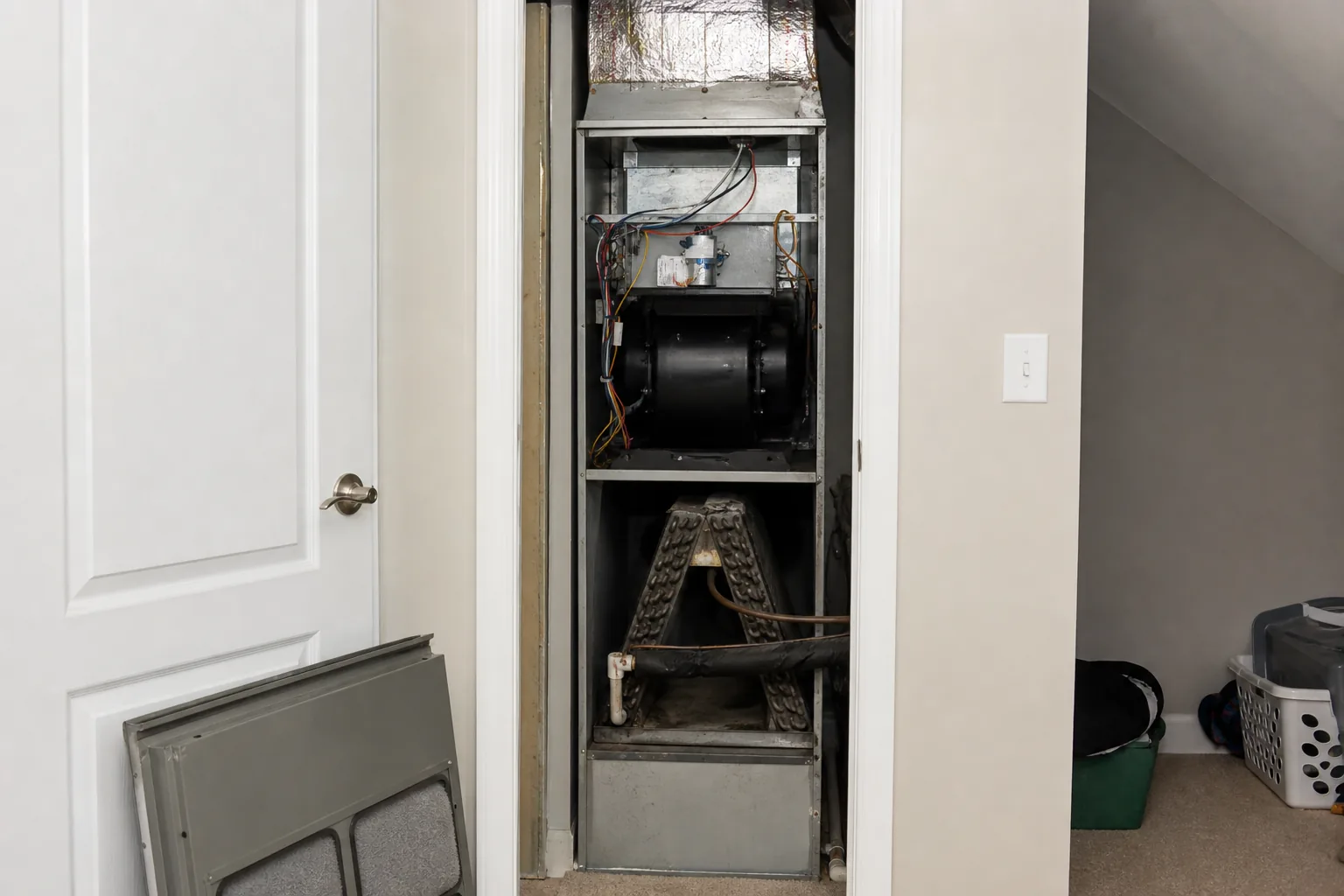
What AC Repair Actually Costs in Baldwin County in 2026
What AC repair actually costs in Baldwin County in 2026: a representative invoice line by line, what each charge means, and how to spot an honest quote.
Published 2026-07-21 · Updated 2026-07-21
Author: Landon Jahnke | ACExperts251
Reviewed by: Landon Jahnke · Owner · Alabama HVAC License AL #16117 · EPA 608 Certified
A representative summer repair invoice on a Daphne home in 2026 typically has five common lines: a diagnostic service call, a run capacitor replacement on the outdoor unit, an outdoor coil chemical wash, a small refrigerant top-off, and a float-switch test. Here's what every line means, what to look for in a written quote, and how to spot when an honest tech is being honest with the line items. For specific dollars on your specific system, call 251-383-HVAC for a written quote.
I'm going to walk through this representative invoice like I'd walk through it with the homeowner if she asked. Then I'll give you red flags that suggest a quote isn't honest, regardless of the dollar figures.
The scenario in mind is a 2,000-2,400 sq ft single-family home with a 12-14 year old 3-ton split system, where the AC has been "running but not cooling well" — a small gap between thermostat setpoint and indoor temperature in mid-afternoon. The system was tuned in spring.
Line 1: Diagnostic service call — $79
What it is: a licensed HVAC tech driving to your home, running a structured diagnostic on the system, identifying the failure mode, and writing a quote for the recommended repair.
What it covers in practice: refrigerant pressure readings on both the suction and liquid sides, superheat and subcool calculations, capacitor microfarad measurements on both run and start capacitors, contactor visual and electrical inspection, blower amperage check, condensate drain flow test, indoor coil visual inspection, outdoor coil visual inspection, thermostat function check, filter inspection, supply and return temperature measurement (delta-T), and static pressure readings if there's a comfort complaint.
What we charge: a flat $79 service fee, covering the tech's time and a written diagnosis. Free second opinions on any quote you've already received from another contractor.
What's a red flag: a "free service call" usually means the actual diagnostic isn't free — the cost is built into inflated parts and labor rates on the repair. Diagnostic fees significantly above the typical range in this market are hard to justify on a residential call.
Line 2: Run capacitor replacement (dual-run, 45/5 µF or similar)
What it is: replacement of the dual-run capacitor that supports both the compressor (high-µF side) and the outdoor fan motor (low-µF side). When the technician measures both sides below the 10% tolerance threshold, the capacitor is on its way out and replacement is the right call.
What labor takes: about 15-25 minutes of actual work — disconnect power, discharge old capacitor, swap, reconnect, verify operation. The capacitor stress test that flags the drift before it becomes a failure should have been part of the prior spring tune-up.
What it should cost: priced in writing before any work begins, based on the capacitor type and rating your system needs. Single-run capacitors (fan-motor-only) cost less than dual-run capacitors.
What's a red flag: a capacitor swap priced multiple times above what peer shops quote on a residential system. Some contractors price capacitor replacement very aggressively — that's a markup, not a repair. Free second opinions if you've been quoted.
A marginal capacitor is a common primary cause of a "running but not cooling" complaint. Marginal capacitor → reduced motor torque on the fan → reduced airflow across the outdoor coil → elevated head pressure → reduced cooling capacity. Replacing the capacitor restores the system to spec.
Line 3: Coil chemical wash (outdoor)
What it is: spraying a non-acid coil cleaner across the outdoor condenser fins, allowing it to dwell for 5-10 minutes, then rinsing with low-pressure water. The cleaner dissolves the film of pollen, oxidation, dirt, grass clippings, and (in coastal areas) salt deposits that build up on the fins over a year of operation.
Why it shows up on a typical repair invoice: a coil with significant obstruction from accumulated debris drops heat-rejection capacity meaningfully, which compounds any capacitor issues. Cleaning the coil while the truck is already on-site avoids a second service call and resolves the underlying performance loss that the capacitor replacement alone wouldn't have addressed.
What it should cost: priced in writing, lower as a bundled add-on to an existing service call than as a standalone visit since the truck and tech are already there. The work itself takes 25-30 minutes including the rinse and dry time.
What's a red flag: chemical coil cleaning quoted at premium-rebuild pricing on a residential split system, or "deep cleaning" services priced like a full equipment overhaul. The work is real and valuable, but it's not a four-figure line item.
For coastal homes — Gulf Shores, Orange Beach, Fort Morgan, and the bay-front zones of Daphne and Fairhope — annual coil cleaning is essentially mandatory because of salt corrosion. For inland communities like Foley and Loxley, every 18-24 months is usually adequate.
Line 4: Refrigerant top-off (R-410A)
What it is: adding refrigerant to the system to restore charge to manufacturer spec, only after the tech confirms with superheat and subcool measurements that the charge is actually low and not within tolerance.
Why "top-off" is a careful word: refrigerant doesn't get used up. If a system is low on refrigerant, there's a leak somewhere. A small enough leak can take years to drift the charge meaningfully off-spec, and the cost-benefit of leak detection on an older system is different than on a newer system. On an older system, the conversation is often: top off, monitor, and if the charge drifts again within 12 months, do a leak search and either repair the leak (if economically appropriate) or have a replacement conversation.
What it should cost: priced in writing per pound. The cost has climbed steeply with the R-410A phase-out, so the per-pound price is meaningfully higher than it was a few years ago. R-22 systems are a separate conversation entirely — recovered/reclaimed R-22 pricing has climbed sharply, and for most R-22 systems still in service, the math has shifted decisively toward replacement rather than continued charge maintenance.
What's a red flag: any quote that adds refrigerant without measuring superheat and subcool to confirm the charge is actually low. A tech who guesses at refrigerant charge by gauge pressure alone is missing the diagnostic that confirms the work is needed.
Line 5: Float-switch test — included
What it is: testing the secondary drain pan float switch that's supposed to shut down the system if the primary condensate drain clogs. The tech raised the float manually and confirmed the system shut down within 5 seconds, then released the float and confirmed normal restart.
Why it was on the invoice as "included": because it should be part of every diagnostic that touches a system in cooling mode. A failed float switch leaves the homeowner with an unprotected system, and the next condensate clog (a real possibility in Daphne humidity) can lead to ceiling water damage that costs thousands to repair.
We don't separately bill the float-switch test. If your invoice from another contractor adds a standalone "safety switch testing" line item, that's a markup item, not a real charge. The test takes 90 seconds. It's part of the diagnostic.
How to read pricing on any Baldwin County HVAC repair
Specific repair pricing varies by tonnage, refrigerant type, motor specs, brand, salt-spec rating, and whether the repair is bundled with other work on the same truck visit. Rather than publish ranges that won't match your specific equipment, I quote every job in writing before any work begins. For your specific repair, call 251-383-HVAC.
If you're looking at repair numbers that are starting to approach the cost of a partial replacement on a 12+ year old system, the conversation should shift to repair-vs-replace math — see our existing piece on how much AC installation costs in Baldwin County for that side of the calculation. Replacement estimates are free.
Red flags in a quote
Hidden labor. A quote that gives a single dollar figure for a capacitor replacement without breaking out parts and labor is hiding something. Honest invoices show parts cost, labor cost, and any service fees as separate lines.
Unnecessary "system protection" packages. Adding a "compressor saver" hard-start kit on a healthy 4-year-old system is not a repair — it's a sale. Hard-start kits make sense in specific failure scenarios (see hard starts on Foley compressors), but routine installation on systems that don't need them is upsell behavior.
Refrigerant charge without superheat/subcool measurement. A tech who adds refrigerant based only on gauge pressure readings, without confirming charge by measuring superheat and subcool, is guessing. The quote should reference these readings; if it doesn't, ask why.
Pressure to decide today. "This is the best price I can offer if we do it now" is a sales tactic, not honest pricing. Reputable contractors quote work, give you written documentation, and let you call back when you've decided. Same-day repair is often available, but it shouldn't depend on you accepting the quote within 10 minutes.
No written quote before work begins. Verbal "it'll be about [number]" estimates that turn into substantially higher invoices after the work is complete are how disputes happen. Get the quote in writing — even a photo of a handwritten quote with a signature is enough.
What we charge and why
My pricing structure across Daphne, Fairhope, Foley, Gulf Shores, and the rest of Baldwin County is consistent:
- $79 diagnostic service fee
- Free second opinions on any quote you've received from another contractor
- Free replacement estimates
- Written quote before any work begins
- No weekend or evening surcharges during regular service hours; emergency calls answered 24/7, every day, including Saturdays at no extra charge
- Comfort Plan members ($20/month or $240/year) get two tune-ups per year, 10% off repairs and replacements, $0 service fees, and no overtime fees
- 1-year labor warranty on all repairs, manufacturer warranty pass-through on parts
The math on the Comfort Plan works out favorably the first time it prevents an emergency: the annual plan cost covers two tune-ups (which catch the marginal-capacitor signals before they become 95° afternoon failures) plus a 10% repair discount when something does need fixing, plus no service fee on covered visits, plus no overtime fees.
The honest version of every line
The right test for whether a quote is honest isn't price alone. It's whether you can ask "why is this on the invoice?" and get a clear, specific answer that ties to a measurement or an observation:
- Capacitor: measured below tolerance with a multimeter, replacement restores spec.
- Coil wash: visually obstructed, restoring heat rejection capacity.
- Refrigerant: superheat and subcool readings off-spec, top-off restored both.
- Float switch: tested as part of diagnostic, confirmed working, no charge.
If you can't get that level of explanation from a contractor's quote, the price isn't your real problem. The transparency is.
Schedule diagnostic at /schedule/ or call 251-383-HVAC. Free second opinions on any quote you've already received — bring us the written estimate and we'll measure independently.
FAQ
- Why do AC repair quotes vary so much between contractors?
- Three reasons: parts markup, labor rate, and diagnostic depth. Markup on a wholesale capacitor can run anywhere from 2x to 5x on the same part across different contractors. Labor rates in Baldwin County vary widely depending on the contractor's overhead structure. And diagnostic depth varies — some techs replace the obvious failed part and leave; others measure every supporting component, which surfaces additional repairs but also catches the secondary failure that would have come back as a service call in 30 days. Free second opinions on quoted repairs are standard at ACExperts.
- Should I always get a second opinion on a quoted repair?
- On any larger repair, yes. Free second opinions are standard at ACExperts. We measure the system independently and either confirm the quote or tell you what we'd recommend differently. Most second opinions land close to the original quote — but the ones that don't can save you real money or surface a misdiagnosis that would have wasted the original quote entirely.
- What does $79 diagnostic actually cover?
- A licensed tech driving to your home, performing a structured diagnostic on the system (refrigerant pressures, electrical components, airflow, controls), identifying the failure mode, and providing a written quote for the recommended repair. The $79 is credited toward the repair if you proceed, so the effective cost of the diagnostic when you do the repair is zero. If you decline the repair, $79 covers the tech's time and you walk away with a written diagnosis you can use for a second opinion or to authorize a different contractor.
- Does ACExperts charge weekend or evening upcharges?
- No. We answer service calls during normal business hours (including weekends) at the same $79 diagnostic rate with no weekend surcharge, and emergency calls are answered around the clock with no overtime fees. Whatever the visit costs, we disclose it before we roll the truck. The point is: a Saturday afternoon call shouldn't cost more than a Tuesday afternoon call for the same diagnostic and repair.
Need this handled?
Straight to the service page for your town — pricing, local details and a form that reaches a technician.
More from AC Repair Cost 2026

ACExperts HVAC
We Take The Heat So You Don't Have To
Fast, honest heating and air service across Baldwin County. Speak with a technician and get on the schedule today.