
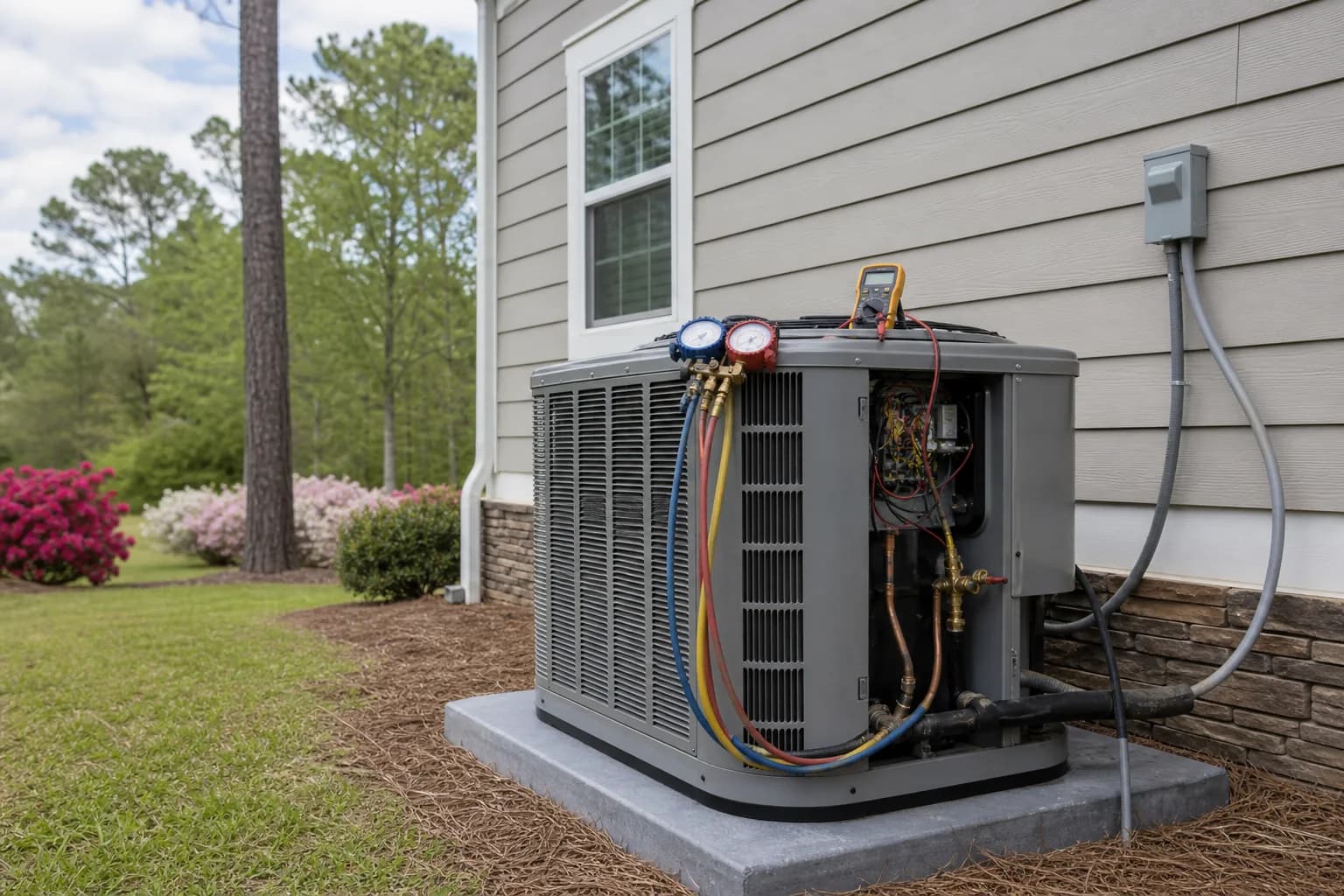
7 Signs Your AC Needs Repair Before It Quits Completely
7 early signs your AC needs repair before it quits — the warnings systems telegraph for days, so a cheap fix never becomes a mid-August outage in Baldwin County.
Published 2026-04-05 · Updated 2026-04-05
Author: Landon Jahnke | ACExperts251
Reviewed by: Landon Jahnke · Owner · Alabama HVAC License AL #16117 · EPA 608 Certified
Air conditioners almost never die out of nowhere. The breakdown that strands a family with no cooling on a 95-degree August afternoon was, in most cases, weeks of small warnings that went unnoticed — a system that did not get quite as cold as it used to, a new noise that everyone tuned out, an electric bill that crept up. The failure feels sudden only because nobody was listening to the system telling on itself.
That is good news, because it means most no-cooling emergencies are preventable. The trick is knowing what the early warnings actually look like so you can act while the repair is small and scheduled instead of large and urgent. Here are the seven signs we tell Baldwin County homeowners to watch for, roughly in the order they tend to matter.
1. Warm air or weak airflow
The most obvious sign is also the one people second-guess the longest: the air coming out is not as cold as it should be, or there is barely any air coming out at all. It is easy to talk yourself into believing it is just an especially hot day, particularly here, but a healthy system should hold your set temperature comfortably even when it is brutal outside.
Warm air can mean a refrigerant problem, a failing compressor, or a dirty coil that cannot transfer heat anymore. Weak airflow house-wide more often points to a clogged filter, a failing blower motor, or duct problems. Either way, when the system is running but not delivering, something has changed — and the longer you run it straining to do a job it can no longer do, the more wear you pile onto the expensive parts.
2. Ice on the lines or coil
This one surprises people: ice on an air conditioner, in the middle of summer, is bad. If you see frost or ice on the refrigerant lines or the indoor coil, the system is not working harder — it is failing. Ice forms when airflow across the coil is restricted (a dirty filter or coil, a weak blower) or when the refrigerant charge is low, and once it forms it makes everything worse by blocking airflow further.
The reason to act fast is the compressor. When that ice eventually melts, liquid can slug back into the compressor — and a flooded compressor is one of the most expensive failures on the whole system. So if you spot ice, do not keep running it hoping it works through. Turn the system off, let it thaw completely, and call for service. The underlying cause has to be found before the system goes back to cooling.
3. Water or moisture where it does not belong
A puddle near the indoor air handler, a damp spot on the closet floor, or a stain spreading on the ceiling below an attic unit all point to the same culprit: the condensate system is not draining. Your AC pulls a lot of water out of our humid air, and that water is supposed to exit through a drain line. When that line clogs — and in Baldwin County's pollen and humidity, they clog readily — the water backs up and finds another way out.
Take this one seriously even though the symptom looks minor. A slow drain can quietly soak drywall, rot a subfloor, or ruin a ceiling over a few weeks, and the repair to your house can dwarf the repair to your AC. If your system keeps shutting itself off on a hot day, that may be a float switch doing its job against a clogged drain — which is a reason to call, not a reason to keep resetting it.
4. Strange noises
A well-running air conditioner makes a steady, familiar sound. New noises are some of the most valuable early warnings you get, because the parts that make them are usually cheap to replace right up until they fail. A buzzing or humming at the outdoor unit often points to an electrical part like a failing capacitor or contactor. Grinding or screeching tends to mean a motor bearing on its way out. A rattle can be a loose panel, a failing fan, or debris that worked its way in.
The point is not to diagnose the exact sound yourself — it is to treat any new, persistent noise as the system asking for attention. A capacitor caught while it is buzzing is a small repair. The same capacitor ignored until it quits can take the compressor with it.
5. Short cycling
Short cycling is when the AC turns on, runs for a short stretch, shuts off, then starts again a few minutes later, over and over. A healthy system runs in longer, steadier cycles — and in our climate those longer runs are actually what pull humidity out of the house. Rapid on-off cycling does the opposite: it leaves you humid and clammy even when the thermostat reads the right number, and it is hard on the equipment because start-up is the most stressful moment for the compressor.
Short cycling has several possible causes — a refrigerant problem, an oversized system, a failing control component, a dirty coil, even a thermostat in a bad spot. It is not something to wait out. The constant restarting wears the costliest part of the system fastest, so it is worth diagnosing early.
6. A climbing electric bill with no other explanation
Your AC is one of the biggest electricity users in the house, so when it starts to struggle, the power bill is often the first place it shows up — before you have consciously noticed any comfort change. If your usage jumps and your rates, your habits, and the weather have not, the comfort system is a prime suspect. A dirty coil, low refrigerant, a failing component, or a system fighting restricted airflow all make the equipment run longer and pull more power to deliver the same cooling.
A bill that is creeping up is the system working harder than it should to keep up. Catching the cause turns a rising bill back down and usually heads off the bigger failure that the inefficiency is a warning sign of.
7. Rising humidity and uneven rooms
The last sign is comfort that has quietly gotten worse even though the thermostat still hits its number. The house feels sticky and damp. One room never cools like the rest. You find yourself nudging the thermostat down to feel comfortable. On the Gulf Coast, humidity control is half of what an air conditioner is for, and losing it is a real symptom — it can point to a refrigerant issue, a coil problem, short cycling, or duct trouble. Do not write off "it just feels muggy" as nothing. It is often the earliest and most ignored sign on this list.
What to do when you spot one
Catching any of these early is the whole game. A problem you notice in spring is a scheduled AC repair on your timeline; the same problem ignored until July is an emergency call during the busiest, hottest stretch of the year. HVAC failures cascade — small parts take out big ones — so acting on the small sign is almost always the cheaper path.
When we come out, the service fee is $79 with no upcharge for weekends during regular hours, we diagnose the real cause, and we put the repair price in writing before any work begins. If another company already quoted you, we offer free second opinions. And if you would rather run the numbers yourself first, the repair-or-replace calculator lets you do that before we ever show up.
The best way to never see this list play out is to not give it the chance. A pre-summer tune-up catches failing parts while they are cheap, cleans the coil, and clears the drain before any of it becomes an outage. The ACExperts Comfort Plan rolls two seasonal visits, $0 service fees, and 10% off repairs into $20 a month or $240 a year.
If your AC is showing any of these seven signs, do not wait for it to quit completely. Call 251-383-HVAC. Regular scheduling runs Monday through Saturday, 8am to 6pm, and we answer emergencies 24/7, every day.
FAQ
- Should I keep running my AC if it has ice on it?
- No — turn it off. Running a system that is iced over can push a fixable problem into an expensive one, most seriously by flooding the compressor with liquid refrigerant when the ice melts, which is one of the most costly failures there is. Switch the system to off (leave the fan on if your thermostat allows it, to help the ice melt faster), let it thaw fully, and call for service. Ice almost always means a restricted airflow problem or a refrigerant problem, and both need to be diagnosed before the system goes back to cooling.
- Is it normal for an AC to get louder as it gets older?
- A little more operating noise over the years is normal, but specific new sounds are not — and they are some of the best early warnings you get. A buzzing or humming at the outdoor unit can point to an electrical component like a failing capacitor or contactor. Grinding or screeching often means a motor bearing. A rattle can be a loose part or debris. The reason to act on a new noise quickly is that the parts making those sounds are usually cheap to replace before they fail, and the failures they cause are not. A new noise is the system asking for attention while the fix is still small.
- How much does an AC repair cost in Baldwin County?
- It depends entirely on what failed — a worn capacitor is a minor repair, while a compressor or coil is a major one — so we do not quote a number sight-unseen. What we can tell you is how the visit works: our service fee is $79, with no upcharge for weekends during regular hours, and we put the repair price in writing before any work starts so there are no surprises. We also offer free second opinions if another company quoted you a repair and you want it checked. If you would rather run the numbers yourself first, our repair-or-replace calculator lets you do that before we ever come out.
- If I catch a warning sign early, will it really save me money?
- Usually, yes, and often by a wide margin. HVAC failures tend to cascade — a weak capacitor strains the compressor, a dirty coil ices up and floods that same compressor, a slow drain rots a ceiling. Catching the small problem stops the chain before it reaches the expensive component at the end of it. The other savings is timing: a sign you act on in spring is a scheduled visit, while the same problem ignored until July is an emergency call during the hottest, busiest stretch of the year. Early is cheaper on both counts.
- How often should I have my AC checked to avoid surprise breakdowns?
- Once a year at minimum, ideally before the cooling season really starts. A spring tune-up catches failing parts while they are still cheap, cleans the coil and clears the drain before they cause problems, and confirms the refrigerant charge and electrical components are healthy heading into our long, demanding summer. Homeowners who stay on a maintenance schedule see far fewer mid-summer surprises than those who run the system until it quits. Our Comfort Plan includes two seasonal visits a year, $0 service fees, and 10% off repairs for $20 a month or $240 a year.
Need this handled?
Straight to the service page for your town — pricing, local details and a form that reaches a technician.
Related reading

ACExperts HVAC
We Take The Heat So You Don't Have To
Fast, honest heating and air service across Baldwin County. Speak with a technician and get on the schedule today.