
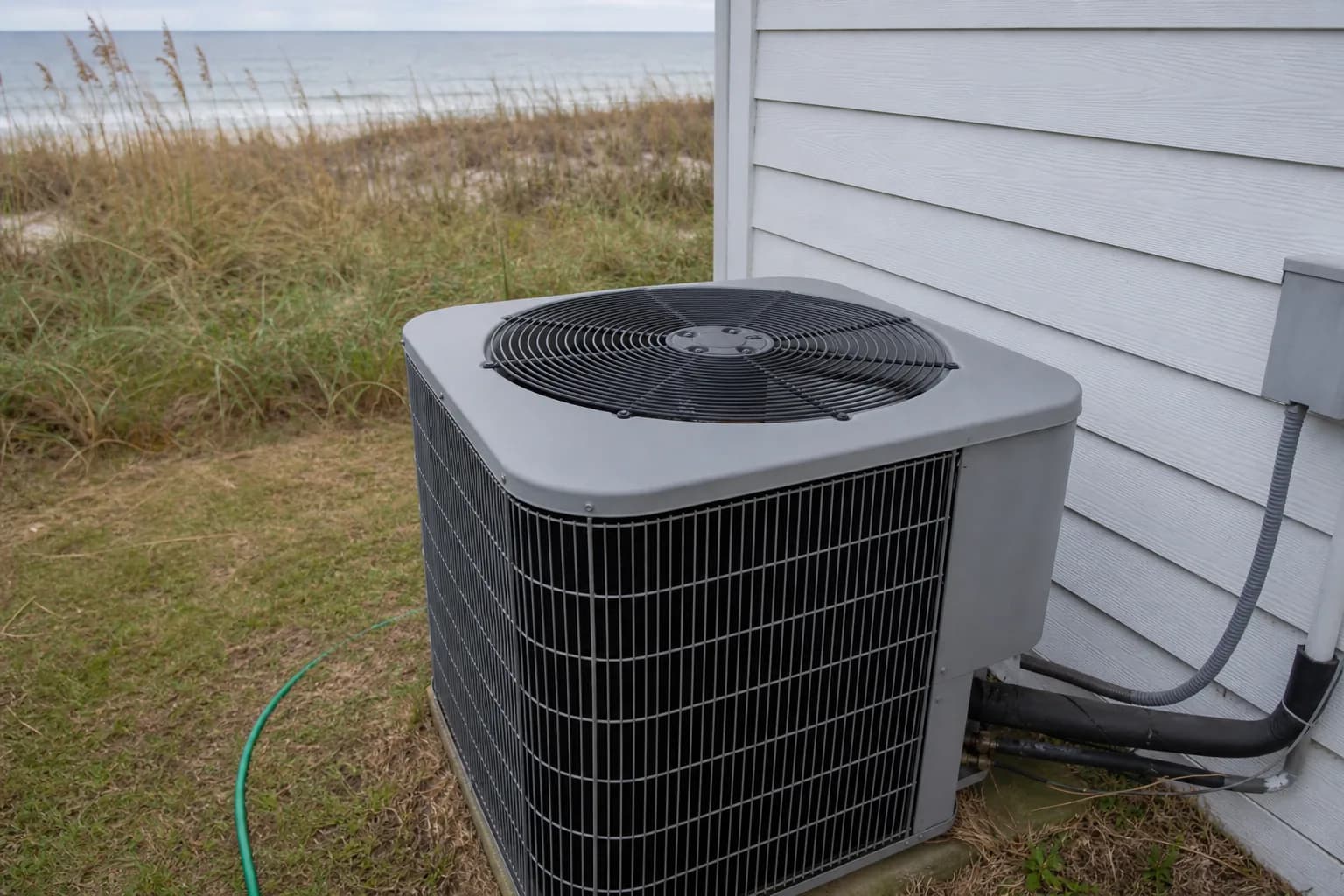
Heat Pump Installation in Orange Beach: Cost vs Long-Term Bill
Weighing a heat-pump install for your Orange Beach home? Here's how to read the long-term electric-bill math against the upfront quote before you sign.
Published 2026-10-06 · Updated 2026-10-06
Author: Landon Jahnke | ACExperts251
Reviewed by: Landon Jahnke · Owner · Alabama HVAC License AL #16117 · EPA 608 Certified
This post is for one specific Orange Beach reader: you own a Gulf-front condo or single-family home, your existing equipment is 8-12 years old, your January electric bill last year was over $260, and you're staying in the property at least 5 more years. If any of those four don't apply, the heat-pump-vs-replacement math comes out differently. Check the Bay Minette gas-vs-heat-pump post if you don't fit this profile. If you do, here's the framework.
Three Orange Beach scenarios get walked through below — Gulf-front condo, bay-front single-family, and Ono Island estate. Specific dollar amounts on your home will depend on equipment selection, current refrigerant pricing, brand choice, current rebate availability, and what your envelope actually needs. The framework is directional, not a quote.
Why this profile specifically
The four conditions exist for a reason.
Gulf-front or bay-front location. Coastal exposure determines equipment selection (coastal-rated vs standard) and maintenance cadence (quarterly vs semi-annual). It also affects equipment lifespan in ways that change the cost-of-ownership math by 15-25%. Inland Orange Beach properties — which exist but are uncommon — have different numbers.
Equipment 8-12 years old. Newer than 8 and the existing system probably has useful life left; the right answer is usually maintain rather than replace. Older than 12 and you're in genuine end-of-life territory where the math is no longer about heat pump vs alternative — it's about which heat pump. The 8-12 window is where homeowners have actual choice.
January electric bill over $260. That number means your existing equipment is using meaningful kilowatt-hours in heating mode, which means the efficiency upgrade has meaningful kilowatt-hours to capture. A Gulf-front condo with a $180 January bill won't see the same efficiency gain from a new heat pump because the heating load isn't there to begin with.
Staying 5+ years. Heat pump payback in Orange Beach is typically 4-7 years on a standalone replacement. Under 5 years of ownership and the math gets thin — you're capturing less than the full payback before selling. Over 7 years and the math is unambiguous.
If those four conditions describe you, keep reading. The framework below is written for your scenario.
Scenario one: Gulf-front condo at Bella Luna or Phoenix on the Bay
Typical profile: 1,400-1,800 sq ft three-bedroom unit, 8-11 years old, currently running a 3-ton split system with the condenser on a balcony or rooftop pad. R-410A. Standard (not coastal-rated) coil. Salt air exposure has worked the outdoor unit pretty hard.
Replacement options for this profile:
- Standard 3-ton heat pump on the new refrigerant standard
- Coastal 3-ton single-stage on the new refrigerant standard
- Coastal 3-ton two-stage on the new refrigerant standard
- Coastal 3-ton variable-speed on the new refrigerant standard
The variable-speed option is rarely much more expensive than single-stage over a 6-year horizon — and the comfort difference, the humidity control, and the dehumidification capability matter enormously in a condo where humidity swings drive musty smells and indoor air quality complaints. The musty smell diagnostic covers this in more detail — short version: variable-speed equipment dehumidifies better because it runs longer at lower output, and that matters more in coastal condos than almost anywhere else.
The standard (non-coastal-rated) equipment is technically the cheapest install but it's the most expensive ownership for a Gulf-front Orange Beach unit. Salt air will get to it. Plan accordingly.
Scenario two: bay-front single-family in Bear Point Estates or Cotton Bayou
Typical profile: 2,400-3,200 sq ft two-story, 9-12 years old, currently running 5-ton single-speed equipment that probably oversized the load when it was installed. R-410A. The bay exposure is not as aggressive as direct Gulf-front but still meaningful.
Right-sizing matters here: a Manual J calculation on this profile typically returns 36,000-42,000 BTU, which is genuinely 4-ton territory, not 5-ton. The original 5-ton was oversized — common for spec construction in the early 2000s. The Foley replacement pricing post covers the Manual J right-sizing math; the same logic applies here.
Replacement options:
- Coastal 4-ton single-stage on the new refrigerant standard
- Coastal 4-ton two-stage with zoning
- Coastal 4-ton variable-speed with zoning
Across an 8-year horizon, the total cost of ownership across these three options often ends up close to a tie because the higher upfront cost of variable-speed gets offset by lower operating cost and longer equipment life. Which means the choice comes down to non-cost factors. For two-story Orange Beach homes, those factors heavily favor zoning — the upstairs/downstairs temperature differential is a common comfort complaint that zoning specifically solves. Variable-speed delivers the best humidity control for the bay-side moisture environment.
Note: the federal 25C heat-pump tax credit expired December 31, 2025 and does not apply to 2026 or later installs — confirm any tax question with a CPA. The upfront math still favors higher-efficiency variable-speed equipment through lower operating costs and utility rebate eligibility.
Scenario three: Ono Island estate
Typical profile: 4,000+ sq ft single-story or two-story estate, 10-12 years old, currently running zoned multi-stage equipment that may or may not have been correctly commissioned. R-410A. The owner is full-time resident, not rental.
This scenario almost always benefits from a multi-zone replacement strategy rather than a single piece of equipment. Manual J typically returns 60,000-78,000 BTU total load for this profile, which is at or above the 5-ton equipment ceiling for residential split systems.
Replacement options:
- Twin variable-speed coastal heat pumps with shared controls
- Single 5-ton variable-speed plus zoning (compromised airflow on a zoned 5-ton)
- Modular VRF system with multiple indoor units
For Ono Island estates in this profile, twin variable-speed equipment is typically the right answer. Two compressors means redundancy (one fails, the other still runs), better part-load efficiency at typical cooling loads, and the ability to zone supply air without the airflow restrictions that come with damper-zoned single equipment. Note: the federal 25C heat-pump tax credit expired December 31, 2025 and does not apply to current installs — confirm any tax question with a CPA.
Across an 8-year horizon, the twin variable-speed setup typically lands ahead of the single-system alternative on cost-of-ownership math depending on usage patterns.
What the credit and rebates actually cover
For all three scenarios above, several incentives stack:
Federal 25C tax credit: Expired December 31, 2025. Does not apply to systems installed in 2026 or later — confirm with a CPA before factoring any federal credit into your planning.
Alabama Power heat pump rebate: Currently a few hundred dollars per installed unit on qualifying programs; amount varies by program year and equipment efficiency.
Manufacturer rebates: Carrier, Trane, Lennox, and Daikin run seasonal rebate programs that typically offer meaningful dollars on premium-tier equipment. These pass through directly on the quote, not as upsell leverage.
The paperwork for all incentives gets documented at install. The combined value can run into four figures on variable-speed coastal-rated installs. Run your specific scenario through the ROI calculator to see how the credits change the numbers.
What ACExperts won't do on an Orange Beach replacement
A few things worth saying explicitly:
We don't quote standard equipment for a Gulf-front property unless you've specifically asked for it after the corrosion math has been explained. Coastal-rated is the default recommendation for properties within a half-mile of the water, and the upcharge pays for itself in equipment longevity. The coastal corrosion picture in the Gulf Shores AC repair guide covers the same dynamics that apply across the Orange Beach coast.
We don't push variable-speed when the budget can't carry it. If you need to replace this fall and the math says single-stage is what fits, single-stage is what gets installed and that's what gets said honestly. The variable-speed comfort and efficiency arguments are real but they're not the only factor.
We don't service the Florida side. ACExperts holds AL HVAC license #16117. Properties in Perdido Key or other Florida zip codes need a Florida-licensed contractor. We're happy to clarify which side of the line your property sits on.
How a maintenance plan changes the long-term math
Coastal equipment without coastal-cadence maintenance fails ahead of schedule. The ACExperts Comfort Plan covers two tune-ups a year, 10% off repairs and replacements, $0 service fees, and prioritized routing during peak rental seasons and post-storm windows. For coastal Orange Beach properties, this is the difference between equipment that hits its rated lifespan and equipment that fails three to five years early.
Plan cost: $20/month or $240/year per system. The plan typically pays for itself within a year or two through extended equipment life and avoided emergency calls during occupancy.
Getting an actual number for your property
Three numbers and the exercise can be run specifically for your Orange Beach property:
- Square footage and number of stories
- Year built and approximate equipment age
- Last January and last August electric bills
A free in-home consultation runs about 90 minutes — Manual J site visit, equipment inspection, and a written cost-of-ownership comparison across three or four sizing/staging options. No-pressure, no-deposit estimate. ACExperts services Orange Beach, Fort Morgan, Lillian, and the rest of the south Baldwin coast.
If your property fits the profile this post was written for, the framework is unusually clear: variable-speed coastal-rated heat pump replacement, with the Alabama Power rebate and any applicable manufacturer rebates factored in, typically lands ahead of single-stage on long-horizon math for most Orange Beach scenarios. Note: the federal 25C heat-pump tax credit expired December 31, 2025 — it does not factor into current install math. If your property doesn't fit the profile, the consultation says so honestly and the recommendation moves to whatever actually pencils out for your specific situation.
FAQ
- Why does the math change for short-term rental properties versus owner-occupied?
- Two factors. First: rental properties run cooling-mode hours much higher than owner-occupied — guests don't conserve energy the way owners do, so the operating-cost gap between high-efficiency and standard equipment is bigger and the payback period is shorter. Second: equipment failures during occupancy carry costs beyond the repair (refunded nights, lost reviews) that don't apply to owner-occupied homes. For rental owners, the break-even on premium variable-speed equipment is typically meaningfully earlier than for owner-occupied scenarios.
- Are heat pumps really powerful enough for Orange Beach winters?
- Yes — easily. Orange Beach's design heating temperature is around 30-32 degrees, and modern variable-speed heat pumps maintain rated capacity down to 17 degrees outdoor temperature. The auxiliary electric resistance heat strips engage automatically below the balance point, but they rarely run for more than a few hours per year here. The performance question is real for Bay Minette and Stapleton (covered [in the gas vs heat pump post](/blog/bay-minette-gas-vs-heat-pump/)), but it's not a question for Orange Beach coastal homes.
- Is the federal 25C tax credit available on an Orange Beach heat pump install?
- No — the federal 25C heat-pump tax credit (up to $2,000) expired December 31, 2025 and does not apply to systems installed in 2026 or later. Confirm your specific situation with a CPA. For homeowners with qualifying 2025-or-earlier installs: the credit was up to $2,000 for heat pumps meeting Energy Star Most Efficient criteria (SEER2 17+, HSPF2 9+), was non-refundable, and required a manufacturer certification statement plus install invoice. That information is only relevant for 2025-return situations.
- How does coastal corrosion affect heat pump lifespan in Orange Beach?
- It's the single biggest factor. A standard heat pump installed 200 yards from the Gulf can lose 30-40% of its rated lifespan to coil and connection corrosion if it's not on a coastal maintenance schedule. Coastal-rated equipment with factory-applied coil coatings (Carrier 'Seacoast,' Trane 'Bayfeather,' Lennox 'CoreSense Coastal,' or third-party coatings like Blygold) costs more upfront and meaningfully extends lifespan in salt environments. For Gulf-front and bay-front Orange Beach properties, coastal-rated equipment is the default recommendation, not the upgrade.
Need this handled?
Straight to the service page for your town — pricing, local details and a form that reaches a technician.
More from Heat Pump Install Cost

ACExperts HVAC
We Take The Heat So You Don't Have To
Fast, honest heating and air service across Baldwin County. Speak with a technician and get on the schedule today.