
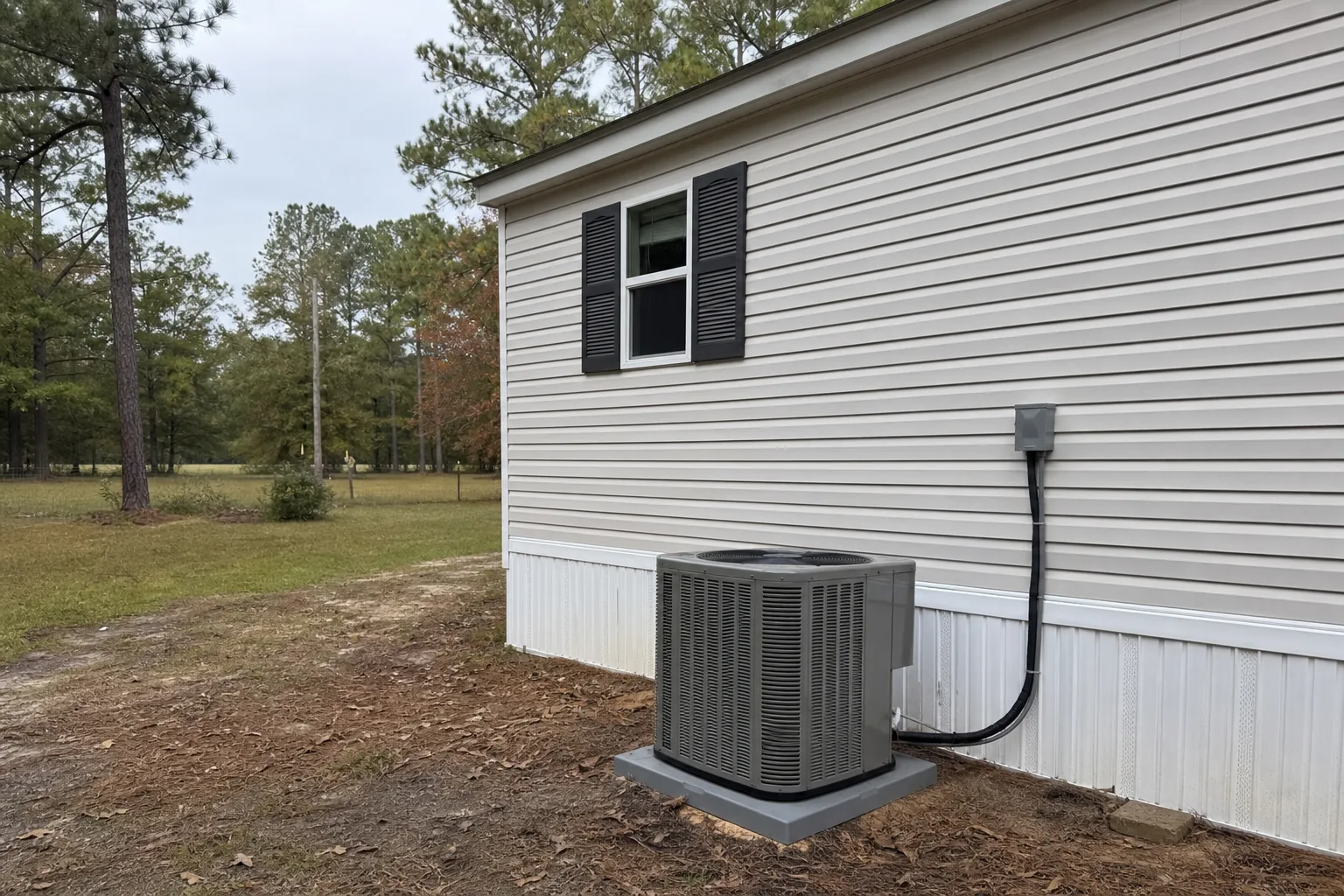
Why an Identical AC Costs $2,800 More in Summerdale in 2026
The same brand, tonnage, and SEER2 condenser costs $2,800 more in Summerdale in 2026 than 2023. Labor is $400; the other $2,400 traces to one industry variable.
Published 2026-11-19 · Updated 2026-11-19
Author: Landon Jahnke | ACExperts251
Reviewed by: Landon Jahnke · Owner · Alabama HVAC License AL #16117 · EPA 608 Certified
$2,800. That's the average gap between an identical 3-ton AC install in Summerdale (2026 dollars) vs. the same equipment installed in 2023 in the same neighborhood. The brand didn't change. The labor rate climbed but only $400 of the gap. The other $2,400 traces to a single industry-wide variable that most homeowners don't know about. Here's the one statistic that explains the whole gap, and how it'll change again in 2027.
The statistic
The single number that explains $2,400 of the $2,800 install-cost increase is this: the global warming potential (GWP) of R-410A is 2,088. The GWP of R-454B is 466.
That ratio — a roughly 78% reduction in GWP — is the federal regulatory finding that triggered the entire 2025 refrigerant transition. The 2020 American Innovation and Manufacturing (AIM) Act required EPA to phase down high-GWP hydrofluorocarbons (HFCs), and the residential AC industry's piece of that phasedown landed on January 1, 2025: new residential split-system equipment manufactured for the U.S. market after that date had to use refrigerant with GWP under 700.
R-410A failed the cutoff. R-454B passed. The entire industry redesigned its product lines to comply.
That redesign — not labor inflation, not supply-chain hangover, not contractor greed — is what drove the $2,400 portion of the $2,800 gap. Here is how it broke down on a representative Summerdale invoice.
The same install, three years apart
Over 13 years working Baldwin County HVAC, I've watched the same model line move through three pricing eras — and Summerdale homes are a good case study because the housing stock is consistent enough that ductwork and load don't muddy the comparison. Take two representative invoices for similar Summerdale homes — both 3-ton, both 16 SEER2-equivalent, both single-stage, both standard-efficiency-tier from the same major manufacturer. Same general neighborhood, comparable ductwork condition.
2023 install:
- Equipment (R-410A condenser + matched evaporator coil + air handler): $5,400
- Refrigerant charge included in equipment
- Standard install labor: $1,800
- Permits, miscellaneous parts, line set: $400
- Total: $7,600
2026 install:
- Equipment (R-454B condenser + matched evaporator coil + air handler): $7,300
- Refrigerant charge included in equipment
- Standard install labor: $2,200
- Permits, miscellaneous parts, A2L-rated line set provisions, leak detector: $900
- Total: $10,400
Gap: $2,800.
Walk through where the gap landed:
- Labor: +$400. Normal three-year wage inflation at roughly 6% per year, plus an extra hour of install time for the A2L safety procedures the new refrigerant requires.
- Equipment: +$1,900. This is the big one. The condenser cabinet had to be redesigned for slightly larger heat exchanger volumes (R-454B is moderately less efficient as a working fluid than R-410A and recovers some of that gap through more transfer area). Compressors and valves use updated materials compatible with the new refrigerant chemistry. The evaporator coil is differently engineered. Manufacturers are pricing the redesigned equipment $1,500-$2,200 above the equivalent R-410A unit from 2023.
- Permits, line set, and A2L provisions: +$500. R-454B is classified as A2L — mildly flammable. That classification triggers code-mandated safety provisions: refrigerant leak detection on the evaporator coil, specific line set materials, and updated installation practices. The provisions add roughly $500 of parts and code-compliance cost to every install.
That is the math. $400 labor + $1,900 equipment + $500 A2L provisions = $2,800. The single statistic — the 78% GWP reduction — is what triggered every component of the equipment and code change.
Why the equipment cost increase is permanent
Some homeowners ask whether the higher prices are a temporary new-product premium that will compress as production scales. Partial answer: yes, some of it will compress. The first-generation R-454B equipment manufactured in 2024-2025 carried genuine new-design overhead — engineering amortization, slower production lines, lower volumes spread across higher fixed costs. Those should ease through 2027-2028 as volume catches up.
But the structural cost increase — larger heat exchangers, A2L-rated components, redesigned valves, leak-detection provisions — is permanent. Manufacturing a 3-ton R-454B condenser is materially more expensive than manufacturing the equivalent R-410A unit was in 2023, and that gap will narrow but not close.
What this means for Summerdale homeowners: if you are waiting on 2027 prices to "come back down," you will be disappointed. The realistic 2027-2028 trajectory is roughly $300-$600 of compression on equipment pricing as production matures, against another 5-7% of labor wage inflation that partially offsets it. Net change vs. 2026: probably $0 to -$400 on the same install. Net change vs. 2023: still up $2,400-$2,800.
For a comprehensive picture of how 2026-2027 install pricing breaks down across Baldwin County, the AC installation service page walks through equipment tiers and what changed with the refrigerant transition. Inland Summerdale homes specifically — see the Summerdale city page — tend to land at the lower end of the cost band when ductwork is in good shape and the upper end when retrofit ductwork from the 1970s-1980s requires repair alongside the install.
Where the efficiency-tier math still matters (after the federal credit expired)
The federal 25C heat-pump tax credit expired December 31, 2025 and does not apply to 2026 or 2027 installs — confirm any 2025-return question with a CPA. That changes the upfront math, but the efficiency-tier decision still matters on its own terms.
The qualifying threshold for the Alabama Power utility rebate and manufacturer premium promotions is still tied to efficiency tier: roughly 16 SEER2 / 9.0 HSPF2 for southern climate zone heat pumps. Standard 14.3 SEER2 single-stage equipment often misses the higher utility rebate tier. Variable-speed heat pumps in the 17-19 SEER2 range typically qualify for the better rebate and deliver meaningfully lower monthly operating costs.
The math on a Summerdale 3-ton install without the federal credit:
- Standard-efficiency 14.3 SEER2 system: $10,400 net (Alabama Power rebate already applied)
- High-efficiency 17 SEER2 heat pump: $12,200 sticker - Alabama Power rebate (higher tier) = roughly $11,500–$11,800 net
The high-efficiency tier delivers materially better long-run energy bills — typically $30-$60 per month savings for a Summerdale home running through Baldwin County summers. Without the $2,000 federal credit, the upfront premium gap between tiers is wider than it was through 2025, but the operating-cost advantage still closes the gap over the equipment's lifespan for most Summerdale homes.
What 2027 will probably look like in Summerdale
Forecasting installation pricing into 2027 is not a precise exercise, but the directional inputs are clear:
Labor: continued wage inflation at roughly 5-7% per year. Expect $100-$200 of additional labor cost on a typical Summerdale 3-ton install.
Equipment: modest compression as R-454B production volumes mature. Expect $200-$400 of equipment cost reduction on standard-efficiency tiers, less compression on high-efficiency tiers (which command structural premiums for variable-speed compressors and inverter electronics independent of the refrigerant transition).
A2L provisions: approximately flat. The leak-detection and code-compliance costs are baked in and will not move much.
Net 2027 vs. 2026: roughly $0 to -$300 on a comparable install. The cost gap to 2023 stays in the $2,500-$2,800 range and probably narrows only marginally over the rest of the decade.
The structural conclusion: 2026 is approximately the new normal. Waiting for prices to drop back to 2023 levels is waiting for something that will not happen.
When to replace, when to wait
For Summerdale homeowners weighing the cost increase against system age, the framework I walk through in person is:
- System under 8 years old, no major repairs in the last 18 months: keep running it. The cost of premature replacement exceeds the cost of continued operation.
- System 8-12 years old, one minor repair in the last 18 months ($300-$500 range): keep running it but plan for replacement in the next 2-4 years. Use that window to budget and to research equipment tiers.
- System 12-15 years old, repair quote $1,200 or higher: run the repair-vs-replace calculator honestly. The math typically tilts toward replacement at this age. Note: the federal 25C tax credit expired December 31, 2025 — the efficiency-tier decision rests on operating cost savings and utility rebate tiers alone for new installs.
- System 15+ years old: replacement is almost always the right answer. Repair costs at this age compound quickly, energy efficiency is dramatically below modern equipment, and the system is past statistical end of life.
A free in-home replacement consultation at (251) 383-HVAC walks through equipment options at multiple efficiency tiers and price points. Note: the federal 25C credit expired December 31, 2025 and is not included in the comparison — utility rebates and operating cost savings drive the tier decision for new installs. You'll get a written estimate before any commitment, and a free second opinion on any quote from another contractor.
Why the gap matters more than the absolute price
The reason this post focuses on the change in cost rather than the absolute cost is that homeowners often make replacement decisions by comparing today's quotes against memories of what their last AC cost. That comparison frame is no longer accurate. A 2023 quote and a 2026 quote are not measuring the same product — different refrigerant, different equipment design, different code requirements, different labor.
Once you understand the structural reason for the $2,800 gap, the right comparison frame becomes: today's quote vs. today's wholesale equipment prices, today's labor market, and today's code requirements. That comparison usually reveals that 2026 quotes from reputable Baldwin County contractors are actually quite tight relative to the underlying cost stack — there is not a lot of room to negotiate downward, because the cost increase is real and structural rather than discretionary contractor margin.
What there is room to do is choose the right efficiency tier (high-efficiency typically wins on long-run operating cost, and utility rebate tier differentials reinforce that — the federal 25C credit that previously added $2,000 to the efficiency-tier case expired December 31, 2025), the right manufacturer (the price-to-reliability ratio varies across brands), and the right time of year (off-peak fall and winter installs in Summerdale typically run $300-$500 below peak summer pricing because availability is better).
If your Summerdale system is approaching replacement age, give the office a call before the next service window and I'll walk you through the actual 2026 cost stack and what 2027 is likely to look like for your specific equipment and home.
FAQ
- Will AC prices come back down in 2027 or 2028?
- Almost certainly no. The 2025 refrigerant transition from R-410A to R-454B was a one-way change driven by the AIM Act and EPA phasedown rules — manufacturers cannot reverse course back to R-410A even if they wanted to. Equipment redesigned for the lower-GWP refrigerant is incrementally more expensive to manufacture (different valve materials, slightly larger heat exchangers, mildly-flammable A2L safety provisions), and those costs are now baked into pricing. What may move down marginally is the new-product premium — first-generation R-454B equipment in 2025-2026 carried roughly $400-$700 of 'new design' margin that should compress as production volume scales through 2027-2028. But the headline gap from 2023 will not close meaningfully.
- Can I avoid the cost increase by installing an R-410A system instead?
- No — and not because anyone is preventing you, but because the equipment is not available. As of January 1 2025, manufacturers stopped producing new R-410A residential split systems for the U.S. market. The only R-410A equipment available to install today is leftover inventory from pre-2025 production runs, and those are mostly gone. Some service-only R-410A refrigerant remains available for repairs to existing systems and will for several more years, but new-install R-410A systems are not a current option in Baldwin County or anywhere else.
- Is the Summerdale-specific cost different from coastal Baldwin County pricing?
- Slightly, in both directions. Summerdale install prices generally run $100-$300 below Eastern Shore equivalents because the drive-time, parts-stocking, and overhead allocations on inland routes are lower. But Summerdale homes also more frequently need duct repairs alongside equipment swaps — older retrofit ductwork from the 1970s-1980s is common in Sunset Acres, the Highway 59 corridor, and the older sections near Town Hall — and a duct repair stacked onto an install can easily push the total back above coastal pricing. The 'identical AC' comparison in this post controls for ductwork by assuming same-house, equipment-only replacement.
- Should I wait until 2027 to replace my Summerdale AC?
- Probably not, for one clear reason: prices are not expected to drop meaningfully in 2027 — the structural cost increase from the refrigerant transition is permanent. On the tax credit side, the federal 25C heat-pump tax credit expired December 31, 2025 and does not apply to 2027 installs — confirm any 2025-return question with a CPA. If your existing system is healthy and 8-12 years old, waiting 1-2 years is reasonable. If it is 14+ years old and starting to need repairs, the math typically favors replacing now while manufacturer and utility rebates are available.
Need this handled?
Straight to the service page for your town — pricing, local details and a form that reaches a technician.
More from AC Replacement Cost 2026

ACExperts HVAC
We Take The Heat So You Don't Have To
Fast, honest heating and air service across Baldwin County. Speak with a technician and get on the schedule today.