
First Run of the Season Failures in Fort Morgan: A Checklist
First-run-of-the-season HVAC failures in Fort Morgan — four versions of the pre-season checklist for where you are in October and November, from full to skip.
Published 2026-10-05 · Updated 2026-10-05
Author: Landon Jahnke | ACExperts251
Reviewed by: Landon Jahnke · Owner · Alabama HVAC License AL #16117 · EPA 608 Certified
Is it before October 15? Run the pre-season checklist now — the highest-value window. Is it October 16-31? Run the checklist this week, but skip the dehumidifier flush if your budget is tight. Is it November 1-15? Run the abbreviated checklist; you've already paid for some equipment stress. November 16+? Skip the checklist; book a full diagnostic instead. Today's date determines which version of the checklist you actually run. Here are all four versions.
Fort Morgan is its own animal in Baldwin County. The peninsula stretches 22 miles west from Gulf Shores along beachfront and bay-side road, and the equipment that serves the vacation rentals, second homes, and permanent residences from The Beach Club to the Fort Morgan Marina lives on the most aggressive HVAC environment we work in. Salt spray reaches outdoor condensers year-round. Tropical airflow loads coils with corrosive moisture. The summer cooling season runs harder and longer than anywhere inland.
That's why the pre-heating-season checklist isn't the same checklist we run for Loxley or Bay Minette. And it's why timing matters more here than anywhere else we serve.
Today is October 5, 2026. If you're reading this within a few weeks of publication, you're squarely in version-one territory. If you're reading it in mid-November or later, scroll down to the right section.
Version 1 — Before October 15: the full checklist
This is the highest-value window. Fort Morgan equipment that's been running 14+ hour days through August and September is ready to be inspected before any meaningful heat-pump cycling begins. Issues found in this window are typically cheap repairs — a capacitor swap, contactor replacement, or drain flush — rather than emergency visits in December.
The full checklist:
Condenser-side (outdoor):
- Visual inspection of cabinet for corrosion penetration
- Coil chemical wash with neutralizer rinse (Fort Morgan-specific: a stronger acid-based foaming cleaner is used compared to inland coils)
- Fan motor amperage measurement against nameplate rating
- Capacitor microfarad measurement against rated value (replacement if drift exceeds 6%)
- Contactor inspection for pitting, arc damage, or corroded terminals
- Compressor amperage under load
- Refrigerant subcool and superheat measurement
- Disconnect and whip inspection
- Pad and base condition (Fort Morgan units on sand bases tend to settle)
Air handler / indoor coil:
- Indoor coil inspection through access port
- Drain pan and condensate line flush
- Float switch operation test
- Blower wheel inspection (look through the access port toward an inspection lamp; biofilm growth is dramatic on coastal equipment)
- Blower motor amperage
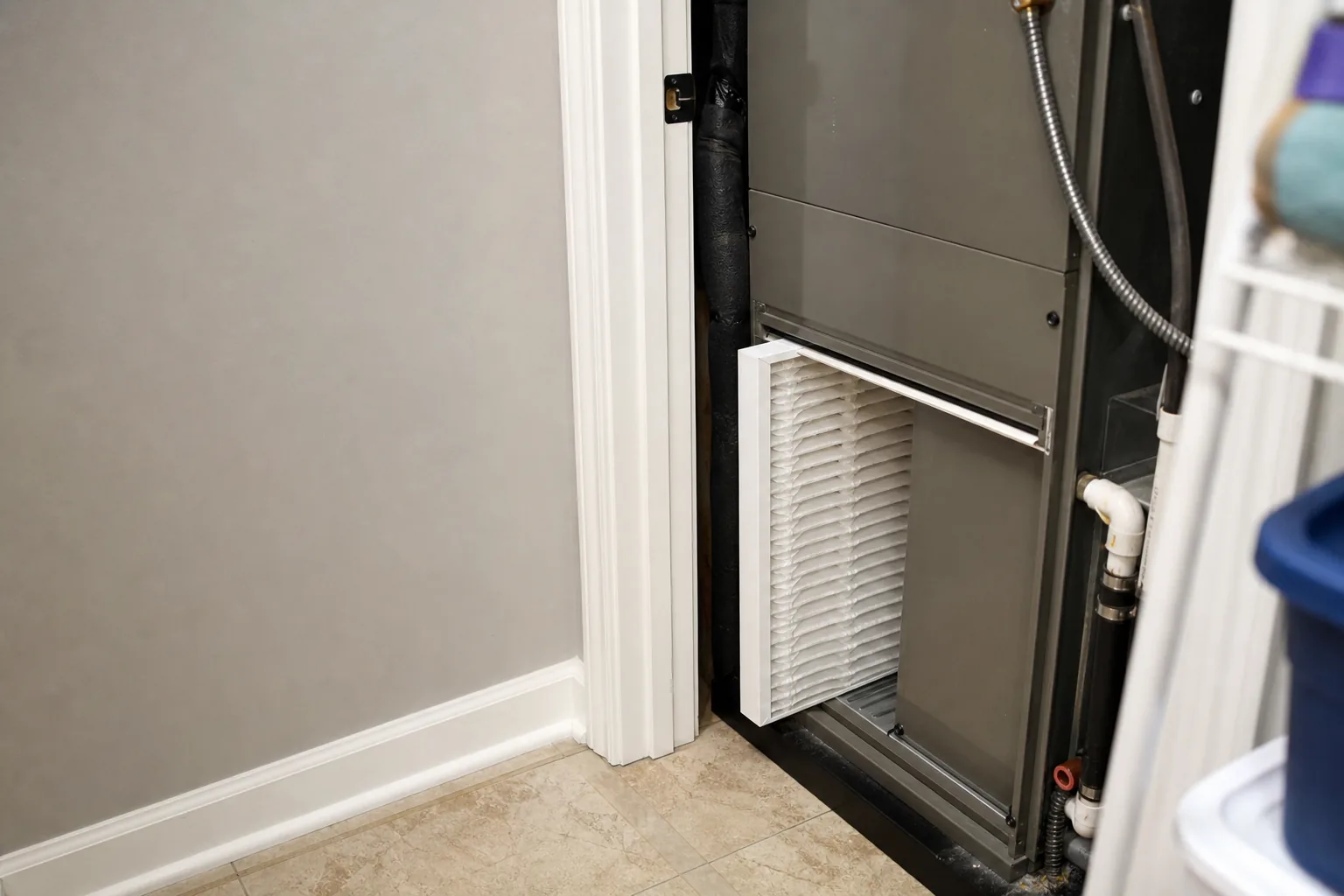
- Air filter replacement
- Static pressure measurement on supply and return
Controls and safety:
- Thermostat calibration check
- Reversing valve operation test (heat pump systems)
- Defrost cycle initiation test
- Safety switch operation
- Wire connections at all junction points
System-level:
- Temperature differential at supply and return
- Indoor humidity measurement at three points
- Cycling pattern observation through one full cycle
- Discussion with homeowner about any seasonal concerns
This full version typically runs 90-120 minutes for a 3-ton single-system Fort Morgan home. Comfort Plan members get two annual visits included as part of the $20/month or $240/year membership.
Version 2 — October 16 through 31: the abbreviated checklist
By the second half of October, you're past the optimal window but still in good territory. Most Fort Morgan equipment will see its first real cool morning between October 25 and November 5, which means heat-pump mode hasn't engaged yet and the contactor and reversing valve haven't been stressed in their winter operating modes.
The abbreviated version drops two items from the full list:
Drop: Coil chemical wash. The wash is a high-value item, but it takes 35-45 minutes and adds $135-$165 to the visit. If your budget is tight in late October, the wash can wait until the next maintenance visit in March. The chemical wash is most valuable when there's a full season ahead of cooling — going into the heating season, the cost-benefit shifts.
Drop: Static pressure measurement. Static pressure is diagnostic gold, but if the system is running normally and the homeowner doesn't report comfort complaints, static pressure findings rarely change the action plan in October.
Keep everything else. The capacitor measurement, contactor inspection, refrigerant pressures, drain flush, and electrical-side checks all stay. These are the items most likely to catch actual failures before they happen in cold weather.
Abbreviated version runs 65-80 minutes and prices at roughly 60% of the full version. Catches about 80% of the issues the full version would catch.
Version 3 — November 1 through 15: the partial checklist
By early November, your Fort Morgan equipment has likely seen at least one heat-pump cycle. If something was going to fail in heat-pump mode immediately, it already has — and you've made the emergency call. If you haven't made that call, the equipment passed its first stress test, and a partial checklist is appropriate.
The partial checklist focuses on three things:
1. Refrigerant pressure check in both cooling and heating modes. This catches developing leaks that the cooling-mode-only summer pressure check would miss. Heat-pump systems run at different pressures in heating mode, and a leak that's invisible in summer can become obvious in winter.
2. Defrost cycle verification. Fort Morgan heat pumps go into defrost mode multiple times per cold morning when bay air pushes humidity onto the outdoor coil. A defrost cycle that fires correctly but doesn't complete cleanly will cause comfort problems through December and January. Forcing a defrost initiation and watching the full cycle is the verification.
3. Electrical-side rapid inspection. Capacitor microfarad, contactor condition, wire connections at the disconnect. These are the highest-failure components on coastal equipment and they don't take long to check.
The chemical wash, the static pressure test, the airflow measurements, and the blower-wheel inspection get skipped. The partial checklist runs 35-50 minutes and prices accordingly. It's a maintenance check, not a tune-up — but it catches the items that genuinely matter for Fort Morgan winter operation.
Version 4 — After November 15: skip the checklist, book the diagnostic
Past mid-November, the math changes. Your equipment has been through enough heating cycles that any latent issues should have surfaced. Running a tune-up at this point is mostly about feeling thorough, and most of what a tune-up would find is now on the boundary between "preventive maintenance" and "actual repair work that should be billed as repair."
Better path: don't book a tune-up. Book a diagnostic visit only if anything is acting unusual.
Symptoms that warrant a diagnostic in late November and December:
- Strange noises during startup or shutdown (especially "hiss-hum" or "click-pause-hum" patterns)
- Cycling that's noticeably shorter or longer than last winter
- Bills that are running higher than the same period last year despite similar weather
- Humidity that lingers above 55% indoors despite the system running
- Any odor when the heat first kicks on
The Gulf Shores compressor warning-sign post covers the audio-side diagnostic for failing equipment, and the musty-smell post covers the odor side. Either of those, or any of the other symptoms, is worth a $79 diagnostic call rather than a generic tune-up.
Why Fort Morgan timing is different
A reasonable question: why does timing matter so much more here than in Spanish Fort or Bay Minette?
Three reasons.
Salt corrosion is daily. Inland equipment sees corrosive exposure during named storms and a few weeks of strong south wind per year. Fort Morgan equipment sees it every day, twice a day, with the marine layer movement. Components degrade on a different curve.
Equipment runs harder. Direct Gulf-front exposure means more solar load on the cabinet, more humidity load on the system, and longer run-times during cooling season. Each summer adds more wear than an equivalent inland summer.
Failure cost is higher. A no-heat call in Fort Morgan during a December cold snap is a long service drive from the nearest dispatch point, often coordinated around bridge traffic and rental check-in schedules. Catching the issue in October at a routine visit costs a fraction of catching it as an emergency in December.
The Daphne summer storm recovery post covers the post-event side of coastal equipment care, and the Foley pre-summer punch list covers the spring-side equivalent of what we're discussing here. The fall side is just as important on Fort Morgan equipment — maybe more so.
Today's date determines which version of the checklist makes sense for your situation. Pick the version that matches your calendar and your budget, and book the visit before the first real cold front pushes through.
FAQ
- Why does the calendar matter so much for a Fort Morgan tune-up?
- Because Fort Morgan equipment lives on the most aggressive corrosion exposure in our coverage area, and the longer summer salt spray sits on the coil before the first real heat-run, the more each component degrades. The pre-October-15 window catches developing problems while they're still cheap repairs. After November 15 the math flips — you've already paid for some equipment stress, and a tune-up that finds problems gets billed against work that's now needed regardless.
- What's the difference between an abbreviated checklist and a full one?
- The full checklist is 28 measurements and inspections including subcool/superheat, compressor amperage under load, capacitor microfarad against rated value, contactor pitting, condensate drain flow rate, indoor static pressure, return air filter restriction, and complete coil chemical wash. The abbreviated version drops the chemical wash and the static pressure test — about a third of the labor — and focuses on the diagnostic measurements that catch actual failures. The abbreviated version costs about 60% of the full one and catches roughly 80% of issues.
- Should I just skip the tune-up if it's already mid-November?
- Skip the standalone tune-up, yes. But don't skip a diagnostic visit if anything is acting unusual — strange noises, odd cycling, higher-than-expected bills, or lingering humidity issues. By mid-November, Fort Morgan equipment that's about to fail in heat-pump mode usually shows symptoms within the first two weeks of below-50-degree mornings. A diagnostic catches that before it becomes a no-heat call on Christmas Eve.
- Does Fort Morgan really need different timing than the rest of Baldwin County?
- Yes. Direct Gulf-front exposure means salt spray contact every day of the year, which accelerates electrical and coil degradation. Inland Baldwin County equipment can wait until January for a tune-up without much consequence. Fort Morgan equipment that hasn't been touched between the last service call and the first cold morning is rolling the dice — the salt corrosion that built up over summer is exactly what causes contactor failure, capacitor failure, and coil leaks once the system starts cycling differently in heat-pump mode.
Need this handled?
Straight to the service page for your town — pricing, local details and a form that reaches a technician.
More from After Winter Startup

ACExperts HVAC
We Take The Heat So You Don't Have To
Fast, honest heating and air service across Baldwin County. Speak with a technician and get on the schedule today.