
5 Pollen Mistakes Foley Homeowners Keep Making
Spring filter spending and a coil-replacement bill four months later are connected by five pollen mistakes — fix them before the bigger bill lands.
Published 2026-03-25 · Updated 2026-03-25
Author: Landon Jahnke | ACExperts251
Reviewed by: Landon Jahnke · Owner · Alabama HVAC License AL #16117 · EPA 608 Certified
Spring-pollen filter spending stacks up fast in Foley, and a corroded, biofilm-loaded coil four months later — when the cooling season puts it under sustained load and refrigerant leaks past a pinhole that pollen-acid eroded over years — is the bigger bill nobody plans for.
The five upstream spring-pollen mistakes that connect those two numbers are about to cost you the second one if you don't catch them now. None of these are obscure. Over 13 years working Baldwin County HVAC, these are the same five patterns I've seen show up every March on tune-up calls in Glenlakes, Cypress Gates, Cottages on the Greene, and Walker Grove. The fixes are cheap. The not-fixes get expensive.
Mistake 1: buying expensive filters and changing them quarterly
This is the single most common pollen-season mistake I see in Foley homes, and it leaves homeowners with filters that are only partially functional for half of their installed life.
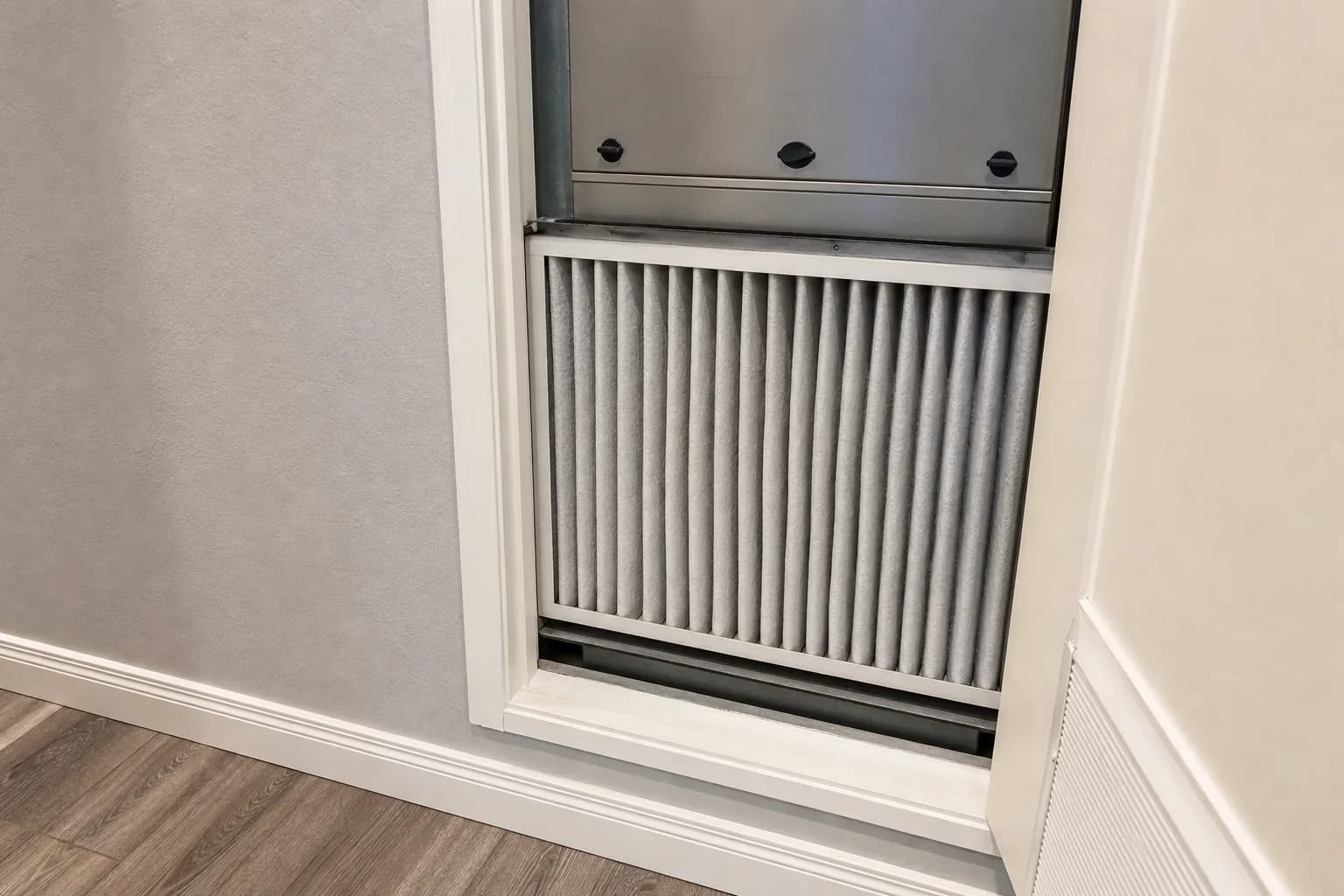
A MERV 13 4-inch media filter costs roughly $50-70 retail. They're rated for 3-12 months of use depending on conditions, and most homeowners interpret that as "change every 6 months." During Foley's pollen season — late February through early May, with peak oak and pine load in mid-March — a MERV 13 filter loads to capacity in 30-45 days. After that, three things happen:
- Static pressure climbs. The blower works harder against a loaded filter, draws more amps, and the bearings and capacitor age faster.
- Bypass develops. Air finds the path of least resistance, which means around the filter frame rather than through the loaded media. Pollen-laden bypass air goes directly to the coil.
- Static-pressure-driven coil icing. Reduced airflow across the coil during cooling-season operation drops coil temperature below freezing, condensate freezes, and the coil ices over. Repeated icing damages fins.
The fix is simple but counterintuitive: buy cheaper filters and change them more often during pollen season. A $25 MERV 11 changed every 30 days through March-April-May does more for indoor air quality than a $60 MERV 13 changed every 90 days. The total filter spend is similar. The system protection is dramatically different.
For Foley homes specifically, the Foley service area page covers the housing stock context — Glenlakes and Cypress Gates with newer construction and tighter envelopes, Walker Grove with 1970s ranches and retrofit ductwork. The filter strategy adjusts: newer tight homes can run MERV 13 if static pressure supports it; older homes typically need MERV 11 because their return-air sizing can't push higher-MERV without strangling airflow.
Mistake 2: ignoring the outdoor unit during pollen season
The condenser outside has a heat-exchange function that depends on clean fins. Pollen-loaded condenser fins reduce heat-rejection capacity, which means the system runs longer to do the same cooling work, which means more cycles through the indoor coil, which means more wear on every component.
The mistake comes in two flavors. The minor version: homeowners forget the outdoor unit exists until it makes a noise. The serious version: homeowners try to "help" by hosing the unit down with high pressure, which bends fins, drives debris deeper into the coil, and damages the fan motor seals.
The right cadence for Foley:
- March 15 baseline rinse. Low-pressure garden hose, no nozzle, water from the top down through the fins. Five minutes per side. Pollen rinses cleanly when wet — leave it dry and it cakes and binds.
- April refresh. Same procedure. Pine pollen peak in April requires a second rinse.
- Pre-cooling-season inspection. This is the tech visit — pulling the top, inspecting the fan motor, vacuuming the bottom of the cabinet, checking fin straightness, verifying line set insulation, and documenting the starting condition for the cooling season.
Don't use a pressure washer. Don't use household degreasers. Don't bend the fins with a fin comb if you don't know what straight looks like. The preventive maintenance service page covers what a spring tune-up includes — fin condition assessment is part of it.
Mistake 3: running the indoor fan continuously to "filter the air more"
This advice circulates every March and it's wrong for Foley specifically. The reasoning seems sound: more fan runtime equals more passes through the filter equals more pollen captured. The reality during shoulder season:
When the AC compressor isn't running but the fan is running continuously, three problems develop:
- Re-evaporation from the drain pan. Any condensate sitting in the pan evaporates back into the airstream when the fan moves air across the wet evaporator. Indoor humidity rises. Coil biofilm accelerates.
- No coil-side particulate capture. When the AC is running, the cold coil condenses moisture and pulls fine particulates out of the airstream — the coil acts as a secondary filter. With fan-only operation, you lose that secondary capture.
- Pollen redistribution. The fan moves pollen that's settled on furniture, drapes, and carpet back into airborne circulation. Some of it lands on the filter. Some of it doesn't. Net allergen exposure can increase.
The right fan strategy during March-April-early May in Foley:
- Intermittent circulate mode if your thermostat supports it (Nest, ecobee, Honeywell T-series). 20-30 minutes of fan per hour. This balances mixing with the dehumidification benefits of compressor cycles.
- Auto mode if your thermostat is older or doesn't support intermittent. Let the fan run only when the AC is calling.
- Avoid "On" continuous until you're well into cooling season (mid-May onward) when compressor cycles are long enough that re-evaporation isn't a problem.
The indoor air quality service page covers fan strategy in more detail, including what changes when you have integrated UV-C or polarized media filtration in the system.
Mistake 4: skipping the spring tune-up because "it ran fine last summer"
The marginal capacitor that ran fine last summer at 80% capacity is going to fail this summer at 70% capacity, on a Saturday afternoon, when ambient is 92°F and the condenser is asked to start under heavy load. The contactor that ran fine last summer with pitted contacts is going to fail this summer when those contacts won't make a clean connection. The drain line that ran fine last summer is going to back up this summer because pollen-and-condensate biofilm has finally bridged the line.
The pollen-season connection is direct: pollen-loaded coils run hotter, draw more amperage, and stress every electrical component. A tune-up isn't paperwork. The actual diagnostic work — capacitor microfarad reading against nameplate, contactor resistance check, refrigerant subcool/superheat verification, blower amp draw under load, static pressure measurement — finds the marginal parts before they fail. Foley's high cooling load from May through October punishes marginal parts. The tune-up is when those get caught.
Our $79 service-fee diagnostic covers the visit; for ongoing care, the Comfort Plan runs $20/month or $240/year and includes 2 tune-ups annually, 10% off repairs, and waived service fees. Compare that to a Saturday no-cool diagnostic with capacitor replacement under load and the math is straightforward — there's no Saturday upcharge during regular hours, but you still pay parts and time.
If you've never been on a maintenance plan, the preventive maintenance overview explains what the visit covers and what the plan model looks like. The pattern across years on the trucks: homes on a regular tune-up cadence catch marginal parts under controlled conditions instead of having them fail under load.
Mistake 5: assuming "the new system" doesn't need pollen-season attention
This is the mistake that shows up most in Glenlakes, Cypress Gates, Graham Creek Estates, and the newer Cottages on the Greene phases — homes built in the last 8 years with HVAC that's still under manufacturer warranty. The reasoning: it's new, it's covered, why does it need spring attention.
The reasoning misses that warranty doesn't cover damage from neglect. A coil that's been allowed to load with pollen-and-biofilm during the warranty period and starts leaking refrigerant in year 9 (12 months after warranty ends, conveniently) is not covered. A blower motor that's burned out from running against a perpetually loaded filter is sometimes covered, sometimes not, depending on the manufacturer's interpretation.
More importantly: spec construction in newer Foley subdivisions doesn't always mean correctly commissioned construction. Across 13 years working Baldwin County HVAC, the patterns I've seen on supposedly "new" installs include:
- Refrigerant charge off on systems less than 2 years old because the installing contractor topped off based on guesswork instead of measurement.
- Static pressure well above manufacturer specification because returns weren't sized correctly during construction.
- Thermostat staging set to factory defaults that don't match the actual system installed.
- Drain line slopes that don't meet code, so the line backs up in the first heavy condensate week.
A spring tune-up on a 2-3 year old system isn't redundant. It's often the first time anyone has actually measured what's happening inside the equipment, and the findings inform everything from filter strategy to whether you should escalate a warranty claim before it expires.
The AC repair service page covers diagnostic logic for systems showing comfort or efficiency issues; the AC installation service page covers what proper commissioning looks like, which is the standard against which we evaluate existing installations.
What the math looks like, end-to-end
The pattern is straightforward. The mistake-driven path stacks inefficient filter spend on top of avoidable emergency calls on top of an early coil replacement when cumulative pollen-and-biofilm damage finally breaks through. The correct-cadence path is right-sized filters changed at the right interval, plus a maintenance plan, and a system that hits its full design life.
The gap between those two paths over five years on a typical Foley home is real money. The fixes are cheap. The systems I've seen fail at the 5-7 year mark in Foley over my career are almost universally on the mistake-driven path, and almost universally fixable for a fraction of the eventual replacement cost if caught in year 2 or year 3.
What to do this week
If you're reading this in late March, you're at the peak of oak pollen season. Three things to do this week:
- Replace your filter today if it's been more than 30 days since last change. Mark the new install date on the frame.
- Rinse the outdoor condenser — low-pressure water, top down, both sides — for five minutes per side. Pull any leaves or debris within 18 inches of the cabinet.
- Schedule a spring tune-up for the next 2-3 weeks. Maintenance plan slots fill quickly through April.
If your symptoms — allergy, indoor smell, comfort complaints — haven't resolved after these three steps and a filter change cycle, the next escalation is a coil-and-drain reset. The Daphne 3-step IAQ reset post covers the full coil-cleaning protocol; the same steps apply to Foley with minor adjustments for the inland-from-Gulf geography.
For nearby cities running similar pollen exposure, the Fairhope spring pollen post covers the Eastern Shore variant. The Daphne city page, Fairhope city page, and Gulf Shores city page get into the housing-stock differences that change pollen strategy across the county.
Phone line is open Monday-Saturday 8am-6pm; emergency calls around the clock, every day of the week, no Saturday upcharge. Same-day service in Foley when routing allows. $79 service fee on diagnostics. Free second opinions on quoted repairs and free estimates on replacements. The coil replacement you'd rather not need in year five is the kind of work I'd rather not sell — which is why catching the mistakes now is the whole point.
FAQ
- Is $4,000 a real number for coil replacement in a Foley home?
- Yes, and it's actually conservative on a 3-ton or larger system. Evaporator coil replacement on a typical Foley residential system runs $1,800-2,800 for parts plus $1,200-1,800 in labor for proper extraction, brazing, charge management, and pressure testing. On older R-22 systems where the coil match isn't available, you're often forced into a full air handler replacement, which pushes the number toward $5,500-6,500. The mistake-driven version of this bill is fully avoidable.
- Do filter subscription services like the big-box quarterly delivery actually save money?
- They save money on filter purchases but they often hide a bigger problem. Quarterly delivery encourages quarterly filter changes, which is wrong for Foley homes during pollen season. A filter that should be replaced every 30 days during March-May will be 90+ days into use during peak pollen if you're on a quarterly schedule. The filter still 'works' visually but airflow drops and bypass increases. The subscription is fine for July-October. Override it during pollen season.
- My system is only 4 years old — does pollen really matter that much?
- Yes, and a 4-year-old system is exactly when the damage compounds invisibly. The coil is still under warranty, the system is still cooling, and the homeowner has no reason to suspect a problem. But a coil that's been allowed to load with pollen-and-biofilm for four spring seasons enters its fifth year with surface contamination that takes professional cleaning to reverse. Over 13 years working Baldwin County HVAC, I've seen 5-7 year old systems with coil conditions that look more like 12-year systems because of cumulative pollen-season neglect.
- Can I clean the indoor coil myself with a coil cleaner from the hardware store?
- Sometimes — for very light surface load. The risks are: damaging the fins with too-aggressive technique, getting cleaner into electrical components, missing biofilm in the deeper coil rows that surface spray can't reach, and not having the airflow afterward to verify the system is operating to spec. For Foley homes, where the coil load comes from heavy oak and pine pollen plus cooling-season humidity, professional cleaning every 18-24 months is the right cadence.
Need this handled?
Straight to the service page for your town — pricing, local details and a form that reaches a technician.
More from Spring Pollen

ACExperts HVAC
We Take The Heat So You Don't Have To
Fast, honest heating and air service across Baldwin County. Speak with a technician and get on the schedule today.