
Orange Beach Hurricane Prep for Your HVAC: 9 Steps Before the Storm
Nine priority-ordered HVAC steps Orange Beach owners should run before a named storm — condo balconies to Ono Island pump-houses, real failure modes.
Published 2025-09-02 · Updated 2025-09-02
Author: Landon Jahnke | ACExperts251
Reviewed by: Landon Jahnke · Owner · Alabama HVAC License AL #16117 · EPA 608 Certified
Nine steps. Run them in order — the first three matter most, the last three are for owners who have time and want to do it right. This is what I'd do at my own place if a named storm was forecast to make landfall anywhere from Pensacola to Pascagoula.
Orange Beach has roughly 9,000+ active vacation rentals across condo towers and single-family homes, plus full-time owners on Ono Island, Bear Point Estates, Terry Cove, and the Cotton Bayou neighborhoods. Sally proved in September 2020 what most longtime residents already knew: the wind isn't usually what kills HVAC equipment here. The voltage chaos during landfall and recovery is.
Step 1 — Kill the breaker before the wind hits
The single most important thing you can do is shut off both the indoor air handler breaker and the outdoor condenser disconnect before tropical-storm-force winds arrive. Not the thermostat — the breaker. If grid power flickers on and off through landfall (it will), the compressor restarts under load each time and burns a little more capacitor and contactor every cycle.
This is true whether you're at a Bella Luna unit, a Phoenix on the Bay condo, an Ono Island waterfront home, or a Cottages at Romar duplex. Different equipment, same physics. If you're evacuating, set the thermostat to 78°F first so the system isn't trying to cool an empty closed-up house in the days before you can get back — but kill the breaker the moment local conditions deteriorate.
Step 2 — Pull power to the wall-sleeve PTAC units in condos
If you own a unit at one of the older Gulf-front buildings — anything from the 1990s and early 2000s along Perdido Beach Boulevard — you may have wall-sleeve PTAC units rather than central air. Those are wired to dedicated breakers in the unit panel, and they're more vulnerable to surge than central systems because the surge enters directly at the unit. Kill them at the breaker.
Building-wide chillers and central plant systems are the building's problem, not yours, but coordinate with management. Most of the high-rise corridor has formal storm-power-down protocols and you'll want to know whether the building is keeping common-area HVAC running on generator backup or shutting it all down.
Step 3 — Disconnect smart thermostats if you have time
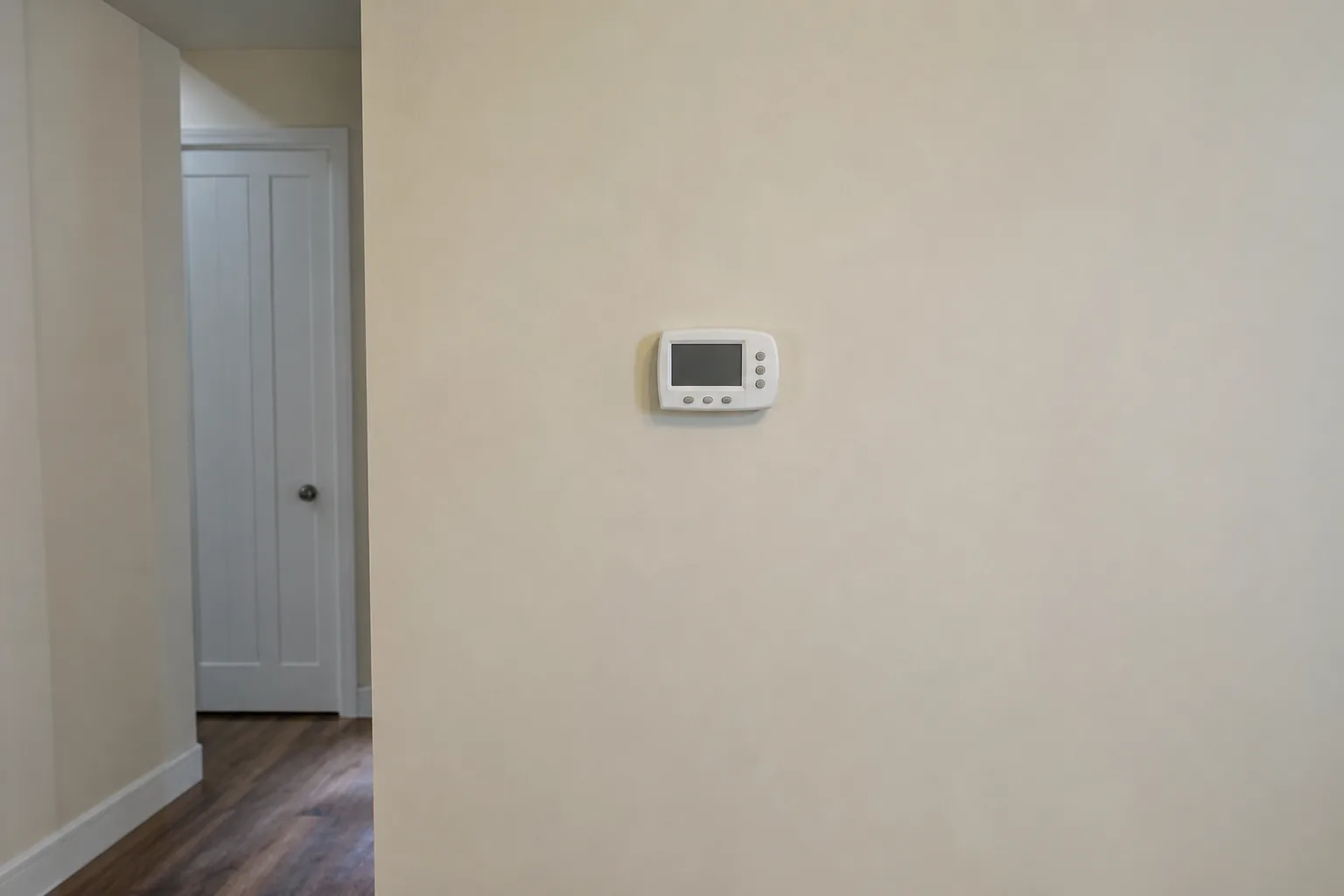
A Nest, ecobee, or Honeywell smart thermostat sits on 24-volt low-voltage wiring that's directly exposed to lightning-induced surges. The thermostat itself is replaceable for $180-300 — what's expensive is when the surge travels through the thermostat into the air handler control board ($350-650 part, $200-300 labor). Pulling the thermostat off the wall and isolating the wires takes 90 seconds and meaningfully reduces that path.
If your thermostat is hardwired and you don't want to mess with low-voltage wiring, just leave it. The breaker is the bigger lever.
Step 4 — Walk the outdoor unit and clear debris
Anything that can become a projectile within 20 feet of the outdoor condenser needs to come inside or get tied down. Patio furniture, planter pots, grill covers, kayaks, decorative landscaping rocks. The fan shroud is the most exposed mechanical part of the system and the easiest piece to bend or puncture from airborne debris — palmetto fronds, untied patio chairs, anything heavier than a soda can flying at 70+ mph.
Trim any palm fronds or branches that hang directly over the cabinet. The unit can take wind. It can't take a 4-foot live oak limb landing on the fan shroud.
Step 5 — Photograph everything for insurance
Before the storm, walk every piece of HVAC equipment with your phone in video mode. Talk through what you're seeing — make, model, serial number visible on the data plate, condition of the cabinet, surrounding area. Do this for the outdoor unit, the air handler in the closet or attic, the thermostat, and any mini-split heads if you have them.
If you end up filing a claim post-storm, this video is the difference between a smooth process and a six-week argument with the adjuster about whether the corrosion was pre-existing. Insurance companies in coastal Alabama are very good at finding pre-existing-condition exclusions when there's no documentation.
Step 6 — Check your surge-protection setup
There are two layers worth having: a service-entrance surge protector at the main panel ($120-180 installed) and a dedicated HVAC surge protector at the air handler or condenser disconnect ($90-140 installed). The first one catches the big stuff. The second one catches what slips past the first one and protects the most expensive single component in the house — the variable-speed ECM blower motor and communicating control board.
If you don't have either, a hurricane forecast isn't really enough lead time to install them, but call us once the storm passes and let's get them in before the next one. We cover this exact failure-mode math in the Robertsdale surge protector breakdown — the dollar figures translate directly to Orange Beach equipment.
Step 7 — Top off any portable generator fuel and verify the inverter rating
Running a 5-ton central AC on a portable generator is generally a bad idea unless you bought the generator specifically for that purpose. You need 5,000+ watts continuous, true sine wave output, and ideally an inverter generator rather than a contractor-grade open-frame model. Dirty power from a $700 Home Depot generator will burn the compressor or blow the variable-speed inverter board on a modern system within a few cycles.
If you have one of the smaller window-shaker or portable-AC backups for hurricane season, those are fine on standard generators. The whole-house central system isn't.
Step 8 — Plan your post-storm restart sequence
Don't restore power to the AC the moment the lights come back on. Alabama Power restores feeders in waves and the grid will continue to flicker for hours, sometimes days, after the initial restoration. Each flicker punishes the compressor.
The sequence I run at my own house and on customer calls: wait until grid power has been stable for 6-12 hours, restore the outdoor disconnect first, restore the indoor air handler breaker second, set the thermostat 8-10°F above current room temp, and let the equipment ease into the load gradually over 2-4 hours. If anything sounds wrong on startup — humming compressor with no fan spin, loud grinding, immediate breaker trip — kill it and call. The full safe-restart procedure is detailed in our Silverhill post-hurricane restart guide, and it applies the same way in Orange Beach.
Step 9 — Know who you're calling before you need them
After a named storm we triage emergency HVAC calls based on occupancy: hospitals, dialysis-dependent residents, families with infants, vacation rentals with imminent check-ins. If you're a Comfort Plan member or a tagged storm-response customer, you're prioritized in the routing.
Save 251-383-HVAC in your phone now. Save the building manager's contact if you're in a condo. Know whether your home warranty company contracts with anyone on the Eastern Shore and whether their dispatch line works after a major event (most don't). Have a plan that doesn't depend on the cell network being functional in the first 12 hours after landfall, because it usually isn't.
A note on the post-storm pattern in Orange Beach
The pattern is consistent across 13 years working Baldwin County HVAC. Gulf-front condo buildings with wall-sleeve PTAC units — Bella Luna, Perdido Grande, Phoenix on the Bay, and the rest of the Perdido Beach Boulevard corridor — generate clusters of capacitor and contactor failures in the days after grid recovery, because those units take surge directly. Single-family homes on Ono Island and Bear Point generate control-board and ECM motor failures from lightning-induced surges that came in through the panel. Cotton Bayou and Terry Cove generate refrigerant-line damage from displaced equipment pads and downed branches.
We staff up extra inventory of these specific parts during named-storm forecasts. Capacitors, contactors, control boards, blower motors, thermostats. If you're a vacation rental owner with check-ins booked the week after a storm, the 48-72 hours after grid recovery is when you want us already on your route — which means calling early, not waiting until the unit fails Saturday morning.
Sally was September 2020. Helene was September 2024 and brushed us harder than the forecast suggested. The pattern doesn't change. The equipment does, and the corrosion environment in Orange Beach has already done damage to most outdoor units that the next storm will accelerate. Treat hurricane prep as the moment to look hard at equipment age and condition — if you've got a 14-year-old condenser sitting 800 feet from the Gulf, the next named storm is the one that ends it. We can quote a coastal-grade replacement and walk the AC installation options at multiple efficiency tiers before you have to make a decision under pressure. The full Orange Beach service profile, neighborhoods, and condo-coordination process is on our Orange Beach service area page if you're new here.
Run the steps. Stay safe. Call us when it clears.
FAQ
- Should I cover my Orange Beach outdoor AC unit before a hurricane?
- No. Outdoor condensers are engineered to take wind and rain — what kills them is voltage. Tarps trap moisture against the cabinet and can be ripped off and slammed into the fan blade by gusts. Skip the cover, kill the breaker, and pull a hard-wired surge protector if you have one rated for removal. Salt-air corrosion on Orange Beach equipment is a bigger ongoing threat than any single storm.
- How do I prep a condo HVAC system at Phoenix on the Bay or Bella Luna before evacuation?
- Set the thermostat to 78°F (not off — humidity damage to drywall and cabinetry is worse than a few days of cycling), kill the breaker for any wall-sleeve PTAC unit you can access, photograph the equipment closet for insurance, and notify the building manager you're evacuating. Most Orange Beach high-rise condos have building-wide power-down protocols; coordinate with management rather than going rogue.
- Will my AC work after grid power flickers during a tropical storm?
- Probably not the way you want it to. Each grid flicker slugs the compressor with a restart it can't gracefully handle. The two weeks after a named-storm landfall are the heaviest capacitor-and-contactor failure window in this trade — I saw it firsthand after Sally in 2020 over my prior career. Leave the system off at the breaker until Alabama Power has been stable for at least 6-12 hours, then bring it up gradually.
- Do I need a whole-home surge protector on my Ono Island house?
- Yes — and you probably already have outdoor units worth protecting. A $120-180 panel-mounted surge protector at the main service entrance plus a $90-140 dedicated HVAC surge protector at the air handler is cheap insurance against a $2,200 control board replacement after a near-strike. Lightning is a bigger Orange Beach risk than most owners assume because the bay-and-Gulf storm cell pattern produces frequent ground strikes inland of the beach.
Need this handled?
Straight to the service page for your town — pricing, local details and a form that reaches a technician.
More from Hurricane Prep

ACExperts HVAC
We Take The Heat So You Don't Have To
Fast, honest heating and air service across Baldwin County. Speak with a technician and get on the schedule today.