
Summerdale HVAC Hurricane Prep: A Field-Tested Walkthrough Checklist
A walk-the-property HVAC checklist for Summerdale homeowners before a named storm — the disconnect screws, the breakers, the debris, and the restart sequence.
Published 2026-06-23 · Updated 2026-06-23
Author: Landon Jahnke | ACExperts251
Reviewed by: Landon Jahnke · Owner · Alabama HVAC License AL #16117 · EPA 608 Certified
Over 13 years working Baldwin County HVAC before founding ACExperts in 2026, the single most valuable hour I've spent ahead of a named storm is a slow tour of an HVAC system pointing out the things that will fail if nobody touches them. None of it is glamorous. All of it pays back.
Below is the walkthrough I'd run at a typical Summerdale home — ranch on a half-acre, equipment somewhere between 5 and 15 years old, electrical service from Baldwin EMC or Riviera Utilities — ahead of any named storm forecast for Mobile Bay landfall.
The walkthrough, in order
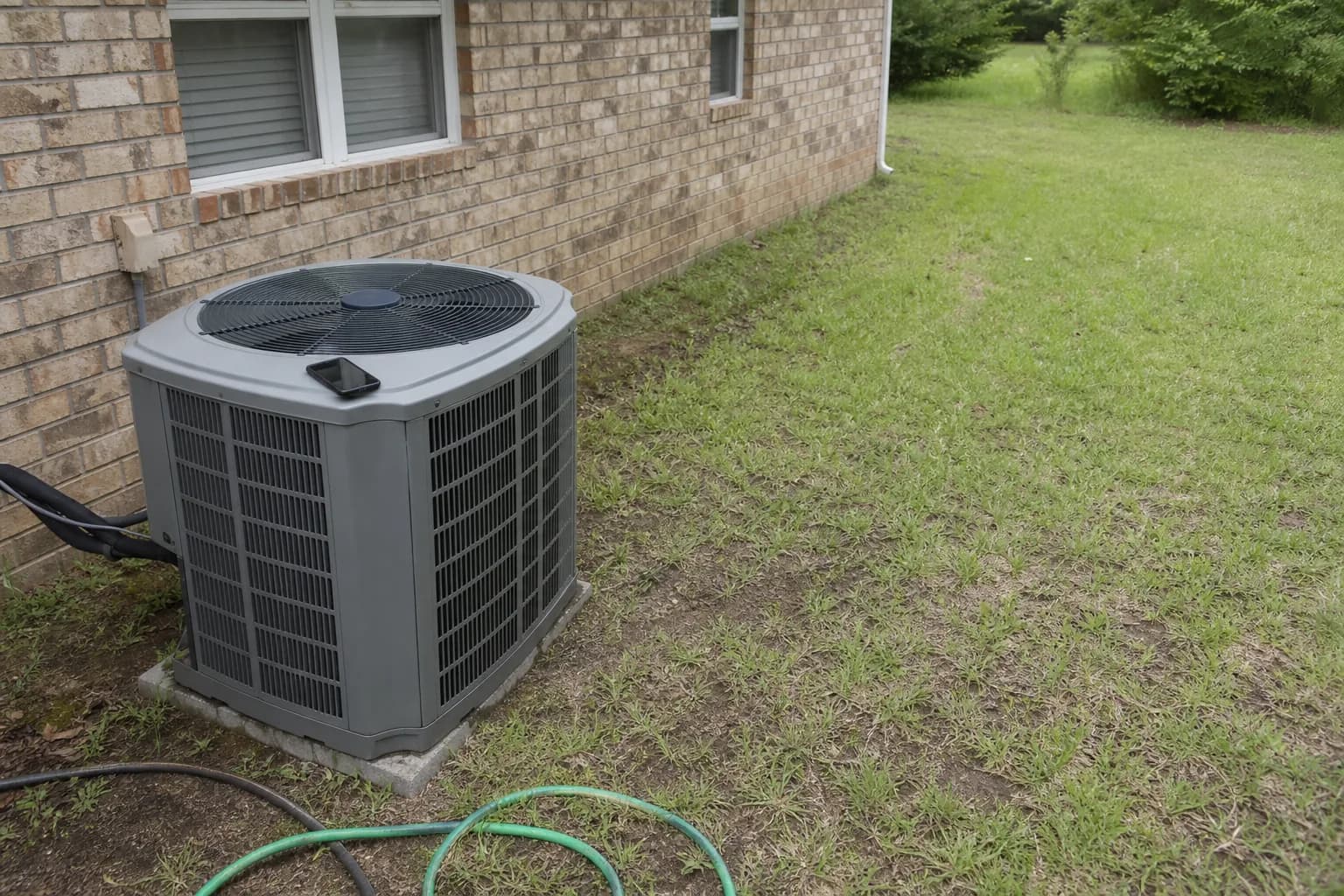
Outdoor disconnect. The first thing I check, every time, is whether the outdoor disconnect mounted to the wall next to the condenser is held on with all four of its original mounting screws. Loose disconnects are remarkably common. The fix is five minutes and four screws — but the consequence of skipping it is meaningful: a disconnect ripped off the wall during the storm exposes wiring to rain and creates a real shock hazard for whoever shows up to assess damage afterward.
Pad and clearance around the condenser. Walk around the outdoor unit. Pine straw packed against the rear coil, eroded soil at the back of the pad, an overhanging branch from the property line — all worth fixing before the storm. A hot rear coil during peak load is the difference between an emergency call and a normal August.
Yard perimeter. Anything light enough to fly in 65-mph wind needs to come into the garage. Lawn chairs, kids' bikes, terra-cotta planters, grills, gas cans, hanging plants. The hardest-hit category I see post-storm is lightweight planters: terra cotta breaks, plastic ones launch.
Main electrical panel. This is the single most-overlooked prep item. Most homeowners can find the main breaker. Far fewer can identify the specific HVAC breakers — outdoor disconnect, indoor air handler — under storm pressure, in the dark, with rain coming down. Label them with masking tape and a marker. Ten minutes of work. Pays back every storm.
Surge protection. Look for a surge protector at the main panel and at the HVAC disconnect. If there isn't one, note it for a post-storm install — not something to retrofit in the 24 hours before landfall. Modern variable-speed equipment exposed to whatever the grid does during restoration is the single biggest avoidable storm-related HVAC failure mode.
Indoor air handler. While you're inside, check the filter and look at the drain pan. An overdue filter heading into a storm and a long outage is asking for trouble — the pre-storm power-down means six to twelve hours of stagnation, and a borderline drain pan can become a real biofilm problem during a power outage.
The shutdown drill. Walk through the sequence with whoever else is in the house: thermostat off, outdoor disconnect pulled, air handler breaker off at the panel. Have them do it once on their own from memory. If somebody other than you needs to power down because you're not home, this is the moment that matters.
What shows up most often
If I had to rank what shows up on Summerdale pre-storm walks by frequency, the order is roughly:
- Yard debris that needs to come in
- Air handler breaker not identified in the panel
- Filter overdue
- No surge protection installed anywhere
- Loose outdoor disconnect mounting screws
- Vegetation grown into the condenser airflow
- Drain pan biofilm starting to form
- Equipment over 12 years old with no documented service history
Every one of those is fixable in less than 15 minutes, and the cumulative effect on storm outcomes is real.
The before-during-after sequence
For a typical Summerdale home, here's the procedure:
48 hours out. Walk the perimeter. Anything light enough to fly goes in the garage. Trim back vegetation around the condenser if you can do it safely.
24 hours out. Locate every breaker that controls the HVAC system. Label them. Walk through the shutdown sequence with whoever else is in the house so somebody else can do it if you're not home.
6 hours before peak. Thermostat off. Outdoor disconnect pulled. Air handler breaker off at the panel. Don't skip this — it's the single most valuable prep step.
During the storm. Leave it off. Don't second-guess if power flickers come back.
After the storm. Wait 6 to 12 hours of stable utility power before restarting. Walk the outdoor unit. If anything looks off, leave it off and call us.
What's different about Summerdale specifically
A couple of factors that shape the prep here:
Baldwin EMC feeder topology. Summerdale sits on radial feeder lines that originate from substations to the east and south. After named storms, restoration in rural feeders often takes longer than in Daphne or Spanish Fort because the high-density-population feeder priority comes first. Plan accordingly — a longer outage means more reclose cycles and more cumulative voltage stress on plugged-in equipment.
Mobile and manufactured housing. A meaningful share of Summerdale's housing is mobile or manufactured. Package units on those homes have different storm-prep considerations: tie-down inspection, skirting integrity check, and electrical service weatherhead inspection are all worth ten minutes ahead of the storm.
Single-stage equipment dominance. Most Summerdale homes run single-stage equipment. That's actually a small advantage during storm restart — single-stage compressors are more tolerant of dirty grid voltage than variable-speed equipment is. The trade-off is they're more expensive to operate during normal cooling season. If you're running a 12-plus-year-old single-stage system, the question of when to upgrade to variable-speed is partly a storm-resilience question.
The bottom line
Pre-storm walkthroughs are not glamorous work. They're a slow tour of someone's house pointing out unscrewed disconnects and unidentified breakers. But the cumulative effect on what fails after the storm passes is real money.
If you want a walkthrough ahead of the next named storm, schedule it here or call 251-383-HVAC. ACExperts routes Summerdale regularly. Service fee is $79. The cluster reads worth a look: the Lillian hurricane prep mistakes post for the bay-front version, and the Spanish Fort early-catch case study for a similar walkthrough in a different market.
ACExperts is a one-truck shop — Landon Jahnke, AL #16117, 13 years of Baldwin County HVAC experience before founding the business in 2026.
FAQ
- How far inland does hurricane prep matter for HVAC equipment?
- All of Baldwin County, including Summerdale. The direct wind threat decreases as you move inland, but the electrical grid disruption follows storms 50 miles past landfall. Summerdale is roughly 12 miles from the Gulf and sees grid feeder issues on every named storm that crosses the coast. The HVAC concerns shift from wind-driven debris to power surge, recloser cycling, and extended outage damage. The prep procedure stays largely the same: power down before the storm, wait for stable utility power afterward, restart in sequence.
- Should I cover my outdoor unit during a hurricane?
- Generally no. A cover trapped against the unit during 70-mph wind becomes a sail and damages the cabinet, and after the storm a wet cover holds moisture against the equipment. The exception: a few specific manufacturer-supplied storm covers designed for the equipment, properly secured and removed within 24 hours of the storm passing. For most Summerdale homeowners the better play is a perimeter walk to remove flying debris and let the unit ride out the storm uncovered.
- How long should I wait after a storm before turning the AC back on?
- 6 to 12 hours minimum after stable utility power returns — meaning no flickers, no brownouts, lights running steady. During the first few hours of restoration the grid is still settling, reclosers are still cycling, and voltage chaos is at its peak. Turning the AC on during that window is when control boards die. After 6 to 12 hours of clean power, walk the outdoor unit, check for debris and damage, and restart in sequence: outdoor disconnect, indoor breaker, thermostat.
- Is whole-home surge protection worth installing in Summerdale?
- For most homes with HVAC under 12 years old, yes. A two-stage surge protector setup at the main panel and the HVAC disconnect protects against the everyday voltage chaos that follows storms — induced voltage from nearby strikes, switching transients during grid restoration, and sustained over-voltage events on partially restored feeders. A modern variable-speed control board can cost a thousand dollars or more in parts alone, and the math typically works out in Summerdale's grid environment.
Need this handled?
Straight to the service page for your town — pricing, local details and a form that reaches a technician.
More from Hurricane Prep
- How One Spanish Fort Homeowner Caught Hurricane Prep Trouble Early — A Conversation in Three Endings
- Orange Beach Hurricane Prep for Your HVAC: 9 Steps Before the Storm
- Should a Bay Minette Homeowner Cover the Outdoor Unit Before a Hurricane?
- Post-Hurricane Silverhill HVAC Restart: Don't Flip the Breaker Yet

ACExperts HVAC
We Take The Heat So You Don't Have To
Fast, honest heating and air service across Baldwin County. Speak with a technician and get on the schedule today.