
Post-Hurricane Silverhill HVAC Restart: Don't Flip the Breaker Yet
After a named storm hits central Baldwin County, the worst damage to Silverhill HVAC happens during restart. Here's the diagnostic walk-through I use.
Published 2025-09-12 · Updated 2025-09-12
Author: Landon Jahnke | ACExperts251
Reviewed by: Landon Jahnke · Owner · Alabama HVAC License AL #16117 · EPA 608 Certified
The morning after a named storm comes through Silverhill, the ground is wet, the porch furniture is on the lawn, the power's been off eighteen hours, and the lights just flickered back on for the third time since 4 a.m. The kitchen clock is blinking. The fridge hummed back to life and then dropped out again. Somewhere in your house the thermostat is calling for cool and the question on your mind is whether to flip the breaker and let the AC run.
Don't. Not yet. The next two or three hours are the most expensive window in the entire storm cycle. Over 13 years working Baldwin County HVAC, most of the post-hurricane damage I've seen in central Baldwin happens right here — not during the storm, but during the restart that follows it.
This is the diagnostic walk-through I use when a Silverhill homeowner calls me on a morning like that one. You can do most of it yourself before you ever pick up the phone, and the parts you can't do, I'd rather you not attempt anyway.
Why Silverhill's restart math is different than the beach
The coast gets the wind. Silverhill gets the grid problem.
We sit roughly twenty miles inland, in the central Baldwin agricultural belt that the Swedish and Czech families settled in 1897 and that still feels close to that quiet today. By the time a Cat-2 hurricane making landfall at Gulf Shores reaches Silverhill, the sustained winds have dropped meaningfully and the worst of the rain has tracked east toward Foley and Robertsdale. We don't typically see roof loss, salt-spray contamination of condenser coils, or wind-driven rain forced into duct boots the way Orange Beach and Gulf Shores homes do.
What we do see is a longer power outage and a messier recovery. Most of Silverhill is on Baldwin EMC, not Alabama Power, and Baldwin EMC's restoration pattern in agricultural areas runs differently from the coastal feeders. Crews work the trunk lines first, then branch out across pasture and pine. A typical Silverhill outage following a named storm can run anywhere from many hours to multiple days, with several flicker events during the recovery as feeders come back online and substations switch capacity around. Every one of those flickers asks your compressor to start against a refrigerant charge that hasn't equalized, and every one of those starts pulls a locked-rotor amperage spike that stresses the contactor, the run capacitor, and the compressor windings themselves.
Cumulatively, those flickers do more compressor damage than the storm itself.
The first walk: outside, before any breakers
Before you touch anything electrical, walk the outdoor unit. Bring a flashlight even if it's daylight; you're looking into shadowed corners.
Stand back from the condenser first. Is it where you left it? Concrete pads in central Baldwin sit on sandy clay loam that softens dramatically when saturated, and a condenser can settle, tilt, or shift several inches off pad if water pooled around the base. A tilted condenser still runs, but it stresses the compressor mounts and the line-set flares. If it's tilted more than a finger-width off level, leave the breaker off and call.
Look at the fan blade through the top grille. Branches, palmetto fronds, asphalt shingle pieces, anything ferrous — those all need to come out before the fan spins. The fan motor doesn't care; it'll try to spin against any of those and either jam or shred the obstruction.
Open the electrical service compartment cover. (This is the panel on the side of the outdoor unit, usually held by one or two screws.) You're looking for standing water inside the compartment, debris, or evidence that water was in there and has since drained out — leaf staining, mud lines, corrosion bloom on copper. If the compartment is wet or shows recent water-line evidence, do not energize the unit. Wet contactors arc on closure and can weld themselves shut, and a welded contactor sends continuous power to a compressor that wasn't asked for it. That failure mode is one of the top causes of total compressor replacement after a storm event.
Last outside check: the line-set insulation. The black foam tubing wrapping the copper lines from the condenser to the house. Storm wind plus debris plus UV-degraded foam means it sometimes tears off in chunks during the storm. Missing insulation isn't an emergency, but it means your system runs less efficiently and the suction line will sweat heavily. Note it; we can replace insulation as part of the post-storm visit.
The second walk: inside
Open the air handler closet or the attic hatch and look at the indoor unit. In most Silverhill homes built before 1995 the air handler sits in the attic; in newer homes off Highway 104 or out toward Magnolia Springs Road it's more often in a closet or garage.
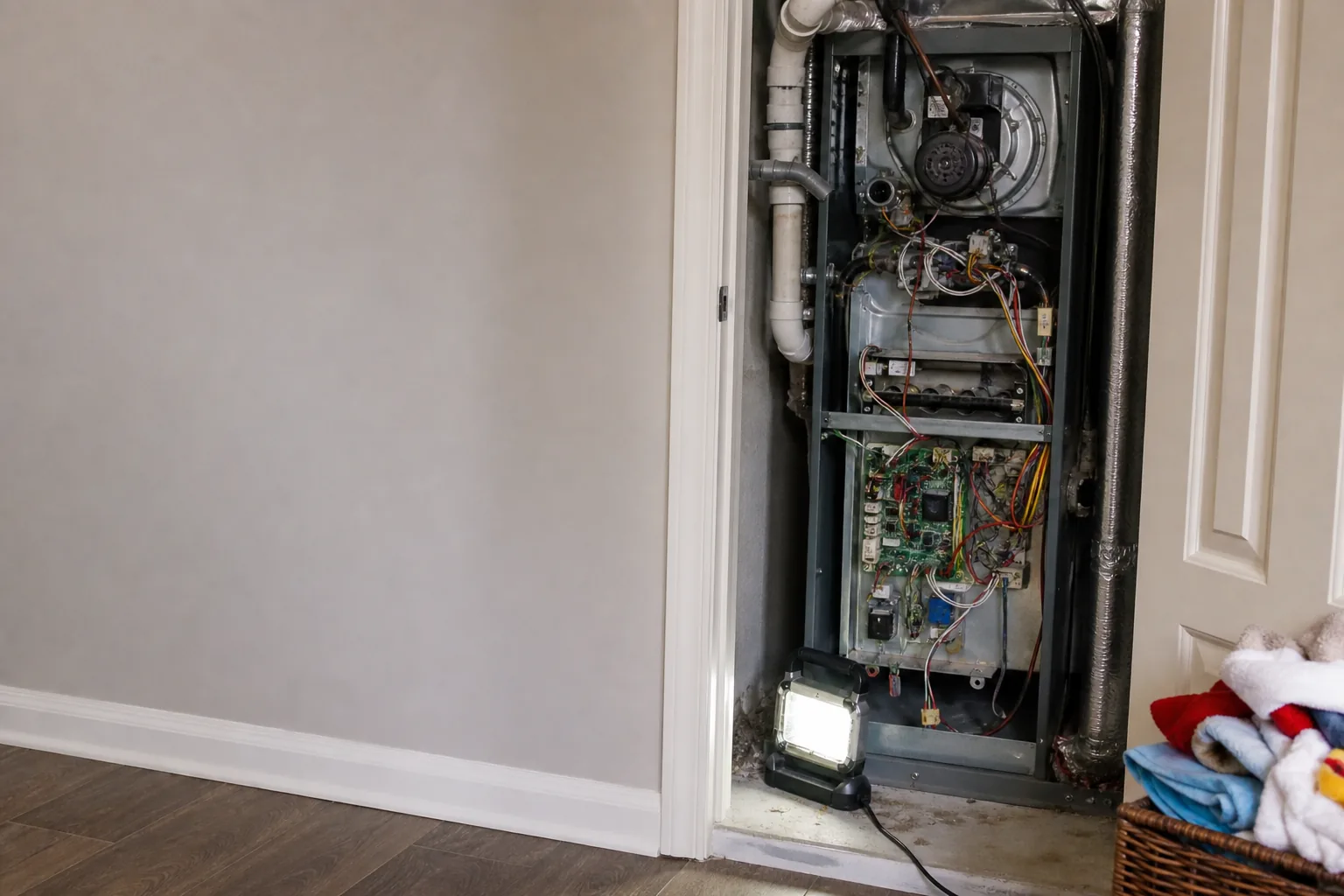
Check the condensate drain. After a power outage of more than twelve hours, the condensate pan on the indoor coil has had time to grow algae or develop a sludge layer. When you energize the system and the coil starts cooling again, the drain line may not flow freely and the safety float switch will shut the system down — which is the safety doing its job, but it presents to the homeowner as "the AC won't run." If you have a wet/dry vac, pulling the secondary drain line for thirty seconds usually clears it.
Look at the air handler's electrical compartment. Same drill as outside: water, debris, corrosion. Less common indoors but it happens after roof leaks during named storms. Spanish moss and pine straw end up in attics through any small soffit gap a storm widens.
Check the thermostat. If it's battery-backed it's still showing a display; if it's hardwired with no battery backup it'll be blank until power's restored. If the display is on and showing strange temperatures, error codes, or won't respond to button presses, the low-voltage transformer or the thermostat itself may have taken a lightning hit. Don't try to "reset" it by flipping breakers — that's how you find out the hard way.
When you're ready to restart
If the outdoor unit is dry, level, debris-free, and the indoor unit looks normal: wait. Specifically, wait six hours after stable power has been continuous — not flickering, not dropping out. Phone the neighbors if you have to; if anyone within a quarter-mile is still seeing flickers, you are too.
When you do restart, do it in this order:
The outdoor disconnect (the small box mounted on the wall next to the condenser) goes first. Flip it to ON. Listen for thirty seconds. You should hear nothing — the outdoor unit shouldn't run on its own without a thermostat call.
Then the indoor air handler breaker at the panel. Wait another minute.
Then set the thermostat. Don't ask it to drop to 72°F immediately. Set it eight to ten degrees above whatever the room currently reads, let it ramp up to temperature on its own gradually over two to four hours. A hard dive from 84°F to 72°F right out of the gate is exactly the situation that smokes a contactor that's already been stressed by the storm.
Watch and listen during the first cycle. The outdoor fan should spin smoothly. The compressor should start with a single firm hum and then settle into steady operation. You shouldn't hear repeated clicking, grinding, or a sustained loud hum without the fan turning. If you hear any of those, kill the breaker and call.
Symptoms that mean stop and call
If after restart you see any of these, shut the system down at the breaker:
The outdoor compressor hums loudly but the fan blade doesn't spin. That's almost always a failed run capacitor — one of the most common post-storm part failures, and continued operation will burn out the compressor windings within an hour.
The system short-cycles on and off every thirty seconds. That's a failed contactor, a thermostat low-voltage problem, or a refrigerant pressure issue from a damaged line set. None of them get better by leaving the system running.
You get cool air for five to ten minutes, then warm air. That's almost always refrigerant charge — either a slow leak that opened during the storm or a flooded compressor that's not pumping. Either way it needs gauges on it.
You smell anything electrical or see any visible smoke from the outdoor unit. Stop. Don't restart. Call.
The breaker trips repeatedly. One trip can be a transient. Two is suspicious. Three means something is drawing fault current and you're going to start a fire if you keep resetting it.
For any of those, that's our emergency HVAC service — call 251-383-HVAC. We answer emergency calls around the clock, every day of the week, including Saturdays at no extra charge, and after named-storm events we route Silverhill calls ahead of further-out work because we're based here.
What gets fixed and what to expect
When we get on site, the diagnostic itself usually tells us most of what we need to know in twenty to thirty minutes. We carry common parts on the truck — capacitors, contactors, frequently-needed control boards — so single-component repairs often happen on the same call without a return trip. Parts we don't carry on truck — full compressors, specific OEM control boards for older units — we order and stage; turnaround is usually a few business days.
The pattern after every named storm is the same: the calls within forty-eight hours of restart are mostly capacitors and contactors — modest repairs. The calls a week or two later are compressors that survived the storm, started up wrong, ran damaged for days, and finally seized — major repairs or replacements that didn't have to happen.
Surge protection at the outdoor disconnect is the upgrade I recommend after every named-storm event. It's the single most cost-effective post-storm change a Silverhill homeowner can make.
Why this matters more in central Baldwin than people realize
Silverhill homes lean older. The housing stock around Elizabeth Gardens, Hoiles Heights, Camellia Woods, and the streets immediately around the People's Supply Store includes a meaningful share of homes built between 1940 and 1980, with HVAC equipment that's already aged into the back half of its expected service life. A storm-stressed contactor in a unit that's twelve years old has very different replacement economics than the same failure in a four-year-old system. That's the conversation we walk through on the first post-storm visit — what got hit, what's recoverable, and whether the spend makes sense given what you've already got out there.
Your job after a storm isn't to get the AC running fast. It's to get it running right. The rest is patience, a flashlight, and a phone call before you flip the breaker.
FAQ
- I'm in Silverhill and Baldwin EMC just restored power. Can I turn the AC back on?
- Not yet. Wait at least 6 hours after stable power returns. Baldwin EMC's recovery pattern in central Baldwin involves multiple feeder switchovers and you'll see flickers for several hours after the lights come back. Each flicker stresses the compressor. Walk the outdoor unit, look for water in the electrical compartment, then bring it up one breaker at a time — outdoor disconnect first.
- My condenser was sitting in standing water after the storm. Is the unit a total loss?
- Probably not, but don't power it on. Standing water above the service valves usually means the contactor, capacitor, and low-voltage wiring are compromised. We dry the electrical compartment, replace the affected components, megger-test the compressor windings, and reseal connections. A condenser that you energized while still wet is the worst-case scenario — that's how a recoverable problem turns into a full replacement.
- Does Silverhill see less hurricane damage than the beach cities?
- Less wind damage, yes — Silverhill is roughly 20 miles inland and storms have weakened by the time they reach central Baldwin. But the power-grid impact is often worse. Baldwin EMC restoration in agricultural areas takes longer than Alabama Power coastal restoration, and the long outage windows plus repeated brownouts during recovery do more cumulative damage to HVAC equipment than a single 100 mph gust would.
- How fast can you respond after a named storm in Silverhill?
- ACExperts is headquartered in Silverhill — Landon lives at 22048 Cesta Way. After named-storm events we route Silverhill, Robertsdale, and Loxley calls first because they're our nearest service area. Comfort Plan members get prioritized scheduling. Call 251-383-HVAC and we'll triage by severity.
Need this handled?
Straight to the service page for your town — pricing, local details and a form that reaches a technician.
More from Hurricane Prep

ACExperts HVAC
We Take The Heat So You Don't Have To
Fast, honest heating and air service across Baldwin County. Speak with a technician and get on the schedule today.