
5 Father's Day Garage Mistakes Bay Minette Homeowners Keep Making
9 AM tools out, 8 PM cold beer and a humming garage AC — that's the perfect Bay Minette Father's Day mini-split. Here are the 5 mistakes that turn it into an expensive do-over.
Published 2026-06-17 · Updated 2026-06-17
Author: Landon Jahnke | ACExperts251
Reviewed by: Landon Jahnke · Owner · Alabama HVAC License AL #16117 · EPA 608 Certified
9 AM: tools out, mini-split unboxed, the drywall pencil-marked at the bracket location.
11 AM: line set decision, 3/8 versus 1/2, made and the conduit drilled.
2 PM: vacuum pull begun.
4 PM: charge release, gauges reading clean.
6 PM: first run, indoor coil pulling 22 degrees of differential.
8 PM: cold beer, garage AC humming, project shelf already feeling 20 degrees cooler than the kitchen.
That's the perfect Bay Minette Father's Day mini-split day. Eleven hours, one helper, a homeowner-purchased unit installed for a fraction of what a full-service install would cost, and a workshop that goes from 110F dead zone to 76F functional space.
Here are the five mistakes that turn it into an expensive do-over instead — and where in that timeline each one happens.
Mistake #1: Bracket location, locked in by 9:15 AM
The 9 AM step is laying out the indoor cassette location. This is the moment where most mistakes get baked in for the rest of the day, and where the rest of the install can't undo what gets decided.
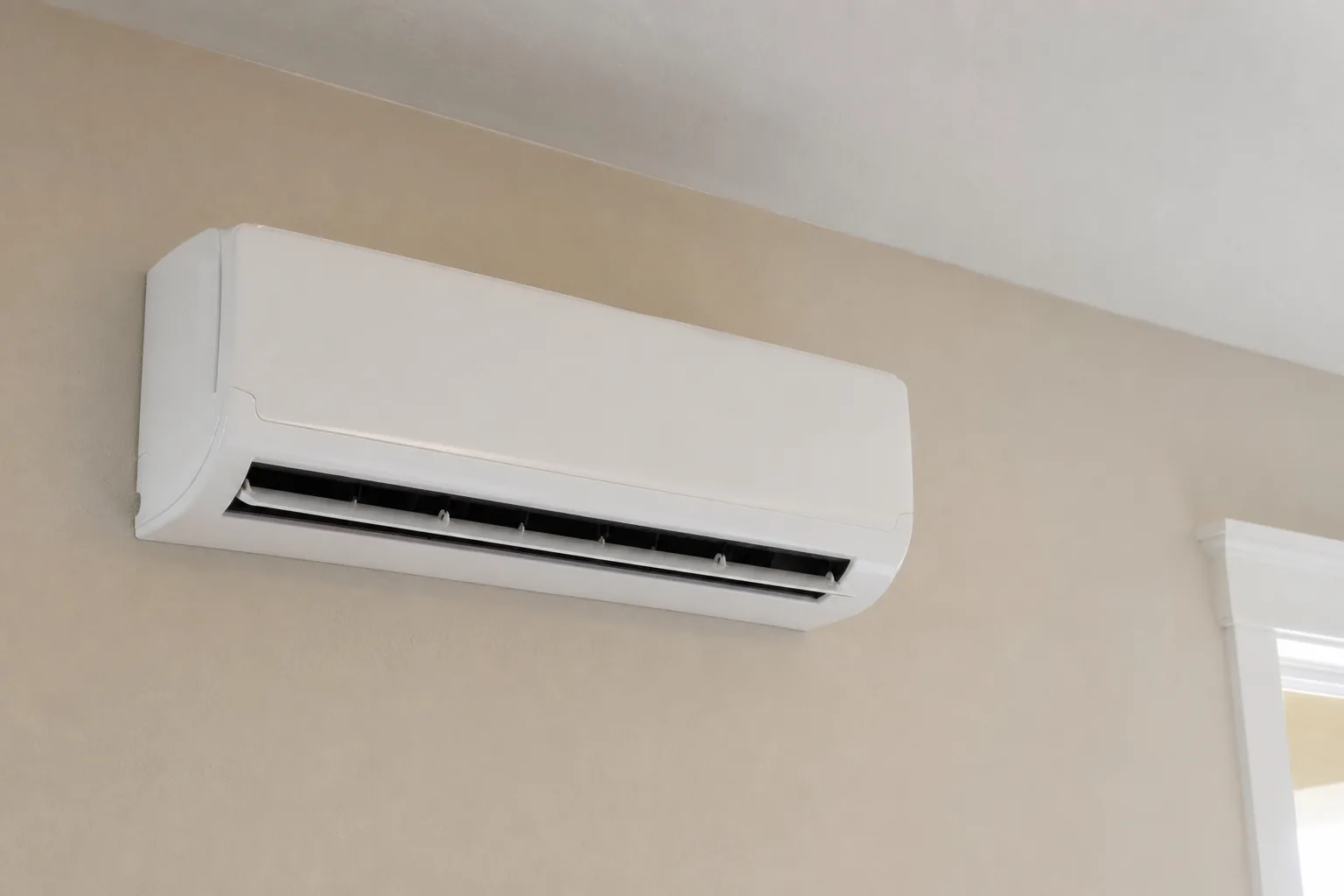
The mistake: mounting the indoor cassette where it looks good rather than where it works. In a Bay Minette garage, "looks good" is usually centered on a wall, eight feet up, opposite the garage door. "Works" is dictated by airflow physics and the location of the outdoor unit.
What actually matters for cassette placement:
A clear thermal path through the longest dimension of the room. The cassette throws conditioned air in a defined cone, typically 12-18 feet of effective reach. Mounting it on a short wall blowing toward the long wall is correct. Mounting it on the long wall blowing across the short dimension wastes capacity and creates dead spots.
Distance from the garage door. The garage door is the leakiest part of any garage envelope. Mounting the cassette directly above or near the garage door means you're conditioning the air that's about to leak out and pulling in the worst of the outside air every time someone enters. Move the cassette to the opposite wall.
Stud location. Cassettes are heavy enough that anchoring to drywall alone is not acceptable. The bracket must hit at least one stud, ideally two. Pencil-mark the studs before you commit to the cassette location, not after.
Line set distance to the outdoor unit. Most pre-charged mini-splits ship with a 15-25 foot line set length. If your indoor cassette is 35 feet of line set away from where the outdoor unit needs to sit, you're either ordering an extension kit or moving one of the units. Plan the routing before you drill.
In Bay Minette specifically — older retrofit garages with framed-out concrete walls or block walls behind drywall — the stud-finding can be deceptive. Magnetic stud finders read the cement nails in older block construction and tell you "stud" where there isn't one. Use a long bit and an exploratory hole hidden behind the bracket footprint to confirm before you commit. Over 13 years working Baldwin County HVAC I've seen multiple do-overs where a homeowner mounted the cassette to drywall over block, the bracket pulled out under load weeks later, and the cassette swung free.
Mistake #2: Line set sizing, decided by 11 AM
The 11 AM step is choosing line set diameter and routing. The factory line set that ships with a 12,000 BTU unit is typically 1/4 inch liquid line and 3/8 inch suction line. The factory line set that ships with an 18,000-24,000 BTU unit is 1/4 inch liquid and 1/2 inch suction. A few units use 5/8 inch suction at the larger end.
The mistake: using the wrong line set diameter for the BTU rating. This happens when a homeowner buys a generic line set kit at the hardware store rather than the manufacturer-matched kit, or when they reuse line set from a previous install on a different-size unit.
Why it matters: refrigerant flow depends on line set diameter matching the compressor's design. An undersized suction line causes pressure drop, reduces capacity, and overworks the compressor. An oversized line slows refrigerant velocity, prevents oil return to the compressor, and causes the compressor to fail prematurely from oil starvation. Neither is recoverable with a charge adjustment. Both require replacing the line set.
The right answer: use the line set that came with the equipment, or use a manufacturer-spec replacement of the same diameter. If you bought a 24,000 BTU unit and it shipped with a 25-foot line set but you need 35 feet to reach your outdoor unit location, order the manufacturer extension kit. Don't mix and match.
Mistake #3: Vacuum pull tools, learned at 2 PM
The 2 PM step is where DIY mini-split installs in Bay Minette quietly fall apart. The vacuum pull is the moment between making the flare connections and releasing the refrigerant from the outdoor unit. It's where you remove the air and moisture that are inevitably trapped in the line set after a manual connection.
The mistake: using a homeowner-grade vacuum pump and a needle vacuum gauge.
A residential refrigerant line set must be evacuated to 500 microns or below, then held at that pressure for 10 minutes with the pump off. That's the spec for a system that runs reliably for 15 years.
A typical $80 vacuum pump from a big-box store achieves 1500-2500 microns at best. The needle gauges in homeowner manifolds don't read below 1000 microns at all. So a homeowner runs the pump for 30 minutes, the needle pegs at "vacuum," and they think they're done. They aren't. There's still moisture in the lines. That moisture freezes at the metering device, blocks refrigerant flow, and acidifies the lubricating oil. The system runs fine for the first month, marginal in month three, and dies in year two.
The right tools: a two-stage rotary vane pump rated to at least 75 microns ultimate, and a digital micron gauge calibrated to read 0-1000 microns. Together that's several hundred dollars of equipment used for one job. The math doesn't work for a one-time DIY install.
The clean handoff option: do the mounting work yourself, stop at the flare connections, and call us for the refrigerant commissioning step. We arrive with a vacuum pump that pulls to 500 microns, a digital gauge, a torque wrench calibrated for flares, and refrigerant for charge top-off. Written quote before we start, warranty registration included, $79 service fee and free second opinions on any other quotes you've received. The Gulf Shores Father's Day mini-split tutorial walks through this handoff in more detail.
Mistake #4: Outdoor unit placement, locked in by 4 PM
By the time you're releasing refrigerant at 4 PM, the outdoor unit is already where it's going to live. If the placement is wrong, undoing it is a project for another weekend.
The Bay Minette-specific mistake: putting the outdoor unit on a concrete pad in direct afternoon sun, with no airflow clearance, against the wall of the garage.
Three problems with that:
Direct afternoon sun reduces capacity. A condenser working in 95F ambient air rejects heat fine. The same condenser with the cabinet sitting in 130F radiant sun and surrounded by hot concrete works against itself. Capacity drops 8-15% in the worst hours of the day, which is exactly when you need it most. The right answer is a north-facing location, an east-facing location with shade, or a shaded area on any side. If those aren't available, a simple shade screen offset from the unit by 18+ inches helps meaningfully.
Inadequate airflow clearance starves the unit. Manufacturer specs require minimum clearance — typically 12 inches from the back, 24 inches from the side that faces walls or fences, and 60 inches above the unit clear of overhangs. Pushing the unit tight against the garage wall to "save space" reduces airflow through the coil, raises operating pressures, and shortens compressor life.
Cement pad on settling soil tilts. Bay Minette soil is mostly clay loam, which expands wet and contracts dry. A condenser pad sitting directly on undisturbed soil tilts within a year, sometimes within months. The right base is a 24-36 inch square pre-cast concrete pad on a leveled bed of compacted gravel, or a wall-mount bracket attached to the structure. Avoid asphalt — it deforms in summer heat and lets the pad sink unevenly.
The other Bay Minette consideration: north Baldwin County has more pine and oak canopy than the bay cities, which means more falling debris on outdoor units. Position so the coil is not directly under a heavy branch, and clean the cabinet top monthly during pollen season. The general why coastal AC units fail faster post is corrosion-focused, but the airflow and debris principles apply inland too.
Mistake #5: Skipping the commissioning, found at 6 PM
The 6 PM step in the perfect day is the first run. The system fires up, the indoor cassette pulls cold air, the homeowner feels it, declares victory, and starts on the cold beer.
The mistake: declaring victory without commissioning.
Commissioning is the 30-minute step where you verify the system is operating to manufacturer spec. Specifically:
Temperature differential at supply versus return. A properly running mini-split in Bay Minette summer conditions should pull 18-22F of differential at the indoor cassette. Less than 16F means a refrigerant problem (charge, leak, restriction, or moisture in lines). More than 25F can mean low airflow over the indoor coil.
Outdoor coil temperature versus ambient. The outdoor coil should run 15-20F above ambient outdoor temperature when the system is in cooling mode at full capacity. Higher than that means the coil is fouled, the fan is undersized, or the refrigerant is overcharged.
Compressor amp draw versus rated load amps. Every compressor has a nameplate rated load amp (RLA) value. Running amp draw should be roughly 70-90% of RLA at standard conditions. Higher than RLA means an overload — overcharge, restriction, or impending compressor failure.
Indoor electrical connections checked under load. Loose connections at the disconnect box or the indoor terminal block heat up under load. A torque wrench on every electrical connection during commissioning takes 10 minutes and prevents a fire risk that develops six months later.
A homeowner without an amp clamp, a manifold gauge, and a temperature probe can't verify any of this. They feel cold air, conclude the install worked, and find out 18 months later that the install was undercharged or overcharged or had a partial leak. By then the warranty registration window has expired and the diagnostic costs more than the original handoff visit would have cost.
The handoff option here is the same: have us come finish the commissioning step. Written documentation, warranty registration. The mini-split installation service page covers the full menu, and the ductless mini-split guide for Alabama homeowners covers the equipment selection conversation that happens before any of this.
The cluster context
This post is part of the Father's Day cluster. The Gulf Shores tutorial covers the camera-by-camera install walkthrough for coastal homes; the Orange Beach early-catch story tells the story of one homeowner who avoided this whole list by planning ahead.
The Bay Minette gas vs heat pump post covers the related decision of whether to choose a heat pump mini-split or a gas heater for the same garage application — the heat pump answer almost always wins in Climate Zone 2A but the math is worth seeing.
The version where it goes right
Here's the punchline. The five mistakes above all happen between 9 AM and 6 PM on Father's Day. The single decision that prevents all five is made on Saturday — the day before — when the homeowner calls us at 251-383-HVAC and books the handoff visit for Sunday afternoon.
The Sunday timeline then looks different:
9 AM: tools out, equipment unboxed, drywall pencil-marked. 11 AM: cassette mounted, line set conduit drilled, line set routed. 1 PM: lunch. 2 PM: ACExperts truck pulls into the driveway. I arrive with the vacuum pump, the gauges, the torque wrench, and the warranty paperwork. 4 PM: vacuum pulled to 380 microns, held clean. Refrigerant released. Electrical commissioned. 5 PM: first run, 22F differential, the homeowner sitting in the garage watching the gauges with me. 6 PM: I leave with a signed warranty registration and a photo of the manifold readings for the file. 7 PM: cold beer, garage at 76F, project bench cleared off, summer ahead.
The DIY work the homeowner did saves real money. The licensed work he didn't do is what makes the system reliable for 15 years.
Call us before Father's Day, not after. 251-383-HVAC.
FAQ
- Do Bay Minette garages actually need mini-splits, or is this a coastal-only thing?
- Bay Minette garages need mini-splits more than coastal garages, not less. Bay Minette is 25 miles inland with no bay-breeze moderation, which means summer afternoon temperatures inside an attached garage can hit 105-115F by 4 PM. That's the workshop temperature where projects stop, hand tools stop being usable, and stored items in the garage degrade. A 12,000-18,000 BTU mini-split brings that down to a workable 75-78F for a modest amount of summer electricity. The economics are stronger inland because the temperature delta is bigger.
- What size mini-split for a typical Bay Minette two-car garage?
- Most attached two-car garages in Bay Minette (440-500 sq ft) need 12,000-15,000 BTU. Detached garages or workshops with limited insulation often need 18,000-24,000 BTU because the load is higher. The sizing depends on insulation level, ceiling height, west-facing wall exposure, and whether the garage is used for heat-generating work like welding. A real load calculation takes 20 minutes and prevents the mistake of buying a 9,000 BTU because that's what the big-box store had in stock.
- Can I install a mini-split in a Bay Minette garage that doesn't have its own electrical panel?
- Yes, but it needs a dedicated 240V circuit pulled from the main house panel, properly sized to the equipment (typically 20-30 amps depending on BTU rating). If the panel doesn't have spare capacity, you may need a panel upgrade before the install, which adds to the total project cost. A licensed electrician should size and pull the circuit; ACExperts coordinates with electrical contractors when a combined visit is needed.
- Will a mini-split in my Bay Minette garage handle winter heat too?
- Yes. Modern mini-splits are heat pumps that handle both cooling and heating, and Climate Zone 2A (which covers Bay Minette) is rated favorable for heat pump heating year-round. Most variable-speed inverter units maintain rated heating capacity down to about 17F outdoor, which is well below the typical Bay Minette winter low. Your garage will run 65-70F on a 30F January morning for a modest amount of heating electricity.
Need this handled?
Straight to the service page for your town — pricing, local details and a form that reaches a technician.
More from Fathers Day

ACExperts HVAC
We Take The Heat So You Don't Have To
Fast, honest heating and air service across Baldwin County. Speak with a technician and get on the schedule today.