
Why a Stapleton 2-Stage System Hates a Cheap Thermostat
If a Stapleton homeowner could ask one diagnostic question on a service call, this is it: is my thermostat compatible with my system's staging? Here's why it matters.
Published 2026-11-06 · Updated 2026-11-06
Author: Landon Jahnke | ACExperts251
Reviewed by: Landon Jahnke · Owner · Alabama HVAC License AL #16117 · EPA 608 Certified
If a Stapleton homeowner could only ask their HVAC tech ONE question on a service call, the right one is: "Is my thermostat compatible with the staging on my system?" Most homeowners ask "how much will it cost?" or "is the compressor still good?" Both fair. But over 13 years working Baldwin County HVAC, the staging-compatibility question — answered honestly — would have headed off a meaningful share of the Stapleton comfort complaints I've worked. Here's why two-stage systems hate cheap thermostats and what "cheap" even means in this context.
What 2-stage actually means and why Stapleton homes have it
Two-stage HVAC equipment runs at two operating capacities: roughly 65-70% capacity in first stage, full capacity in second stage. The control logic is supposed to start every call for cooling or heating in first stage, then escalate to second stage only when first stage can't keep up with the load.
The benefit, when it works: longer runtimes at lower capacity, which is exactly what you want for dehumidification in a humid climate like Baldwin County. The Stapleton summer humidity profile — 85-92% relative humidity for hours at a time — needs equipment that runs long and steady, not short cycles at full blast. Two-stage systems deliver that. Single-stage systems don't.
A meaningful share of mid-tier replacement equipment going into Stapleton homes in recent years has been 2-stage or variable-speed. Most of it is the upgrade scenario for homes that had a 1995-2010 single-stage system fail and the homeowner moved up one tier. The equipment is often Lennox 2-stage, Trane XR16, Carrier Performance 17, or comparable. All of these systems require a thermostat that supports staging logic — and that's where the trouble starts.
The cheap-thermostat problem
When we say "cheap thermostat" in this context, we're not talking about cosmetic price points. We're talking about staging compatibility. A $35 home-center thermostat with a basic LCD screen and 7-day programming may look fine and may even cycle the system reliably — but if it doesn't have separate Y1 and Y2 outputs (cooling) and W1 and W2 outputs (heating), it can't tell the equipment when to escalate stages.
What happens in practice: the cheap thermostat connects only to the Y1 (first stage) terminal. The compressor receives a first-stage call on every cooling cycle. It never gets the Y2 call because the thermostat isn't sending one. So the 2-stage compressor runs first stage only, forever. The system that the homeowner paid extra for because of its 2-stage capability is functioning as a single-stage system — and they don't know it.
The downstream symptoms are predictable: long runtimes that don't cool the home down on hot afternoons (because first stage alone can't meet peak load), high humidity in late evening (because the system doesn't have second-stage dehumidification), and higher utility bills (because the equipment is undersized in single-stage mode for the load it's actually trying to serve).
How to tell your Stapleton thermostat is the wrong one
Five tells that the thermostat isn't matched to a 2-stage system:
1. The system never reaches setpoint on hot Stapleton afternoons. A properly-staged 2-stage system handles peak load at 95°F outdoor temperature without breaking a sweat — it has the second-stage capacity in reserve. A 2-stage system stuck in first stage struggles or fails to keep up.
2. Indoor humidity stays above 60% RH during cooling season. Second-stage operation is what does the deep dehumidification work. Single-stage operation (which is what an incompatible thermostat is forcing) handles temperature but not the moisture removal that's critical for Stapleton's humid climate.
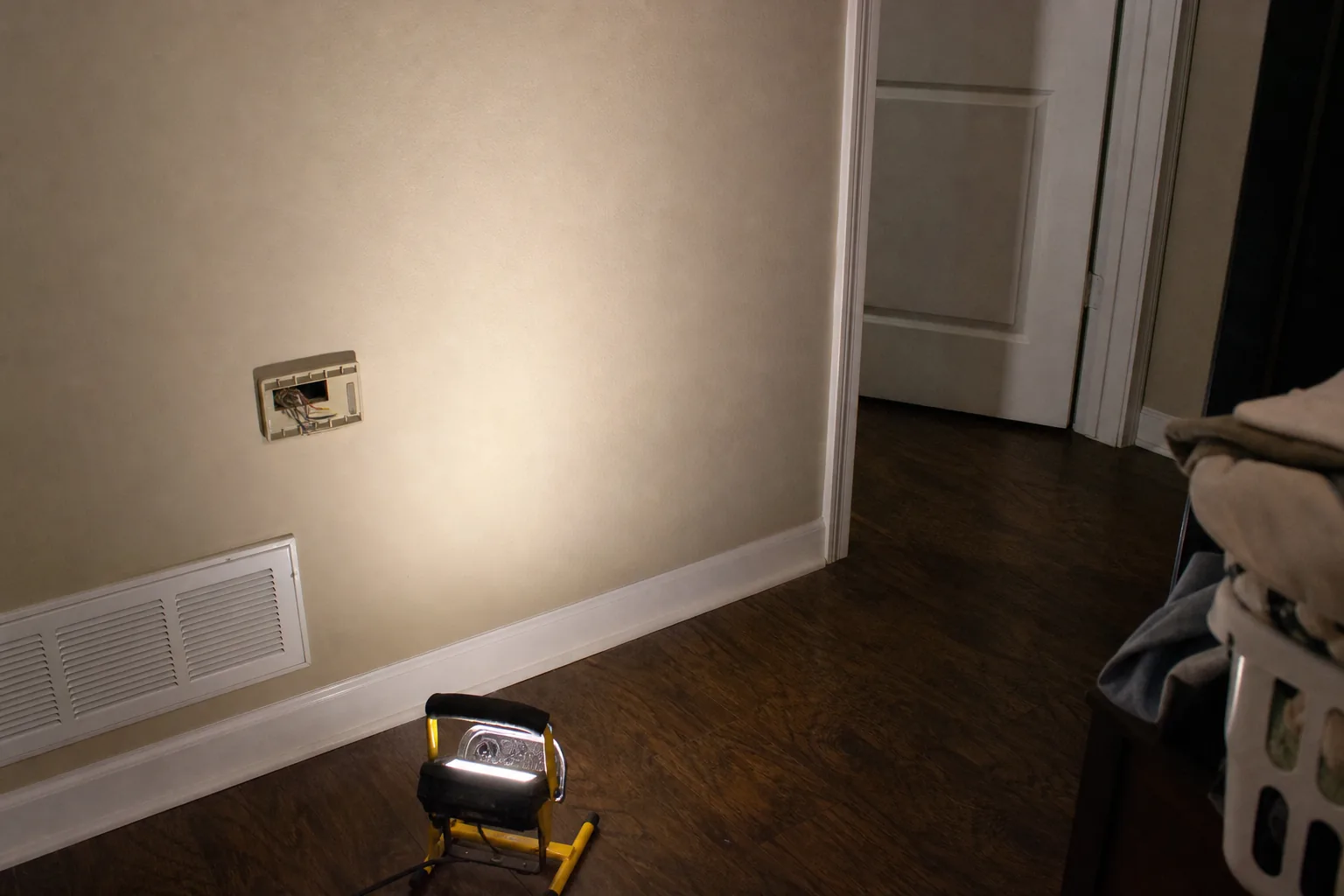
3. The thermostat has a single Y wire visible at the back. Pull the thermostat off the wall. If you see only one Y connection (no Y1 and Y2 distinction), the thermostat can't drive 2-stage operation regardless of what the equipment is capable of.
4. Outdoor temperatures don't seem to affect runtime patterns proportionally. In a properly-staged system, mild days run mostly first-stage (long, gentle cycles); hot days run more second-stage (longer cycles at higher capacity). If your Stapleton system runs the same way regardless of outdoor temperature — same cycle lengths, same airflow, same noise level — staging probably isn't engaging.
5. The original installer left the thermostat that came with the equipment and the homeowner replaced it later with a "smart" thermostat from the home center. This is the most common path to incompatibility. Original install includes a staging-compatible thermostat. Three years later, the homeowner replaces it with whatever the home center had on sale. New thermostat doesn't support staging. Compatibility is lost.
The Stapleton-specific reasons this matters more here
Three reasons why staging compatibility matters more in Stapleton than in coastal Baldwin County:
Reason 1: longer drive distance to service. Stapleton's rural location means a service call from our Silverhill base is a meaningful round trip. A homeowner who's been struggling with comfort issues for months has often racked up multiple service visits trying to chase the wrong problem. Diagnosing staging compatibility correctly on the first visit saves real money in repeat trips. The structural rural-service economics for Stapleton are described in Stapleton service area page and the broader north Baldwin context.
Reason 2: Stapleton homes have higher heating loads. With 8-12 nights below freezing per winter (vs. 3-7 for coastal cities), the heating-side staging matters. A 2-stage gas furnace or 2-stage heat pump that's stuck in first stage on a 25°F night may not maintain temperature setpoint in a Stapleton home with imperfect envelope characteristics. The companion city analysis on dual-fuel and staging in north Baldwin County is in Bay Minette gas vs heat pump.
Reason 3: manufactured-home concentration. About 18-22% of Stapleton's residential stock is manufactured housing. Manufactured homes often have higher relative cooling loads per square foot because of envelope characteristics — single-pane glass, modest insulation, and air leakage. Two-stage systems serve these loads better than single-stage systems but only if the staging actually engages.
What the right thermostat looks like
For a 2-stage Stapleton system, the thermostat needs four characteristics:
1. Multi-stage support — Y1, Y2, W1, W2 terminal capability. This is the headline. Without it, no staging, period.
2. Configurable stage timing. The control logic that determines how long first stage runs before escalating to second stage should be programmable, not hardcoded. Default timings (typically 10-20 minutes) work for some homes; Stapleton homes with high cooling loads may benefit from shorter first-stage timing (5-10 minutes) to bring second stage online faster on hot afternoons.
3. Adaptive recovery (smart recovery). This anticipates setpoint changes and starts ramping the system early enough to reach the new setpoint at the scheduled time without forcing aggressive runtime spikes. On a 2-stage system, adaptive recovery uses first-stage ramping rather than full-load second-stage to reach setpoint.
4. Outdoor temperature input (heat pump systems specifically). For dual-fuel hybrids common in Stapleton, the thermostat needs to know outdoor temperature to switch between heat pump and gas furnace at the programmed balance point. Without an outdoor sensor, balance-point switching doesn't work and the system runs whichever heating source is configured by default.
Three thermostats that meet these criteria for typical Stapleton systems: Honeywell T6 Pro Z-Wave (around $135 installed for the unit, $185-$245 with professional installation and configuration), Ecobee Premium (around $185-$235 installed), and Sensi Touch 2 (around $145-$195 installed). All three support 2-stage cooling and heating, configurable stage timing, and outdoor temperature input via wired sensor or wireless.
What a real Stapleton diagnostic visit looks like
The Stapleton service call where staging compatibility comes up usually unfolds the same way:
The homeowner calls about humidity issues, long runtimes, or high bills. The tech arrives, runs through the standard diagnostic flow — refrigerant pressures, temperatures, electrical, airflow, condensate. Everything looks normal. Compressor amperage is appropriate. Refrigerant charge is correct. Airflow at the registers is within design spec. The equipment isn't broken.
So the tech opens the thermostat. Maybe sees only Y1 wired. Maybe sees Y1 and Y2 both wired but the thermostat is a model that only supports single-stage logic. Maybe sees a configuration menu where staging is set to "off" by default. The fix is a thermostat replacement and configuration — a fraction of what the homeowner has been losing in utility bills and lost comfort over months or years. We quote it in writing before any work starts.
For more on this style of diagnostic discipline applied to other components, see capacitor or compressor: a Fairhope diagnostic walkthrough and why Silverhill outdoor fan motors die at the 7-year mark. Same logic — measure the system, identify the actual constraint, fix the actual issue.
The single-question version of this whole post
If a Stapleton homeowner is reading this with a 2-stage system installed and has been wondering whether their thermostat is right, the question to ask the next tech who comes out: "Pull the thermostat off the wall and tell me whether Y1 and Y2 are both wired and whether this thermostat model supports staging logic." A reputable tech answers in two minutes. The answer is either yes (system staging is operational) or no (you've been running a 2-stage system as a single-stage system).
If the answer is no, the fix is one visit, one thermostat, one configuration session. Within 24 hours of the swap, runtime patterns shift, humidity drops, and the equipment finally runs the way the manufacturer intended.
For broader context on AC repair pricing in Stapleton specifically, see Stapleton service page and the relevant context on system-level compatibility in AHRI matched systems in Silverhill: why it's not marketing fluff. Staging compatibility is the same underlying principle — equipment and controls have to be matched for either to perform as designed.
Stapleton homeowners with comfort or humidity issues that don't seem to make sense given the equipment installed: call 251-383-HVAC. The single-question diagnostic — is your thermostat compatible with your staging? — is part of every visit.
FAQ
- How do I know if my Stapleton home has a 2-stage system?
- Check the outdoor condenser nameplate for stage information — most 2-stage units list 'two-stage' or '2-stage compressor' in the model description. Inside, look at the air handler or furnace control board for terminal designations: a 2-stage system has Y1 and Y2 wires (cooling stages) or W1 and W2 wires (heating stages) running to the thermostat. A single-stage system only has Y or W. If the original installation paperwork is available, the AHRI matched certificate identifies staging. If not, our diagnostic call confirms staging configuration as part of the visit.
- What's the price difference between a compatible and an incompatible thermostat?
- A staging-compatible thermostat (Honeywell T6 Pro, Ecobee Premium, Sensi Touch 2) runs $135-$285 installed. A standard programmable thermostat that lacks staging support runs $65-$135 installed. The $70-$150 premium for the staging-compatible unit pays back through proper system operation: the 2-stage compressor actually staging instead of running first-stage only, the dehumidification performance the equipment was designed to deliver, and the longer compressor life that comes from softer staged starts vs. full-load on every cycle.
- Can I install a staging-compatible thermostat myself?
- Mechanically yes for most homeowners — wiring is typically R, C, Y1, Y2, W1, W2, G, plus heat pump O/B if applicable. The technical risk is configuration: stage timing, balance points (heat pump systems), heat lockout temperatures, and dehumidification setpoints all need to match the equipment specifications. A Stapleton homeowner installing a thermostat with default settings on a 2-stage system often gets a thermostat that's wired correctly but never engages second stage because the timing parameters are wrong. If you're not comfortable in the configuration menu, $185-$285 for a tech to install and configure is reasonable.
- Does a smart thermostat from the home center work on a 2-stage Stapleton system?
- Some do, some don't. Read the spec sheet before buying. The Ecobee Premium and Ecobee Smart Thermostat Enhanced support staging. The Honeywell T6 Pro and T9 support staging. The Nest 3rd Gen and 4th Gen support 2-stage cooling and heating but require correct wiring and configuration. Lower-tier units — the basic Honeywell programmables, the entry-level home center brands — often don't support staging or support only single-stage operation. The phrase to look for on the spec sheet: 'compatible with 2-stage cooling and heating systems' or 'multi-stage HVAC support.'
Need this handled?
Straight to the service page for your town — pricing, local details and a form that reaches a technician.
More from Thermostat Failure

ACExperts HVAC
We Take The Heat So You Don't Have To
Fast, honest heating and air service across Baldwin County. Speak with a technician and get on the schedule today.