
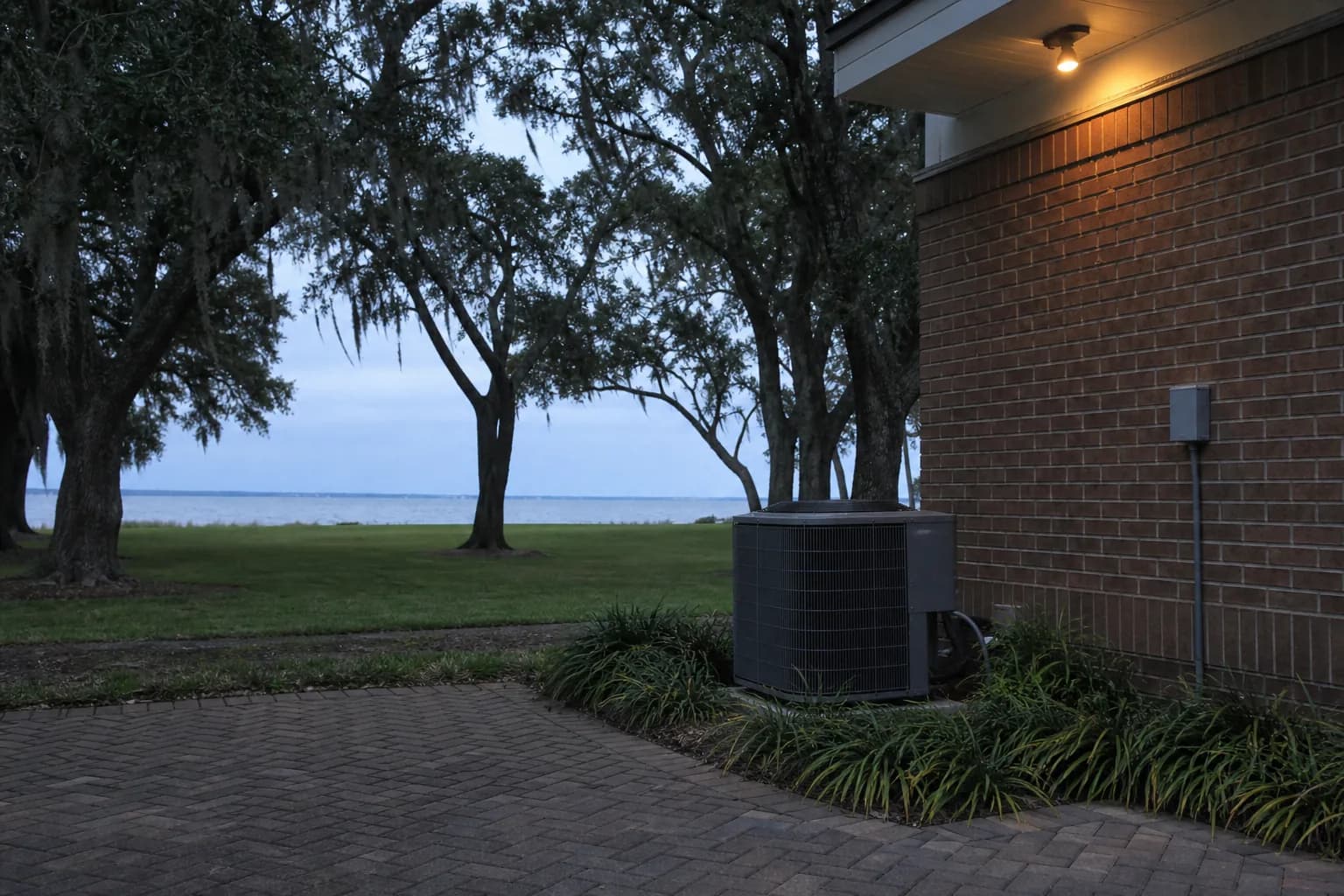
Breaker Trips After 20 Minutes — A Lillian Field Diagnosis
AC breaker trips after about 20 minutes in a Lillian home? Most techs guess refrigerant. The runtime pattern points elsewhere, and they are usually wrong.
Published 2026-10-29 · Updated 2026-10-29
Author: Landon Jahnke | ACExperts251
Reviewed by: Landon Jahnke · Owner · Alabama HVAC License AL #16117 · EPA 608 Certified
Trivia question for Lillian homeowners: an AC breaker that trips after exactly 20 minutes of runtime, every time, at the same time of day, is most likely caused by — A) low refrigerant, B) thermal-cutout in the compressor, C) loose neutral on the disconnect, or D) ground fault in the line set conduit?
The answer is C. Most homeowners and most techs guess A. Here's why the textbook answer is wrong and how a 20-minute pattern points cleanly to the disconnect-side issue.
The pattern itself
The classic version of this call: a coastal rental, an older split heat pump, salt-pitted disconnect hardware, and a tenant or property manager reporting that the system runs for about the same span of time every cycle before the breaker pops. Reset, runs about the same span, pops again. Same time of day reinforces the pattern.
Twenty minutes — or whatever the consistent span happens to be — is a number. Numbers in HVAC diagnosis are diagnostic clues, not background noise. The textbook play is to assume thermal cutout: compressor heats up under load, internal overload trips, signals back to the breaker. That's a reasonable hypothesis. It's also frequently wrong when the pattern is consistent runtime, repeatable, same time of day.
Here is why.
What different breaker-trip patterns actually mean
Random trips with no pattern suggest a marginal breaker, an aging disconnect with intermittent corrosion contact, or a compressor with degrading insulation in the windings.
Trips on startup (within seconds of compressor call) suggest a hard-start condition — failing run capacitor, weak start capacitor on systems that have one, locked rotor, or shorted compressor windings.
Trips after several hours of runtime, only on the hottest days, suggest a thermal overload condition — refrigerant undercharge, dirty condenser coil, compressor working past spec, or undersized breaker for the actual load.
Trips after exactly 20 minutes, repeatable, at the same time of day, point at something different: a connection that's marginal at room temperature and fails when it warms up to a specific threshold. The 20 minutes is the time it takes for resistive heat at a loose connection to warm the metal to the point where expansion breaks contact entirely. The "same time of day" piece is ambient temperature reinforcement — afternoon sun warms the disconnect cabinet, cuts the margin, makes the failure faster and more reliable.
That pattern is not refrigerant. That pattern is a connection problem, and the connection that fails this way most often in coastal Lillian is the neutral lug on the outdoor disconnect.
The disconnect, opened up
Cut power at the panel, lock it out, open the disconnect cabinet. The pattern of findings on this kind of failure tends to look like:
Top lugs (hot legs): typically clean, tight, snug torque. Fine.
Neutral / ground busbar: lug screw backed off slightly. Exposed copper showing visible discoloration — bronze-to-brown oxidation, the kind that develops when a connection has been arcing under load. Lug screw threads with corresponding heat marks.
That's the failure mode. A loose neutral, oxidized contact point, sitting in years of bay-front salt humidity. Under load, the resistive heat at that point rises, the metal expands, the marginal contact breaks, the breaker sees a fault and trips. After the system cools, the contact reseats enough to pass the next reset. Then the same cycle.
The fix is retorquing the lug to spec, cleaning the busbar contact, applying a small amount of conductive antioxidant paste, closing the cabinet, and restoring power. On a sound disconnect, the system runs clean afterward. On a disconnect with broader corrosion damage, replacement is the right call instead of repair.
The discipline that saves this call is not assuming refrigerant first. The wrong diagnostic path — refrigerant top-off, capacitor replacement, return visit when the breaker trips again 20 minutes later — racks up multiple invoices and ends with a frustrated homeowner and the disconnect still untouched.
Why the salt-air environment in Lillian makes this pattern common
The Lillian service area page covers the geography here — Spanish Cove on the bay, Perdido Beach with direct waterfront, the rental-heavy housing stock with out-of-state ownership. The salt-air exposure creates a specific failure mode at outdoor disconnects:
Step 1: salt humidity infiltrates the cabinet through unsealed conduit penetrations, cover gaskets that age out, and the inevitable thermal expansion gaps. Even disconnects rated for outdoor use are not sealed against salt-fog environments without specific coastal ratings.
Step 2: thin oxide layer forms on connection points — lug threads, bus bar surfaces, wire ends. The oxide is electrically resistive, which means a tight connection still carries current, but a slightly-loose connection develops measurable resistance.
Step 3: thermal cycling loosens the connection. Every cooling-on-cooling-off cycle expands and contracts the metal. Over 8-12 years of cycles, lug screws back off slightly. The connection that was perfect at install is now 75% of original torque.
Step 4: resistive heat at the marginal contact raises temperature each time the system runs. Over a 20-minute runtime, a marginal lug can climb 30-60°F above ambient.
Step 5: thermal expansion breaks the marginal contact. The breaker sees a fault — either a ground fault, an arc fault on a properly-equipped breaker, or a simple overcurrent — and trips.
Step 6: cool-down restores marginal contact. The breaker can be reset, the system runs again, and the cycle repeats.
That sequence is what produces the consistent-runtime trip pattern with same-time-of-day reinforcement. It is one of the more common mid-system-life failure modes in coastal Baldwin County, and it frequently gets misdiagnosed as refrigerant trouble when another contractor has been there first.
What a homeowner can do before calling
If your AC is tripping the breaker on a repeatable pattern, here are three observations to write down before you call. They'll save diagnostic time on the visit:
- How long does the system run before the breaker trips? Time it from the moment the compressor starts to the moment the breaker pops. Use a phone timer if needed. The number itself is diagnostic.
- What time of day does it trip? Is it always the same hour, or random? Does it trip more on hot afternoons than mornings?
- Does it ever run all day without tripping when it's cooler outside? Cool-day immunity points at thermal/connection issues. All-day-tripping points at electrical short.
The AC repair service page covers the full diagnostic logic; the Comfort Plan is where loose lugs and oxidizing contacts get caught at twice-yearly visits before they cascade into emergency calls.
The trivia answer in context
Most homeowners guess refrigerant. Most general-service techs guess refrigerant. Refrigerant is option A in the trivia question because it's the answer everyone expects.
But option C — loose neutral on the disconnect — is the right answer in this specific pattern, in this specific city, on this specific kind of rental property, more often than the textbook gives it credit for. The reason it doesn't make the textbook is that the textbook is written for mainland inland environments where salt corrosion isn't a primary failure mode. Lillian is not that environment. Spanish Cove and Perdido Beach are not that environment. Neither are most coastal Baldwin County HVAC installs that have crossed the 8-year mark.
For nearby cities running comparable failure patterns, the Magnolia Springs service area page covers the river-corridor variant of this issue (humidity-driven contact corrosion rather than salt-driven), the Fort Morgan city page covers the most aggressive Gulf-front version, and the Stapleton city page covers the relatively-clean inland variant where these patterns are far rarer.
Three rules for breaker-trip diagnosis in Lillian
- Time the trip pattern before resetting more than once. The pattern is more diagnostic than any individual measurement.
- Don't accept refrigerant as the answer without a subcool/superheat measurement. If the tech doesn't measure, the tech doesn't know.
- Open the disconnect. In coastal Baldwin County, on systems past 8 years, the disconnect is the first place to look — not the last.
Hours are Monday-Saturday 8a-6p, with emergency calls answered around the clock, every day at no Saturday upcharge. Spanish Cove, Perdido Beach, Josephine, and the bay-front communities are all on our regular service routes. Service fee is $79; free second opinion on quoted repairs. Most disconnect repairs resolve in a single visit with parts on the truck.
FAQ
- If my Lillian AC breaker trips at the same time every day, is it always the disconnect?
- Not always — but the time-of-day pattern is one of the strongest diagnostic clues in HVAC, and most general-service techs ignore it. A breaker that trips at the same time every day is responding to a thermal or load condition that recurs at that time. In coastal bay-front rentals, a common cause for this pattern is a loose neutral on the disconnect that warms under sustained load until it loses contact, which signals as a ground fault or overcurrent at the panel. The fix is a small lug repair and not much labor — but only if the diagnosis sees the pattern instead of swapping refrigerant first.
- How long should I wait between resets before calling someone?
- Don't reset more than twice. A breaker that trips, gets reset, then trips again is performing its protective function correctly — it's interrupting current that exceeds its rated value. Repeated resets push more amperage through whatever fault caused the trip, and the fault gets worse, not better. If a breaker trips twice, leave it off and call. The third reset on a loose neutral can melt the lug, the wire, or the cabinet itself.
- Why does refrigerant get blamed for breaker trips so often?
- Because low refrigerant *can* cause breaker trips — it's not a wrong answer in every case. When a system is undercharged, the compressor works harder and runs hotter, which can trigger thermal overload protection that signals back to the panel as an overcurrent trip. But it's the third or fourth most likely cause, not the first. The reason it gets named first is that adding refrigerant is something a tech can do quickly, sells well as an invoice line item, and frequently 'fixes' the symptom temporarily even when the root cause is electrical. In Lillian's bay-front salt-air environment, electrical faults at the disconnect deserve a serious look before refrigerant.
- Should the disconnect be replaced or just repaired?
- Depends on condition. A loose lug on an otherwise sound disconnect is a quick repair. A disconnect with melted insulation, scorched lugs, or visible salt-air corrosion on the bus bars needs replacement. In Lillian's bay-front exposure, replacement over repair is the safer call if the disconnect is more than 8 years old or shows visible corrosion, because a marginal disconnect will fault again before long.
Need this handled?
Straight to the service page for your town — pricing, local details and a form that reaches a technician.
More from Breaker Tripping

ACExperts HVAC
We Take The Heat So You Don't Have To
Fast, honest heating and air service across Baldwin County. Speak with a technician and get on the schedule today.