
Why a Daphne Compressor Grunts on Startup in 95-Degree Weather
A Daphne compressor lifts refrigerant from ~70 to ~250 PSI; on a 95F afternoon with restricted condenser airflow it climbs past 400. That grunt is the physics.
Published 2026-08-19 · Updated 2026-08-19
Author: Landon Jahnke | ACExperts251
Reviewed by: Landon Jahnke · Owner · Alabama HVAC License AL #16117 · EPA 608 Certified
The physics.
A residential AC compressor lifts refrigerant from low-side suction pressure (around 70 PSI on R-410A in normal Daphne summer conditions) to high-side discharge pressure (around 250 PSI). The compressor doesn't move air; it moves a chemical phase change. The cooling effect happens at the indoor coil where the refrigerant evaporates; the heat rejection happens at the outdoor coil where the refrigerant condenses; the compressor sits in between and provides the pressure differential that drives the cycle.
On a 95-degree Daphne afternoon when condenser airflow is restricted — by leaves in the coil, by a partially-failing fan motor, by salt-corroded fins from years of bay-air exposure, by a stack of pool noodles the homeowner stored against the unit because there wasn't anywhere else for them — head pressure climbs toward 400 PSI. The compressor still has to lift the refrigerant from the low side to the high side. But now it's lifting against a 330 PSI gradient instead of the design 180 PSI gradient.
The motor stalls for a fraction of a second on startup, draws locked-rotor amperage (typically 90-130 amps on a 3-ton compressor that runs at 14-18 amps), and the run capacitor has to absorb that surge. The "grunt" you hear coming from your driveway is that physics happening in real time. The compressor housing vibrates briefly, the contactor chatters, and the system either starts or it doesn't.
Here's what that grunt means and what to do about it.
How to translate physics back to the home
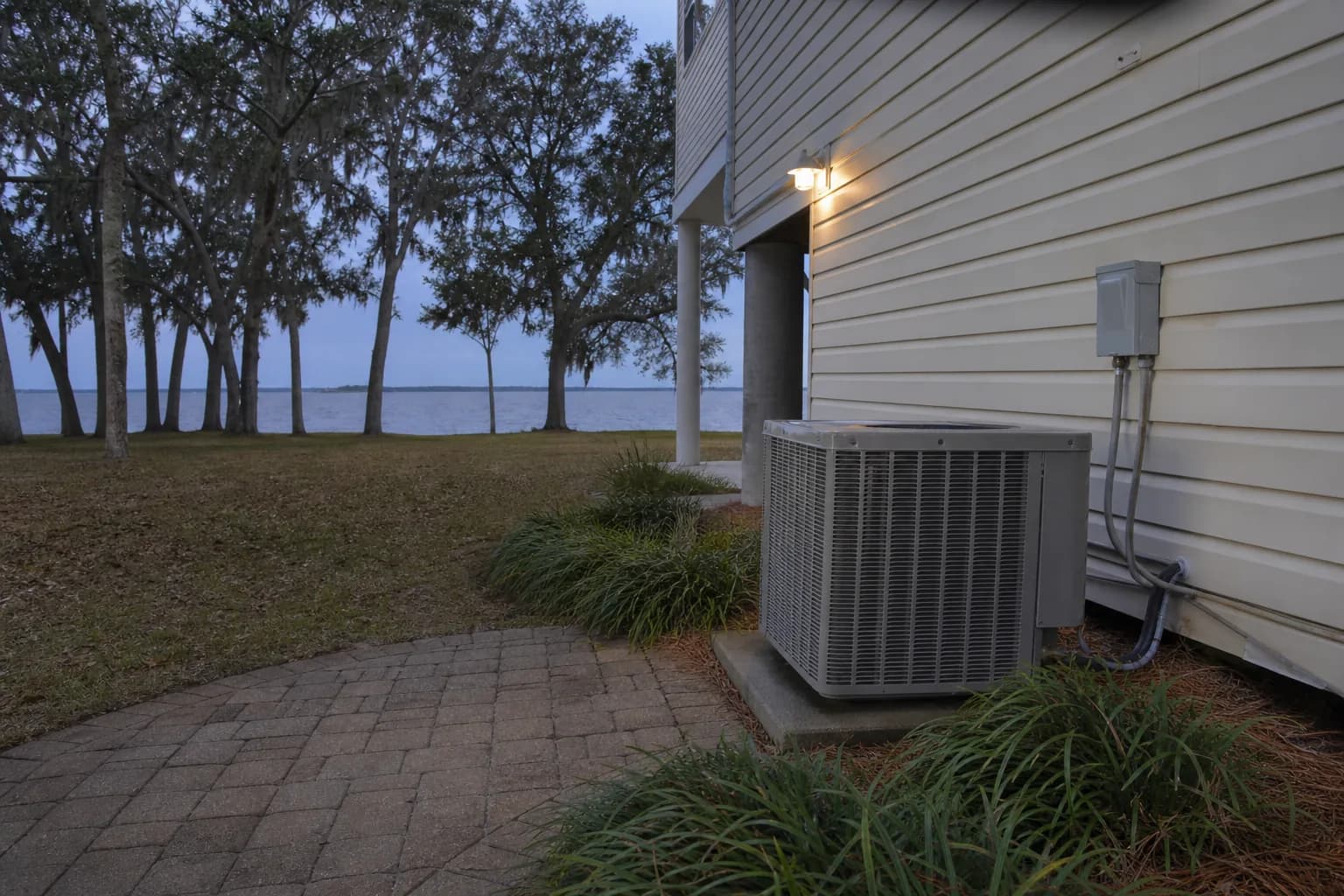
The Daphne home you're standing in has an outdoor unit on a concrete pad somewhere on the side or back of the house. That unit is doing one job in two parts: rejecting heat from the indoor space to the outdoor environment, and providing the pressure differential that lets the refrigerant cycle happen.
When everything works:
- Indoor temperature: 75 degrees, thermostat satisfied
- Outdoor temperature: 95 degrees
- Indoor coil temperature: 40-45 degrees (refrigerant boiling point at 70 PSI suction)
- Outdoor coil temperature: 115-130 degrees (refrigerant condensing point at 250 PSI discharge)
- Compressor amp draw: 14-18 amps continuous
- Locked-rotor amp draw on startup: 80-110 amps for ~150 milliseconds
- Capacitor microfarad reading: at rating plate value (typically 40 or 45)
When something is restricting condenser airflow (the most common Daphne cause):
- Indoor temperature: 78 degrees, thermostat NOT satisfied, system running continuously
- Outdoor temperature: 95 degrees
- Indoor coil temperature: 50 degrees (refrigerant boiling at higher suction pressure due to restricted heat rejection)
- Outdoor coil temperature: 145-160 degrees (refrigerant condensing at elevated discharge pressure)
- Compressor amp draw: 20-26 amps continuous (high)
- Locked-rotor amp draw on startup: 110-140 amps for 400-800 milliseconds
- Capacitor microfarad reading: degrading under repeated stress
The grunt is the audible expression of that 400-800 millisecond extended startup at elevated locked-rotor draw. The compressor is still functional, but it's working at the edge of its design envelope, and every additional startup wears it further.
The three causes, ranked by how often we see them in Daphne
In rough order of frequency for Daphne homes specifically:
Cause 1: Restricted condenser airflow. The single most common cause in Daphne, especially in neighborhoods with mature trees: Lake Forest, Bellaton, TimberCreek, Old Daphne. Pollen cake on the coil fins from spring, oak leaves and pine straw in the lower coil section, salt-air corrosion narrowing the fin spacing along the bay-side homes on Scenic Highway 98 and the Bluff. The fix is a thorough coil clean, and the symptom typically resolves within hours.
Cause 2: Failing condenser fan motor or fan capacitor. The fan on top of the outdoor unit moves air across the coil. If the fan is slow or stopping intermittently, the coil can't reject heat, head pressure climbs, and the compressor grunts. Over 13 years working Baldwin County HVAC, I've seen this much more often in homes with 12+ year old equipment than in newer installs. A fan motor and capacitor are always replaced together — a fan motor that failed once will take the capacitor with it.
Cause 3: Low refrigerant charge. If the system has lost refrigerant to a slow leak, the suction pressure drops, the compressor runs hot, and the startup transients become more pronounced. This is harder to spot from outside the system because the symptoms overlap with the first two causes. We measure it with manifold gauges. Top-off cost depends on how much refrigerant the system needs and where the leak is, and we quote it in writing before adding any refrigerant.
Cause 4 (less common but worth noting): Degraded run capacitor. Covered in detail in the Stapleton capacitor failure pattern post. A run capacitor that's drifted below 80% of its rating produces a similar audible signature on startup. We test for it during the same diagnostic visit.
Diagnosis without tools
Three checks a homeowner can do before calling, none of which require instruments.
The coil-fin visual check. Walk to the outdoor unit. Look at the coil fins on every side of the unit — usually 4 sides, sometimes 3 if one side is against a wall. Are the fins clean and parallel, with visible spacing between them? Or are they packed with pollen cake, leaves, grass clippings, or salt corrosion? If the fins are visibly fouled, cause #1 is your most likely answer. A garden-hose rinse from the top down (no pressure washer — that bends the fins) clears most of it. If the fins are bent or eaten through, you need our service.
The fan operation check. Watch the fan on top of the unit while the system is running. The fan should spin at a steady, fast RPM — fast enough that the blade edges blur. If the fan is spinning slowly enough that you can count individual blades, or if it's stopping and starting, cause #2 is your answer. Don't reach into the unit to check anything; kill the disconnect first if you need to inspect closely.
The startup-pattern check. Have someone inside drop the thermostat 4 degrees while you stand near the outdoor unit. Listen for the startup. Three patterns:
- Quick contact, quick spin-up, quiet operation: healthy system. Grunt has another cause or you're imagining it.
- Brief grunt (under half a second), then clean operation: mild capacitor degradation or mild head-pressure stress. Service call, not emergency.
- Extended grunt (over a second), buzzing, possible failure to start: significant problem. Call same-day.
The Daphne-specific factors
Two factors elevate the grunt frequency in Daphne specifically compared to the surrounding county.
Bay-air corrosion on coil fins. Salt-laden southwest wind reaches the eastern shore homes on a daily basis, and the corrosion product on aluminum fins narrows the air gap between fins by 10-20% over a 10-year service life. Narrower gaps mean restricted airflow, which means elevated head pressure, which means the grunt pattern shows up earlier in the equipment's life here than in inland cities like Robertsdale or Loxley. The why coastal AC units fail faster post covers the corrosion mechanism in detail.
Mature-tree pollen and leaf load. Old Daphne, Lake Forest, and the bluff homes along Scenic Highway 98 sit under heavy oak and pine canopies. The annual pollen and leaf load on coil fins is meaningfully higher here than in newer subdivisions like Jubilee Farms or The Reserve. Daphne Comfort Plan members typically need an extra coil clean on top of the standard two tune-ups a year for exactly this reason. The Daphne pre-summer punch list walks through the May-side prevention work.
The repair-versus-defer decision
A grunt that started this week and the system is still cooling: this is a service call you can schedule for the next available slot. Catch it within a week or two. The compressor is wearing but not catastrophically. Cost: $79 diagnostic plus the underlying repair, quoted in writing before we proceed.
A grunt that's been happening for months and the system is still cooling: this is wear that's accumulated. The compressor windings have eaten dozens of extended-locked-rotor startups already. The fix is the same as above, but we'll also recommend you start budgeting for a compressor replacement in the next couple of years. The repair quote today will be a small fraction of what a full compressor or condenser replacement costs later.
A grunt followed by failure to cool: same-day emergency. Don't wait. Every additional startup attempt accelerates the damage to a part you don't want to replace. Call 251-383-HVAC and tell whoever answers it's an emergency.
Related reading
The Foley hard-start kit post covers the decision about whether to install a start kit as a fix versus letting the kit hide an underlying problem. The Stapleton capacitor pattern post covers the bill-side warning sign for the same family of problems before they progress to the grunt stage in this post.
For the broader pre-summer prevention conversation that catches most of these issues before they appear in August, the Daphne pre-summer punch list is the right reading. For the back-to-school cooling-load context that's happening simultaneously, the Gulf Shores reset post and the Magnolia Springs pricing post round out the August picture.
The fix conversation
When we arrive for a grunt diagnostic in Daphne, we bring a manifold gauge set, an amp clamp, a microfarad meter, an infrared thermometer for coil-temperature spot checks, and the common parts on the truck (capacitors in the standard values, condenser fan motors in 1/4 HP and 1/3 HP for residential split systems, refrigerant for top-off if charge is low).
The diagnostic itself takes 30-45 minutes. We measure suction and discharge pressures, calculate superheat and subcooling, read the run capacitor, clamp the compressor amps under load, inspect the coil, check the fan motor amps, and pinpoint which of the four causes is actually driving the grunt.
The fix happens the same visit if it's a part we carry. Coil cleaning is in-truck. Capacitor replacement is in-truck. Fan motor replacement is in-truck for the common sizes. Refrigerant top-off is in-truck. Compressor replacement requires a separate scheduled visit and is a different conversation about repair-versus-replace.
Calling
251-383-HVAC. Tell whoever answers that you read the Daphne compressor grunt post and want a diagnostic for hard-start symptoms. Same-day if the system isn't cooling. Same-week otherwise. We'll bring the gauges. The grunt you've been hearing is physics with a known cause and a known fix. The longer you let it run, the more expensive the fix gets.
FAQ
- Is the grunt always a sign that the compressor is about to fail?
- Not always — but always a sign that something is making the compressor work harder than designed. The grunt itself is locked-rotor amperage hitting the start circuit, which is normal for the first 0.1-0.2 seconds of a startup. When you can hear it as a distinct sound, you're hearing it persist for 0.4-0.8 seconds, which is well past normal. That extended draw is wearing the compressor windings every time it happens. A grunt that started this week is a service call, not an emergency. A grunt that's been happening for a month while the system still cools is wear that's accumulating; the system will eventually fail to start at all.
- Can I diagnose this myself?
- You can narrow it to one of three causes without tools, then we measure to confirm. Walk to the outdoor unit. Look at the coil — visible debris, pollen cake, leaves packed in the fins indicates restricted airflow (cause #1). Listen for the condenser fan running normally during operation — a slow or stalling fan indicates fan motor or capacitor failure (cause #2). Check whether the grunt happens on every startup or only on hot afternoons — only on hot afternoons points to head pressure climbing past spec, which combined with restricted airflow or low refrigerant charge is cause #3. Self-diagnosis narrows the call. We measure to finish it.
- What does a hard-start fix actually cost in 2026?
- Range depends on root cause. Coil cleaning is the most common Daphne fix and is typically the least expensive. A failed condenser fan motor (replaced with its capacitor) costs more. A degraded run capacitor on its own is the cheapest electrical fix. Refrigerant charge correction depends on how much refrigerant the system has lost and whether we need to find and patch a leak. We come out for a $79 diagnostic, measure the system, and quote the repair in writing before we touch anything. Free second opinions if you already have a quote you want sanity-checked. The Foley hard-start kit post covers when a start kit makes sense versus hides failure.
- Is this a same-day call or a wait-list call?
- Same-day if the system is currently not cooling — that's an emergency tier and we route accordingly. Same-week if the system is cooling but the grunt has appeared. Wait until next routine slot if the grunt has been happening for months and the system is still hitting setpoint. The reason same-day matters when the system is not cooling: every additional startup with a struggling compressor accumulates winding wear that turns a small electrical repair into a full compressor replacement.
Need this handled?
Straight to the service page for your town — pricing, local details and a form that reaches a technician.
More from Compressor Hard Start

ACExperts HVAC
We Take The Heat So You Don't Have To
Fast, honest heating and air service across Baldwin County. Speak with a technician and get on the schedule today.