
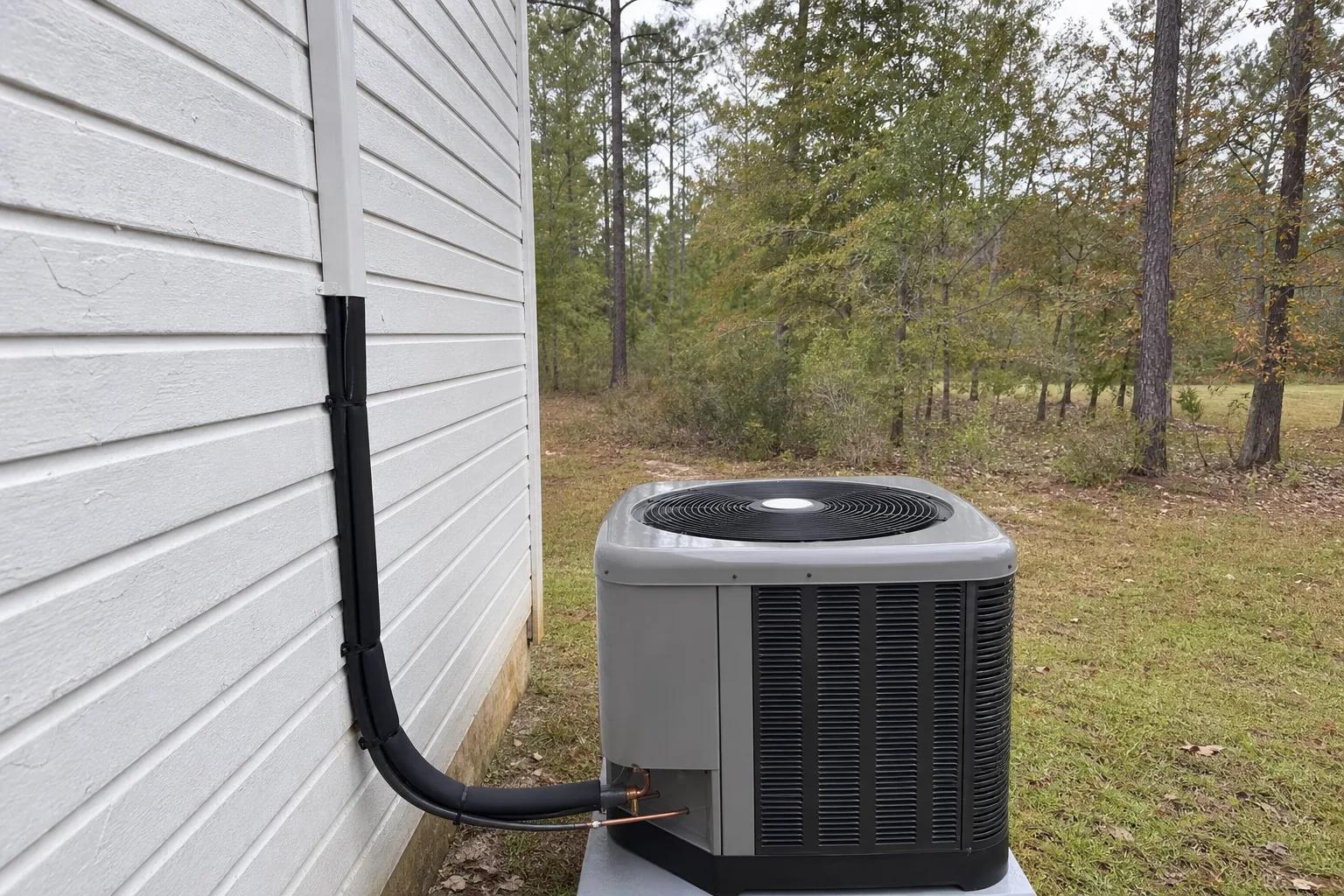
Whole-Home Surge Protection for Summerdale HVAC: ROI in One Storm
Summerdale's grid drives more transient voltage events than other Baldwin County zips, and post-storm HVAC repairs result. The local math on surge protection.
Published 2026-11-20 · Updated 2026-11-20
Author: Landon Jahnke | ACExperts251
Reviewed by: Landon Jahnke · Owner · Alabama HVAC License AL #16117 · EPA 608 Certified
A wholesaler-side observation that's been circulating among coastal Alabama parts reps: Summerdale orders more replacement control boards per capita than other Baldwin County zip codes. It's not because Summerdale techs are sloppy. It's because Summerdale homeowners don't install whole-home surge protection — and the grid out here has more transients than anywhere else in Baldwin County.
The pattern shows up in service tickets too. Post-storm calls in 36504 cluster around the same failure modes — control boards, capacitors, contactors, ECM blower motors — and almost all of it was preventable with a properly installed surge protector at the service entrance.
This post breaks down why Summerdale specifically has this transient problem, what the protection actually costs, and the one decision that determines whether the surge protector pays off in one storm or in three.
Why Summerdale's grid behaves differently
Most Baldwin County homeowners assume their utility service is roughly equivalent to their neighbors' a few miles away. It isn't. Summerdale sits on a grid configuration that produces measurably more voltage transients than the bay-front cities or even Robertsdale a few miles north.
Three factors are at work:
Long radial feeder topology. Summerdale is served primarily by 12.47 kV radial distribution lines that run out from substations in Robertsdale and Foley. Radial means single-path — there's no meshed alternative route, so any disturbance on the feeder propagates straight to every customer on the line. Eastern Shore cities like Daphne and Fairhope have more meshed grid topology and more substation density per square mile, which absorbs transients that on the Summerdale feeders show up at the meter.
Tree-line proximity to feeders. The Highway 59 corridor and the secondary roads through Summerdale Heights, Caldwell Farms, and Pine Ridge run through pine forest. Pines drop limbs in afternoon thunderstorms, and even a small limb-on-line event causes a brief fault that the recloser at the substation clears with a 2-5 cycle outage. Each of those clearings is a transient event at the customer service entrance. Across a Summerdale summer, customers on tree-lined feeders see anywhere from 30 to 80 of these events.
Sand-clay soil and grounding behavior. Summerdale soil is sandier than the Eastern Shore's bay-mud or the Gulf-front salt-saturated soils. Sand has higher electrical resistivity than salt-saturated clay, which means home grounding systems here are slightly less effective at dissipating induced surge currents. When a strike hits within a quarter-mile, a higher fraction of the induced current finds its way onto the home's wiring rather than going to ground through the rod. We've measured ground-rod resistance in Summerdale homes ranging from 35 to 90 ohms; closer to the bay we see 8 to 25 ohms.
The combined effect: a Summerdale home sees roughly 2x to 3x the transient exposure of a comparable home in Daphne or Fairhope, and slightly higher than a comparable home in Foley just south.
What actually fails: the Summerdale failure profile
Pull any Summerdale post-storm service ticket and the failure modes cluster predictably:
Control board failure — the most expensive line item and the most surge-sensitive component in modern HVAC equipment. Summerdale's transient exposure pushes board failure to the top of the failure list. The board sits on the 240V supply, the 24V control loop, and the communication bus on premium systems — three separate paths a surge can ride to reach it. Communicating-system boards (Carrier Infinity, Trane XV, Lennox iComfort) cost considerably more to replace than single-stage equipment boards.
Capacitor failure — capacitors fail from brownout cycling more often than from direct surge. The repeated low-voltage starts during grid recovery weaken the dielectric, and the capacitor pops 2-10 days after the storm. Symptoms: humming compressor with no fan spin, or breaker trip on startup attempt.
Contactor failure — the 240V relay that pulls in to start the compressor pits and burns from in-rush current during repeated start attempts. Common in homes with older equipment whose contactors were already nearing end-of-life before the storm.
ECM blower motor failure — the integrated inverter on variable-speed blower motors is surge-sensitive in a way that older PSC blower motors aren't. A near-strike induces voltage on the thermostat wiring, which travels back to the motor controller. Failure is sometimes immediate, sometimes delayed by weeks. The replacement is one of the more expensive line items on the post-storm bill.
Thermostat failure — smart thermostats sit directly on the low-voltage path and take the brunt of induced surges that travel up the thermostat wire bundle. Nest, ecobee, and premium Honeywell units fail at higher rates than basic non-communicating thermostats.
Other failures — TXVs, sensors, and miscellaneous components round out the post-storm ticket population.
The control-board failure rate is what makes Summerdale stand out compared to Foley, Robertsdale, and Fairhope over the same period — and that disparity tracks back to the grid topology described above.
The math: surge protection against control-board replacement
A Summerdale homeowner deciding whether to install a whole-home surge protector is essentially making a probabilistic bet against named storms over the equipment's remaining service life.
Run the numbers conservatively. A home built in 2015 with original equipment is 11 years into a 15-year typical lifespan. Over the next 4 years, Baldwin County will see roughly 1.5 to 2.5 named storms passing within wind-impact distance, plus 8 to 12 unnamed severe-thunderstorm events that produce close cloud-to-ground lightning. That's 12 to 16 transient events with non-trivial probability of inducing damage.
Without protection, the Summerdale base rate puts the probability of a control-board, ECM blower motor, or capacitor failure during that 4-year window in the 35-50% range. With a service-entrance protector installed, the loss probability drops to roughly 8-15%.
The expected savings over 4 years exceed the installed cost of a typical service-entrance protector — payback typically falls inside the first 12-30 months on expected value alone, faster if a single storm produces the failure that would have otherwise hit unprotected.
Add a dedicated HVAC surge protector at the disconnect, and the two-layer setup pushes the failure probability to under 5%. The marginal install cost is small relative to a single avoided control-board replacement.
The one decision that determines payback timing
The protector pays off in one storm or in three storms based on a single variable: how old your equipment is when you install the protector.
If your system is 8+ years old, the protector pays off on the next named storm with a high-confidence margin. Older equipment has weakened components — capacitors with degraded dielectric, contactors with pitted contacts, control boards with thermal-cycled solder joints — that fail at much higher rates from transient stress. The marginal protection from the surge device prevents the failure that a healthy system might have shrugged off.
If your system is under 5 years old, the protector still earns out, but the payback runs across 2-3 storm seasons rather than 1. New equipment shrugs off more transients on its own; the protector mostly buys you longevity rather than preventing imminent failure.
Either way, install before storm season, not after. Post-storm installation prevents the next storm's damage but doesn't unwind the cumulative wear from prior transient events.
When the protector won't help
Two scenarios where a surge protector is the wrong solution:
Direct strike to the service drop. A direct cloud-to-ground strike on the utility line within 200 feet of the meter produces voltage levels that overwhelm any consumer-grade protector. Damage is typically catastrophic and homeowners insurance becomes the relevant conversation, not surge protection. These are rare in Summerdale — maybe 2-4 per zip code per decade.
Wear-and-tear failures misdiagnosed as surge. Not every post-storm equipment failure is storm-related. Capacitors fail from cumulative heat aging on a schedule that's roughly independent of storm exposure; if your capacitor was going to fail in October regardless, the storm just provided the trigger. We diagnose distinguishing patterns at the service call — surge damage shows specific signatures (carbon scoring on board traces, fused capacitor terminals, blower inverter fault codes) that we can identify and document for warranty and insurance purposes.
What goes in and why
For Summerdale specifically the right install is an Eaton CHSPT2-series service-entrance protector — 80 kA per phase, Type 2 device, UL 1449 listed, with audible and visual fault indication. The 80 kA rating handles the Summerdale transient profile with margin, and the audible alarm tells the homeowner when the protector has absorbed enough energy to need replacement.
At the air handler, a dedicated HVAC surge device (Diversitech APS-D4 or equivalent) goes in with the line-set bonded to the equipment ground. Two-layer protection is what makes the Summerdale numbers work.
To schedule an install, the office answers Monday-Saturday 8am-6pm at 251-383-HVAC. Most installs are 60-90 minutes and coordinate cleanly with a fall maintenance visit so a separate trip charge doesn't apply.
The Summerdale takeaway
The wholesaler observation and the post-storm ticket pattern tell the same story: Summerdale homeowners pay more in post-storm HVAC repairs than other Baldwin County zip codes, and almost all of it is preventable. The grid topology won't change. The pine-tree limb falls won't stop. The sand-clay soil grounding won't get better. What can change is the protection between Alabama Power's service drop and your air handler's control board.
If you're between maintenance visits, book a surge protector install standalone. If you're due for a tune-up anyway, bundle the install and skip the separate trip charge. Either way, the math is settled. The transients are coming. The only question is whether they reach the board.
FAQ
- Why does Summerdale see more control-board failures than other Baldwin County zip codes?
- Two reasons. First, Summerdale sits at a grid topology choke point — it's served by long radial feeders from substations in Robertsdale and Foley, which means more transient voltage events per year than the meshed grid serving Eastern Shore cities. Second, the local soil is a sand-clay mix with relatively poor grounding compared to the saltier soils closer to the bay, so induced surges from nearby strikes find their way onto Summerdale wiring more easily. Net effect: more transients reach control boards, more boards fail.
- What does a whole-home surge protector cost installed in Summerdale?
- The device itself is a name-brand unit (Eaton, Square D, Siemens) rated 50-80 kA per phase. Installation runs less when bundled with a tune-up visit. For Summerdale specifically the higher-rated 80 kA unit makes sense because of the inland-feeder transient profile — the small marginal cost buys real protection against the most common failure mode here. ACExperts quotes the install line-by-line with a free estimate.
- Does the Comfort Plan cover surge protector installation?
- The ACExperts Comfort Plan includes 10% off repairs and replacements plus $0 service fees and no overtime fees, which lowers the bundled cost when the surge protector goes in during a Comfort Plan tune-up visit. The device itself isn't bundled into the plan, but the plan member rate brings the total down meaningfully compared to a standalone install.
- Should I add a second surge protector at the air handler?
- For Summerdale, yes. The service-entrance protector catches the big hits at the panel, but a dedicated HVAC surge protector at the air handler or condenser disconnect catches what slips past — and on Summerdale homes with retrofit ductwork and long thermostat wire runs, what slips past matters. Two-layer protection prevents the post-storm failure cluster that's most common here.
Need this handled?
Straight to the service page for your town — pricing, local details and a form that reaches a technician.
Related reading

ACExperts HVAC
We Take The Heat So You Don't Have To
Fast, honest heating and air service across Baldwin County. Speak with a technician and get on the schedule today.