
Loxley Hurricane Strap Installs — When to Spend the $180 (and When It's a Coin Flip)
A hurricane-strap install on a Loxley outdoor unit only pays back when three conditions are all true. Here's the threshold rule and the field-tested install spec.
Published 2026-11-17 · Updated 2026-11-17
Author: Landon Jahnke | ACExperts251
Reviewed by: Landon Jahnke · Owner · Alabama HVAC License AL #16117 · EPA 608 Certified
The $180 hurricane-strap install on a Loxley outdoor unit pays back when ALL THREE of these are true: (1) your home is within 12 miles of the I-10 corridor, (2) your homeowners insurance has a separate windstorm rider, (3) your equipment is 4+ years old. If even one of those isn't true, the $180 is a coin flip — sometimes good, sometimes wasted. Here's the threshold rule and the math behind each condition.
This is one of the rare add-on spends in residential HVAC where the answer isn't "yes, do it" or "no, skip it" — it's genuinely conditional. The wrong call in either direction costs real money. So let's walk it.
The threshold rule, stated plainly
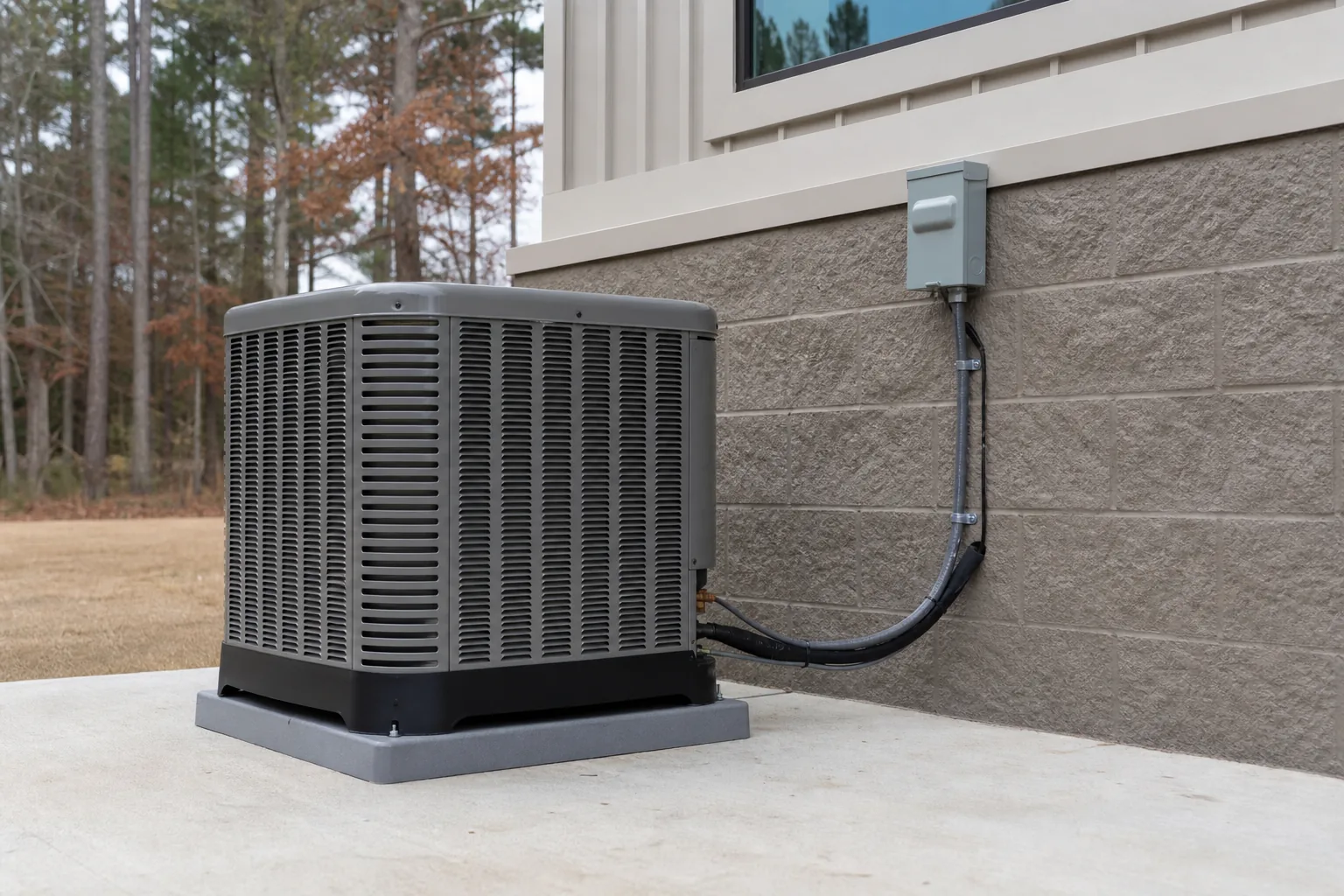
A hurricane strap is a piece of galvanized steel and a few concrete anchors that hold an outdoor condenser to its pad during sustained tropical-force wind. Cost installed in Loxley in 2026 runs $160–$210 depending on cabinet size, slab condition, and whether the existing pad needs reinforcement. Round to $180 for the analysis.
The strap pays back economically only when three specific conditions stack:
- Geographic exposure: Your home is close enough to the I-10 corridor (or further south toward the bay/Gulf) that a Cat 1+ storm has realistic odds of pushing 90+ mph gusts across your slab.
- Insurance structure: Your homeowners policy carries windstorm as a separate named-peril rider with its own deductible — usually 2-5% of dwelling value rather than the flat $1,000 deductible on the main policy.
- Equipment age: Your condenser is 4+ years old, meaning it's outside the factory warranty window where the manufacturer would replace a wind-displaced unit on their dime.
Miss any one of those and the math wobbles. Here's why each matters.
Condition 1 — geography (the I-10 corridor rule)
Loxley sits about 13 miles inland from Mobile Bay along I-10. That position is meaningful: the corridor runs roughly east-west across the same band of latitude that historically receives the worst inland penetration of named storms moving through the Gulf. Sally in 2020 dropped sustained winds in this band that exceeded the design rating of unanchored equipment. Ivan in 2004 did worse.
If you're north of Loxley toward Bay Minette or Stockton, the wind exposure drops meaningfully — the same storm that hits 95 mph in Loxley may only reach 70-75 mph by the time it crosses Bay Minette. At 70-75 mph sustained, a properly-set 200-pound condenser on a level pad doesn't move. Below that wind speed, the strap is dead weight.
If you're south of Loxley toward Foley, Magnolia Springs, or Lillian, the exposure climbs. By the time you're at the Gulf coast in Gulf Shores or Orange Beach, the strap isn't a coin flip — it's a baseline expectation, the same way coastal-rated equipment is a baseline expectation.
The 12-mile rule is rough but reliable: if your driveway is within 12 miles of the I-10 alignment in either direction, geographic exposure is high enough that a strap is worth considering. Outside that band, exposure drops faster than most homeowners realize.
Condition 2 — insurance structure (the windstorm rider rule)
This is the condition most homeowners get wrong because they don't read their policy.
Standard homeowners insurance in Baldwin County splits into two flavors:
- Bundled wind: Wind damage is covered under the main dwelling policy. Deductible is whatever the main deductible is — usually $1,000 to $2,500.
- Separate wind rider (or wind exclusion): Wind damage requires a separate named-peril rider with its own deductible — typically 2% of dwelling value, sometimes 5%. On a $400,000 home, that's $8,000 to $20,000 before coverage starts.
The strap math turns on which one you have.
If you have bundled wind: a $4,500 condenser blown off its pad triggers a $1,000 deductible, and you get a $3,500 check. The strap saved you $1,000 on a 30-year storm event, which works out to maybe $33/year of expected value — well below the $15/year the strap costs amortized. Coin flip leaning skip.
If you have a separate wind rider: that same $4,500 condenser doesn't even reach the deductible. You eat the entire $4,500. The strap saved you $4,500, which on the same storm probability works out to $150/year of expected value — comfortably above the strap's amortized cost. Clear win.
Pull your declarations page. Search for "wind" or "windstorm" or "named storm." If you see a separate deductible amount on a wind line item, you have the rider. If not, you don't.
Condition 3 — equipment age (the warranty rule)
New equipment carries 5-year (sometimes 10-year) parts warranties from the manufacturer, and most coastal-rated installations include the optional labor warranty as well. If a 2-year-old unit gets blown off its pad during a hurricane, the manufacturer's warranty often replaces the displaced equipment at no cost — provided the install was to spec, the property has the requisite documentation, and the cause was clearly storm-related.
That's why brand-new equipment sometimes doesn't need a strap from a pure economic standpoint: the manufacturer is essentially the strap. Move the unit, get a replacement.
But that warranty math reverses sharply at the 4-year mark. A 4-year-old condenser is past most factory parts warranties (typically 5 years standard, sometimes shorter on labor). At 4+ years, a wind-displaced unit means out-of-pocket replacement — exactly the scenario the strap defends against.
If your equipment was installed in the last 12-24 months, the strap is doubly insured (manufacturer warranty + insurance) and the marginal value drops. From year 4 forward, the strap is on its own as the primary defense.
What the install actually involves
When we quote $180 for a Loxley install, here's what's included:
- Galvanized hurricane strap kit rated to 150 mph design winds (the cheap kits flex too much under load — spec matters)
- Verification of pad anchoring: We pull on the existing pad to confirm it's a real footing, not landscape blocks. If it's not real, we either pour a proper pad ($340 add-on, separate quote) or tell you the strap won't help and we won't install it.
- Concrete anchors at minimum two corners of the cabinet, sized to the cabinet's reinforced mounting points
- Torque verification to manufacturer spec
- Photo documentation for your insurance file (matters for some carriers if a claim ever happens)
Time on site: 45-90 minutes depending on whether the pad needs work. A typical clean install on a properly-set pad is under an hour.
The Loxley-specific wrinkle: pecan trees and outbuildings
Loxley's character — pecan orchards, satsuma groves, large lots with detached outbuildings — adds a wind exposure variable that's worth flagging.
If your condenser sits within 25 feet of a mature pecan, satsuma, or live oak, the dominant risk during a storm isn't the unit moving — it's a limb coming down on top of it. A strap doesn't help with that. Over 13 years working Baldwin County HVAC, I've seen compressors crushed by tree limbs in Loxley after named storms, and the strap did exactly nothing for those units.
The defense for tree-fall is different: trim aggressively before season, or move the condenser to a less-exposed location during a major install. Neither is in the $180 strap budget.
If your condenser sits in the open between the house and a metal outbuilding, the wind tunnel effect between structures can amplify gusts by 15-25%. In that geometry, the strap's value goes up. Units in this configuration have been known to walk several feet across a yard during borderline events.
When the math says skip it
Three Loxley scenarios where I'd tell you to keep the $180:
-
You're in a newer subdivision (Whitehouse Forks, Carter Plantation post-2018) with a 1-2 year old condenser, bundled wind on your insurance, and no large trees within 30 feet. The factory warranty plus the bundled coverage makes the strap redundant.
-
Your condenser is at end of life (12+ years) and you're planning to replace within the next 2-3 years anyway. Spend the $180 toward the replacement budget. New equipment install will include proper pad and anchoring as part of the work.
-
You rent the home and the landlord won't reimburse. This is a landlord call, not a tenant call. Equipment damage during a storm is a landlord/insurance event.
When the math says do it
Three scenarios where I'd push you toward the install:
-
Established Loxley home (1980s-2000s ranch) with a separate windstorm rider on insurance and equipment in years 5-10. This is the cleanest version of the threshold rule firing on all three conditions. Spend the $180.
-
Your condenser is on a side or back of the house with a wind-tunnel orientation toward an open field or pasture. Geographic exposure is amplified by terrain. Spend the $180.
-
You've already lived through Sally or Ivan and you remember what it felt like. Lived experience is its own data. The strap is partially insurance against repeat trauma.
The bottom line
The strap is one of the most condition-dependent spends in residential HVAC. Walk the three threshold conditions honestly. If all three are true, install it before the next named storm enters the Gulf. If two are true, lean toward installing it. If only one is true, you can skip it without losing sleep.
If you want a second opinion on whether your specific Loxley address fits the threshold, ring us Monday-Saturday 8am-6pm at 251-383-HVAC and we'll walk it with you. Free, no quote pressure — we'd rather you spend the $180 only when the math works.
FAQ
- What does a hurricane strap install actually do for an outdoor condenser?
- It mechanically anchors the condenser cabinet to the slab (or to a code-approved equipment pad) using galvanized straps and concrete-rated fasteners that can resist roughly 130–150 mph design wind speeds. The function is straightforward: keep the unit from skating, tipping, or going airborne when a tropical system pushes wind across the home. The strap itself isn't expensive — most of the $180 is labor, the slab fasteners, and the time to verify pad attachment is real (we've seen 'pads' that were nothing more than four landscape blocks set in pea gravel).
- Why doesn't every Loxley homeowner just install one preemptively?
- Because for a meaningful share of Loxley homes, the threshold conditions don't all line up. If you're 18 miles inland, your homeowners policy folds windstorm into the main coverage with no separate rider, and your condenser is two years old still on factory warranty, the $180 is genuinely a coin flip — your unit probably stays put through any storm Loxley realistically sees, and your insurer would replace it if it didn't. The strap math only works cleanly when all three threshold conditions hit. Otherwise it's a comfort spend, not an economic one.
- Can I install the strap myself?
- Technically yes if you're comfortable with concrete anchors and you read the manufacturer's spec carefully. Practically, the value of a professional install is verifying the pad is actually anchored to a real footing (not floating on gravel), confirming the strap geometry matches the cabinet's reinforced corners, and torquing the fasteners to spec without cracking the slab. Mistakes on any of those defeat the whole point of the strap. If you DIY, follow the strap manufacturer's printed instructions exactly and don't substitute hardware.
- Does a hurricane strap affect equipment warranty?
- No, when installed correctly. The strap attaches to the cabinet through factory-designated mounting points or to the pad — neither breaks the refrigerant circuit or modifies any sealed assembly. A strap installed incorrectly (drilling into the cabinet wall, for example) could create a corrosion path that voids coastal-rated warranty coverage, which is one more reason to use someone who knows the spec for Baldwin County equipment.
Need this handled?
Straight to the service page for your town — pricing, local details and a form that reaches a technician.
Related reading

ACExperts HVAC
We Take The Heat So You Don't Have To
Fast, honest heating and air service across Baldwin County. Speak with a technician and get on the schedule today.