
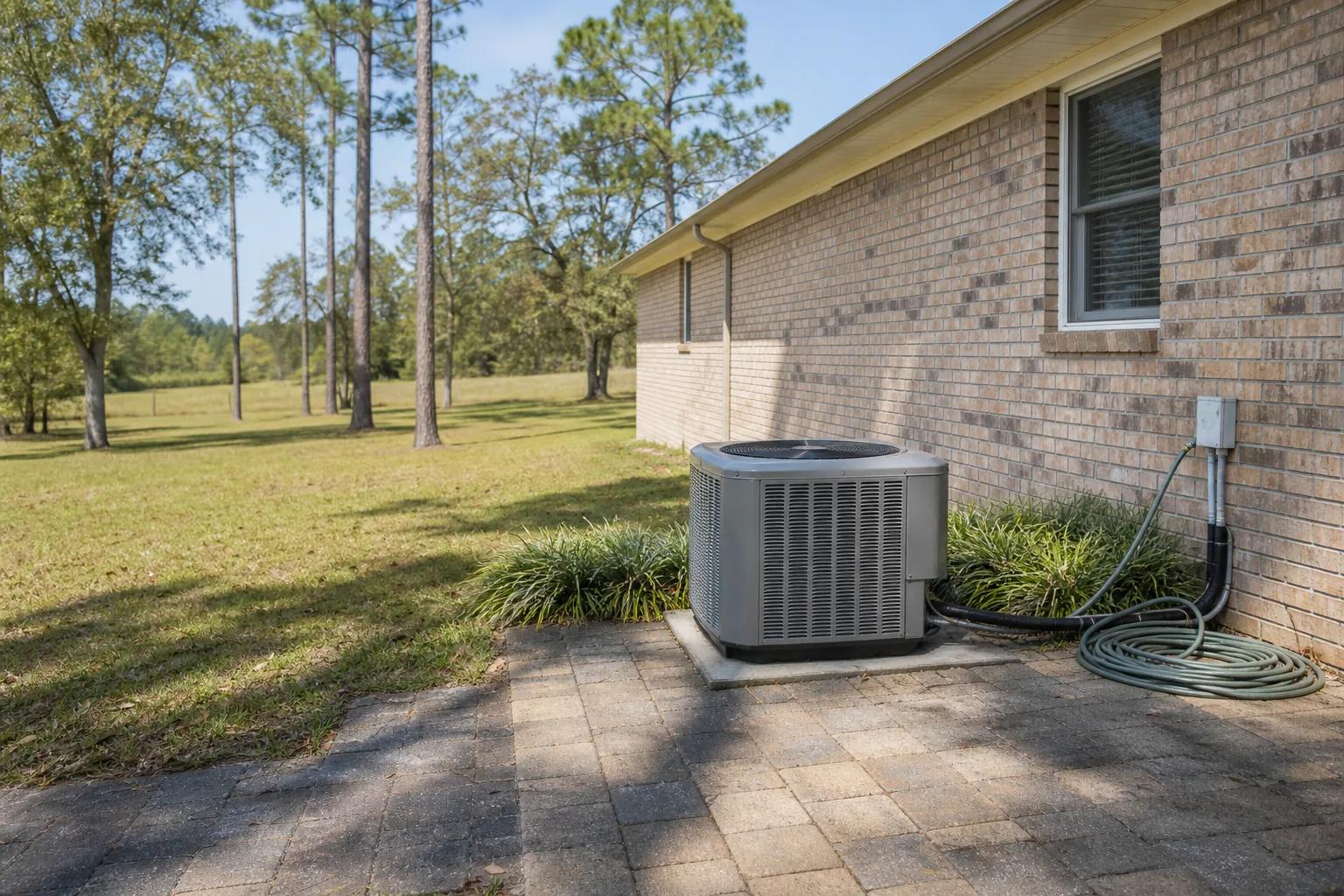
How Salt Air Eats Silverhill Condensers — A Visual Tour
Pitted aluminum fins, oxidized copper, welded contactors — the failure modes salt-laden air drives in Silverhill condensers, and what to do at your house to slow them down.
Published 2026-11-12 · Updated 2026-11-12
Author: Landon Jahnke | ACExperts251
Reviewed by: Landon Jahnke · Owner · Alabama HVAC License AL #16117 · EPA 608 Certified
Over 13 years working Baldwin County HVAC, I've pulled a lot of parts off Silverhill systems. The same three components show up over and over on the salt-air casualty pile: pitted aluminum fins, oxidized copper, and contactors with welded or eroded contacts. Most came from homes within four to seven miles of Mobile Bay. Many ran less than nine years before the first major failure.
This is the visual tour of why salt-air kills coastal condensers — and how to slow it down at your house.
Pitted aluminum fins
The first thing you notice on a pulled coil is the white powder. Aluminum oxide has a chalky white appearance, and aluminum condenser fins from coastal exposures look like someone dusted them with flour. From two feet away, the white coating resolves into a constellation of tiny pits — most no bigger than a pinhead, some clustered into larger eroded zones where the metal has dissolved entirely.
This is electrochemical corrosion, accelerated by chloride ions in salt humidity. Aluminum is a reactive metal — in dry air, it forms a thin protective oxide layer that prevents further corrosion. In salt-laden humid air, the chloride ions disrupt that protective layer, allowing oxidation to proceed indefinitely. Each oxidation cycle removes a microscopic layer of aluminum from the fin surface and replaces it with white aluminum oxide that flakes away.
Why fins matter: the condenser coil rejects heat from the refrigerant to the outside air, and that heat transfer happens through the fins. A condenser with a third of its fin surface area pitted, eroded, or covered in oxide is a condenser that can't reject heat efficiently. The compressor works harder. Refrigerant pressures climb. The system runs longer to do the same cooling work. Energy bills climb. Eventually the compressor overheats or refrigerant pressures exceed safety limits.
The general pattern from a long Baldwin County career: uncoated aluminum fins on Silverhill installs show meaningful pitting within a handful of years and significant degradation toward the end of the first decade. Coated fins (factory-applied corrosion-resistant treatments) push both milestones years further out. The coating roughly doubles the functional life of the coil in Silverhill exposure.
The Silverhill service area page covers the geography in more detail — properties on the western side of Silverhill, closer to the bay, get more salt exposure than properties on the eastern side. The treatment recommendation varies accordingly.
Copper coil oxidation and pinhole leaks
Move past the fins and the metal turns green. Copper coils — the U-bends and headers that carry refrigerant through the condenser — develop a characteristic green-blue patina under salt exposure, similar to what you see on old copper roofs in coastal cities. The patina itself isn't catastrophic; it's the early stage of copper corrosion. The catastrophic stage comes a few years later when the corrosion penetrates the tube wall and forms a pinhole.
Pinholes leak refrigerant. A condenser with a coil pinhole loses charge slowly — sometimes a few ounces a year — and the system limps along until cooling capacity drops below what the family notices as comfort. By then, the leak has often spread to adjacent corrosion zones, and a single-point repair turns into a coil replacement or full system replacement decision.
Two specific failure modes show up here:
Formicary corrosion — sometimes called "ant nest" corrosion because it looks like the tunneling pattern ants make. Microscopic channels develop in the copper from the inside out, driven by formic acid and other VOCs in the indoor air interacting with copper at the evaporator coil. Ironically, this isn't primarily a salt-air phenomenon — it shows up in inland systems too — but salt-air exposure to the condenser coil accelerates the same general weakening of copper structure.
External pitting corrosion — this one is salt-air specific. The outer surface of the copper U-bend develops localized pits from chloride attack, similar to the aluminum fin pattern but progressing more slowly because copper is more corrosion-resistant than aluminum. When a pit penetrates the tube wall, you have a leak.
The repair-versus-replace decision on a leaking coil depends on age, cost, and refrigerant type. R-410A coils can usually be replaced economically through the first decade of system age. R-22 coils on older systems are often unobtainable, which forces a full replacement decision. The AC repair service page covers the diagnostic logic; the ROI calculator at /tools/roi-calculator/ runs the cost comparison on specific numbers. ACExperts provides free written estimates on replacements and free second opinions on quoted repairs.
Contactors with welded contacts
The third major casualty mode is electrical. Contactors are the high-voltage switches that send power to the compressor and outdoor fan motor. They have two contact surfaces — line side and load side — that physically come together every time the system calls for cooling and separate every time the system shuts off. Over the life of a typical residential system, a contactor cycles tens of thousands of times.
Each cycle creates a small arc as the contacts make and break. In dry, clean indoor environments, the arc is brief and the contacts hold up well. In salt-air outdoor cabinets, the arc happens through humid, chloride-laden air, and three failure modes develop:
Contact pitting. The arcing erodes the silver-alloy contact surfaces over time. Pitted contacts have higher electrical resistance, which generates heat under load, which accelerates further pitting. It's not unusual to find contactors on coastal installs where the contact surfaces have eroded to a fraction of original thickness.
Welding. When pitted contacts make solid contact under high load, they can fuse together — micro-welding the two surfaces. The system runs continuously even when the thermostat stops calling for cooling, because the contacts can't separate. Homeowners notice the outdoor unit running around the clock. Sometimes the breaker eventually trips from cumulative thermal load. Sometimes the compressor overheats first.
Open failure. The opposite mode: pitted contacts that can no longer make a clean connection at all. The compressor doesn't start, or starts intermittently. The "running but not cooling" symptom often traces here.
A new contactor is a low-cost part. A welded contactor that ran the system continuously for two months before anyone noticed can cost a four-figure compressor that overheated under sustained operation. The cost asymmetry is enormous, and contactor inspection is one of the highest-value items on a maintenance visit.
What's happening in your Silverhill cabinet right now
If your outdoor condenser is past 5 years old and you've never had a coil rinse or contactor inspection, the corrosion progression on these three components is happening inside your cabinet right now. Not visibly — the cover stays on, the fan keeps spinning, the air still gets cold. But the chemistry is running.
You can do a quick visual check this weekend:
- Turn off power at the disconnect. Important. Do not skip this.
- Remove the top grille screws (typically 6-8 sheet metal screws around the perimeter) and lift the top with the fan attached.
- Look at the coil from the inside. White chalky residue on aluminum fins is salt deposit and oxide. Green-blue patches on copper bends are oxidation. Visible pitting is advanced corrosion.
- Look at the contactor — usually a black plastic block with copper contacts visible on top. Pitting, discoloration, or visible heat damage signals a contactor approaching failure.
- Replace the top, restore power.
The visual check takes 10 minutes. It tells you roughly where your equipment is on the corrosion timeline. If anything looks dramatically worse than you expected, schedule a maintenance visit before the spring cooling season demands the equipment perform at its limit.
How to slow it down at your house
The corrosion environment in Silverhill can't be eliminated, but the corrosion rate can be slowed substantially. Five things, in descending order of impact:
1. Twice-yearly coil rinse. Low-pressure garden hose, top down through the fins, five minutes per side. Spring (April) and fall (October) at minimum. Removes salt and dust deposits before they hold moisture against the metal long enough to drive serious corrosion. Free, takes 15 minutes total.
2. Sealed disconnect cabinet. A simple gasket kit on the disconnect stops salt humidity from infiltrating the electrical compartment, which preserves contactor life. Worth requesting on any new install or replacement.
3. Coastal coil coating at next replacement. Factory-applied corrosion-resistant coatings on aluminum fins double or triple the corrosion resistance. The AC installation service page covers what's included in coastal-spec installations for properties in salt-influenced areas — ACExperts provides free written estimates on replacements.
4. Annual contactor inspection. Visual inspection of contact surfaces, resistance check, replacement when contacts show pitting. A small part caught at maintenance prevents compressor failures that cost orders of magnitude more.
5. Maintenance plan attendance. Twice-yearly visits with documented coil condition, contactor status, refrigerant pressures, and capacitor microfarads build a baseline that catches degradation before it becomes failure. The Comfort Plan covers two tune-ups a year at $20/month or $240/year, with 10% off repairs and replacements, no service fees, and no overtime fees. The preventive maintenance service page covers what each visit includes.
What the casualty pile doesn't show
The components I just walked you through are the failure end of the story. What that pile doesn't show is the homes on the other side — the Silverhill households that paid for unexpected repairs, weathered hot weekends without cooling, and ultimately replaced systems earlier than they planned because the corrosion environment was working on the equipment the whole time.
The flip side is also true: there are plenty of systems in the same neighborhoods that have made it to 14, 16, even 18 years on regular twice-yearly maintenance attention. The difference between those two outcomes is not dramatic technology or expensive equipment — it's regular attention to coil condition, electrical components, and the small interventions that interrupt corrosion chemistry before it accumulates.
For nearby cities with comparable or more aggressive salt exposure, the Foley service area page covers the inland-Foley salt context (about 8 miles from the Gulf), the Gulf Shores city page covers direct Gulf-front exposure (where corrosion progresses substantially faster than Silverhill), and the Spanish Fort city page covers the bay-influenced Eastern Shore environment that's broadly similar to western Silverhill.
ACExperts operates Monday-Saturday 8am-6pm and answers emergency calls around the clock, any day of the week (including Saturdays at no extra charge). Fall maintenance slots fill quickly in the November-December window — coil condition checks before winter dormancy are one of the highest-value visits in Silverhill. The diagnostic service fee is $79, with free second opinions on quoted repairs and free estimates on replacements. ACExperts is headquartered in Silverhill at 22048 Cesta Way — when you call 251-383-HVAC, you're calling the city the truck works in, not a regional dispatch center.
FAQ
- Silverhill is 20 miles from the Gulf — is salt air really a problem here?
- It's a smaller problem than Gulf Shores or Orange Beach, but it's not zero. Silverhill sits roughly 4-7 miles from Mobile Bay depending on which part of town, and bay-driven salt humidity reaches inland communities through prevailing southerly breezes during summer. Silverhill condensers tend to fail meaningfully earlier than fully inland equipment in places like Bay Minette or Loxley — a real difference, even though it's far less aggressive than direct Gulf-front exposure. The properties along the western edge of Silverhill, closest to the bay, see the most accelerated corrosion. Properties on the eastern side toward Robertsdale and inland Baldwin County see much less.
- Does coil cleaning actually slow down corrosion, or is it just cosmetic?
- It meaningfully slows corrosion. Salt deposits on aluminum fins and copper coil surfaces hold moisture against the metal, which accelerates galvanic and electrochemical corrosion. Removing those deposits with a proper coil rinse — quarterly for direct salt exposure, semi-annually for inland Silverhill — interrupts the chemistry. Homes on a twice-yearly maintenance cadence routinely make it years longer to first refrigerant-related repair than homes without scheduled coil cleaning. The math favors maintenance even before counting the comfort and reliability difference.
- Should I pressure-wash my outdoor condenser to remove salt and dust?
- No, never. A pressure washer can bend aluminum fins, drive debris deeper into the coil, damage the fan motor seals, and force water into electrical components. Use a low-pressure garden hose, no nozzle, with water flowing from the top of the coil downward through the fins. Five minutes per side. The coil is designed to be rinsed gently — the salt and dust comes off easily when the surface is wet, and high pressure causes more damage than the dirt itself does. If your condenser has visible salt crust that won't rinse off with low-pressure water, a coil cleaning service uses appropriate detergent and pressure to do it without damage.
- When should I replace a corroded condenser instead of continuing to repair it?
- When the cost of repair plus expected next-year repair exceeds roughly half of replacement cost on a system more than 10 years old. Specifically: if your Silverhill system is past 12 years, the coil shows visible pitting and oxide staining throughout, and you're facing a substantial refrigerant repair, replacement is usually the right call — the next leak is coming within a year or two, and the cumulative cost of patches will exceed a new install with proper coastal protection. The ACExperts ROI calculator at /tools/roi-calculator/ runs the math on your specific numbers. Free written estimates on replacements, no sales pressure.
Need this handled?
Straight to the service page for your town — pricing, local details and a form that reaches a technician.
Related reading

ACExperts HVAC
We Take The Heat So You Don't Have To
Fast, honest heating and air service across Baldwin County. Speak with a technician and get on the schedule today.