
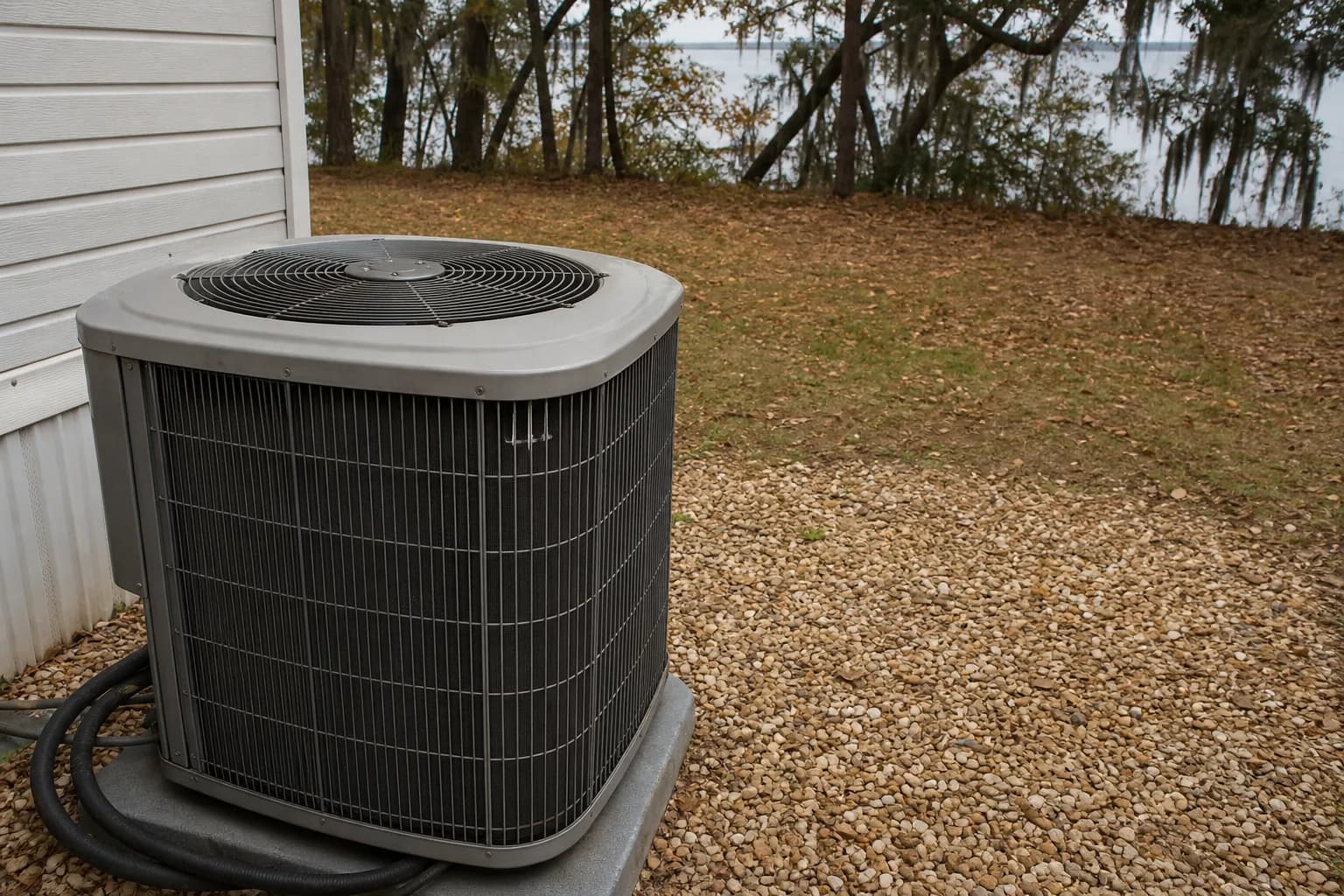
When a Spanish Fort 12-Year-Old AC Is Still Worth Saving
A mediation-style breakdown of the keep-or-replace decision on a 12-year-old Spanish Fort AC, with five exhibits per side and the verdict that decides which way the math actually goes.
Published 2026-10-28 · Updated 2026-10-28
Author: Landon Jahnke | ACExperts251
Reviewed by: Landon Jahnke · Owner · Alabama HVAC License AL #16117 · EPA 608 Certified
Imagine this dispute heads to mediation: homeowner argues "my Spanish Fort AC is 12 years old, replace it, the manufacturer says lifespan is 10 to 15 years." HVAC tech argues "this 12-year-old system has documented annual maintenance, no major repairs, R-410A is still in spec, and the duct system was redone five years ago — keep running it." The judge needs evidence. Here's the framework with five exhibits per side, and the verdict that decides whether your specific 12-year-old AC is worth saving.
This isn't an academic exercise. Spanish Fort had a major buildout between 2010 and 2014, which means a meaningful percentage of the Spanish Fort housing stock — Stillwater, TimberCreek, Stonebridge, Spanish Fort Estates, Audubon, parts of Churchill — is sitting on original AC equipment that's now 11 to 15 years old. The keep-or-replace question is being asked across the city at scale this fall, and the answer is genuinely different for each home.
Exhibit A through E for the homeowner side
These are the five strongest arguments for replacement at year 12. If three or more apply to your system, the math is tilting toward replacement.
Exhibit A: rising annual repair spend
Track the trailing 3-year repair total. If the trailing 3-year sum is over $1,800 — meaning you've averaged $600 per year — the failure cascade is in motion. Add one more year of similar repairs and you've spent more than 30 percent of replacement cost on a system that's still 12 years old.
Exhibit B: a refrigerant top-off in the past 18 months
R-410A loss isn't normal. A properly sealed system holds refrigerant for 15+ years without intervention. If a tech has had to add refrigerant in the past 18 months, there's a leak somewhere — and on a 12-year-old system, the leak is most likely the indoor coil, which is a $1,650 to $2,200 repair on a chassis that may not last another 4 years to make that repair pay off.
Exhibit C: indoor humidity above 58 percent in summer
Properly functioning Spanish Fort AC equipment should hold indoor humidity at 45 to 52 percent during summer cooling season. If your hygrometer is reading 58 to 65 percent indoors when the thermostat is at setpoint, the system is short-cycling — either from being oversized originally, from compressor degradation, or from coil airflow issues. This is comfort failing before equipment failure shows up on the bill.
Exhibit D: power bill rising faster than rate inflation
Pull your last 4 August power bills. If they're trending up by more than 4 to 5 percent annually after accounting for utility rate increases, equipment efficiency is degrading. A 12-year-old condenser in Spanish Fort that's drawing 15 percent more amperage than its data-plate spec is producing 15 percent less cooling per dollar — and that's a hidden replacement-economic argument that doesn't show up as a repair invoice.
Exhibit E: original ductwork with no recent assessment
If the ductwork is original to the home and hasn't been pressure-tested or sealed in the last 8 years, you're losing 15 to 30 percent of conditioned air to attic spaces. New equipment running through compromised ductwork delivers a fraction of its rated capacity. The duct condition is itself an argument for a comprehensive replacement that includes duct work — not a piecemeal equipment swap that leaves the underlying problem in place. The same logic shows up in our Bay Minette retrofit walkthrough.
Exhibit F through J for the tech side
These are the five strongest arguments for keeping a 12-year-old Spanish Fort AC running another 3 to 5 years. If three or more apply, the keep-it case is solid.
Exhibit F: documented annual maintenance
A 12-year-old system that has documented annual tune-ups — capacitor testing, coil cleaning, refrigerant pressure verification, electrical connection retorque — has been getting the small problems caught before they became big problems. That maintenance discipline routinely extends Spanish Fort system life from the equipment-rated 12 to 15 years out to 16 to 18 years.
Exhibit G: zero compressor or coil replacements
If the compressor is original and the indoor coil is original, the two highest-failure-cost components are still in their first life. A 12-year-old system that's never needed major component replacement is a system whose installer did the original install correctly — proper sizing, proper line set, proper commissioning. That installation quality typically translates to longer life than the average.
Exhibit H: refrigerant pressure in spec
A tech can verify suction pressure (typical 110 to 130 PSI for R-410A in cooling mode at Spanish Fort summer conditions) and discharge pressure (typical 350 to 425 PSI under the same conditions). If both are within the manufacturer's published range, the refrigerant circuit is sealed and the compressor is producing rated work. That's a direct measurement that the system is mechanically healthy, regardless of calendar age.
Exhibit I: ductwork was addressed within the last 5 years
If the ducts were sealed, replaced, or significantly improved between 2020 and 2025, the delivery side of the system is in better-than-original condition. A 12-year-old condenser running through 4-year-old ductwork is delivering more usable cooling than a 4-year-old condenser running through 12-year-old ductwork. We've covered this dynamic in our Spanish Fort multi-head sizing post and the principle holds across single-zone systems too.
Exhibit J: no intermittent failures, no comfort complaints
If the system is currently performing — holding setpoint, running quiet, dehumidifying properly, no temperature drift, no unusual cycling — the case for proactive replacement is weak. Equipment that's working should generally be allowed to keep working until it gives a real signal. The "average lifespan" number isn't a deadline; it's a population statistic. Some Spanish Fort AC equipment makes it to year 17 or 18 with appropriate maintenance, and that incremental life is real value.
The verdict
The judge weighs the exhibits and applies a simple rule: if 3 or more "replace" exhibits apply AND fewer than 3 "keep" exhibits apply, replace now. If 3 or more "keep" exhibits apply AND fewer than 3 "replace" exhibits apply, keep running with proactive maintenance. The tie cases — 3 vs 3, or 2 vs 2 — go to a more detailed economic analysis.
The tiebreaker: the 35 percent rule
When the exhibit count is close, run this number. Get a written estimate for system replacement from a contractor (we provide this free, no obligation). Compare against the trailing 3-year repair history plus a forward-12-month repair forecast based on current age and failure mode.
If the trailing-plus-forecast 4-year repair number exceeds 35 percent of replacement cost, replace. If it's under 25 percent, keep. The 25-to-35 percent band is where the maintenance discipline question matters: a homeowner who'll commit to twice-yearly maintenance for the next 4 years can keep; a homeowner who admits maintenance is going to slip should replace now while the chassis still has resale value.
The Spanish Fort specifics that affect the verdict
A few Spanish Fort realities adjust the standard math.
Salt-air exposure shortens equipment life by 2 to 4 years for homes east of Highway 31 or within a mile of bay water. A 12-year-old condenser in eastern Stillwater is closer to end-of-life than a 12-year-old condenser in inland TimberCreek. Corrosion state gets documented during diagnostic — fin condition, line-set oxidation, contactor enclosure seal — and the recommendation adjusts accordingly.
The 2010-to-2014 buildout used a specific equipment generation. R-410A condensers from that era are now navigating the R-454B refrigerant transition. R-410A is still serviceable through 2030 and probably beyond, but new R-410A equipment isn't being manufactured. If your 12-year-old system needs a major component swap, it's getting the new component but you're still running R-410A — and the parts availability landscape is going to keep narrowing each year. This isn't a reason to replace today, but it's a real consideration when the keep-vs-replace math is close.
Spanish Fort homeowners are typically in the home long enough for the math to matter. Median tenure in Stillwater and Spanish Fort Estates is 9+ years. That's long enough that the difference between "spend $9,400 now and have a 12-year clock reset" vs "spend $1,800 in repairs over the next 4 years and replace then" is a meaningful financial decision. Run both numbers. The right answer is sometimes the patient one.
What the tech should bring to the diagnostic visit
A keep-or-replace assessment on a 12-year-old Spanish Fort system should produce a written summary covering:
- Capacitor microfarad reading (current vs rated)
- Contactor contact pad condition (visual + amperage measurement)
- Suction and discharge refrigerant pressure (compared to spec)
- Indoor and outdoor coil condition (visual + temperature split)
- Static pressure across the air handler (compared to design)
- Indoor humidity at setpoint (measured during operation)
- Compressor amperage at running load (compared to data plate)
- Estimated remaining service life with current maintenance trajectory
- Estimated remaining service life with adjusted maintenance trajectory
- Replacement cost estimate at three equipment tiers, with 8-year cost-of-ownership math
The diagnostic fee is $79, credited toward any work you decide to schedule. You walk away with a written document you can use to make the keep-vs-replace decision on your own timeline. Free second opinions on quoted repairs and free estimates on replacements apply in Spanish Fort, Magnolia Springs, Fort Morgan, and Lillian.
Call 251-383-HVAC or book online. Office hours Monday-Saturday 8am-6pm; emergency calls answered around the clock, every day, including Saturdays at no extra charge.
FAQ
- Is 12 years really still worth saving for a Spanish Fort AC, or is that wishful thinking?
- It depends entirely on the maintenance history and the failure profile. A 12-year-old Spanish Fort AC with documented annual maintenance, no compressor replacements, no major refrigerant losses, and a duct system that was upgraded within the last 5 years is genuinely worth saving for another 3 to 5 years. A 12-year-old Spanish Fort AC with no maintenance records, a 2024 compressor swap, two refrigerant top-offs, and original ductwork is not worth saving — replace now. The age number alone is a poor predictor; the failure profile is the actual signal.
- What's the most expensive mistake a Spanish Fort homeowner can make at year 12?
- Putting $2,400 into a coil replacement on a 12-year-old condenser that needs replacing at year 14. The coil swap is fine in isolation, but if the condenser, line set, and air handler are all entering end-of-life, the smart spend is the full system replacement — not piecemeal repairs that don't extend the rest of the system's runway. The check we run: if the proposed repair is more than 35 percent of replacement cost AND the system is older than 10 years AND there's no manufacturer warranty coverage, replace instead of repair.
- Does Spanish Fort's bay-proximity salt-air exposure actually shorten AC lifespan meaningfully?
- Yes, by 2 to 4 years on average, depending on specific microclimate. A condenser sitting on the bay-facing side of a house in Spanish Fort Estates or eastern Stillwater will show fin corrosion, copper line oxidation, and contactor pitting noticeably earlier than the same equipment in inland Spanish Fort or in [Robertsdale](/service-areas/robertsdale/) 12 miles inland. Quarterly coil rinses with fresh water — not a power washer — slow the corrosion meaningfully. We address this in the maintenance-plan walkthrough during every Spanish Fort service visit.
- If the math says keep it, how do I make a 12-year-old AC last another 5 years reliably?
- Three things. First: schedule maintenance twice a year (spring AC tune-up, fall heat-pump or furnace check) and don't skip them. Second: replace the capacitor proactively at year 13 — a modest spend that prevents a year-14 emergency call and protects the compressor from arcing damage. Third: clean the indoor coil annually and the outdoor coil quarterly. A 12-year-old system that's been ignored for 12 years won't make it to 17. A 12-year-old system that gets serious attention from year 12 forward routinely makes it to 16 or 17 in Spanish Fort's climate.
Need this handled?
Straight to the service page for your town — pricing, local details and a form that reaches a technician.
More from Repair VS Replace Roi

ACExperts HVAC
We Take The Heat So You Don't Have To
Fast, honest heating and air service across Baldwin County. Speak with a technician and get on the schedule today.